Hill NapoleonABAA
56 résultats
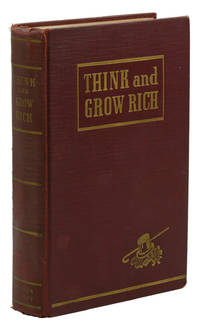
1937140941529Meriden CT: The Ralston Society 1937. First Edition. Very Good. First edition first printing. Bound in publisher's maroon cloth stamped in gilt lacking the dust jacket. Very Good. Cloth a bit frayed at extremities and lightly stained. Light stain to top textblock edge. Pages toned a paperclip impression to several leaves and several are edge-worn. A scarce first printing of a book Hill claimed was inspired by a suggestion from Andrew Carnegie. The Ralston Society unknown books
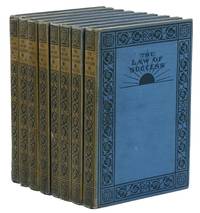
1928140940868Meriden CT: The Ralston University Press 1928. First Edition. Very Good. First edition. Complete eight volume set bound in light blue variant cloth stamped in dark blue. First edition. Very Good with sunning to spines light mottling to cloth heads and tails a little worn and frayed. Scratch to spine of Vol. 1 binding error with front free endpaper pasted onto paste down penciled gift inscription on page facing copyright page another to Vol. VIII front hinge a little over-opened. A classic of the self-improvement genre. The Ralston University Press unknown books
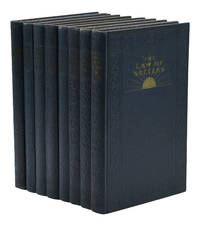
1928140938609Meriden CT: The Ralston University Press 1928. First Edition. Very Good. First Edition complete eight volume set bound in dark blue variant cloth with volumes ranging from Very Good to Near Fine. Rubbing to gilt stamping and to cloth at tips. Foxing to edges heaviest at top edge; pages toned. Several volumes show faintly soiled cloth. A beautiful set. The Ralston University Press unknown books
191363108Grenoble France: Jules Rey 1913. 4to. 4 9-158 pp. Illustrated from photographs engravings portraits facsimiles etc. plates including frontispiece. History of Napoleon's military campaigns in Egypt and Syria 1798-1801 and his occupation of the former country. Later sheep rubbed front joint cracking from spine ends leather title labels on spine and upper board. Fragile joints else very good all of the documents and other added illustrations very good. 9873. Richly extra-illustrated with 30 autographs letters documents portraits prints and a plan of the city of Alexandria most described below as they appear through the text:<br/><br/>1 Bonaparte Napoleon 1769-1921; French statesman and military leader Emperor of the French 1804-1814. Military order to General Rampon signed 13 Messidor 1798 July 1st in Egypt the day Napoleon arrived there with his army; 2 Barras Paul 1755-1829; Leader of the Directory 1795-1799. Document signed; 3 Barras Paul. Document signed 1799; 4 Plan of the cities of Alexandria vetus and New Alexandria or Scanderia; with the old and new ports: also Lower Egypt and the Bay of Aboukir 21 x 33 cm. on a sheet 34 x 43 cm. London: Engraved & published Novr. 5th 1798 by John Luffman 1801 hand-colored; inset of Bay of Aboukir includes brief description of the Battle of the Nile July 1798. OCLC locates three copies Library of Congress Cambridge British Library the National Library of Australia also holds a copy; 5 Kleber Jean-Baptiste 1753-1800; commanded a division under Napoleon in Egypt leading the victory at Mt. Tabor left in command in Egypt on Napoleon's return to France in 1798 assassinated there in 1800. Letter signed from Alexandria 1798; 6 Leclerc Charles V.O. 1772-1802; brother-in-law to Napoleon and general in command of a division and corps in Germany 1798-1801 oversaw the disastrous campaign in Saint-Domingue 1801-1804 and died there of yellow fever. Document signed 1797 concerning the "safety of his holiness" after the French occupation of Rome; 7 Sartelon Commissary-General and paymaster for Napoleon in Egypt. Document signed in Egypt to Dominique Jean Larrey 1766-1842 Chief Surgeon of the French army there; 8 Kleber Jean-Baptiste and Nicolas-Antoine Sanson 1756-1824; chief engineer for Napoleon in Egypt. Document signed by Kleber as commander-in-chief of the French army in Egypt and by Sanson as commander-in-chief of engineers 1799; 9 Kleber Jean-Baptiste. Document signed as commander-in-chief of the French army in Egypt 1799; 10 Smith Sir Sidney 1764-1840; Commodore in the British campaign against Napoleon in Egypt instrumental in defeating the army he left behind eliciting Napoleon's assessment "That man made me miss my destiny". Autograph letter signed to the flagship in Egypt 1801 thanking the admiral for ammunitions and other aid; 11 Clarke Henri Jacques Duc de Feltre 1765-1818; charismatic Franco-Irish general and Napoleon's chief topographical officer Minister of War under Napoleon 1807-1813. Letter signed from Paris 18l6 the year he was promoted to Marshal; 12 Berthier Louis-Alexander 1764-1815; chief of staff to Napoleon in Egypt a Marshal from 1804. Document signed as "Chef de L'Armee" undated but mid 1790s; 13 Kleber Jean-Baptiste. Autograph note signed as division commander to General Guillaume Philibert Duheme i.e. Duhesme requesting they meet at headquarters 1795; 14 Bessieries Jean-Baptiste 1768-1813; Chef de Brigade in Egypt winning distinction at Acre and Aboukir promoted to Marshal in 1804. Letter signed to a brigade commander on the Moselle 1794; 15 Rampon Antoine-Guillaume 1759-1842; commanded a division in Egypt. Autograph note signed 1820; 16 Carnot Lazare 1753-1823; French politician engineer Member of the Directory 1795-1797 Minister of War 1800. Document signed as Minister of War 1800; 17 Cambaceres Jean-Jacques 1753-1824; Minister of Justice in 1799 co-author of the Napoleonic Code. Document signed as Minister of Justice to the Minister of Finance 1799; 18 Andreossy Antoine-Francois 1761-1828; commanded the French flotilla on the Nile during the Egypt campaign later a division commander and diplomat. Document signed as an artillery division commander 1802; 19 Saint-Hilaire Etienne Geoffrey 1772-1844; French naturalist who established the principle of "unity of composition" member of Napoleon's scientific expedition to Egypt in 1798. Autograph note signed 1826. 20 Kleber Jean-Baptiste. Signature and seal from a wrapper; 21 Kleber Jean-Baptiste. Letter signed to General Francois-Severin Marceau 1769-1796; army commander killed on the Rhine in 1796 as a division commander on the Meuse 1796; 22 Kleber Jean-Baptiste. Note signed in Egypt as commander-in-chief of the French army 1800; in addition there are a number of extra portraits and prints bound in one of the prints picturing the assassination of Kleber in 1800.<br/><br/>All of the military figures and politicians represented in this extra-illustrated volume were involved in some way with Napoleon's expedition to Egypt with the exception of Generals Leclerc and Clarke who were intimately involved in the November 1799 coup that boosted the future emperor into the role of France's ruler. Generals Kleber Sanson Berthier Bessieries Rampon and Andreossy all held important commands; Kleber "undoubtedly one of the greatest generals of the French revolutionary epoch . as a second in command he was not excelled by any general of his time" Encyclopedia Britannica; Sartelon was responsible for provisioning the army; Barras Carnot and Cambaceres helped lead the Directory through this period; Commodore Smith led the British forces to important land and sea victories especially in Syria; and Saint Hillaire was one of the important members of the scientific efforts that were the expedition's lasting contribution. Especially remarkable is the seven-item archive of Kelber autographs including three as commander-in-chief of French forces in Egypt more than have appeared at auction in the past 40 years ABPC 1976-2017 shows four sales during the period. The beautifully hand-colored plan of Alexandria is rare in trade with no copies recorded at auction for the past 40 years ABPC 1976-2017; RareBookHub.<br/><br/>Following his successes in northern Italy 1796-1797 Napoleon pondered a move father east furthering a decades old discussion of the possibility of annexing Egypt as a French colony suggesting that such a move would protect French trade interests and undermine British influence there particularly as potential disruptions to its commerce and access to India and the East Indies; in addition France might establish scientific and other intellectual examinations of culture in the region. Although the military efforts eventually failed the scientists who accompanied Napoleon's army discovered the Rosetta Stone creating Egyptology as a field of study and recorded many other important previously unknown aspects of life history archaeology etc. concerning the Near East. The military expedition started off successfully with the occupation of Malta in May 1798 and eluding the British navy landed successfully in Egypt in early July routed the opposition and established headquarters in Cairo by the end of the month. Despite the near destruction of the French fleet in the Bay of Abukir by Admiral Nelson and his fleet and persistent uprisings in the native population Napoleon consolidated his power and had full control of Egypt in the fall. Early in 1799 the Ottomans sent several armies into the near east and Napoleon continued his offense there chalking up wins in Jaffa Haifa and Mount Tabor but was unable to take Acre after a two-months' siege declared victory and returned to Egypt to earn his greatest victory of the expedition defeating local armies at Giza in late July. Having restored his reputation an not particularly liking what he saw of the political situation either in Egypt or France he returned home in late August 1799 leaving Gen. Jean-Baptiste Kelber in command of the expedition forces. Kleber defeated his opponents mostly local troops again at the battle of Heliopolis in March 1800 and then suppressed an insurrection in Cairo but in late June he was assassinated by a Syrian student Gen. Jean-Francois de Menou taking his place as commander. Following a disastrous battle of Alexandria in March 1801 and siege of that city by the British Menou capitulated the terms allowing the French army to return to France. <br/><br/> Jules Rey hardcover books
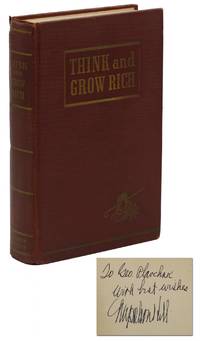
1937140940541Meriden CT: The Ralston Society 1937. First Edition. Very Good. First edition first printing. Signed by Napoleon Hill on the front free endpaper and inscribed to a former owner. Bound in publisher's maroon cloth stamped in gilt lacking the dust jacket. Very Good. Damage to cloth at the top spine end toward the rear; otherwise cloth lightly rubbed at spine joints and lightly frayed at corners and spine ends with a long light scuff to the spine panel. Gilt darkened. Pages toned with several instances of light underlining. Inner rear hinge exposed. A scarce first printing of a book Hill claimed was inspired by a suggestion from Andrew Carnegie. While first editions of this title with signed bookplates a Frankenstein of a collector's item which can be conjured up as late as today are more common first editions signed directly by Napoleon Hill are not. The Ralston Society unknown books
193789533CT: Ralston Society 1937. First edition of this classic bestseller which has sold over 100 million copies. Octavo original cloth. Boldly signed by Napoleon Hill on the front free endpaper. Near fine in a near fine dust jacket. Housed in a custom half morocco clamshell box. This is the first example of a first printing we have seen signed. Rare and desirable. Think and Grow Rich was written in 1937 by Napoleon Hill promoted as a personal development and self-improvement book. Hill writes that he was inspired by a suggestion from business magnate and later philanthropist Andrew Carnegie. While the book's title and much of the text concerns increased income the author insists that the philosophy taught in the book can help people succeed in any line of work to do and be anything they can imagine. First published during the Great Depression at the time of Hill's death in 1970 Think and Grow Rich had sold more than 20 million copies and by 2015 over 100 million copies had been sold worldwide. It remains the biggest seller of Napoleon Hill's books. BusinessWeek magazine's Best-Seller List ranked it the sixth best-selling paperback business book 70 years after it was published. Ralston Society hardcover books