155 résultats
185634806Washington D.C.: Printed at the Office of the Congressional Globe 1856. First Edition. Wraps. Fair. Single sheet folded wraps. 8 pages. Light toning to the paper. Small holes at the fold intersections margins and edges. No loss of print. Light edge wear to the paper with minimal loss of a couple of letters. Speech covers recent violence and Kansas becoming a free State. Fair condition. Printed at the Office of the Congressional Globe unknown
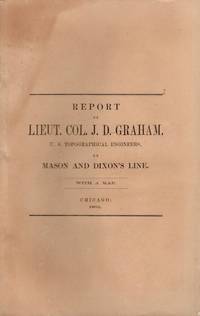
186234999Chicago: Steam Presses of F. Fulton & Co 1862. Second Edition. Wraps. Very good. Wraps. 95 pages. Folding frontispiece map. Tan colored stitched wraps with printed title on the front cover. Light toning to the front wrap. The Mason Dixon line history goes back to the 18th century involving property lines between Maryland Pennsylvania and Delaware familes. Pre Civil War the line was better known for the demarcation between free states and the Slave states from the South.<br /> <br /> A pre-Chicago fire imprint. Chicago Ante Fire imprints 641; Sabin 45089. Steam Presses of F. Fulton & Co unknown
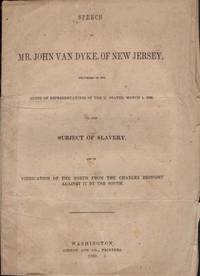
185031527Washington DC: Gideon and Co. Printers 1850. First Edition. Wraps. Good. Wraps. 14 pages 1 page blank. Title printed on page 1. Spine strengthened by archival tape. Page edges creased. Light toning to contents. Gideon and Co., Printers unknown
186335430New York: Carleton 1863. First Edition. Hardcover. Good. 12mo. 1 308 pages 1 page advertisement 1 page blank 1 page advertisement 1 page blank 1. . 4pp ads. Brown pebble cloth hardcover stamped in blind on the covers. Gilt stamped title on spine. Edge wear to the cloth head and base of the spine. Toning to the end papers. Light to moderate scattered foxing to the contents. Previous owners name on the front paste down. Civil War era stories revolve around treatment of Slaves with some stories of white southerners. Good only. Carleton hardcover
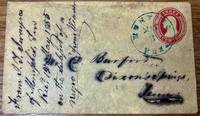
185536035Memphis: n.p. 1855. Paper. Fair. Paper envelope. Approximately 6" x 3". No letter with the envelope. A stamped three cent envelope with postal mark dated May 8 location not clear. Paper is toned with small thin tear located under the address from use of the pen. <br /> <br /> Written on the front side is "From J. T. Swayne of Memphis Ten Rec'd 12 May 1855 on the subject of a Negro from Weaver." This was addressed to Mr. C. Burford of Dixon's Springs Tennessee. J. T. Swayne was a former Mayor of Memphis during the reconstruction. There are references to the Burford family in Dixon Springs Smith County Tennessee online. n.p. unknown
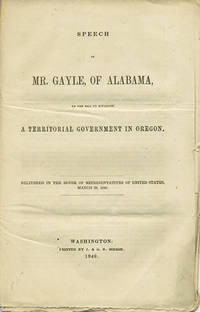
184837646Washington D.C.: J. & G.S. Gideon printers 1848. First edition. Removed. A very good unopened uncut and intrimmed copy with a mail fold. 14 pp. 8vo. Against Oregon admittance over the slavery issue: "The position I shall assume and attempt to maintain is that Congress has no power to organize what is called a territorial government by ordinance or otherwise; nor has Congress the power to pass laws for the people of the territories of the United States.The speech of the honorable member from Ohio Mr. Root delivered on the 15th of the present month. That speech breathes nothing but hostility to Southern institutions. It was uttered in a tone of defiance and in such language of menace as left the impression that the honorable speaker thought that empty threats were quite sufficient to intimidate what he was pleased to call “Southern chivalry.What does the gentleman from Ohio mean by this haughty and vainglorious boasting Does he think that the South are to be frightened from their duty to their country and themselves by these empty menaces The proposition to exclude slave labor from the territories of the United States is a proposition to degrade the slave States—to render them inferior to the free States."<br /> <br /> John Gayle 1792-1859 "was Alabama's seventh governor and also served as a U.S. congressman state legislator and jurist. Gayle was a fervent champion of states' rights and his advocacy laid the foundation for that movement in Alabama in the 1850s and for the realignment of state political parties." Sarah Woolfolk Wiggins: John Gayle Encyl. of Alabama. Sabin 26798. J. & G.S. Gideon, printers unknown
186035032Washington D.C.: W.H. Moore Printer 1860. First Edition. Wraps. Good. Folded uncut wraps. 16 pages. A single sheet of paper 24" x 19" printed on both sides with 8 folds. Light damp stain and toning to the contents. This speech centers around the debate of allowing Slavery in the western territories. W.H. Moore, Printer unknown
186135341Philadelphia: William W. Moore 1861. Hardcover. Fair. Quarto. 1 viii 832 pages. Marbled paper covered boards with leather corners. Leather spine with title. The boards are very worn. Most of the paper on the back cover is missing. Leather spine is rotted dried and cracked. Light toning and scattered foxing to the contents. Last few pages are damp stained and soiled. Fair only. <br /> <br /> Contents include 52 issues covering parts of 1860 and 1861. Article headings include Africans in Key West recaptured from the Slavers; Cotton Spinning; The Slave Trade; A Journal of the Life of John Gratton; Thoughts on Emigration; Origin and Introduction of Railroads Into America; Slave Statistics; and much more. William W. Moore hardcover
188435270Chicago: Jansen McClug & Co 1884. First Edition. Wraps. Very good. Stitched wraps. Two copies. 8 pages. Original covers present and in very good condition. The Thirteenth Amenment passed the Congress in April 1864 officially ending Slavery. Jansen, McClug & Co unknown
185633823Rochester: E. Darrow & Brother 1856. First Edition. Hardcover. Fair. 12mo. xvi pages 17-432 pages. Lacking the frontispiece. Brown cloth hardcover with faded title on the spine. Cloth binding has several faults including a pronounced lean heavy shelf and edge wear worn and exposed corners and worn and chipped edges of the spine. Light stains on the covers. Moderate toning and foxing to the contents. Text block lightly shaken with some pages in front starting to loosen. Fair condition only. Complete. E. Darrow & Brother hardcover
184834435Washington DC: Printed by J. & G. S. Gideon 1848. First Edition. Wraps. Fair. Wraps. Approximately 9.5" x 6". 16 pages. Untrimmed wraps folded with splits and loose pages at the folds. Contents clean. John Gorham Palfrey May 2 1796 – April 26 1881 was an American clergyman and historian who served as a U.S. Representative from Massachusetts. A Unitarian minister he played a leading role in the early history of Harvard Divinity School and he later became involved in politics as a State Representative and U.S. Congressman Wikipedia. Palfrey argued that the existence of slavery was a major political problem that threatened the stability and future of the Union. He believed that slavery was incompatible with the principles of liberty and equality upon which the nation was founded AI generated. Printed by J. & G. S. Gideon unknown
185634998Philadelphia: Printed for the Author by C. Sherman and Son 1856. First Edition. Wraps. Very good. Original brown printed stitched wraps with title on front. 46 pages 1. Very light chipping to head and base of spine.<br /> <br /> Sabin 14916. Printed for the Author by C. Sherman and Son unknown
1837101441Pamphlet small 8vo removed dbd 11 pp. Removed some minor foxing normal aging and browning; otherwise very good. This pamphlet was prepared for the New York chapter of the Religious Society of Friends Quakers for their annual meeting to oppose slavery. Not surprisingly this tract encourages people to help end "this stain upon our national character." While there are religious sentiments in this work much of the discussion relates to social injustice and morality. Mahlon Day (and New York Quakers),
188037129Circa 1880. 1880. Good. - A slip of paper 2-3/8 inches high by 4-3/8 inches wide is inscribed & signed in black ink: "Let us thank God for the Saxon Grit / Robert Collyer". The paper is mounted on a piece of cream-colored card of approximately the same size. The card is unevenly cut & both paper & card are slightly rippled from the mounting. Good. <p>"Saxon Grit" is the title of an 1880 poem by Collyer about the Norman conquest of England in which the phrase recurs in each verse.<p>Robert Collyer 1823-1912 was an English-born American Unitarian clergyman. He became a Methodist minister in England in 1849. Emigrating to The United States in the following year he found employment as a hammer maker in Pennsylvania and soon began preaching on Sundays while still employed at the factory. His earnest rugged simple style of oratory won him great popularity but his advocacy for the antislavery cause then frowned upon by the Methodist authorities aroused opposition. He was tried for heresy and his license was revoked. Continuing as an independent preacher he joined the Unitarian Church in 1859. In 1860 he organized and became pastor of the Unity Church the second Unitarian Church in Chicago. The church grew to become one of the strongest Unitarian churches in the West and Collyer was regarded as one of the foremost pulpit orators in the country. He left Chicago in 1879 and became pastor of the Church of the Messiah now renamed the Community Church in New York City. In 1883 he was a featured speaker at the convention of the American Woman Suffrage Association where he spoke movingly about his deceased wife and their struggles over "the woman question". Circa [1880]. unknown
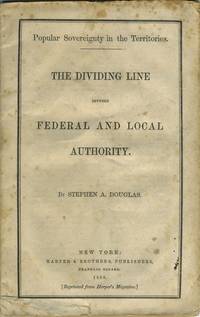
185927949New York: Harper & Brothers 1859. Paperback. Good overall. The United States will forever be in this struggle between the rights of the States vs. the rights of the Federal Government. In this case the question is slavery. One of Douglas' papers promoting 'Popular Sovereignty" or the right of the people of a state or territory to decide the slavery question for themselves-as a Union-saving formula. 8vo 40pp publisher's paper wraps slt foxed still very readable. Harper & Brothers paperback
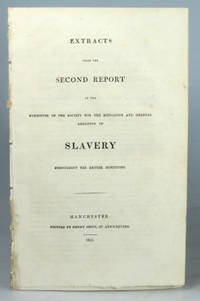
182529465Manchester: Printed by Henry Smith 1825. 8vo 36 pp. Disbound. The report running to 193 pages was published the same year in London. Manchester: Printed by Henry Smith unknown
186135992New York: D. Appleton and Company 1861. First Edition. Wraps. Good. Wraps. 34 pages. Original printed stitched wraps with title on the outer cover. Light edge chips and to the covers. Front cover lightly soiled. Interior contents are clean. Inscribed at the top of the front cover but it does not resemble the author's signature. Speech given during an Alumni Association meeting Dartmouth. <br /> <br /> From wikipedia:<br /> <br /> Caleb Sprague Henry was born in Rutland Massachusetts on August 2 1804.2 He graduated from Dartmouth College in 1825 and studied theology at Andover Theological Seminary and New Haven.3. In 1828 he became a Congregational minister at Greenfield Massachusetts and in 1833 removed to Hartford Connecticut. In 1834 he started the American Advocate of Peace the organ of the American Peace Society. In 1835 he entered the ministry of the Protestant Episcopal church.1 He also became professor of moral and intellectual philosophy in Bristol College Pennsylvania 1835–1838. In 1837 with the aid of Rev. Francis L. Hawks he established the New York Review. He was professor of history and philosophy in New York University from 1839 to 1852. Later he was rector of various churches but was chiefly engaged in literary work. He translated Guizot's History of Civilization and other works from the French and was the author of several works including Compendium of Christian Antiquities 1837 Social Welfare and Human Progress 1860 and Satan as a Moral Philosopher 1877.4 He died in Newburgh New York on March 9 1884.25<br /> <br /> <br /> Sabin 31387. D. Appleton and Company unknown
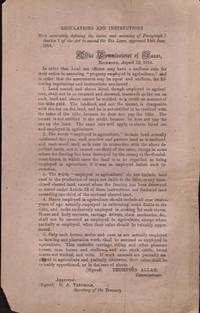
186435137Richmond: Treasury Department 1864. First Edition. Broadside. Fair. Approx. 8.5" X 5.25" broadside. Signed printed text Thompson Allan Commissioner; Approved G. A. Trenholm Secretary of the Treasury. 5 thin closed tears to the fragile paper no loss of content. A few small light spots. Fair only. <br /> <br /> Part 4 of the Regulations and instructions states; "Slaves employed in agriculture should include all over twelve years of age actually employed in cultivating crops liable to the tithe and cooks exclusively employed in cooking for such slaves. House and body servants carriage drivers slave mechanics &c. shall not be assessed as employed in agriculture except where partially employed when their value should be rateably apportioned." <br /> <br /> Parrish & Willingham 2175. Treasury Department unknown
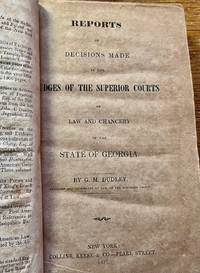
183736669New York: Collins Keese & Co 1837. First Edition. Hardcover. Poor. Octavo. 4 pages advertisements xxxii 4 blank leaves. Binding in poor condition. Spine missing and repaired with tissue paper. Hinges are glued and cracked. Heavy toning to the preliminary pages. Rest of text has light to moderate foxing and or toning. Contents include the a case relating to Slavery: a motion for a new trial concerning ownership of Slaves owned by the Coxe family on page 5. Scarce. Collins, Keese & Co hardcover
189435946Chicago: Published for the Trade 1894. Wraps. Fair. Stapled wraps. Approx. 7" x 5". 192 pages. Illustrated front cover with title. Original pink wraps have faded on the front cover. Front cover is chipped bottom right edge. Small chips to the spine and joints. Paper is brittle and browned. <br /> <br /> Anonymous author but credited to Charles Chandler a white author. This is a fictionalized story of Slavery of Paul the Slave and his young mistress. The author condemns Slavery in the preface. Published for the Trade unknown
1858660371858. Dividing Prize Money After the Capture of a Slave Ship Slavery. United States. In the Senate of the United States. February 21 1858-Ordered to Be Printed. Mr. Polk Made the Following Adverse Report To Accompany Bill S. C. of C. 108.: The Committee of Claims To Whom was Referred the Opinion of the Court of Claims in the Case of O.H. Berryman and Others Report: The Claimants in this Case are the Officers and Crew of the United States Schooner "On-Ka-Hy-E" drop-head title. Washington DC: S.n. 1858. 13 pp. Octavo 9" x 5-1/2". Disbound light rubbing to extremities some toning and light foxing. $100. 35th Congress 1st Session Senate Rep. Com. No. 33. This speech disputes the distribution of prize money between the Federal government and the crew that captured the slave ship Laurens. unknown
186261272New York: D. Appleton & Co 1862. Second Edition. Octavo 20.5cm. Green cloth titled in gilt on spine; yellow coated endpapers; 39018pp; 8 tinted lithographs. A firm copy rubbed at spine ends and bumped at corners mildly foxed: Very Good.<br /> <br /> Commander Andrew Hull Foote 1806-1963 served on the USS Perry from 1849 to 1851 suppressing the slave trade off the coast of Africa. In 1854 he published an abolitionist history of Africa describing African cultures American colonies and the slave trade. He was a noted commander for the Union Navy until his unexpected death of kidney disease in 1863. D. Appleton & Co unknown
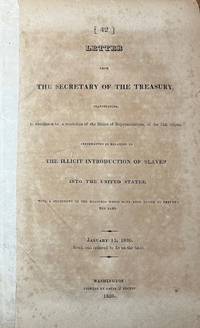
182035023Washington D.C.: Printed by Gales & Seaton 1820. First Edition. Wraps. Fair. Disbound wraps. Approx. 9" x 4". 12 pages. Toning to the paper. First 4 pages have a small edge chip not affecting the print. Wraps spine backed with later tissue paper. Pages 3-6 are loose. Scarce. 10 copies located in OCLC. The Act Prohibiting Importation of Slaves promoted by President Thomas Jefferson was passed in 1807 and took effect in 1808.<br /> <br /> From the 1820 letter submitted by the Treasury Department Spain and individuals were responsible for the illegal importation of Slaves into the United States. Secretary of Treasury William Crawford writes "From information recently received by this Department there is just reason to believe that Sir Gregor MacGregor has taken military possession of Amelia Island Florida in the name of the Spanish Patriots" Continued on the same page "In addition to the circumstances already communicated the disposition which has been manifested by the vessels of Spain engaged in the African Slave Trade to introduce illicitly into that section of the Union the persons who in the prosecution of their traffic have been subjected to their control seems to require the presence of a force sufficient to enforce the due execution of the laws against the introduction of slaves into the United States." The Treasury Department recommends "To guard against the unlawful introduction of slaves and to repress any attempt that may be made by the foreign belligerent force collected in that neighborhood to excite domestic insurrection among the blacks it appears to me to be absolutely necessary that a land and naval force be stationed at St. Mary's." <br /> <br /> Soon after this letter was published Florida was ceded to the United States by Spain in 1821. Florida was a territory until 1845. Printed by Gales & Seaton unknown
185435390Boston: Phillips Sampson and Company 1854. 1854. Hardcover. Fair. Small octavo. 1 viii 9-256 pages 4 pages advertisements 1. Folding frontispiece map. Blue cloth hardcover with blind stamped covers. Gilt title and decoration on the spine. Folding map has some wrinkling and creases. Cloth hardcover is shelf worn rubbed at the extremities and chipped at the head and base of the spine. Lean to the binding. Light scattered toning and foxing to the contents. Fair. <br /> <br /> Graff 1079. Phillips, Sampson and Company hardcover
18508864Washington: Buell & Blanchard 1850. Disbound. near Very Good binding. Octavo. 8 pp. Removed from volume. Inner margin a bit irregular; horizontal creases from being folded. <br /> <br /> Stevens rails against "Southern gentlemen" who he argues have obstructed the business of Congress by speeches on the subject of slavery. The remedy Another speech on slavery. And no doubt the subject was indeed occupying Congress and the country. In fact the Compromise of 1850 and its Fugitive Slave Act was just months away from passage when Stevens took the floor with this searing speech against the institution of slavery and the Southern legislators who were holding Congress hostage. Stevens cites Mr. Clingman of North Carolina who in Stevens's words "was selected to open the debate in behalf of human bondage distinctly notified us that unless Congress as a condition precedent submitted to settle the Slavery question according to Southern demands there should be no legislation even the passage of the ordinary appropriation bills necessary to sustain the Government." A heated time indeed! Sabin 91565. Buell & Blanchard unknown