155 résultats
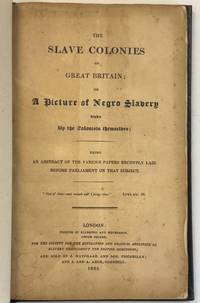
182541192London: Printed by Ellerton and Henderson Gough Square for the Society for the Mitigation and Gradual Abolition of Slavery Throughout the British Dominions; and Sold by J. Hatchard and Son Piccadilly; and J. and A. Arch Cornhill 1825. iv 164 pp. Some foxing to first and last few leaves; title and last page toned. Bound in modern dark boards with gilt-lettered title stamped on front cover. Good plus. <br /> <br /> A second edition issued in 1826. The book reviews developments concerning slavery in each of the British West India colonies: laws for free people of color and for slaves manumissions proposed reforms and objections to reforms trials of alleged rebels and insurgents including the destruction of the Methodist chapel in Barbados and revolts and trials in Jamaica changes in the law punishments inflicted manumissions the slave trade slave unrest.<br /> "The reports were called for in order to learn what had been done in the way of effecting amelioration in the colonies. This work brought out by the Society for the Mitigation and Gradual Abolition of Slavery Throughout the British Dominions. . . showing that nothing substantial has been done" Ragatz. It "presents cases of extreme cruelty" id. to slaves in Berbice. <br /> Authorship and editorship are attributed to Zachary Macaulay founder and organizer of several antislavery societies and a major force in accomplishing the British Emancipation. He focused on providing a picture of Negro Slavery based on reports of "the colonists themselves."<br /> FIRST EDITION. Ragatz 458. Sabin 82063. Not in LCP. Printed by Ellerton and Henderson, Gough Square, for the Society for the Mitigation and Gradual Abolition of Slavery Throughout unknown
18391240991839. First Edition. JAY William. A View of the Action of the Federal Government in Behalf of Slavery. New-York: J.S. Taylor 1839. Small octavo 5 by 7-3/4 inches original gilt- and blind-stamped brown cloth; pp. i-iii iv-viii 13-217 1. $1600.First edition of the highly influential work by William Jay son of Founding Father John Jay documenting the ""grim"" legacy of the U.S. Constitution's ""guilty compromise""with Frederick Douglass honoring Jay at his death for his dedication to ""the great cause of universal freedom a tower of strength and his pen a two-edged sword""especially scarce in original cloth.Abolitionist and jurist William Jay was the son of John Jay the first Chief Justice of the Supreme Court and president of the Revolutionary Continental Congress. William Jay ""intensely invested in the fundamental goal of ending American slavery"" served as president of the New York Anti-Slavery Society drafted the constitution of the American Anti-Slavery Society and was removed as a judge in a New York county for his abolitionist activism. His 1839 View of the Action with its epigraph taken from the Constitution demonstrated Jay's conviction that ""Americans had to own up to their sin"" and acknowledged his family's part in that legacy. His book details the ways in which the Constitution's ""'guilty compromise' had shaped federal policy foreign and domestic"" for decades. In its ""nearly 200 pages of research"" he exposes officials ""who regularly made the choice to enact proslavery laws and procedures the data was grim. Yet by putting in one place such a well-informed catalog of federal policy Jay created a guidebook to issues on which antislavery politicians and lawyers could make their stand"" Gellman Liberty's Chain 190 209.Jay documents ""all the ways the federal government advanced slaveholding interests at home and abroad . the Constitution's three-fifth compromise had created substantial"" yet unacknowledged ""political advantages"" for slaveholding states and their supporters. The ""dominoes that fell included the Missouri Compromise"" which Jay firmly assails for surrendering ""all the cruelties and abominations"" of slavery to the territory. He also attacks a ""repugnant"" 1792 law barring Blacks from militia service as well as policies that made the nation's capital ""'the great slave mart of the North American continent' in Jay's book the poison born of moral compromise spread in every direction"" as he cites ""''gross hypocrisy and duplicity' in the lax enforcement of the international slave trade and insidious effects on domestic institutions and policies"" that hollowed out the Constitution in areas such as freedom of the press. In providing antislavery forces with ""a stiff empirical legal backbone ""View of the Action also reinforced a determination to use his family's ""insiders' credentials"" in order to advance defense of the Amistad rebels and to work closely with Black activists such as David Ruggles and minister and African nationalist Alexander Crummell. At Jay's death in 1858 Frederick Douglass honored him as man who ""in the great cause of universal freedom was a tower of strength and his pen a two-edged sword"" Gellman 209-213 3. First edition first printing: issued in brown this copy and dark green cloth no priority determined; mispagination as issued without loss of text. Work 327. Sabin 35866. Text fresh with light scattered foxing mild rubbing to original cloth. A distinctive near-fine copy. hardcover
18161138361816. First Edition. SLAVERY. The Interference of the British Legislature in the Internal Concerns of the West India Islands Respecting Their Slaves Deprecated. London: J. Mawman 1816. Slim octavo modern blue-gray paper wrappers; pp. 58. $1800.First edition of this defense of the West Indian slave trade arguing against emancipation.Cloaked in pro-abolition language and anonymously written by a person claiming to be an abolitionist this work is actually a zealous condemnation of British interference in the slave trade of the West Indies. After briefly discussing the abolition movement the 1807 act abolishing slavery in britain and prominent anti-slavery organization the author sets out to make his main argument: that a bill requiring registry of slaves in the West Indies would infringe on the rights of those colonies. The author swiftly aligns himself with the interests of the West Indian Planters arguing that abolishing slavery is a different cause from emancipating people of African descent. He points out that this bill is merely the first in a projected series of measures meant to emancipate the Black population of the West Indies. Set in the awkward period between 1807 and 1833 when slavery in Britain was illegal but the slave trade still thrived abroad this work makes sense of obvious hypocrisy by arguing that slavery was permitted by God and that Blacks of African descent were better off as slaves than in Africa. The will of those against slavery proved stronger and complete abolition eventually became the law of the land. Sabin 34904. Kress 21649. This work last appeared at auction over 25 years ago; prior to that it had not been seen since the 1940s.Interior quite clean with only slight pressure offsetting toning to spine of modern wrappers. A beautiful copy in fine condition. unknown
1863101890Letterpress broadside 18 7/8" x 11 3/4" bold black type for highlighted words. Paper evenly toned some wrinkling considerable archival conservation and restoration with archival paper repair; despite the imperfections it is still a decent copy with a nice impression. This appears to fall into the political dirty tricks department in an election between John Brodhead and Henry Bumm for city treasurer in Philadelphia. The broadside is supposed to highlight a letter from John Brodhead to Jefferson Davis in 1860. It has strong racist overtones as Brodhead supposedly requests a position in Nicaragua so he can "help open it up to civilization and Niggers." He goes on to state he is "tired of being a white slave at the North and long for a home in the sunny South." These kinds of political tricks were not uncommon during the Civil War period perhaps that's still true today and the racist overtones would certainly not help one's chances in a Northern election.
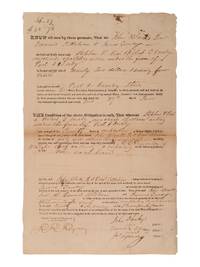
1822215261822. Manuscript debt bonds created in Mecklenburg County North Carolina during the early 1820s document the use of enslaved people as collateral within the financial system of the antebellum South. These legal instruments record obligations owed between creditors and debtors while identifying enslaved individuals as property subject to seizure in the event of nonpayment. Such documents illustrate the legal framework through which slavery operated as both a labor system and an economic structure where enslaved men women and children were routinely mortgaged pledged and sold to satisfy financial claims. Surviving manuscript bonds naming enslaved individuals provide direct evidence of the mechanisms through which courts and creditors enforced debt within slaveholding societies.<br /> <br /> Archive of three partially printed manuscript bonds completed in ink each measuring approximately 12 x 8 inches and bearing signatures of the involved parties. 1 Blanks John; Tillotson Edward; and Turney James. Debt bond to Stephen P. Pool and Robert O. Courby. Mecklenburg County North Carolina: 27 June 1822. The document binds the debtors for "ninety five dollars and seventy four cents" secured against property including "one land horse" with a notation on the reverse indicating the obligation was later settled by payment. 2 Carter Charles and Bullock John P. Bond to Thomas Howerton and John F. Howerton. Mecklenburg County North Carolina: 21 March 1823. The bond records a debt of $2214.67 associated with a writ of fieri facias issued against the estate of Charles Carter and identifies "one Negro man named Manuel Jack" as collateral subject to seizure if the debt remained unpaid. 3 Lenton Charles. Bond to James and John H. Irwin for the benefit of Michael Newton. Mecklenburg County North Carolina: 23 April 1823. This document binds Lenton for $337.42 and identifies "one Negro boy by the name of Peter" as property pledged to secure the obligation specifying that the enslaved child must be produced for sale if required under the terms of the writ.<br /> <br /> During the nineteenth century enslaved people were legally classified as chattel property under the laws of slaveholding states allowing them to be mortgaged seized by courts and transferred between owners as part of debt enforcement procedures. Legal instruments such as bonds and writs of fieri facias formed part of the judicial process through which creditors pursued unpaid obligations and frequently resulted in the forced sale of enslaved individuals. Documents naming individuals such as Manuel Jack and Peter provide stark evidence of how the legal and financial systems of the American South treated human lives as collateral within commercial transactions. Three manuscript bonds written on partially printed forms with handwritten text and signatures. Light creasing toning and handling wear consistent with age; text remains clear and legible. Overall very good condition. The archive preserves primary documentary evidence of the legal and economic structures sustaining slavery in the early nineteenth century United States. unknown
18091187761809. First Edition. SLAVERYABOLITION MONTGOMERY James GRAHAME James and BENGER Elizabeth. Poems on the Abolition of the Slave Trade. London: Printed for R. Bowyer 1809 i.e. 1810. Tall quarto contemporary brown calf gilt rebacked with original spine laid down raised bands marbled endpapers and edges. $2000.First edition of famed publisher and artist Bowyers richly illustrated volume featuring eloquent anti-slavery poems by Montgomery Grahame and Benger a major antislavery work issued shortly after Britains abolition of the slave trade with engraved portraits of abolitionists Sharpe Clarkson and Wilberforce engraved allegorical title page and nine full-page engravings after paintings by artist Sir Robert Smirke a handsome wide-margined copy in contemporary boards.This handsomely illustrated volume features three epic poemsMontgomery's The West Indies Grahame's Africa Delivered and Elizabeth Benger's A Poem Occasioned by the Abolition of the Slave Trade in 1806. All were ""commissioned by the London publisher Robert Bowyer for inclusion in a lavish volume of antislavery poetry timed to celebrate the abolition of the slave trade"" Basker Amazing Grace 612. With biographies and engraved full-page medallion portraits of leading British abolitionists Sharpe Clarkson and Wilberforce Poems on the Abolition of the Slave Trade is especially noted for its nine full-page engravings and the allegorical title page vignette engraved by Scriven and Worthington after paintings by renowned artist Sir Robert Smirke whose works were considered ""gems in the art of history painting"" American Daily Advertiser. On presenting a copy to George III Bowyer described this as a ""most beautifully embellished volume of Poems which have been written expressly for the occasion on the Abolition of the Slave Trade"" Baptist Quarterly 35. Poems won early critical praise as an ""elegant publication on the Abolition of this traffic and we congratulate the poets the artist and the editor"" Monthly Review. First edition: plates dated ""Dec. 1 1809""; portraits dated ""Jan 1 1810."" With engraved and letterpress title pages. With directions to the binder leaf bound in at rear. Lowndes 1591. Goldsmiths 19923. Kress B5549. Sabin 50145. Benezit IX:656. Occasional faint foxing chiefly marginal. A near-fine copy scarce and desirable in contemporary binding. hardcover
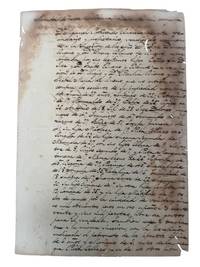
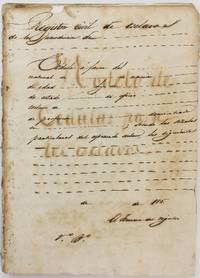
1875231241875. Slavery Cuba Spanish colonial slave sale manuscript recording the transfer of thirty-eight enslaved individuals in Cuba in 1875 materializing the sheer scale and organization of enslaved labor within the island's plantation economy during the final decade before abolition. The document enumerates a large group of enslaved people including multiple family units with young children demonstrating how slavery functioned as both an economic system and a hereditary condition sustained through the sale and reproduction of enslaved populations. Created eleven years prior to the abolition of slavery in Cuba in 1886 the manuscript documents the continued legality and normalization of large-scale slave transactions despite decades of international pressure and earlier prohibitions on the transatlantic trade offering concrete evidence of how internal markets sustained the institution in its final phase.<br /> <br /> Official Cuban slave contract documenting the sale of thirty-eight enslaved individuals for the sum of 126000 pesetas formalized before a public notary or legal authority. Single manuscript leaf written in Spanish cursive in black ink on both recto and verso densely filled with names ages and relational identifiers. Measures 8.5" x 12.25". The text lists individuals sequentially including men women and children with repeated references to kinship structures such as mothers with multiple children indicating the sale of family groupings rather than isolated individuals. The script reflects extended passages detailing ownership exclusions and conditions of transfer. A partial watermark of the official coat of arms of Cuba is visible. <br /> By 1875 Cuba remained one of the last major slave societies in the Atlantic world with sugar production driving demand for large controlled labor forces. Even after Spain curtailed the official slave trade earlier in the century illegal importation persisted into the 1860s and alternative systems of coerced labor including Chinese indenture supplemented plantation workforces. The scale of this transaction demonstrates the consolidation and redistribution of enslaved labor within domestic markets while the inclusion of children underscores the long-term economic logic of slavery as a self-reproducing system. Moderate toning and foxing concentrated along the edges with numerous small closed wormholes a few affecting portions of the text. Light edge wear present. Overall in good condition. This document provides unusually extensive nominal data on a large enslaved population encompassing the roles of kinship valuation and labor organization in late Spanish colonial Cuba. unknown
1864106752<p>9 leaves of blue lined paper written in ink on rectos only. 31.5x20 cm 12¼x8" set in custom-made half cloth folder .Minor aging old folds; near fine. Official court document from Bexar County Texas summarizing the case of "Jim Owen a free person of African descent thirty years of age a resident of said county and state" who "desires to choose an owner and mistress and has selected for his mistress Sephrony Kerr…" Owen states that "he was brought from the State of Illinois to his state in 1850 before he was of lawful age by one John H. Burrus… who has since said time assumed a kind of guardianship over your petitioner without lawful authority…" All seemed on track until John H. Burrus filed suit stating that he was the "owner of said petitioner Owen" and "proof was not made that said petitioner is a free man of African descent" and "the negro Jim Owen… is his slave that he was brought to this State by the respondent in January 1850 as is slave and has been so held and owned up to the present time…" A new trial was granted and Kerr and Owen's petition denied. An appeal was allowed contingent on paying to Burrus a surety bond of $1500. A fascinating glimpse into the legal morass surrounding slavery as the Civil War raged and the "peculiar institution" of slavery was soon to be ended by force of arms.</p>
183431598Philadelphia 1834. 3pp. Later annotation at head of first page. Scarce letter on the Liberian colonization movement by one of its founders.<br/> <br/> Writing to Hawes a member of Parliament and a committee member of the Society for the Extinction of the Slave Trade Cresson wishes for success in the British anti-slavery action off the coast of Sierra Leone writing "I hope that you may yet enjoy the satisfaction of crushing one of the worst & most unacceptable of the slave markets in existence that at Gallinas." After mentioning the travels of the colonial governor of Liberia he writes: ". I have been gratified to learn from several highly respectable sources that such a Colony as you propose located either at the mouth of the Cape Mount River or even a little more to the Northward say at Sugaree & provided with a good supply of trade goods to exchange with the natives would have a powerful tendency to break up the monopoly now enjoyed by the Spanish Slavers. My letters from Africa state that the demand is so great in Cuba from the ravages of Cholera among their ill-fed human cattle as to have rendered the shipments from the Gallinas during the past year almost unprecedented. It appears that the benevolent efforts of your Govt. are not likely to extirpate the evil until commercial & agricultural colonies shall be substituted for cruisers." The letter continues with news from their consul at Liberia before turning to American politics: ". political affairs engrossing the entire energies of the nation. The excitement is painfully great . Our military chieftan Jackson by his acts of unauthorized assumption has called forth a burst of indignation which cannot subside until we get rid of the offender." The letter concludes with an introduction for Gerard Ralston. Cresson a noted Philadelphia businessman and philanthropist was among the most ardent supports of colonization the movement to relocate former slaves and free African Americans to colonies in Liberia. In 1833 Cresson and the Philadelphia Young Men's Colonization Society a branch of the American Colonization Society founded Port Cresson in Liberia. However the colony was attacked in 1835 by Bassa tribesmen incited by Spanish slave traders and destroyed. unknown
18401132391840. First Edition. SLAVERY BUXTON Thomas Fowell. The African Slave Trade and its Remedy. London: John Murray 1840. Octavooriginal brown clothuncut and partially unopened; pp.14 viii 3 6-273 274-276 i ii-vi 277 278-582. $2800.First expanded and revised edition of British abolitionist Buxton's powerful call for an end to the slave trade the first to include his extensive and influential Remedy two major works that followed the lead of Wilberforce in calling for treaties and commerce to end the slave trade and outlined a way to ""secure the regeneration of Africa through agricultural development"" with large folding map a handsome copy in original cloth.Quaker Thomas Buxton was in Parliament when in 1824 Wilberforce asked him to become his successor. ""In 1789 Wilberforce had begged Parliament to 'make reparation to Africa by establishing a trade upon true commercial principles Fifty years later Buxton redeveloped this appeal in The African Slave Trade To support his vision Buxton formed the African Civilization Society July 1839."" In this first expanded edition of African Slave Trade 1839the first to include his RemedyBuxton argues for the ""agricultural colonization of West Africa and the development of a broad-based commerce that could undercut the economic dominance of the illicit slave trade"" Hopkins Peter Thonning 615. He documents the horrors of the Middle Passage to show that despite all efforts to end the slave trade ""twice as many human beings are now its victims as when Wilberforce and Clarkson entered upon their noble task."" And in Remedy he further develops his argument: showing how ""legitimate commerce would put down the Slave Trade by demonstrating the superior value of man as a laborer on the soil to man as an object of merchandise.""With African Slave Trade and its Remedy Buxton powerfully ""synthesized contemporary currents of thought developed the arguments about the relationship between abolition and African improvement more systematically than before and then catapulted them to national prominence His views prevailed. The belief that the only way to suppress the African slave trade was to promote 'legitimate commerce' and that this new trade would launch Africa on the road to moral and material progress became the conventional wisdom in mid-19th-century Britain."" Among those he convinced was David Livingstone who as ""an unknown medical student attended the 1840 meeting of the African Civilization Society where Buxton first announced his remedy for the slave trade. What Livingstone heard on that occasion helped inspire a lifetime of work and travel on the continent"" Mann Slavery and the Birth of an African City 88-90. First expanded and revised edition: first to include Buxton's Remedy which was issued separately in 1839. Precedes the first American edition. With folding map of ""Central Africa."" Paginated as issued without loss of text. With 14-page ""Prospectus of the Society for the Extinction of the Slave Trade and for the Civilization of Africa"" preceding title page. Sabin 9685. Goldsmith's 31743. Kress C5121 See Goldsmith's 31181; Kress C4818; Blockson 9121. Interior fresh with light foxing to folding map as often front inner paper hinge starting but very sound mild rubbing and toning to bright original cloth. A desirable near-fine copy. hardcover
183331599England: Elliott Cresson 1833. Bi-folded folio. 3 pp. 12 1/3 x 7 1/2 inches. Important autograph letter from Elliott Cresson one of the foremost proponents of the American Colonization Society and its colony in Liberia to Member of Parliament Benjamin Hawes presenting a resolution to found the British African Colonization Society. Discusses the famed abolitionist William Lloyd Garrison's opposition to the colonization movement.<br/> <br/> The letter begins with the two-page text of a resolution to establish the British African Colonization Society under the patronage of the Duke of Sussex: "That Colonies composed of fair settlers of African race established on judicious principles on the Coast of Africa appear calculated beyond any other plan to put an effectual stop to the slave trade . . . Resolved that a Society be formed to be called the British African Colonization Society and that its objects be to cooperate with the American Colonization Society and with the several missionaries and other religious and charitable societies in Great Britain and the United States of America in such measures as may promote the total abolition of the slave trade and the establishment of Christianity and Civilization among the Natives of Africa chiefly by the employment of Free Persons of African birth or descent . . ." In the letter which follows Cresson writes of William Lloyd Garrison's opposition to the colonization movement: "I send the list of officers as far as accepted several others have not yet answered but I trust we shall present a bold front. I have just heard thru his Chaplain from the Duke. Garrison has written to poison his mind and probably will annoy our meeting. I trust that as the notice has been so short our friends will bring many with them . . . My letter to the Times in answer to Garrison they have not yet noticed so that it will be put in the Globe whose Editor has offered it a place in his columns." Cresson a noted Philadelphia businessman and philanthropist was among the most ardent supporters of colonization the movement to relocate formerly enslaved people and free black Americans to colonies in Liberia. In 1832 he traveled to England to promote international support for the movement. The following year Cresson and the Philadelphia Young Men's Colonization Society a branch of the American Colonization Society founded Port Cresson in Liberia. However the colony was attacked in 1835 by Bassa tribesmen incited by Spanish slave traders and destroyed. Although initially in favor of colonization William Lloyd Garrison changed his mind and decried the efforts of the American Colonization Society as a perpetuation of slavery. For Garrison's 28 June 1833 letter to the Duke of Sussex referenced above see The Letters of William Lloyd Garrison I:107. Elliott Cresson unknown
1823423251London: Printed by Ellerton and Henderson Gough Square 1823. Near Fine. Folio 21.5 x 33 cm / 8½" x 13â€. pp. 1 2-3 4 blank. Light vertical and horizontal center folds three short tears at the horizontal fold near fine with a contemporary drawing of a few survey lines and diagrams very lightly sketched in ink and pencil on the final blank page. The Society states its case against slavery in the Colonies of Great Britain where "there are at this moment upwards of 800000 human beings in a state of degrading personal slavery." It provides a brief but detailed description of "the immoral inhuman and unjust" nature of the slave trade and of the absolute power of slave owners. Printed by Ellerton and Henderson, Gough Square unknown
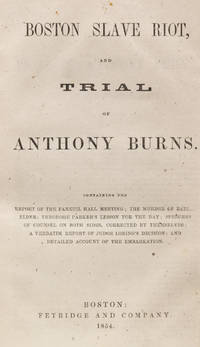
18541266841854. First Edition. SLAVERY BURNS Anthony. Boston Slave Riot and Trial of Anthony Burns. Boston: Fetridge 1854. Slim octavo modern half calf and marbled boards. $3000.First edition of a seminal pre-Civil War pamphlet on the 1854 arrest and Boston trial of fugitive slave Anthony Burns whose return to his Virginia slave owner at the order of the Boston court sparked public fury and ""set Boston on its ear in the spring of 1854"" inspiring Whitman to write his Boston Ballad and Thoreau to deliver his speech Slavery in Massachusetts to a July 4 1854 antislavery rally.The trial of fugitive slave Anthony Burns which ""set Boston on its ear in the spring of 1854 .was nothing less than a pocket revolution"" Von Frank Trials of Anthony Burns xii. The arrest and trial in Boston of Burns whose Virginia slave-owner Suttle followed him there was ""one of the most dramatic and famous incidents in the enforcement of the Fugitive Slave Act."" When Boston Commissioner Loring signed Burns' arrest warrant Richard Henry Dana Jr. and Charles Ellis immediately volunteered to defend Burns. On ""May 26 there was a mass meeting in Faneuil Hall to protest Burns' arrest. This meeting was followed by a poorly planned and disastrously executed attempt to rescue Burns Despite conflicting testimony and imperfect evidence provided by Suttle Loring declared Burns was indeed Suttle's slave."" With that Burns was taken from the courtroom and through streets crowded with his supporters then placed aboard a ship ""for return to Virginia. The trial and removal of Burns from Boston created one of the great spectacles of the late antebellum period"" Finkelman 107-112.""The Burns case made slavery appear to Northerners as an immediate threat Walt Whitman was impelled to write an ironic piece A Boston Ballad soon to be incorporated into his revolutionary volume Leaves of Grass At an antislavery rally in Framingham Massachusetts on July 4 William Lloyd Garrison burned copies of the Fugitive Slave Law and the Constitution as the large crowd chanted 'Amen!' Thoreau delivered his speech Slavery in Massachusetts declaring that the American system had lost its integrity and purity The antislavery sentiment bred by the case helped give birth to the Republican Party which in turn fostered Lincoln's Presidency the South's secession and the Civil War"" New York Times. Containing ""valuable primary source material about the trial and the events surrounding it"" including testimony legal documents"" as well as the full texts of the speeches of the counsel and the opinion of Commissioner Loring."" Bound without rear advertisements: ""some have advertisements at the back of the pamphlet while others do not"" no priority established Finkelman 113. Sabin 6505. Harvard Law Catalogue II:1030. Text fine. hardcover
183384791Lexington KY: Abraham Skillman 1833. First Edition. First printing. 12mo 18.5cm; original brown cloth-covered boards; viii207pp. Respined to style with facsimile printed spine label; Bookplate of the Young Men's Christian Institute New Haven to front pastedown; bookseller's ticket Williams' Bookstore Under the Old South Meeting House Boston at base of front flyleaf; pencil signature faded and illegible to front endpaper. Complete sound and Good. <br /> <br /> One of a tiny number of pre-Civil War abolitionist texts to have been written by a Virginia author. Paxton 1784-1868 was a Presbyterian minister born in Rockbridge County Virginia and educated at Princeton Theological Seminary; it is likely his mentorship there under Charles Hodge helped develop Paxton's antislavery sentiments. In 1826 after publishing an essay asserting the institution of slavery to be incompatible with the teachings of the Bible Paxton was expelled from his pastorship of Cumberland Presbyterian Church near Farmville in south-central Virginia. The present text addressed to his former congregation recounts the events of his expulsion reprints the essay in question and adds a series of epistolary essays supporting his theological position in oppostion to slavery. <br /> <br /> The existence of any abolitionist sentiment during this period in Virginia's history is remarkable in itself. For a native-born minister to willfully preach the gospel of antislavery even the relatively conservative version of abolitionism professed by Paxton before a congregation whose sentiments on the subject would have been diametrically opposed - and which doubtless included a number of slaveholding families - must have amounted to apostasy in some congregants' eyes. By publishing the present work Paxton essentially doubled down on his unpopular beliefs making him in this cataloguer's eyes a rather remarkable figure. We find it surprising that so little biographical information exists regarding Paxton. His name barely appears in the scholarly literature on the period; perhaps because no mention of abolition is made in either the title nor the sub-title of his book the work is rarely discussed in articles on the antebellum southern antislavery movement. Though reasonably available institutionally Letters on Slavery is perenially scarce in commerce having appeared at auction only three times in the current century. This a quite decent copy in a discreetly restored binding. SABIN 59264. DUMOND Antislavery Bibliography p.89. LCP AFRO-AMERICANA 7501. Abraham Skillman unknown
185723389.07<p><strong>Rare New York Senate Print of Proposed State Law to Combat the <em>Dred Scott</em> Decision</strong></p><p>"<em>Every slave … who shall come or be brought or be involuntarily in this state shall be free.</em>"</p><p>SLAVERY AND ABOLITION—NEW YORK STATE.</p><p>New York Senate. "An Act To secure Freedom to all persons within this State" Edward M. Madden April 9 1857 Passed the Assembly on April 17; failed in the Senate. Printed with numbered lines for the use of the Senate. 1 p. 6.5 x 11.5 in. </p><p><strong>Excerpts</strong></p><p>"<em>Neither descent near or remote from an African…nor color of skin shall disqualify any person for being or prevent any person from becoming a citizen of this state; nor deprive such person of the rights and privileges of a citizen thereof.</em>"</p><p>"<em>Every person who shall hold or attempt to hold in this state in slavery…under any pretence or for any time however short shall be deemed guilty of felony and on conviction thereof shall be confined in the state prison at hard labor for a term not less than two nor more than ten years.</em>"</p><p><strong>Historical Background</strong></p><p>In 1799 the New York legislature passed "An Act for the gradual abolition of slavery" that indentured and would eventually free slave children born after July 4 1799. In 1817 it passed a law freeing those slaves in 1827. But non-residents and part-time residents could still bring their slaves into the state temporarily.</p><p>On March 14 1857 New York Assemblyman Samuel A. Foot introduced resolutions declaring that the U.S. Supreme Court through its decision in <em>Dred Scott v. Sanford</em> "has in effect declared slavery to be national" and calling for the creation of a joint committee of three senators and five assemblymen to "consider and report what measures if any the Legislature of this State ought to adopt to protect the constitutional rights of her citizens." The resolution passed by a vote of 49-24 and the Senate concurred on April 2.</p><p>On April 9 Edward M. Madden introduced this bill in the Senate. Simultaneously Foot introduced this bill #24129 and three resolutions #23389.08 in the Assembly. Eight days later the Assembly with 81 Republicans 38 Democrats and 8 American Party members passed the bill 72 to 38. In the Senate with 17 Republicans 9 American Party members Know Nothings and 4 Democrats attempts to move the bill to the Committee of the Whole were evenly divided. Lacking the two-thirds majority required for this procedure the bill died.</p><p>Very similar language appeared in an 1859 bill which also failed; New York passed no new Personal Liberty Law during the decade before the Civil War.</p><p>The New York Senate had thirty-two members in 1857 so it is likely no more than fifty copies of this bill were printed for Senate consideration. We can find no evidence that any other copies have survived.</p><p><strong>Edward M. Madden</strong> 1818-1885 was born in Orange County New York and began work at a cotton factory at age nine. He worked as a merchant and then opened a saw factory in Middletown. He entered politics as a Democrat and was a delegate to the 1852 Democratic state convention. He joined the new Republican Party and served as a member of the New York Senate in 1856-1857 1872-1873 1875 and 1880-1881. He also served as a delegate to the 1864 and 1876 Republican National Conventions.</p>
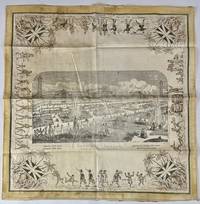
189012893N.p. likely London 1890. Lithograph on silk handkerchief approximately 24 x 24 inches with additional lithographed scene printed around the outer margins in brown and blue ink. Previously matted and framed with resultant edge wear and adhesive staining around margins. Old folds some foxing and staining in image area. Overall good plus condition. A very rare and impactful 19th-century British lithograph-on-lithograph the original a view of London's Crystal Palace with the addition of a satirical scene detailing the history of British colonialist activities in Africa. The overall scene is presented in four linear parts one across each mostly blank margin of the Crystal Palace scene; interestingly the two lithographs overlap each other at a few places along the short edge. The scene seems to begin with the part labeled "African Slave Trade" picturing two slave traders leading a chained procession of African slaves men women and children. The next edge is labeled "The Rescue" and shows three British soldiers including one bagpiper freeing the slaves who are pictured free of their chains and dancing and now detaining the two slave traders in chains. <br /> <br /> The third panel pictures two groups of Africans -- one group running to a rum dealer and another group listening to a man holding a book presumably a missionary preacher. This scene seems to allude to British activities in the West Indies. The final panel labeled "Civilization" is the most varied. It pictures a couple of British railway agents under the banner "Change for Timbuctoo;" a group of African men in Western garb one holding a sign reading "African Times;" an African man riding a bicycle; and a family scene of a man kneeling in front of a seated woman while he kisses her hand and a young man in the background sells matches. How civilized indeed. Each corner of the work is emblazoned with a British lion and the Union Jack amidst a field of African foliage and West Indian palm trees. The scene seems to celebrate the effects of British colonialism while ignoring the country's own history as slaveholders and traffickers the previous century.<br /> <br /> "The border panels of this printed cotton handkerchief caricature the impact of British colonial policy on Africa. It was probably produced at the end of the 19th century at a period when European colonial rule led to increasing social and political intervention in African societies. It illustrates the rescue of a group of slaves by a British military detachment and their subsequent 'westernization' through the introduction of European goods and commodities." This description comes from the online description of the only other example of this scene we can find which resides at the National Maritime Museum NMM at Greenwich London. The NMM example is printed on a blank cotton handkerchief in brown and red and is slightly smaller on one side than our example. Their dating is likely correct if for nothing else because of the depiction of a chain-driven bicycle which became popular in the UK in the 1890s. unknown
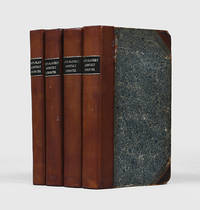
1827163198London: Printed for the London Society for the Mitigation and Abolition of Slavery in the British Dominions 1827-32. A new age of abolitionist agitation First collected editions being the full run under its original title of Zachary Macaulay's abolitionist magazine the leading organ of British abolitionist thought and campaigning. It was afterwards renamed the Anti-Slavery Reporter and has lasted under changing titles to this day. The journal "systematically collected information on the abuses of slavery" ODNB. "Highlighting the rise of abolitionist petition drives antislavery discussions in church and government venues and debates over unfree labor throughout the empire the paper celebrated a new age of abolitionist agitation" Newman pp. 44-45. The volumes collect the monthly issues from June 1825 to December 1831 with collective title pages and contents tables. 4 vols. octavo 216 x 129 mm. Contemporary half calf rebacked black morocco labels marbled sides edges speckled brown. Wear at extremities inner hinges reinforced a little browned and spotted: still very good copies. Richard S. Newman Abolitionism: A Very Short Introduction 2018. unknown
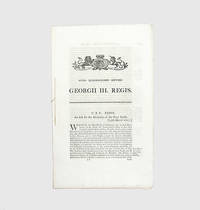
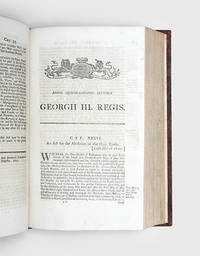
1807184142London: Printed by George Eyre and Andrew Strahan 1807. The African Slave Trade. is hereby utterly abolished prohibited and declared to be unlawful First edition of one of the most consequential acts of legislation in world history abolishing the slave trade within the British Empire. This copy is a well-preserved example of the separate folio printing. From 1807 enslaved persons could no longer be bought or sold within the British Empire while the Royal Navy was empowered to target vessels engaged in slave transportation a task it took up with vigour. Parliamentary acts were issued in collected annual volumes and as individual pamphlets all printed from the same type. As King's Printers Eyre & Strahan held the exclusive rights to publish and sell parliamentary statutes and this pamphlet would have been among those sold at their offices near Fleet Street. Folio 319 x 197 mm pp. 317-326 2. Woodcut headpiece. Stab-sewn as issued edges uncut. Minor offsetting else a near-fine copy. unknown
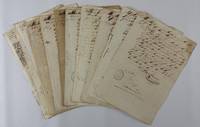
187312720Cuba 1873. Twelve manuscript documents on folio sheets approximately 8.5 x 12.5 inches all with official rubber-stamped seal. Small pinholes along left margin light wear occasional chipping to edges some ink bleed and light damp staining. Overall very good. A collection of documents recording the liberation or attempted liberation of numerous men women teenagers and a child from enslavement. The child is but seven years old while the remaining slaves range from fifteen to fifty-seven years old. The slave trade ended in Cuba around 1867 but the practice of owning slaves remained legal until 1880 and then was abolished completely by Spanish decree in 1886. Cuba was the penultimate country to outlaw slavery in the western hemisphere beating Brazil to formal abolishment by two years. Even before the official abolition of slavery in Cuba African or criollo slaves were manumitted by a variety of owners and at various costs as evidenced here especially after the practice of importing Chinese indentured servants began. Each of the present documents names the slaveholder and the slave granted "libertad" along with the cost in escudos or pesetas of that liberty. The slaves liberated here are as follows:<br /> <br /> 1 Luis criollo 7 years old for the sum of 28 pesos<br /> <br /> 2 Maria Antonia part criolla 20 years old for the sum of 2500 pesetas<br /> <br /> 3 Catalina morena de Africa 41 years old for c.200 pesetas<br /> <br /> 4 Lorenzo moreno criollo 21 years old for 2500 pesetas<br /> <br /> 5 Lucia morena criolla 15 years old for 320 pesos or 1600 pesetas<br /> <br /> 6 Frigidae "negro.de Africae" 56 years old<br /> <br /> 7 Augusto criollo 19 years old for 1750 pesetas<br /> <br /> 8 Marta criolla 16 years old for 1621 pesetas<br /> <br /> 9 Gil moreno de Africa 57 years old for 1500 pesos<br /> <br /> 10 Carmita morena criolla 20 years old for 1750 pesetas<br /> <br /> 11 Augustina Prieto morena criolla 30 years old for 1750 pesetas<br /> <br /> 12 Edwigio 39 criolla; Lazara 36 criolla; and Maria Leoncia 15 criolla for 2000 pesetas.<br /> <br /> These Cuban slave manumissions are offered with one 1844 manumission document liberating a slave in Spain totaling two pages and measuring about 8.5 x 13.5 inches. The document also has three rubber-stamped official seals at the head noting Isabella II. This document appears to free slave Nicolas 25 years old for the sum of 400 pesos and is signed November 5 1844. unknown
184524737<p>Mary B. Selden was the grandmother of Eleanor Love Selden who married John Augustine Washington III in 1843. She regrets not being able to furnish Washington with the services of one of her slaves as a stacker for the upcoming wheat harvest.</p><p>Still a faithful employee West Ford worked for the Washington family well into the nineteenth century including delivering this letter.</p><p>The letter includes a list of two dozen slaves written in pencil by John Augustine Washington III.</p><p><strong>SLAVERY. MOUNT VERNON. WEST FORD. MARY BOWLES ARMISTEAD SELDEN.</strong> Autograph Letter Signed to John Augustine Washington III hand delivered by West Ford; <strong>JOHN AUGUSTINE WASHINGTON III</strong>. Autograph List of Slaves. Single folio leaf with autograph address on verso. Alexandria Virginia 1845.</p><p><strong>Complete Transcript</strong></p><p><em>My dear Augustine</em></p><p><em> I am very sorry to be unable to render you the service you require. I have a very fine stacker but he is hired by the year to M<u>r</u> Young as I did not expect to have employment enough for him at M<u>t</u> Ida. Another year if you wish it you can have him I receive very small wages for him and as a stacker I have never known any one equal to him.</em></p><p><em>I am very sorry to hear that Nelly is sick. I hope she will be well enough to come up and meet the bridal party on thursday.</em><em> I received a letter from Eliza to day in which she says they will be at M<u>t</u> Ida that day but will bring no company with them. It will give great pleasure to them and to me if M<u>rs</u> Washington</em><em> Nelly and yourself will come up on that day. M<u>rs</u> Lippitt</em><em> will have a room ready for any of the party that will favour her with their company she must by no means be left behind.</em></p><p><em> Most truly and affectionately / yrs</em></p><p><em>M. B. Selden</em></p><p><2></p><p>Address: <em>John A. Washington Esq. / M<u>t</u> Vernon / By West Ford</em></p><p>Docketing by John Augustine Washington III: <em>Mrs. M. B. Selden</em></p><p>List of slaves in pencil by John Augustine Washington III:</p><p><em>Phil</em> b. 1790</p><p><em>Hannah</em> b. 1826</p><p><em>Gabe</em> b. 1820 <em>Eliza</em> b. 1811</p><p><em>Ned</em> b. 1827 <em>Jim</em> Michum b. 1795</p><p><em>Edmund</em> b. 1827 <em>John</em> b. 1833</p><p><em>Betty</em> b. 1833 <em>Mary</em> b. 1819</p><p><em>West</em> <em>Fanny</em> "Belongs to my wife"</p><p><em>Sarah </em> b. 1809 <em>Dennis</em> b. 1838</p><p><em>Hannah</em> <em>Nelly</em> b. 1836</p><p><em>William</em> b. 1830 <em>Jim</em> Starks b. 1805</p><p><em>Joe</em> b. 1832 <em>Sally</em> b. 1827</p><p><em>Ephraim</em> b. 1834 <em>Tom</em> b. 1835 "bound to me till Oct 1856"</p><p><em>West</em> b. 1838</p><p><em>Jesse</em> b. 1785</p><p><strong>Historical Background</strong></p><p>Farmers in mid-nineteenth-century Virginia typically planted winter wheat in September and October and harvested it in the following June. After wheat had been cut a stacker tied the wheat into bundles and piled the bundles in shocks to dry in the field. After the shocks dried they would be stored in a barn or carefully built stack capped with grass to shed the rain until threshing time. Even after Cyrus McCormick developed his mechanical grain reaper in the 1830s men needed to follow the machine to bundle and stack the wheat. Building a good stack was an important skill and those workers free or enslaved who knew how to do so were very valuable at harvest time.</p><p><strong>Mary Bowles Armistead Alexander Selden</strong> 1783-1846 was born in Hanover Virginia. She married Charles Alexander Jr. 1772-1812 with whom she had five children including Louisa Elizabeth Fontaine Alexander 1802-1827. After her first husband's death she married Dr. Wilson Cary Selden 1761-1835. She was his third wife and they had three children. By his first wife Dr. Selden was the father of Wilson Cary Selden Jr. 1796-1843. In 1822 Wilson Cary Selden Jr. married Louisa Elizabeth Fontaine Alexander and they became the parents of Eleanor Love Selden 1824-1860 who married John A. Washington III. Thus Mary Bowles Selden was both the grandmother and step-grandmother of Eleanor Nelly Washington. At the time she wrote this letter she was living at Mount Ida a 6000-acre plantation that stretched along two miles of the Potomac River north of Alexandria Virginia and fewer than ten miles from Mount Vernon. Her first husband built the neoclassical mansion of Mount Ida in 1808.</p><p><strong>John Augustine Washington III</strong> 1821-1861 was born in Blakeley West Virginia the son of John Augustine Washington II and Jane Charlotte Blackburn Washington and graduated from the University of Virginia in 1840. His father inherited George Washington's Mount Vernon estate in 1829 but it passed to his wife at his death in 1832. In 1841 Augustine Washington proposed to manage Mount Vernon for his mother. When she died in 1855 the plantation passed to him. In 1858 after offering the property to both the federal government and to the State of Virginia he sold 200 acres of the Mount Vernon estate including the mansion outbuildings and family tomb to the Mount Vernon Ladies' Association for $200000. Washington married Eleanor Nelly Love Selden 1824-1860 in 1843 and they had seven children. In 1860 he owned 22 slaves. In 1861 Washington joined the Confederate Army as a lieutenant colonel and served as an aide-de-camp to General Robert E. Lee. He was killed while conducting reconnaissance at the Battle of Cheat Mountain in September 1861.</p><p><strong>West Ford</strong> ca. 1784-1863 was born on the Bushfield Plantation in Westmoreland County Virginia to an enslaved woman owned by George Washington's brother John Augustine Washington. When George Washington visited West Ford was his personal attendant. When John Augustine Washington's widow Hannah died in 1802 she granted Ford his freedom at age 21. Bushrod Washington George Washington's nephew and heir to Mount Vernon freed Ford in 1806 and Ford continued working for the Washington family. According to family oral history Ford's mother Venus told her mistress Hannah Washington that he was George Washington's son. Nearly all historians doubt the claim though one of Washington's nephews certainly could have been the father.</p><p>In 1812 West Ford married Priscella Bell a free woman. Their four children—William Daniel Jane and Julia—were educated on the Mount Vernon Plantation despite laws which restricted the instruction of African Americans. When Bushrod Washington died in 1829 he willed 160 acres of land adjacent to Mount Vernon to West Ford who continued to live on the Mount Vernon estate.</p><p>Over the next several years West Ford was frequently highlighted in the media making his private life a matter of public record. In 1850 two Virginia newspapers—the <em>Alexandria Gazette</em> and the <em>Virginia Advertiser</em>—carried articles describing his prestigious position and authority at Mount Vernon. In 1857 an entry in the Fairfax County Deed Books noted that Ford divided his land among his four children. In 1858 Ford was sketched a second time this time by historian and artist Benson Lossing. In March 1859 <em>Harper's New Monthly Magazine</em> published Lossing's feature on Mount Vernon and included his sketch of Ford. Ford told the reporter of his property on Little Hunting Creek where he planned to retire after the Washington estate was no longer in the Washington family.</p><p>In June 1863 an ailing West Ford was brought back to the Mount Vernon estate by the Mount Vernon Ladies' Association. The association cared for West Ford until his death on July 20 1863.</p><p><strong>Condition</strong></p><p>Foxing and show through particularly near the signature.</p>
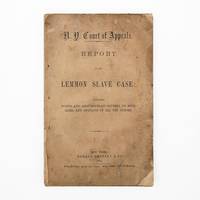
1860372448New York: Horace Greeley & Co 1860. 146pp. 8vo. Stitched self wrappers. Toned title a bit tattered at edges scattered minor staining. 146pp. 8vo. In 1852 the Lemmon family took a ship from Virginia to New York along with eight enslaved people planning to embark immediately on another ship for New Orleans. With slavery abolished in New York the slaves were freed by a writ of habeas corpus. Chief Justice Paine upheld the writ and in 1860 the case went to the court of appeals where the original judgment was overturned to preserve peace in the Union. The case would likely have been considered by the Supreme Court if not for secession and the outbreak of the Civil War.<br /> <br /> "The fullest legal examination of slave transit and comity before the Civil War . One of the most extreme examples of hostility to slavery in Northern courts . pushed the nation one step closer to Civil War" Finkelman Slavery in the Courtroom pages 56-57. Cohen 11900; Library Co. Afro-Americana 7104; Sabin 40003; Work page 346 Horace Greeley & Co unknown
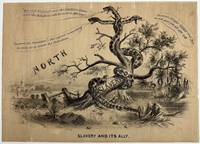
186412816N.p. 1864. Lithograph 14.5 x 20.5 inches. Noticeable toning small areas of light discoloration along top margin short closed tear to left edge minor dust-soiling numerous creases and wrinkles. About very good. A dramatic political cartoon issued during the Civil War and satirizing the dangerous influence of those who argue a compromise on slavery or an easy solution to the war. The work was likely issued in the midst of the 1860 but more likely the 1864 presidential election campaign. The central image of the lithograph involves a three-headed snake -- labeled "The People's Party" and emerging from the American "South" personified by a moss-covered swamp -- which is wrapped around the length of a large tree labeled "Slavery." Each snake vocalizes a different misleading message about the issue of slavery and compromise seemingly aligned with political entities such as the Peace Party and the Copperheads. The messages from each snake head read respectively "Extend Slavery over the Northern States and the Rebellion will be over in 60 days;" "Persevere till after election and then we will give you all you ask;" and "'Support the President' - but oppose everything he may do to crush the Rebellion." This latter message indicates the author of the work supported President Lincoln. The North is personified in the background at left by a depiction of the U.S. Capitol Building. The central image of the lithograph carries echoes of the story of the Book of Genesis with the involvement of a deceptive serpent amid the tree of life.<br /> <br /> The lithograph is signed in the stone at bottom right reading simply "Brooks." Though the work came to us proposing the identify of the artist as Reuben Brooks 1794-1870 we were ultimately unable to confirm this authorship. The lack of an imprint in the lithograph also precludes easy research and identification. In fact the rarity of the lithograph makes it difficult to expound much more about it at all. OCLC reports just a single copy at the Peabody Essex Museum and it is not listed in Weitenkampf or Reilly. Given its rarity and content the present lithograph offers an outstanding opportunity for further research and contextualization. unknown
18651260191865. First Edition. CONSTITUTION. Journal of the House of Delegates of the State of Virginia. for the Session of 18645. Alexandria: D. Turner 1865. Octavo original front printed wrapper respined renewed rear wrapper original string stitching; pp. 1-3 4-83 1. Housed in a custom chemise and clamshell box. $4500.First edition one of 500 copies of the momentous Journal featuring its February 9 1865 entry on the Alexandria Virginia government's passage of the 13th Amendment mere days after the U.S. Congress the first of the four Unionist southern states to pass the Amendment also featuring the governor's Message noting: ""though we have in inherited from our fathers of the revolution the blessings of a great nation yet they also left to us an inheritance of African slavery which has proved a bitter dreg in our cup of freedom"" a vital record of forces for constitutional change near the end of the Civil War.Soon after the 1860 election amidst southern secession ""the great questions of union or disunion war or peace hung in the balance. Probably the crucial weight on the scale was Virginia as long as the federal government did not seek to coerce the states Virginia secessionists were unable to achieve a majority. When Lincoln responded with force to the attack on Fort Sumter however the vote in Virginia went in favor of secession."" Subsequently a Virginia convention ""met in Wheeling on May 13 1861 it elected as Governor Francis Pierpont a western Virginian and ardent Unionist and arranged for the creation of a legislature to replace the body sitting in Richmond in July 1861 the new legislature met at the 'Restored Virginia' capital of Wheeling in a special session called by Pierpont."" Against its ""claim to represent a majority of Virginians"" a new state of West Virginia was created in 1863 and Pierpont's government moved to Alexandria to govern areas of Virginia under Union occupation Harrison Lawfulness of the Reconstruction Amendments 380-83.Scholars observe that the 13th Amendment its fellow amendments and Reconstruction as ""both a political process made possible by military successes and constitutional thought grew from wartime as well as post-Appomattox developments"" Hyman and Wiecek Equal Justice 247. This rare first edition of Journal of the House of Delegates substantiates that in documenting passage of the 13th Amendment by Pierpont's Virginia government mere days after the U.S. Congress passed the Amendment on January 31 1865. With that Virginia became the first of the four Unionist southern states that ratified the 13th Amendment. Of those Louisiana followed on February 17 with Arkansas and Tennessee that April. The 13th Amendment is the focus of the Journal's entry for February 9 1865 which states: ""Mr. Brownley called up Senate bill No. 12 entitled 'An Act to ratify the joint resolution of Congress passed January 31 1865 proposing an amendment to the Constitution of the United States.' The bill was read the first and second time and the rules were suspended and the bill read the third time and the bill passed."" Also notable herein is the complete printing of Governor Pierpont's opening Message where he notes: ""though we inherited from our fathers of the revolution the blessings of a great nation yet they also left to us an inheritance of African slavery which has proved a bitter dreg in our cup of freedom."" He speaks at length of the rights due people of color and the abolition of laws such as those that prohibit ""negro testimony"" or proscribe a ""different punishment for persons of African dissent"" from that of ""white persons.""""The legislature met for its second session on December 5 1864 The governor's message was a long and important document and indicated the changes of opinion that the war was bringing about. Pierpont gave his views upon the all-important negro question. He congratulated the constitutional convention which had met in the spring on the abolition of slavery in Virginia and advocated sweeping changes in the laws concerning negroes. The act prescribing different punishments for blacks should he said be altered in accordance with the amended constitution as well as the law for apprenticing them. The law prohibiting the education of negroes should be abolished His language was on the whole very moderate. He advised the legalizing of the marital relations of negroes and most important the establishment of public schools Notwithstanding the governor's advice no acts of great importance passed the legislature On February 9 1865 the assembly ratified the 13th Amendment to the Constitution of the United States. It adjourned on March 7"" Eckenrode Political History of Virginia During the Reconstruction. Faint ""U.N.C. Duplicate"" stamp to front wrapper.Text fine; just a bit of faint soiling and a tide line to fragile front wrapper. An excellent copy of this elusive item. unknown
1807182125London: printed by George Eyre and Andrew Strahan 1807. The African Slave Trade. is hereby utterly abolished prohibited and declared to be unlawful First edition of one of the most consequential acts of legislation in world history abolishing the slave trade within the British Empire. The Act the culmination of many years of campaigning by British abolitionists ended two centuries in which Britain took the pre-eminent role in the transatlantic slave traffic. The act paved the way for other European empires to abolish the trade and for Britain to use its navy to intercept slave ships which effectively ended the transatlantic slave trade by the latter half of the century. However the act did not end slavery in the British Empire which did not follow until 1833. Parliamentary acts were issued individually and in collected format printed from the same type. This copy includes the full acts for 1807 comprising the only session of the Third Parliament with the first session of the Fourth the second session was held in 1808 together with the separately published report on vaccination. It was bound for use by the civic authorities of the town of Elgin in Scotland. 3 parts in 1 vol. folio 289 x 181 mm pp. 16 466 1; 14 578 2 blank; 16. Contemporary sprinkled calf twin red and green morocco labels "Town of Elgin Acts of Parliament / 1807" edges speckled blue. Pencilled notation at head of title page. Neatly restored at extremities very minor foxing and finger-soiling to contents. A very good copy. unknown
18503976Havana 1850. Good. 138pp. Folio. Stitched with remnants of leather binding along spine. A few blank leaves scattered throughout. Dampstaining and moisture damage at upper fore-edge of scattered leaves slightly affecting text. Moderate offsetting occasional ink burn. Light edge wear and tanning scattered foxing. An extensive list of slave owners in Cuba in the mid-19th century who were issued cedulas for their human property. Cedulas were integral documents for the identification and transportation of enslaved people in the bureaucracy of colonial Cuba and were usually required by the government. In the present manuscript the race and sex of the slaves being issued documents are usually identified -- Negra Negro mulata mulato Chino China e.g. -- though some are just entered as esclavos and there are several entries noted as dotaciones that is complements usually large of slaves on a plantation. The names of the owners are grouped alphabetically according to their first names generally though not in any strict order and the leaves of the manuscript are sometimes bound out of order. Often there are multiple listings of an owner most likely one for each slave in need of a cedula and in all there are approximately 2500 or more separate listings. The first leaf appears to be a model for the cedulas that were being issued to the listed slaveholders with dashes where the information on the slaves and slave owners is to be filled in. The entire document has the appearance of an index with numbers at the right side of each page indicating perhaps the page numbers in the master ledger where the original entry was made. Overall a fascinating and significant document. unknown