SLAVERYABAA
4 résultats
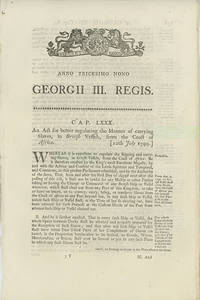
179928145London: Printed by George Eyre and Andrew Strahan Printers to the King's most Excellent Majesty 1799 1799. ESTC N60288 Lincoln's Inn Library and Wellcome Institute. Fine. 4to disbound paginated 637-652 untrimmed. An act passed by Parliament in the summer of 1799 delineated in 39 paragraphs that regulated the slave trade beginning in August 1800 - an act no doubt intended to placate the growing voices of opposition to the English slave trade. The act stipulates how many slaves could be stowed in a ship by mathematical formula according to the size of the ship but never more than 400; that slaves must be separated from other cargo; and that the space for the slaves "be full and complete perpendicular height of five feet." Nothing is said about their treatment other than that the ship's surgeon was required keep a log of illnesses and deaths of both slaves and crew. Much of the act is taken up with its enforcement and the penalties and fines for violations; it also regulates the conditions and treatment of the crew. The acts of Parliament were usually published separately and later issued in collections of the Public General Statutes; this one was issued as part of the collection of statues Passed in the Thirty-Ninth Year of the Reign of His Majesty King George the Third: Being the Third Session of the Eighteenth Parliament of Great Britain. This copy is disbound from such a volume. <br/><br/> (London: Printed by George Eyre and Andrew Strahan, Printers to the King's most Excellent Majesty, 1799) unknown books
1793106470<p>12 lines in brown ink with paper seal on sheet of paper 34x21 cm 13½x8¼". Signed by Thomas Hamilton clerk. Remnant of seal old folds with splitting along them normal aging and browning some offsetting very good overall. Amazing little document relating to the enforcement of Pennsylvania's groundbreaking effort to begin the abolition of slavery "An Act for the Gradual Abolition of Slavery" passed by the Pennsylvania legislature in 1780. The Act prohibited further importation of slaves into the state required Pennsylvania slaveholders to annually register their slaves with forfeiture for noncompliance and manumission for the enslaved and established that all children born in Pennsylvania were free persons regardless of the condition or race of their parents. Those enslaved in Pennsylvania before the 1780 law entered effect remained enslaved for life. The present document seems to reveal non-compliance with the law by Hugh Neilly in part: "I hereby certify on application of Ralph Cherry that a careful search hath been made by me among the Records of Negro's sic entered on the Records of Westmoreland County and that on such search it doth not appear that any Negro's hath been registered in the name of Peter or any other name as his property by Hugh Neilly of Westmoreland County aforesaid under the laws passes for the gradual abolition of slavery. Thomas Hamilton clerk." Docketed on the back "Certificate that no Negro's hath been registered in Westmoreland as the property of Hugh Neilly." </p> books
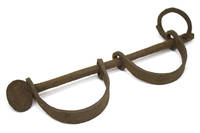
18003062751800. Wrought iron two semicircular wrist pieces approx. 4 inch in diameter attached to an 11-inch long bar. Oxidization consistent with age and material. Wrought iron two semicircular wrist pieces approx. 4 inch in diameter attached to an 11-inch long bar. A set of shackles of the type used in the Middle Passage slave route from Africa to the Americas in the 18th century. An illustration of this type of shackle appears on page 16 of Lydia Maria Child's Appeal in Behalf of that Class of Americans Called Africans Boston 1833 where she notes that these shackles were used to secure the ankles of adjacent slaves. "Yet even thus secured they do often jump into the sea and wave their hands in triumph at the approach of death unknown books
1728100536Pamphlet 8vo modern full calf in the style of an 18th century “Cambridge†binding 32 pp.Very slight aging; in excellent condition. This is a rare first edition of a work that presents a complaint by British planters in the West Indies concerning the Assiento or “agreement’ with Spain that gave Britain a virtual monopoly on the African slave trade. This agreement came out of the Treaty of Utrecht which ended the War of the Spanish Succession. This pamphlet indicates that the planters feared as a result of this agreement British slavers might be required to provide African slaves to the Spanish colonies which could result in insufficient numbers available for the West India plantations. The Assiento with Spain would mark the beginning of the Atlantic slave trade as a very powerful economic growth engine. Unfortunately this would translate into millions of Africans being taken from their homes. H. Whitridge unknown books