81 résultats
181619598Winchester Va.: J. Foster Printer 1816. First edition. Fragile sheep rubbed but sound; some light foxing and spotting; front joint just a trifle tender; a good sound copy of a moderately crude American book. Small 8vo original sheep red leather label gilt lettering 219 1 pages. An eccentric book-length poem from Elder Joseph Thomas 1791-1835 the wide-ranging charismatic North Carolina itinerant preacher known as the White Pilgrim for his habit of attiring himself in white apparel in all seasons and climes. Thomas includes a fairly lengthy and graphic section here leveled against slavery and its e suggesting those who endorse slavery might "Let them be bound and torn away / From wives and friends to Africa. / Let them be starv'd and beat one year / Then say 'tis right I'll say 'tis queer; / Or whip their wives before their eye-- / Is that all right O no they cry." Thomas also suggests abstaining from the product of slave labor "In sugar works where Negroes toil / A leg and arm they often boil; / They grind them up and mix the sweet / Of all that luxury we eat. / O temp'rate man use not that food / That's stain'd or mix'd with negro blood! / That taste luxur'ous now forego / Which causes human gore to flow." Stoddard & Whitesell 1148; Sabin 63639. Early ink autograph ownership signatures to the front free endpaper and to a rear blank and endpapers. Small tear from the lower margin of one leaf with loss of a few letters but no loss of sense. J. Foster, Printer, unknown books
183419536Boston: Russell Odiorne & Metcalf et al. 1834. First edition. Stitching evidently renewed at an early date; some wear and soiling light chipping and foxing; a good sound copy. Stitched pamphlet lacking wrappers 8.88 x 5.38 inches 80 pages. The notorious privateer and slave trader Pedro Gibert operating out of Colombia attacked the Salem brig Mexican off the coast of Florida in 1832 and set the American ship on fire. Captured off the coast of Africa by the Royal Navy in 1833 Gibert and his crew were brought to America for trial making him and two of his crew that last men to be hanged for piracy in the United States. It is interesting to note that one of the defense attorneys was David Lee Child 1794-18874 the abolitionist journalist and husband of Lydia Maria Child. Child had fought on the liberal side in Spain in 1823 as was fluent in Spanish which may have been the reason he was given the job of working with the Spanish-speaking prisoners--though the question of whether his liberal principles guided him to provide adequate counsel to defendants whose numb er included black sailors despite the fact that the Panda was a slave ship seems an open or at least under-explored question not addressed in any of the standard biographical sketches. This first edition of the Russell Odiorne and Metcalf edition of the trial did not include portraits; so-called second and third editions were published the same year had added plates. Sabin 69915. Traces of the original wrappers present. Russell, Odiorne & Metcalf [et al.], unknown books
1837101441Pamphlet small 8vo removed dbd 11 pp. Removed some minor foxing normal aging and browning; otherwise very good. This pamphlet was prepared for the New York chapter of the Religious Society of Friends Quakers for their annual meeting to oppose slavery. Not surprisingly this tract encourages people to help end "this stain upon our national character." While there are religious sentiments in this work much of the discussion relates to social injustice and morality. Mahlon Day (and New York Quakers), books
182919216Albany: Printed by Websters and Skinners 1829. First edition. Some wear to the untrimmed edges; long closed tear to one leaf from the upper edge no loss; some light soiling and a few small stains; a very good copy. Unbound pamphlet stitched as issued 6 x 9.13 inches untrimmed 24 pages. When therefore the fetters whether gradually or suddenly shall be stricken off and stricken off they will be from those accumulating millions yet to be born in bondage it is evident that this land unless some outlet be provided will be flooded with a population as useless as it will be wretched. . . . Whether bond or free their presence will be for ever a calamity." The organizational proceedings of the first iteration of the New-York State Colonization Society intended to help the national organization settle free blacks in Africa. Lib. Co. Afro-Americana 7116; American Imprints 39836. Printed by Websters and Skinners, unknown books
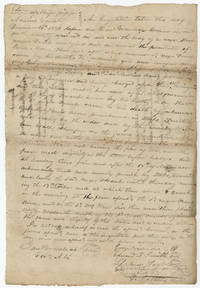
182122479<p>A Mississippi inquest holds a slave overseer accountable for killing a slave.</p> <b>SLAVERY.</b>Manuscript Document Signed by George Newman Edward T. Smith Sheppard Taylor Elijah Norman Hezekiah Kibbee David Collins and Daniel Greenleaf. Adams County Mississippi December 16 1821 1p. 8 5/8 x 12 3/8 in.<p><b><br /></b></p><p><b>Partial Transcript:</b></p><p><i>"the sd negro Frank came to his death by inhuman treatment and severe punishment in stocks starvation and lashes by the order and by the hand of William Wall.and so the sd Wm. Wall did then and there feloniously cause the death of the sd Negro Frank against the peace and dignity of the state and so we say all."</i></p> books
18732024Cuba 1873. About very good. 3 folio leaves. Light wear at edges a couple of small chips at lower left edge of each leaf. Light tanning and foxing. Accomplished in a neat legible script. Scarce manuscript listing of slaves and indentured servants from a Cuban sugar plantation. The present list was made in January 1873 on the Ingenio Tartesio east of Havana near the small village of Las Pozas. On two separate sheets nine Chinese and twenty-eight African or Criollo men are listed as rented to the farm; on a third sheet eighteen slave births for 1873 and 1874 are recorded giving names mothers and dates of birth. The Chinese men are identified simply by first name and owner; the African and other slaves are listed with additional details such as nationality age owner. A section for additional observations notes which slaves have run away and at least one death. A fascinating document of slave hires on an isolated Cuban plantation during the 1870s. unknown books
1827213910London: John Hatchard and Son 1827. Illustrated by 9 etchings. viii 464 pp. 1 vols. 8vo. Full calf spine gilt. Upper board missing 8 leaves damp-stained else Near Fine. Illustrated by 9 etchings. viii 464 pp. 1 vols. 8vo. John Hatchard and Son unknown books
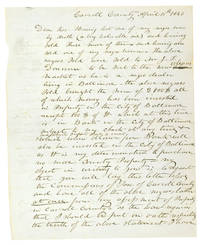
1848262219Carroll County Maryland 1848. 2 pp. pen and ink on signle sheet. 4to. Light creasing from prior folding. 2 pp. pen and ink on signle sheet. 4to. Reading in part: "Having lost one of my negro men by death a big valuable one and having sold three more of them and having also sold one of my negro women - the above negros were sold to Mr. Joseph S. Donovan to be sent to the New Orleans market as he is a negro dealer living in Baltimore - the above negroes sold brought the sum of $2800 all of which money has been invested in property in the city of Baltimore . My object in writing to you is to request that you will lay this letter before the Commissioner of Tax of Carroll County and have all of the above negroes taken at once from my assets .". unknown books
184045421Mobile AL Aug. 10 1840. Autograph letter signed on first and second panels of single bifolium sheet 25.5cm.; approx. 370 words. Previous folds the whole rather wrinkled postally used on rear panel else Very Good. Letter from Jesse Bemis 1808-1843 a Mobile transplant to his brother David of Spencer Worcester Co. Massachusetts where Jesse was born. The author thanks his brother for some fly nets sent him "I have sold about half of them at some profit" later noting that "they are not only worn on horses but they are used to spread over the cradles of the Negro Children as a screen the Negro women also wear them to Church & on dressy occasions. I hope the Abolition Missionarys wont find it out before I can dispose of all that I have for frear that they will glut the market." Bemis goes on to describe the election of 1840 "the tightes sic election in the State that ever was it took place the 3d of this month in this County we elected the whig ticket throughout" and goes so far to mention that "The women say out with Van Buren & give us the credit system." Indeed the women had their way as Van Buren lost to Harrison in large part thanks to the efforts of the Whig Party. unknown books
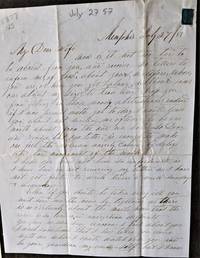
1857708Memphis 1857. 4to. letter sheet. 250 x 195 mm. 9 ¾ x 15 ½ inches. 4 pp. about 840 words. Folded in thirds. Written in black ink faded brown in very legible hand. Jesse McCallum was a hay dealer from Cincinnati Ohio who travelled away from his family on business forays. In this case he writes from Memphis Tennessee complaining about the heat and commenting on the "darkies" as follows: ". the sun is scorching from 10 am to 4 pm the difference is very perceptible I think the heat is greater on account of the drought the ground is parched up and dry.the streets are deserted in the middle of the day but the darkies will be down in the hottest part of the day in the sun and sleep with the sun shining full in their face and appear to enjoy it as much as a white man would in the shade what a difference collar sic makes.the south could not get along well without its black population one months work in the sun of the south would cure the bitterest abolitionist of the north of his bitter oposition sic to institutions of slavery and come over without a groan to be a slave owner if compelled to earn his living by cultivating the soil." McCallum thinks "we will do well on this load of hay.as hay is advancing" and also comments about his wife's lack of correspondence and reminds her that he writes twice a week. The last page is particularly affectionate--he remarks about being a "bachelor husband" and adds ; ". the only true enjoyment I have had was when I recd your letter since I left you and now Elly if you wish me to enjoy myself write often." Jesse McCallum often spelled Mc Collum in historical records was born in Ohio in 1819. In 1850 he was working as a stone cutter. By 1860 he was living with wife Eleanor Welsh and  six children in Marysville Yuba California. In the Civil War he was a Union Corporal 81st Illinois Infantry Company A. In 1870 he was making "gas machines". He died in Marysville in 1880. unknown books
183331599England 1833. 3pp. Scarce letter on the Liberian colonization movement by one of its founders.<br/> <br/>The letter begins with the 2-page text of a resolution to establish the British African Colonization Society: " . that Colonies composed of fare settlers of African race established on judicious principles on the Coast of Africa appear calculated beyond any other plan to put an effectual stop to the slave trade . Resolved that a Society be formed to be called the British African Colonization Society and that is objects be to cooperate with the American Colonization Society and with the several missionaries and other religious and charitable societies in Great Britain and the United States of America in such measures as may promote the total abolition of the slave trade and the establishment of Christianity and Civilization among the Natives of Africa chiefly by the employment of Free Persons of African birth or descent." The proposed Society was to be established under the patronage of the Duke of Sussex. In the letter which follows Cresson writes of William Lloyd Garrison's opposition to the colonization movement: " . I send the list of officers as far as accepted several others have not yet answered but I trust we shall present a bold front. I have just heard thro his Chaplain from the Duke. Garrison has written to poison his mind and probably will annoy our meeting. I trust that as the notice has been so short our friends will bring many with them . My letter to the Times in answer to Garrison they have not yet noticed so that it will be put in the Globe whose Editor has offered it a place in his columns." Cresson a noted Philadelphia businessman and philanthropist was among the most ardent supports of colonization the movement to relocate former slaves and free African Americans to colonies in Liberia. In 1832 he travelled to England to promote international support for the movement. The following year Cresson and the Philadelphia Young Men's Colonization Society a branch of the American Colonization Society founded Port Cresson in Liberia. However the colony was attacked in 1835 by Bassa tribesmen incited by Spanish slave traders and destroyed. Although initially in favor of colonization William Lloyd Garrison would change his mind decrying the efforts of the American Colonization Society as a perpetuation of slavery. For Garrison's 28 June 1833 letter to the Duke of Sussex referenced above see The Letters of William Lloyd Garrison I:107. unknown books
183431598Philadelphia 1834. 3pp. Later annotation at head of first page. Scarce letter on the Liberian colonization movement by one of its founders.<br/> <br/>Writing to Hawes a member of Parliament and a committee member of the Society for the Extinction of the Slave Trade Cresson wishes for success in the British anti-slavery action off the coast of Sierra Leone writing "I hope that you may yet enjoy the satisfaction of crushing one of the worst & most unacceptable of the slave markets in existence that at Gallinas." After mentioning the travels of the colonial governor of Liberia he writes: ". I have been gratified to learn from several highly respectable sources that such a Colony as you propose located either at the mouth of the Cape Mount River or even a little more to the Northward say at Sugaree & provided with a good supply of trade goods to exchange with the natives would have a powerful tendency to break up the monopoly now enjoyed by the Spanish Slavers. My letters from Africa state that the demand is so great in Cuba from the ravages of Cholera among their ill-fed human cattle as to have rendered the shipments from the Gallinas during the past year almost unprecedented. It appears that the benevolent efforts of your Govt. are not likely to extirpate the evil until commercial & agricultural colonies shall be substituted for cruisers." The letter continues with news from their consul at Liberia before turning to American politics: ". political affairs engrossing the entire energies of the nation. The excitement is painfully great . Our military chieftan Jackson by his acts of unauthorized assumption has called forth a burst of indignation which cannot subside until we get rid of the offender." The letter concludes with an introduction for Gerard Ralston. Cresson a noted Philadelphia businessman and philanthropist was among the most ardent supports of colonization the movement to relocate former slaves and free African Americans to colonies in Liberia. In 1833 Cresson and the Philadelphia Young Men's Colonization Society a branch of the American Colonization Society founded Port Cresson in Liberia. However the colony was attacked in 1835 by Bassa tribesmen incited by Spanish slave traders and destroyed. unknown books
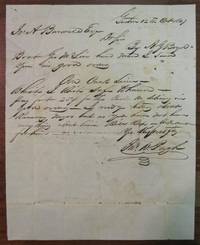
18472183421847. unbound. The writer Mr. Pugh also mentions that he has received a letter concerning a runaway slave and will keep a look out in part: ".I rec'd your letter about a Runaway Negro but as yet have not heard anything about him. Will keep a look out. Yours Respectfully." 1 page 8vo light water-staining 9.25 x 7.5 inches. No place October 12 1847. Very good- condition.<br/><br/> unknown books
1834100531<p>Single small folio leaf printed on both sides. Faint creases whee originally folded probably removed modest aging and browning a couple of very small spots or stains; overall very good. Over forty years after William Wilberforce presnted evidence of the brutality of slavery to Parliament and following Thomas Clarkson's tireless efforts the crown finanlly put an end to salvery in the West Indies and her colonies. The act included a provision that all slaves above the age of six were to present themselves for apprenticeship. The crown also set aside 20 million pounds to compensate the slave owners who could retain their workforce for a modest sum.</p> Ordered by the House of Commons, books
1877CAT0113J.A. Brush: Minnesota 1877. 2 ¼ x 4 inch image on slightly larger mount. Fine. Chambers a seven-year-old boy at the time of the Civil War followed the soldiers Jasper Dickey and David Scofield from Georgia back to their homes in Minnesota. The two soldiers raised him. He died in 1936 at the age of seventy-eight. Inscription on album page from which photograph was removed reads "Samuel Chambers / Zumbrota Minnesota. / Born a slave but followed northern troops to Minnesota at close of war." Verso identifies the photographer as J.A. Brush of 223 Nicollet Av. Minneapolis. A fine example. Minnesota unknown books
1864WRCAM53096Richmond 1864. Broadside 18 x 12 inches. Printed in three columns. Previously folded with a couple small separations along old fold lines. Light toning and foxing. About very good. A very scarce and quite interesting broadside circular printing of the act which allowed slaves and free blacks to be used in certain tasks by the Confederate Army during the Civil War as well as instructions for the conscription and induction of those men into the armed forces. The Confederacy was loath to arm any of its slave population but by 1864 could not spare any further manpower from their infantry to perform menial tasks and the government therefore passed a law allowing slaves to be used "in certain capacities" such as the construction of fortification the production of arms and the transport of materiel. The first column of this broadside comprises a full printing of that law while the remainder sets forth the rules for the impressment of slaves into military service for their care while in service and for the compensation of their owners. <br> <br> A fascinating piece that lays bare the desperation of the Confederacy for labor and supplies in early 1864. Not in Parrish & Willingham. unknown books
183441625Salem MA: W & S.B. Ives 1834. 8 pp. <br /><br />"The society organized January 27 A.D. 1834.--Salem Mass." Waterstained. Bound in original printed wrappers. Front wrapper detached but present. Uncommon. W & S.B. Ives books
1865974Santiago de Cuba 1865. Very good. 10 leaves. Removed from a larger volume and restitched. Minor wear and one small area of worming at edges. Light tanning and foxing. Accomplished in several legible hands. A fantastic set of manuscript records for a slave auction house the General Slave Depository in Santiago de Cuba dating to January 1865. Santiago along with Havana and Cienfuegos was one of three major sites for slave sales on the island during the 19th century. The first leaf of the document provides a statement that the documents were assembled in accordance with the rules established for slave auctions which had been updated and approved at the end of the previous year. The second two documents lay out mortgage agreements and financial obligations between the slave house and the Real Sociedad Economica de Amigos de Pais of the city in which the auction owners acknowledge debts and forthcoming payments on the order of several thousand pesos. Following these are two leaves containing a "Relacion de los esclavos ecsistentes en el deposito de esta Ciudad en el dia de la fecha" that is a list of slaves at the depository on the day of the auction and their owners and renters which perhaps were a part of the collateral for securing the loan. A total of twenty-nine slaves are listed and the leaf that follows certifies that the list is correct according the to the director and the auctioneer of the depository. The final two leaves provide official recognition of the loan from two distinct government offices. All documents are signed by the relevant parties and government officials involved in the agreement. In all the present group of documents provides a detailed assessment of debts and human assets of the slave auction house in Santiago de Cuba in the mid-1860s and is a fascinating and valuable document of the bureaucracy and regulation surrounding the financial realities of selling slaves in Cuba during this period. unknown books
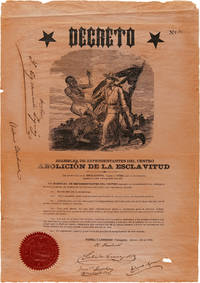
1869WRCAM56566Camagüey Cuba 1869. Pictorial letterpress broadside 18 1/2 x 13 inches. Numbered "54" in manuscript bearing the embossed red seal of the Republica Cubana and signed in ink by Salvador Cisneros y Betancourt Eduardo Agramonte Ignacio Agramonte Loyn áz Francisco Sánchez y Betancourt and Antonio Zambrana. Old horizontal folds minor creasing handful of small edge chips. Small hole in bottom margin just touching one ink signature. Very good condition. A rare and significant pictorial Cuban decree from the provisional rebel government abolishing slavery on the part of the island they controlled issued by the radical faction of the Cuban nationalists fighting against Spanish rule in the first months of the Ten Years' War. <br> <br> This proclamation is illustrated with a dramatic woodcut signed "LFR" depicting an ill-clad but exultant freed slave and a rebel celebrating in front of the Cuban flag. This decree stipulated freedom for all the enslaved people of Cuba in hopes that they would join the revolutionary struggle. The decree also provided for eventual compensation to slaveholders and ordered that freed individuals must serve the revolution either through military service or by continuing with their previous work. Among the important leaders who signed the present document were Salvador Cisneros y Betancourt as president just below the printed text and Ignacio Agramonte y Loynáz as secretary to the left of the engraving. <br> <br> The practical effect of this decree was modest as the rebels only controlled limited territory before their ultimate defeat and their territory was generally under the control of more conservative military commanders but such a proclamation joined a growing chorus of abolitionist sentiment in Cuba which finally realized the end of slavery in 1886. A powerful statement of anti-slavery policy in mid-19th century Cuba with a striking illustration of a jubilant slave celebrating his short-lived freedom. Rare with no copies recorded in OCLC. unknown books
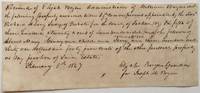
1847266916Jackson County FL 1847. unbound. 1 page 3.5 x 7.5 inches Jackson County Florida February 5 1847 -- a probate court receipt acknowledging that "Elijah Bryon Administrator of William Bryon received the following property awarded to me by the commissioners appointed by the Hon. Richard H. Long Judge of Probate for the County of Jackson one-fifth of three-hundred and twenty acres of land undivided and the following slaves: Mary Ginny and child and Jerry valued at $1500 and three-hundred and thirty one dollars and forty-five cents of the other personal property as my position of said Estate." Signed at the bottom: "Elijah Bryan guardian for Joseph M. Bryan" and docketed on the bacl: "E. Bryan" and "Richard H. Long J.P.C." Richard H. Long 1791 - 1865 was appointed by the Territorial Governor in 1833 to complete the land sale between S. Brown and the Apalachicola Tustenuggee and Hadjo tribes treating the Indians fairly. He was a representative to Florida's first Constitutional Convention and later served as Speaker of the House. During the Civil War he rose to the rank of Colonel of a Florida Regiment and saw much action in the field. His body was recently located in a forgotten Confederate cemetery. Elijah H. Long was known for building a 5200-acre plantation for his mother. The family was well known in Jackson County and evidently all were slave owners. One horizontal fold; uniformly toned. Very good condition.<br/><br/> unknown books
1854CAT0114New York: H. Long 1854. First Edition. 8vo publisher's brown cloth 259 pp. Good Plus. The Vermont-born Chase moved to Tennessee in 1838. He was elected as a member of the Democratic Party to the Twenty-ninth and Thirtieth Congresses serving from 1845-1849 before returning north to New York City to practice law. In this work of fiction which is mostly intended as a diatribe against the hypocrisy of the English he proposes that "The African adopts him-self with greater readiness than the white man." In his view wage slavery in the North and in England was worse than the slavery in the South. An uncommon first edition copy. Some wear and tears to boards some light marginal foxing to contents but still sound and usable good plus condition overall. H. Long unknown books
185519759N. p.: Jan. 4th 1855. Autograph address in ink on an unbound fascicle of 15 folia 30 leaves stitched. These arguments it is believed fairly prove that a man can be at the same time both a slave-holder and a Christian or stated in the abstract that the particular relation of superior & inferior known as slavery is not in itself necessarily sinful." An extensive detailed legal and ethical apology for American slavery arguing that a reciprocal relationship exists between the enslaver and the slave; the speak tentatively argues that Congress does have power to regulate slavery in the territories and had words against the doctrine of Popular Sovereignty. The anonymity of this argument and the popular setting of the lyceum stage perhaps as a student production seems altogether fitting as a reflection of the widespread currency of legalistic equivocation over chattel slavery in America prior to the Civil War. With revisions and interpolations and corrections to the text throughout. Jan. 4th, books
183945020Philadelphia: Printed for the Committee / J. Richards 1839. First Edition. 12mo 19cm.; side-stitched self-wrappers; 12pp. Some foxing faint fold lines else Very Good or better. Extracts taken chiefly from British abolitionist Thomas Fowell Buxton's larger work "The African Slave Trade" in which he argued that the African slave trade could be stamped out by other forms of trade as well as the spread of Christianity. Printed for the Committee / J. Richards unknown books
1840100899Pamphlet leaflet 8vo 4 33-36 pp. Some aging and browning and a small stain at the bottom let margin; otherwise very good plus. Basically this short pamphlet provides "abridged selections" of various slave statutes from states around the country prior to the Civil War .The statutes consistently explain that a slave should be considered a thing not a person and of course has no right to own property. It also outlines various punishments such as 25 lashes for riding a horse without permission 21 lashes if more than six slaves meet together and death for striking a white person 3rd offense. The Anti-Slavery Bugle, books
1826WRCAM40209Philadelphia 1826. 40pp. Original tan wrappers. Wraps a bit creased spine slightly chipped. Contemporary ownership inscription on titlepage. Text a bit tanned. very good. A call for the abolition of the slave trade with sections regarding the involvement of a number of foreign countries in the trade. This copy belonged to the Rev. Leonard Worcester of Peacham Vt. Worcester was a member of the Auxiliary Colonization Society of the State of Vermont a regional subgroup of the American Colonization Society. A nice association copy. SHOEMAKER 23434. paperback books