FREEMASONRY -Biblio.com
5 résultats
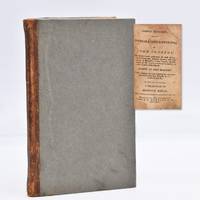
180063138London Newbery 1800. 8vo. Unbound. Leaves frayed and with marginal tears. Spine without paper as issued. First and last leaves browned and partly detached but otherwise internally nice and clean. VI 74 pp. Possibly wanting a frontispiece. <br/><br/><em>Rare later edition first published in 1762 of this highly influential and popular exposure of Masonic rituals. Wolfstieg 29983. </em> unknown
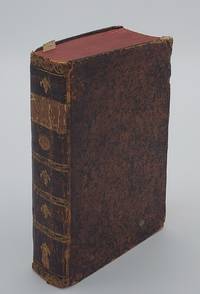
178569714Venezia: Presso Leonardo Bassaglia; Presso Gian Francesco Garbo 1785. Leather Bound. Very Good. 95; 370; 352pp. Duodecimo 18.5 cm Mottled leather with gilt stamping on the spine. Publisher's red stain to the text block edges. Marbled endpapers. Some rubbing and chipping to the leather at the extremities. Underlying boards exposed periodically along the edges. Very occasional light foxing to the pages. Small loss from bottom margin corner of p. 117/18 of second work. Regular errors in the printing of page numbers but no text missing. Italian text. This copy is from the personal library of Kent Walgren Mormon scholar bookseller and author of the definitive bibliography of freemasonry with his brief markings in pencil on the front free endpaper. Pages exceptionally bright. Opens with a rare work on Freemasonry written anonymously. Followed by parts 3 and 4 of Pluquet's work on Christian heretics translated by Tomasso Antonio Contin. Presso Leonardo Bassaglia; Presso Gian Francesco Garbo unknown
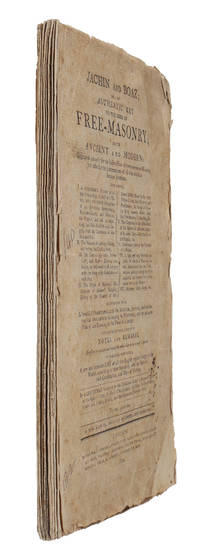
180035948Brookfield Massachusetts: Printed by E. Merriam & Co 1800. 73 of 83 pp. 1 vols. 12mo. Later calf and blue boards. Chips to corners of the title without loss to text. 73 of 83 pp. 1 vols. 12mo. Scarce with three recorded copies AAS Yale Boston Aetheneum.<br /> <br /> The Brookfield printer Ebenezer Merriam was born Dec. 15 1777 in Leicester Massachusetts son of Ebenezer and Margaret Jefferson. At the age of thirteen he began a six year apprenticeship in Worcester with Isaiah Thomas. In 1798 he established with his brother Dan E. Merriam & Co. a printing and book binding business located in the West Parish of Brookfield with a printing press which had formerly been used by Benjamin Franklin. The firm would be the precursor to the formation of Merriam-Webster. Not in Evans. Lowens 208; Walgren 549; ESTC W12639 Printed by E. Merriam & Co unknown
175020179Cont. full calf raised bands gilt back gilt titlelabel. Binding with minor scratches. Top of spine worn. Engraved ornamental titlepage. 893 pp. engraved having 89 "chansons" all with engraved music and engr. text. At end 3 pp. listing the 89 songs. Occasionally a little brownspotted on good paper. hardcover
17734232Paris: Le Breton 1773. 8vo 192 x 120 mm. 566 pages. 5 leaves are cancels as called for in the Avis au relieur on the last page the 5 cancels were originally the last 5 leaves of the final quire. Marginal tear to pp. 399-400 not affecting text. Contemporary French gold-tooled morocco covers tooled with a triple rule frame enclosing a wide dentelle border incorporating emblems of the Freemasons compasses & squares stars shooting stars and a pair of shaking hands fleurs-de-lis at corners at center a large double-ruled Masonic triangle whose band is filled with pointillé dots inner triangle with a shooting star at each corner and the initial P at center; spine in six gold-tooled compartments with title and date in two compartments large and small fleurs-de-lis in the others gilt edges blue endpapers; in fine condition small light dark spot to upper cover a couple of other insignificant small marks. 20th-century leather-backed cloth folding case. Provenance: small booklabel inside folding box “Bibliophilia / AG / Bern†with an image of a binding press. <br /> <br /> A fine Masonic binding on the Almanach royal for 1773. <br /> <br /> This was an important year for the Freemasons in France. In 1773 they reorganized their disparate and in the past often schismatic loges into one hierarchically organized Grand Orient de France whose grand master was none other than Louis-Philippe d’Orléans later known as Philippe-Egalité for his support of radical reform of the French monarchical system. Masonic lodges open to bourgeois and artisans as well as aristocrats were in many parts of France a venue for new social connections and the philosophical opening toward new ideas and they were to take an active part in the elections to the Estates General in 1789. Nevertheless as the Revolution intensified the dangers of being associated with an exclusive secretive and originally aristocratic club were not lost on Louis-Philippe who renounced his position in the winter of 1793; this had little effect on his terrible fate he was guillotined less than 9 months later.<br /> <br /> Other than Le Droit humain an international order of Freemasonry that was founded in the 1880s most Masonic lodges still exclude women and atheists.<br /> <br /> The dentelle of this well-preserved binding is built up from individual tools unlike the Dubuisson bindings that decorate so many Almanachs royaux. The initial P. at the center of each cover may represent a chapter name. Le Breton unknown