161 résultats
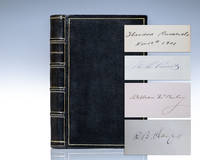
1872149519Philadelphia: J.B. Lippincott & Co 1872. Rare and remarkable autograph book compiled by West Virginia senator and industrialist Henry Gassaway Davis 1823-1916 containing 289 historic autographs including seven presidents seven vice presidents and scores of members of the Senate House of Representatives and presidential cabinets as well as a few other 19th-century notables. Octavo bound in full crushed levant morocco by the Harcourt Bindery with gilt titles and tooling to the spine in six compartments within raised gilt bands gilt ruling to the front and rear panels gilt-scrolled inner dentelles stamp-signed by the Harcourt Bindery all edges gilt title page printed in gilt. With Davis' ownership signature and subsequently that of his daughter to the title page "H. G . Davis 1872" and "Grace T. Davis 1887" Miss Davis was 18 in 1887. The book has approximately 300 unnumbered pages but only the first 144 which were numbered in pencil by hand at some point include the autographs generally three on each side of a page most often including the person's home state or in the case of cabinet members their office title. The highlights of the album are the signatures of seven presidents representing a half-century of American politics: U. S. Grant Rutherford B. Hayes James A. Garfield Grover Cleveland Benjamin Harrison twice William McKinley and Theodore Roosevelt. Also included are seven vice presidents - Hannibal Hamlin Schuyler Colfax Henry Wilson William A. Wheeler Levi P. Morton Garrett A. Hobart and Charles W. Fairbanks - and one first lady Frances F. Cleveland. With the later presidents' autographs are several examples of partial cabinets including: Harrison Secretary of the Treasury Charles Foster Secretary of War Stephen B. Elkins Attorney General William H. H. Miller Postmaster General John Wanamaker Secretary of the Navy Benjamin F. Tracy Secretary of the Interior John W. Noble and Secretary of Agriculture Jeremiah M. Rusk Cleveland Secretary of State Walter Q. Gresham Secretary of the Treasury John G. Carlisle Secretary of the Navy Daniel S. Lamont Attorney General Richard Olney Postmaster General Wilson S. Bissell Secretary of the Navy Hilary A. Herbert Secretary of the Interior Hoke Smith and Secretary of Agriculture J. Sterling Morton McKinley Secretary of State John Sherman Secretary of the Treasury Lyman J. Gage Secretary of War Russel A. Alger Attorney General Joseph McKenna Postmaster General James A. Gary Secretary of the Navy John D. Long Secretary of Agriculture James Wilson and Secretary of the Interior Cornelius N. Bliss and Roosevelt Secretary of State John Hay Attorney General Philander C. Knox Postmasters General Charles Emory Smith and Henry C. Payne and Secretary of the Interior Ethan A. Hitchcock. Others significant names include influential members of the House and Senate many of whom were celebrated veterans of the Civil War. These include: Hamilton Fish William M. Evarts Charles Sumner David Davis Simon Cameron James G. Blaine George S. Boutwell Augustus H. Garland Roscoe Conkling Ambrose Burnside John A. Logan John B. Gordon Carl Schurz Wade Hampton John T. Morgan Henry W. Slocum and William Mahone. Interestingly one page features the autographs of James Cardinal Gibbons Archbishop of Baltimore and famed agnostic lecturer Robert G. Ingersoll. In fine condition. A remarkable collection spanning half a century of American politics. J.B. Lippincott & Co unknown
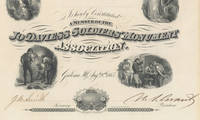
18653462628/08/1865. <p>Ulysses S. Grant was living in Galena Illinois when the Civil War broke out. The Civil War won on August 18 1865 Galena celebrated Grant’s heroic return. Following a jubilant procession with much flag waving and speeches a group of Galena citizens presented the General with a handsome furnished house on Bouthillier Street. Today the house is managed by the Illinois Historic Preservation Agency as the U.S. Grant Home State Historic Site.</p><p>The Soldiers Monument Association was a group of local organizations founded after the American Civil War to fund and erect monuments to fallen soldiers and veterans. In 1865 many such groups formed and one of these was the Jo Daviess Soldiers Monument Association in Galena Illinois established to honor that county's soldiers who served in the Civil War. The Association is known for its handsome membership certificates which pictured vignettes of Lincoln Liberty flags and soldiers and were signed by Grant who was the honorary president. In time a monument to the soldiers of Jo Daviess County was constructed in Grant Park Galena.</p><p>A <strong>membership certificate</strong> to the Soldiers Monument Association with compelling vignettes including Lincoln constituting individuals as members of the Jo Daviess Soldiers Monument Association Galena dated August 28 1865 and <strong>signed</strong> by Grant as President of the Association. Gen. J.C. Smith has also signed as Secretary.</p><p>This is the first Soldiers Monument Association certificate we have ever carried and it is particularly compelling with its association of Grant and Lincoln.</p><p><img class=""alignnone wp-image-25018 size-post-window"" src=""https://cdn.raabcollection.com/wp-content/uploads/20231204144051/Folder-site-11-1600x1327.jpg"" alt="""" width=""1600"" height=""1327"" /></p> unknown
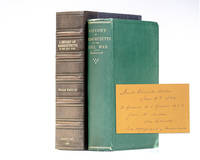
1868149393Boston: E.P. Dutton & Co. Publishers 1868. First edition of this detailed account of Massachusetts’s political leadership military organization and social contributions during the American Civil War. Octavo original publisher's green cloth with gilt titles to the spine tissue-guarded frontispiece of the author. Association copy inscribed by the author to General Ulysses S. Grant "Senate Chamber Boston June 9th 1868 To General U.S. Grant U.S.A. from the Author Wm Schouler Late Adjt General of Massachusetts." Schouler was an American journalist politician and Adjutant General of Massachusetts during the American Civil War. In 1861 a Massachusetts militia training camp was named for him but later renamed for Secretary of War Edwin M. Stanton. He remained Adjutant General throughout all of the U.S. Civil War until 1867. Ownership stamp of Jesse R. Grant to the front pastedown. In very good condition with light toning and rubbing and damp staining to the bottom right corners of the panels. Housed in a custom folding chemise and half morocco slipcase with gilt titles. An exceptional association. Ulysses S. Grant served as the 18th President of the United States from 1869 to 1877 following his leadership as Commanding General of the U.S. Army during the Civil War. A key military strategist Grant played a central role in securing Union victory alongside President Abraham Lincoln. As president he supported Congressional Reconstruction aimed at protecting the civil rights of formerly enslaved people and rebuilding the South. His administration though marked by efforts to stabilize the postwar nation and promote industrial growth was also marred by widespread political corruption. Grant’s presidency reflected the complexities of the Gilded Age and the challenges of reunifying a fractured nation. E.P. Dutton & Co., Publishers hardcover
18793244413/05/1879. <blockquote><p>We are aware of no other autographs of Grant from this trip having reached the market</p></blockquote><p>Richard Nixon was not the first President to visit China. On February 20 1979 the New York Times reported: ""When President Nixon arrives in China today on an unprecedented state visit he will not be the first American President to have set foot on that nation's shores. Nearly one hundred years ago while the Manchu dynasty still held sway over the crumbling Chinese Empire Gen. Ulysses S. Grant entered the gates of Peking and was borne in an imperial palanquin into the heart of the Forbidden City. Just one month after the expiration of his Presidential term General Grant embarked on a worldwide tour which took him to Europe Asia Minor India and Indochina on his way to the two great realms of the Far East. In all he spent six weeks In China visiting the cities of Canton Swatow Amoy Shanghai Tientsin and Chefoo with a full week in Peking from June 3 to 10 1879. During his stay he was entertained in the royal manner and granted interviews with Prince Kung the ruling regent of the Manchu Court —the real Emperor was only 5 years old at the time—and Li Hung_chang the Western_oriented strongman of North China.""</p><p>The Chinese had hopes largely unrealized that Grant would help them handle diplomatic and military crises with Japan and Vietnam where the French had influence. He went with a delegation of his own which included his wife and son officers of the US Navy and one of the earliest US ministers to China Chester Holcombe.</p><p><strong>Document signed</strong> Swatow Shantou China May 13 1879 a place card for the dinner held in Grant's honor that evening belonging to a Mrs. Scott. Signed by Ulysses S. Grant his son Frederick Dent Grant his wife Julia Grant Charge d'Affaires Chester Holcombe two representatives from his naval escort.</p><p><img class=""alignnone wp-image-25018 size-post-window"" src=""https://cdn.raabcollection.com/wp-content/uploads/20231204144051/Folder-site-11-1600x1327.jpg"" alt="""" width=""1600"" height=""1327"" /></p> unknown
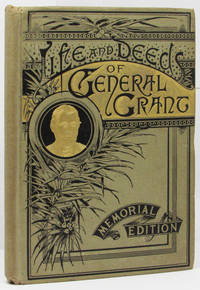
188534195Boston: Boyle Brothers 1885. A rare original publisher's 'Salesman's Dummy' for the Memorial Edition of this early biography of Grant published almost immediately after his death. Specimen pages include two engraved portraits one with facsimile autograph 62 pages of engraved illustrations maps or facsimile records sixteen pages of facsimile manuscripts and 60 pages of text many of which are also illustrated. Bound in the rear are several ruled pages for recording orders including the subscribers' names addresses and preferred binding ten orders are already recorded. 8vo in the original olive cloth decorated in gilt and black on the upper cover and in blind on the lower cover attached to the front endpaper is the sample spine for cloth binding option and attached to the rear endpaper the sample spines for the deluxe morocco and calf binding options floral endpapers. A very fresh copy especially so. The binding is bright and clean the text is free of foxing stains or other evidence of use. A SCARCE SALES DUMMY AND A BEAUTIFULLY PRESERVED ITEM OF PUBLISHING HISTORY AS RELATES TO THE 18th AMERICAN PRESIDENT AND HERO OF THE CIVIL WAR.<br> These 'dummies' were used by door-to-door publisher's salesmen to pre-sell the upcoming publication through subscription. Thus they are full with illustrations and passages of the book chosen to be the most appealing to potential buyers. Boyle Brothers hardcover
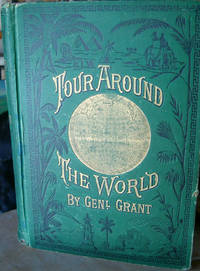
18791391777Philadelphia: The National Publishing Co 1879. Hardcover. Octavo 810 pages. In Fair condition. Spine is green with gold print. Boards in green cloth. Tattering to spine caps and corners mild wear to edges light shelf wear. Text block has spotting to endpapers cracked front hinge shaken binding. Illustrated: b&w frontispiece portrait b&w plates and text drawings. <br /> <br /> NOTE: Shelved in Netdesk Column P. 1391777. FP New Rockville Stock. The National Publishing Co hardcover
18791751022099Philadelphia: National Publishing Co. nd 1879. gilt pictorial green cloth. Hinges cracked front blank edge worn light general rubbing and wear: VG-. 8vo. illustrated with wood engravings. Apparent 1st edition National Publishing Co. hardcover
1879024745Philadelphia: The National Publishing Co. First Edition. Original green decorated cloth. Slight edge wear area of lighter green near the top of the back cover slight spotting on the back cover Very Good. . Very Good. Hardcover. 1st Edition. 1879. The National Publishing Co hardcover
18782401Rome: Henri Le Lieure 1878. First edition. Framed. Very Good. ALBUMEN PHOTOGRAPH OF GRANT IN MILITARY DRESS SIGNED BY GRANT ON THE PHOTOGRAPHER'S MOUNT. A very handsome bust-length portrait of Grant taken by photographer Henri Le Lieure during Grant's visit to Rome in 1878. Signed "U.S. Grant" in ink on the original mount beneath the photograph.<br /> <br /> A handwritten note on the paper backing of the frame reads:<br /> <br /> "This photograph was autographed by U. S. Grant in April 1878 at the home of Dr. Charles McMillan Counsel General Great Uncle of Eunice in Rome Italy. Dr. McMillan had served as Medical Director on Grant's staff throughout the Vicksburg Campaign." <br /> <br /> The frame with the seal of "The Dayton Company Picture Galleries Minneapolis" on the backing likely dates from early-mid 20th century. The Dayton Company was a celebrated Minneapolis department store in Minneapolis from 1911-1962 ultimately serving as the parent company for Target.<br /> <br /> Grant visited Rome on his hugely successful post-presidential world tour. "Grant traveled aboard a government vessel. as the representative of his country an emerging power in the world." In Rome he was granted an audience with both Pope Leo XIII and King Umberto I. "Grant wasn't fazed that a king and a pope vied for his company." Chernow Grant pp. 871-73.<br /> <br /> With printed credit of the photographer "H. Le Lierue Phot. / Rome Place Mignanelli" printed beneath the photo. Henri Le Lieure 1831-1914 was a French-born photographer based in Italy who took photographic portraits of some of the most famous people of his day. <br /> <br /> Size: Mounted image = 4x5.75 in; with mount = 6.5x8.5 in. Rome: H. Le Lieure 1878. A few stray spots to image beginning of Grant's "U" a little faint probably due to trouble getting the ink to flow. An elegant stately image documenting an important event in Grant's post-presidential career with large three-inches long presentation signature by Grant. Henri Le Lieure unknown
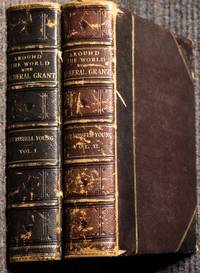
18790010432New York: American News Company 1879 . First Edition. Quarto 631 pages half brown morocco edgeworn marbled endpapers. <br/><br/>With a handsome engraved frontispiece portrait of Grant designed exclusively for this work by Wm. E. Marshall. His previous print of Lincoln drawn engraved and published by William E. Marshall was accepted as soon as it was issued accepted as the finest portrait ever done of Lincoln and in fact was claimed by a number of critics to be one of the finest engravings ever produced. With 20 other full-page illustrations by FennSchell and others with uncounted smaller cuts by A. R. Waud W. H. Gibson Thomas Moran and others there are 800 illustrations claimed for both volumes. This is ONLY VOLUME 1 of 2. American News Company unknown
1879mon0003527901AMERICAN NEWS COMPANY 1879-01-01. Leather Bound. Acceptable. . 2-volume set brown cloth with gilt rebound spines splitting and edgewear rubbing and loss. Loose bindings torn hinges repaired with cloth tape. Pages are tanned and mostly clean. AMERICAN NEWS COMPANY hardcover
187740409Ny NY: Subscription Book Department With American News Co. Very Good with no dust jacket. 1877-9. FIRST EDITION. Leather. 4to 11.5"; Solidly bound with contents fine. Text is fine with 800 illustrations. Vol II spine has faded to brown from black. 3/4 leather bound at spne and corners. Golden print on covers. One of the most popular of the 19th century books. Very discrete inked ownership of Winokur. . Subscription Book Department With American News Co hardcover
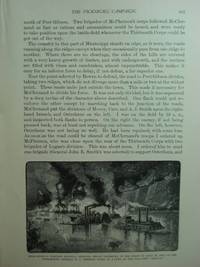
1884108418Century Company. Very Good with no dust jacket. 1884. Magazine. Battles & Leaders of the Civil War; 9 x 11; 75 pages; Very nice condition with illustrations . Century Company unknown
18642764930/12/1864. <blockquote><p>Welles had written at the President's suggestion: ""The largest naval force ever assembled is ready""</p></blockquote><blockquote><p>Fort Fisher guarded the port of Wilmington NC the last port open to blockade runners supplying Robert E. Lee’s Confederate forces in Virginia</p><p> </p></blockquote><p><img class=""alignnone wp-image-28384 size-post-window"" src=""https://cdn.raabcollection.com/wp-content/uploads/20231204120136/Grant_168-2-1-e1694097936583-1600x492.jpg"" alt="""" width=""1600"" height=""492"" /></p><p>As 1864 dawned Wilmington North Carolina protected by Fort Fisher was one of the Confederacy’s last remaining major ports on the Atlantic open to blockade runners and was the chief supply line for General Robert E. Lee’s Army of Northern Virginia. Navy Secretary Gideon Welles reintroduced the idea of a joint operation against Wilmington to the Secretary of the War Edwin Stanton but Stanton saw it as premature. After the Navy’s occupation of Mobile Bay in August all eyes turned to Wilmington. In October 1864 Wilmington finally became the next objective for a joint amphibious operation. Admiral David Porter was chosen to command the naval squadron and General Benjamin Butler the army contingent.</p><p>On December 24 the 63 ships of Porter’s fleet prepared to bombard the fort. Thirty-seven ships formed in three lines of battle end-to-end facing the enemy. Just after midday Porter commenced the Navy’s first bombardment of the fort and continued firing until it became too dark to aim the guns effectively. While the Confederate troops hid and huddled beneath the mounds of the fort this bombardment actually did little damage with the exception of the wooden quarters of the garrison which were set ablaze. Butler’s force returned too late on that first night to attempt a landing. The next morning December 25 the fleet resumed its barrage while a naval contingent sought to secure a landing area for the Union infantry north of the fort. A group of sailors was sent to take soundings south of the fort but Porter withdrew the sounding party after it became clear that the army group was making no progress north of the fort. The timely arrival of Confederate reinforcements caused Butler to question the strength of his position. He felt his forces could not take the fort without a siege for which they were unprepared. Butler immediately began to re-embark his soldiers. On December 27 he called off the expedition and directed the transports to return to Hampton Roads. The U.S. Navy had suffered 83 casualties and the U.S. Army 12. Thus the first attempt by the Union forces to close the port of Wilmington ended in failure. While Butler returned to Hampton Roads Porter remained off the coast of North Carolina dedicated to preparing another attempt to capture Fort Fisher.</p><p>Following the fall of Savannah on December 21 1864 General William T. Sherman prepared to march through the Carolinas. Knowing Sherman could soon be in North Carolina and ready to try to capture the fort again on December 25 Porter wrote to Sherman clearly expressing his frustration with Butler’s decision to abandon the joint operation. Porter was also in communication with Welles. With these communications in hand Welles spoke to President Lincoln who was all for trying again to take the fort. On December 29 Welles wrote to General U.S. Grant in overall command of the army that the President hoped that another joint operation might be forthcoming.</p><p>Welles’s telegram to Grant stated: “December 29 1864 at 9:30 pm. The substance of dispatches and reports from Rear-Admiral Porter off Wilmington is briefly this: The ships can approach nearer to the enemy’s works than was anticipated. Their fire can keep the enemy away from their guns. A landing can easily be effected upon the beach north of Fort Fisher not only of troops but all their supplies and artillery. This force can have its flanks protected by gun-boats. The navy can assist in the siege of Fort Fisher precisely as it covered the operations which resulted in the capture of Fort Wagner. The winter season is the most favorable for operations against Fort Fisher. The largest naval force ever assembled is ready to lend its co-operation. Rear-Admiral Porter will remain off Fort Fisher continuing a moderate fire to prevent new works from being erected and the ironclad have proved that they can maintain themselves in spite of bad weather. Under all these circumstances I invite to such a military co-operations as will insure the fall of Fort Fisher the importance of which has already received your careful consideration. This telegram is made at the suggestion of the President and in hopes that you will be able at this time to give the troops which heretofore were required elsewhere. If it cannot be done the fleet will have to disperse whence it cannot again be brought to this coast.â€</p><p><img class=""alignnone wp-image-28385 size-post-window"" src=""https://cdn.raabcollection.com/wp-content/uploads/20231204120124/Grant_177-1-1-e1694097999755-1600x684.jpg"" alt="""" width=""1600"" height=""684"" /></p><p>Grant responded to Welles immediately. <strong>Autograph letter signed</strong> headquarters at City Point Va. December 30 1864 to Welles. <em>“Your dispatch of 9:30 p.m. 29th received. I will advise fully with the Sec. of War about what you propose. Please call on him for information. U.S. Grant Lieut. Gen.â€</em> Thus Grant promised to inform Stanton “fully†about the plan and requested that Welles consult with Stanton to finalize it. Grant had told Stanton that he did not intend to correspond with the Navy Department except through Stanton and this letter further indicates that.</p><p>Porter had a good working relationship with Grant and a solid record of success in joint operations. Due to this Welles was able to argue successfully with Lincoln for Porter’s retention as commander. In early January Porter coordinated directly with Sherman and Grant about plans for a renewal of operations against Fort Fisher. As Sherman marched north the port of Wilmington was now more important to the U.S. Army than it had been during the first battle for Fort Fisher. Butler rightly took the blame for the first expedition’s failure. For his replacement Grant chose General Alfred Terry one of Butler’s staff officers. Grant assigned him the same troops that had participated in the first attempt augmented with an additional brigade for a total of 8000 soldiers. On January 4 1865 the second expedition to capture Fort Fisher embarked from Bermuda Landing in Virginia. On January 12 they headed for Fort Fisher. Arriving that night Porter and Terry prepared to commence their attack the next day. At dawn on January 13 8000 Federal soldiers landed above the fort as the Navy began its bombardment. Sailors were landed on the 15th and drew fire. This diversion allowed the army to breach the walls of the fort. By 10 p.m. the fort was in possession of the Federal forces. The Confederates started a retreat and when Federal infantry caught up with them General Terry accepted the formal surrender of the fort.</p><p>The first battle of Fort Fisher was the most concentrated naval bombardment of the war. The fleet fired 20271 projectiles into the fort during the first battle. Another 19682 were fired during the second battle. In total the U.S. Navy expended 39953 projectiles at the fort. After Fort Fisher’s capture Porter proceeded to put vessels over the bar and into the Cape Fear River. He declared the port of Wilmington to be “hermetically sealed against blockade runnersâ€. Five weeks after the fall of Fort Fisher the Federal army occupied the city of Wilmington. This occupation ended the trickle of supplies coming along the Wilmington and Weldon Railroad to the Army of Northern Virginia. The fall of Wilmington contributed directly to this army’s surrender at Appomattox Courthouse in April 1865.</p><p><img class=""alignnone wp-image-25018 size-post-window"" src=""https://cdn.raabcollection.com/wp-content/uploads/20231204144051/Folder-site-11-1600x1327.jpg"" alt="""" width=""1600"" height=""1327"" /></p> unknown
18852007Philadelphia: S.n. 1885. Leather over boards. Oblong duodecimo. 54 leaves. Near fine. Leather over thin board with gilt-stamped upper board. Professionally restored with about half of the original gilt-ornamented spine retained. Wesson's name card laid down on front pastedown. A fantastic and eclectic trove of 19th century autographs collected by one Edward Wesson apparently associated with the Continental Hotel in Philadelphia. The autographs range from military figures to actors and actresses singers diplomats explorers and more. <br /> <br /> Some of the most notable figures whose autographs appear here include Ulysses S. Grant Edwin Booth William Tecumseh Sherman P. T. Barnum King David KalÄkaua of Hawaii Henry Ward Beecher David Ross Locke aka 'Petroleum V. Nasby' and Hannibal Hamlin Vice-President under Abraham Lincoln. There are also autographs from survivors of the tragic Jeanette Expedition to the Arctic including John W. Danenhower Louis P. Noros William F. C. Nindemann and George W. Melville. Among the other entertainment figures of the day to sign Mr. Wesson's album were actresses Maggie Mitchell and Emma Abbott and several others. <br /> <br /> Of the 54 leaves only 5 are blank on both sides with the remaining 49 having autographs on one or both sides and one autograph on the recto of rear free endpaper for a total of 57 autographs in all.<br /> <br /> The album originated at Philadelphia's Continental Hotel one of the grandest and most socially prominent establishments of the 19th century. Opened in 1860 and famed for hosting presidents generals and celebrities-including Abraham Lincoln who stayed there en route to his 1861 inauguration-the Continental stood as a national landmark until its 1924 demolition to make way for the Benjamin Franklin Hotel.<br /> <br /> Apart from a single tipped‑in signature from a Mayor of Mt. Vernon NY every autograph in this volume is penned directly onto its original pages. This is of vital significance because unlike albums assembled from clipped signatures from various sources this is a continuous artifact: the very book that moved through the hands of each signer. To hold it now is to experience that unique connection with each of the historical figures who once inscribed it. <br /> <br /> A truly remarkable artifact. (S.n.) unknown
186936730Washington D.C. 1869. Single page entirely in ink manuscript Very Good.<br /> <br /> Randall was a Pennsylvania Democrat born in Philadelphia and a Union soldier during the War. He was Speaker of the House 1876-1881. This letter is an early unfavorable evaluation of President Grant's character only two weeks after Grant's inauguration as President. "The chief characteristic thus far developed is his vindictiveness. He must have much changed from the time when he received Lee's surrender. But we shall see the end is not yet. unknown
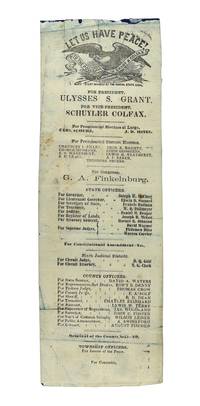
186832549Missouri: The Radical State Committee 1868. Very Good. Missouri: The Radical State Committee 1868. Printed broadside 30.5x10cm with illustrated eagle vignette to top; blue backing. Grant's campaign slogan "Let Us Have Peace" to top followed by the Radical Republicans ballot choices from President on down to the County Officers. Creasing and smudging; nicks and short tears to edges; overall Very Good and sound. <br /> <br /> The Radical Republicans pushed for the complete and permanent eradication of slavery and supported Grant in '68 and here are supporting Missouri Congressional Candidate G.A. Finkelnburg as well. Noteworthy is also the push "For Constitutional Amendment - Yes" presumably referring to the 15th Amendment the 14th was already ratified and adopted that July prohibiting states and the federal government from denying a citizen's right to vote based on race color or previous condition of servitude. A rare survival of Grant campaign ephemera and an illuminating record of the Reconstruction era's battling factions and ideals. More broadly the piece has a certain congruity given the import of the Missouri Compromise of 1820 of which Thomas Jefferson said "I considered it at once as the knell of the Union. It is hushed indeed for the moment. But this is a reprieve only not a final sentence." Not separately cataloged in OCLC. The Radical State Committee unknown
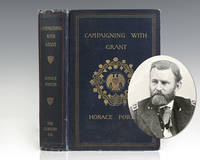
1897132638New York: The Century Co. 1897. First edition of Horace Porter's Civil War memoir. Octavo original cloth illustrated with portraits and maps. In good condition. First editions are rare. American soldier and diplomat Horace Porter served as a lieutenant colonel ordnance officer and staff officer in the Union Army during the American Civil War and personal secretary to General and President Ulysses S. Grant. He also was secretary to General William T. Sherman vice president of the Pullman Palace Car Company and U.S. Ambassador to France from 1897 to 1905. From 1869 to 1872 Porter served as President Grant's personal secretary in the White House. The Century Co. hardcover
188498463Century Company. Very Good with no dust jacket. 1884. Magazine. ; 8x11; 51 pages . Century Company unknown
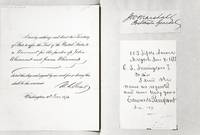
1860730631860-1891. A collection of eleven letters and documents signed and hand-written by the 18th President of the United States Ulysses S. Grant and eight members of his presidential administration. Contents include a printed warrant for the pardon of John and Jerome Whisonant who were held at the Albany Penitentiary in 1874 signed by Grant an 1860 one page autograph letter signed by Secretary of the Treasury Lot M. Morrill discussing misappropriated funds an autograph quotation in the hand of 17th Vice President Schuyler Colfax "Let this be all thy care To stand approved in sight of God Though worlds should judge thee wrong. Schuyler Colfax Feb 8. 1873" an 1865 autograph letter signed by 18th Vice President Henry Wilson to President Johnson and 1873 autograph note signed by Attorney General Edwards Pierrepont a clipped signature by Postmaster General James W. Marshall an 1875 autograph letter signed on Depart of the Interior letterhead by Secretary of the Interior Zachariah Chandler to Gent. Adam Badeau with a second clipped signature an 1867 autograph note signed by Secretary of the Treasury George S. Boutwell and an 1891 autograph letter signed by Secretary of the Treasury Benjamin Bristow. An exceptional collection. The presidential administration including the cabinet of Ulysses S. Grant was fraught with scandal and corruption following the Black Friday gold panic in 1869 scandals were discovered in seven federal departments including the Treasury Interior and State. Known to run his cabinet in an unprecedented military style Grant often pardoned whose accused and convicted of government crimes nepotism became prevalent in his appointments with over 40 family members appointed by him to the United States government throughout his two terms. unknown
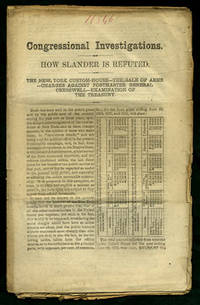
187227653n.p.: n.p. 1872. First edition. Self-wrappers. An untrimmed unopened uncut single folio leaf edges soiled fore edge with a few small tears rear leaves creased overall still about very good. 16 pp. 8vo. The Grant administration was one of the most corrupt of the 19th century with numerous investigations convened. As it prepared for the elections of 1872 and Grant's run for a second term it issued this piece of campaign literature in an attempt to refute the charges. n.p. unknown
185849829Chur 1858. Nach dem unedirten italiänischen Originalmanuskript bearbeitet mit Anmerkungen erläutert. Beigebunden: Salis-Seewis J.U.von; Gesammelte Schriften zur Bündner Geschichte Zwei Bände in einem Einband-Ecken u. Kanten berieben ansonsten in gutem Zustand Pradella 8°. Hln. marm. Raetica unknown
187420587Lausanne : G. Bridel 1874. 175x100mm. cartonnage de l'diteur. Indiquation de la date de 1875 sur la couverture. 240 G. Bridel unknown
187811145Paris: A. Picard 1878. Fine. A. Picard Paris 1878 15 x 23 cm broché First edition of this offprint printed in a small number of copies. A. Picard unknown
187423500Washington D. C.: Government Printing Office 1874. First Impression. Hardcover. In exceptionally good condition. Octavo 23.5cm/9.25 inches full embossed rose-madder cloth sans dust jacket pp. xxvii 710; xxiii 1456 indexed. Fully Illustrated with aforementioned large folded map Please feel free to inquire as to particulars and/or additional snapshots. Government Printing Office hardcover