161 résultats
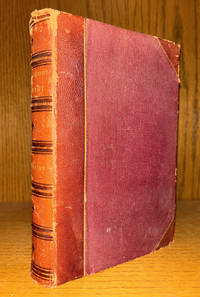
187623666Washington D. C.: Government Printing Office 1876. First Impression. Hardcover. In exceptionally good condition. Octavo 23.5cm/9.25 inches full embossed rose-madder cloth sans dust jacket pp. lvi 648 indexed. Please Feel free to inquire as to particulars and/or additional snapshots. Government Printing Office hardcover
183361260Lausanne : Marc Ducloux 1833. 220x140mm. XV- brochÂŽ. IntÂŽrieurs propre. Couvertures ab”mÂŽes. Dos ab”mÂŽs fortement sur seconde livraison. Manque ÂŽgalement la quatriÂme de couverture de la seconde livraison. Cahier des pages 105-126 se dÂŽtache. Une nouvelle reliure serait souhaitable. 430 Marc Ducloux unknown
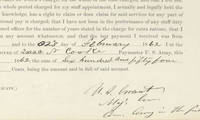
1862806901/03/1862. <blockquote><p>In it he also pays for his servants 3 of whom were black; An extreme rarity the first such document we can find having reached the market in a quarter century</p></blockquote><p>The battle of Fort Henry in Tennessee took place on February 6 1862 and an obscure and virtually unknown brigadier general named Ulysses S. Grant captured the fort and opened the Tennessee River to Union movements. This early in the war Union victories of any kind were scarce and this one was probably the most consequential of the war to date. Grant then moved directly on Fort Donelson entrapping the place both by land and sea from February 11-16. On the morning of February 15 the Confederate commander Simon B. Buckner sent a note to Grant requesting an armistice and asking terms of surrender. Buckner was expecting to give up the fort but get his soldiers paroled so they would not be prisoners of war. Grant refused to give terms but demanded unconditional surrender. The Confederates surrendered the next day the 16th. This victory opened the Cumberland River an important avenue for the invasion of the South to Union operations and Grant became instantly famous earning the nickname ""Unconditional Surrender"" Grant. President Lincoln took note of the fact that in Grant he had a general who could win. On February 20 1862 Lincoln promoted Grant to the rank of Major General a prerequisite to Grant's being able to command a large army.</p><p>However Grant’s very successes at Forts Henry and Donelson incurred the jealousy of his superior Gen. Henry Halleck who was in command of the whole Western Theater of war. Grant not yet realizing the peril Halleck's opposition placed him in knew Nashville was wide open with little in the way of defensive forces. Though Halleck had expressly forbade him to advance Grant ordered Union forces to enter Nashville. It fell on February 25 with Gen. Don Carlos Buell accepting the city's surrender. Nashville thus became the first Confederate state capital to fall into Union hands. Over the next week thousands of Union soldiers poured into the city and Grant took a boat upriver from Donelson to Nashville to confer with Buell. Halleck saw the taking of Nashville not as Grant recognizing and seizing an important opportunity but as willful disobedience of an order. And Grant's unauthorized trip to see Buell there only added to Halleck's anger.</p><p><img class=""alignnone wp-image-32063 size-post-window"" src=""https://cdn.raabcollection.com/wp-content/uploads/20240907140939/Grant-March-1-1862-1-1-1600x348.jpg"" alt="""" width=""1600"" height=""348"" /></p><p>So on March 1 1862 Halleck decided to tie Grant's hands by ordering him to return to Fort Henry and from there to launch an expedition up the Tennessee River to the state of Mississippi. The objective was the destruction of several key railroad bridges. Grant was to “avoid any general engagement with strong forces†and was told that it was “better to retreat than to risk a general battle.†Grant went to Fort Henry as ordered but did not communicate with Halleck directly. The next day Halleck complained to Gen. McClellan that he had heard no word from Grant for a week and that “his army seems to be as much demoralized by the victory of Fort Donelson as was that of the Potomac by the defeat of Bull Run.†On March 4 Halleck relieved Grant from his command writing him: “You will place Maj. Gen. C. F. Smith in command of expedition and remain yourself at Fort Henry.†Grant was shocked. “Thus"" say Grant's Memoirs ""in less than two weeks after the victory at Donelson the two leading generals Halleck and McClellan in the army were in correspondence as to what disposition should be made of me and in less than three weeks I was virtually in arrest and without a command.â€</p><p>Grant turned over command to Smith on March 5. Even as he did so he felt intensely frustrated and longed for action writing on the same day “I have not been well for the last ten days and don’t see that I will be much better until I can get to moving again.†Grant and Halleck exchanged letters after which Grant on March 11 demanded that Halleck relieve him from duty altogether in order to clear his name. ""There is such a disposition to find fault with me that I again ask to be relieved from further duty until I can be placed right in the estimation of those higher in authority.""</p><p>Perhaps this letter caused a change of mind or it may be that Halleck just could not risk loss of the popular Grant altogether. In any event surprisingly he refused and instead told Grant he would receive a new command writing him ""You cannot be relieved from your command. There is no good reason for it…Instead of relieving you I wish you as soon as your new army is in the field to assume the immediate command and lead it on to new victories."" Just four days later Grant was actually given a new command - he was placed in charge of Union forces in Tennessee. He proceeded to Pittsburg Landing Tennessee and arriving on the 17th established a wide camp with his forward units around Shiloh Church some 2.5 miles south of Pittsburg Landing. He wrote ""I at once put all the troops at Savannah in motion for Pittsburg Landing knowing that the enemy was fortifying at Corinth and collecting an army there under Johnston. It was my expectation to march against that army as soon as Buell who had been ordered to reinforce me with the Army of the Ohio should arrive; and the west bank of the river was the place to start from. Pittsburg is only about twenty miles from Corinth…When all reinforcements should have arrived I expected to take the initiative by marching on Corinth and had no expectation of needing fortifications though this subject was taken into consideration."" He reported to Halleck on his troop dispositions and imminently awaited reinforcements so he could move against Corinth. Halleck meanwhile continued to nitpick at Grant for supposed failure to discipline his troops properly.<br />The month of March was a significant one in Grant's career one that saw the tables turn twice on him. First in the flush of his great successes at Forts Henry and Donelson he was victimized by jealousy and relieved of command. Then when all seemed lost he was given an even greater command. And as he assumed that command and awaited reinforcements so he would move on Corinth he was unwittingly actually preparing for the Battle of Shiloh one of the most fateful of the war.</p><p><img class=""alignnone wp-image-32064 size-post-window"" src=""https://cdn.raabcollection.com/wp-content/uploads/20240907141021/Grant-March-1-1862-2-1600x657.jpg"" alt="""" width=""1600"" height=""657"" /></p><p><strong>Document signed</strong> Pittsburg Landing Tenn. April 2 1862 being a voucher for his own pay and expenses and those of his four private servants for the period from March 1 to March 31 1862. His pay was $220 per month and he received $52 per month for the pay of his servants. Forage for his seven horses came to $56 for the month. He received $10 per month as a clothing allowance and he was entitled to <em>""double rations for commanding army in the field""</em> which came to over 1000 rations for the month. The rations called ""<em>subsistence</em>"" cost $316.20. At the end the document recites that Grant has received a total of $654.20 from the paymaster and he has signed <em>""U.S. Grant Maj. Gen. Commanding Army in the field."" </em>Interestingly Grant's four servants are named and their skin color height and eye and hair color given. Frank was white; and Dan Jim and Sam were black. The voucher is docketed on the verso.</p><p>This is the first signed voucher for Grant's pay during the Civil War that we have seen. Research in public records going back 40 years discloses one previous monthly voucher having reach the market and that was a quarter century ago.</p><p>On April 6 1862 just four days after signing this document the Confederates commenced the Battle of Shiloh by bursting through Union lines and threatening to drive Grant's men back into the Tennessee River. Historians differ on whether Grant was at fault in being surprised but it is clear that Union forces only escaped being routed with the arrival of Buell's army. The next day the Union recaptured the initiative and drove the Confederates back in disorder. The battle was essentially a draw while also being the bloodiest battle yet to occur on the American continent. When the news reached the North where expectations had been high a storm of abuse broke out against Grant who was held responsible. He may well have not deserved the blame but he admitted reassessing the war after Shiloh. He wrote “Up to the battle of Shiloh I as well as thousands of other citizens believed that the rebellion against the Government would collapse suddenly and soon if a decisive victory could be gained over any of its armies. Donelson and Henry were such victories.But when Confederate armies were collected which not only attempted to hold a line farther south.but assumed the offensive and made such a gallant effort to regain what had been lost then indeed I gave up all idea of saving the Union except by complete conquest.â€</p><p><img class=""alignnone wp-image-25018 size-post-window"" src=""https://cdn.raabcollection.com/wp-content/uploads/20231204144051/Folder-site-11-1600x1327.jpg"" alt="""" width=""1600"" height=""1327"" /></p> hardcover
1887001282Boston Massachusetts: Cupples Upham & Co 1887. Light soil to covers and a touch of rubbing at the extremities. Pages show a thin strip of light damp stain at the bottom edge only less than 1/4 inch - text is not affected else Very Good condition. No owner's name or bookplate. No underlining. No highlighting. No margin notes. This 1887 first edition is not in Broadfoot. . First Edition. Hardcover. Original green cloth gilt/No dust jacket. 66pp. 37 page publisher's catalog. Cupples, Upham & Co Hardcover
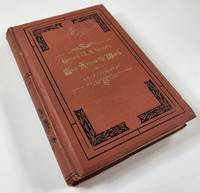
1879047975Hartford CT: James Betts & Co. 1879. First edition 1879. Attractive Victorian binding in brick red cloth over beveled boards gilt lettering decoration in black frontis portrait of Grant 350 pages. Modest wear to corners and spine ends smudge on front cover from what looks like removal of a price sticker good hinges firm text block a little foxing to the top of the frontis portrait and title page lightly age-toned but clean pages no names or other markings. First Edition. Hard Cover. Very Good. 8vo - over 7¾" - 9¾" tall. James Betts & Co. Hardcover
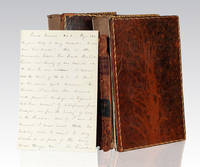
1885145720New York: Charles L. Webster & Company 1885-86. Exceedingly rare first edition of the autobiography of Ulysses S. Grant the 18th President of the United States which focusing mainly on his military career during the Mexican War and the Civil War entirely singular owned and annotated by Grant's close friend and most esteemed general: William Tecumseh Sherman. Octavo 2 volumes bound in the original full deluxe tree calf with gilt titles and elegant tooling to the spine gilt ruled borders to the front and rear panels gilt inner dentelles all edges gilt engraved portrait frontispieces illustrated with numerous facsimile letters 2 folding maps and wood engravings. William Tecumseh Sherman evidently read thes volumes in great detail making marginal notes on at least 18 pages in Vol. I several of them signed with his initials. On the last page of Vol. I Sherman wrote: "Read at St. Louis Mo. Dec 5 6 1885. This account of the Civil War is wonderfully accurate and him. W.T.S." Many of the notes are small corrections and additions by Sherman. On a passage regarding the Yazoo Pass Expedition on page 435 of Vol. I Sherman pointedly writes: "This conforms literally to my memoirs on the point most contested by Grant's pretended friends. W.T.S." He provides further thoughts regarding political interference on the next page: "If Grant had gone ahead living off the country we would have been inside of Vicksburg by Christmas 1862 the distance from Grenada to Vicksburg is little more than the circuit we afterward made from Bruinsberg via Jackson to Vicksburg --- This was my understanding when we parted at Oxford and the intervening country was better supplied with hay hominy. W.T.S." On p. 440-441 Grant wrote about the need to assign politically-connected John McClernand as Corps Commander: "I would have been glad to put Sherman in command to give him an opportunity to accomplish what he had failed in the December before; but there seemed no other way out of he difficulty for he was junior to McClernand. Sherman's failure needs no apology." In the margins Sherman's distinctive hand writes passionately: "because it was no failure at all." There is only one marginal annotation in Vol. II; however an autograph note is laid in at p. 123 supplying Sherman's recollection of Grant's first meeting with Lincoln which corroborates Grant's account. While Sherman was not present at the meeting between Grant and Lincoln he almost certainly heard about what transpired from Grant himself. The note reads in full: "Grants Memoirs Vol 2 Page 123 A good story is very correct. 'Si non vero ben trovalo.' Even if it is not true it is well conceived. This is the conversation between Genl. Grant President Lincoln and Secretary of War Stanton at the time he was addressed to command all the Armies of the U.S. Grant said in his usual quiet manner 'Mr. Lincoln I am told that several well planned campaigns in Virginia have been marred by interference from Washington viz from the Secretary of War or the President now if I am to command I must insist that no military order be issued to any detachment or part of the Army except through me' Mr. Lincoln in his inimitable way turning to Stanton said 'Stanton you and I have been running this machine for two years and have not made a brilliant success. I guess we had better trust this little man' Grant and then then and there the promise was made. And it is to the credit of Mr. Lincoln to say that he kept his word literally never interfering or making any order even when Washington was in real peril from Early's Army in 1865." Grant's insistence that there would be no political interference was likely particularly important to General Sherman who famously hated politicians. In good condition with detaching of the front boards and spines of each volume detaching of the rear board and separation of the folding facsimile letter at p. 312-313. Copies bound in highly polished gilt tree calf are extremely rare with only three other copies known. The first prospectus of Grant's Memoirs listed only 4 bindings: fine cloth full sheep fine half morocco and full Turkey morocco. The only other copy of Grant's Memoirs bound in tree calf was sold at auction - a copy presented to Mark Twain by Julia Grant and inscribed by both. Only two other known copies are located in private collections. To date no copies bound in the tree calf have been traced to institutional collections. As Grant died before publication was complete the only copy that he saw before his death was a prospectus bound in cloth; the extant tree calf copies suggest that the binding was perhaps reserved exclusively for presentations made by Julia Grant. Even the copies presented by publisher Mark Twain to his friends and colleagues were bound in one of the other available bindings. Though this copy bears no presentation inscription by Julia Grant Mark Twain or anyone else it is plausible that one of these figures would have sent the copy directly to General Sherman. After his second presidential term and world tour President Grant was stripped of nearly all of his life's earnings by conman Ferdinand Ward. Grant had forfeited his and his widow's military pension when he resigned as general to assume the presidency and his recent throat cancer diagnosis brought him deep concern about how his wife and family would manage financially after his death. In this moment of crisis Sherman rushed to Grant's aid and assisted him in restructuring his debt ensuring that Grant was able to keep his most prized possesions. Most importantly Sherman also encouraged Grant to do what he should have done years ago - write his memoirs. By June 1884 Grant had begun publishing articles on his major engagements of the Civil War for 'Century Magazine' which paid him $500 for each submission. The articles were received with great enthusiasm and Grant met with the magazine's representatives in early September to arrange for the publication of his memoirs. However when Samuel Clemens popularly Mark Twain learned of the potential arrangement with 'Century Magazine' he convinced Grant to sign with his own subscription publishing company which was able to offer Grant 70% of the net profit made from the sale of his memoirs. This rate was exorbitantly higher than what 'Century Magazine' had proposed. Grant began writing his memoirs in earnest racing against the illness to finish and ensure his family's financial stability. During this time Grant welcomed Sherman's repeated visits. On December 24 1884 Sherman wrote to his wife Ellen: "Grant says my visits have done him more good than all the doctors" Flood p.395. Grant with the moral support of Sherman lived to finish the memoir dying five days after its completion. Widely considered the finest military narrative ever published the memoirs were a national bestseller and Grant's widow Julia would eventually receive nearly $450000 about ~$14000000 today in royalties from their sale. Charles L. Webster & Company hardcover
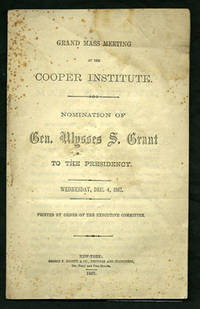
186727894New York: Printed by Order of the Executive Committee George F. Nesbitt & Co. Printers 1867. First edition. Stitched. Title paged foxed at the edges dampstain to upper front corner; a good copy. 40 pp. 8vo. They were all there Astor to Vanderbilt to give the Republican nomination to Grant. Printed by Order of the Executive Committee, George F. Nesbitt & Co., Printers unknown
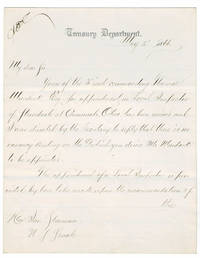
186698961<p>Washington D.C. May 5 1866. 1866. Very good. - Over 85 words penned in a secretarial hand on 2 pages of a 9-7/8 inch high by 7-3/4 inch wide "Treasury Department" stationery with an integral attached leaf. Hartley replies to Senator John Sherman of Ohio who has recommended Thomas Murdock Esq. for the position of Local Inspector of Steamboats at Cincinnati Ohio that "there is no vacancy in the District you desire Mr. Murdock to be appointed." Signed "John F. Hartley" as Assistant Secretary of the Treasury. Folded for mailing the document is docketed by Senator Sherman on the verso. There is a stain from a seal at the top inner corner of the integral leaf with a very small chip. Very good.</p><p>John F. Hartley 1809-1897 served as Assistant Secretary of the Treasury from 1865 to 1875 under Presidents Andrew Johnson and Ulysses S. Grant.</p> [Washington, D.C.], May 5, 1866.
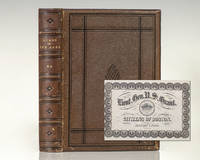
1865138284Boston: Ticknor and Fields 1865. First edition of the second series of Hymns of the Ages from the library of Ulysses S. Grant. Octavo bound in full pebbled morocco with gilt titles and tooling to the spine in six compartments within raised bands gilt turn-ins and inner dentelles all edges gilt marbled endpapers tissue-guarded frontispiece. From the library of Ulysses S. Grant with a presentation bookplate to the pastedown which reads “Lieut. Gen. U. S. Grant from the Citizens of Boston January 1 1866.†In very good condition. Rare and desirable. Ulysses S. Grant was the 18th President of the United States 1869–77. As Commanding General of the United States Army 1864–69 Grant worked closely with President Abraham Lincoln to lead the Union Army to victory over the Confederacy in the Civil War. He implemented Congressional Reconstruction often at odds with Lincoln's successor Andrew Johnson. Twice elected president Grant led the Republicans in their effort to remove the vestiges of Confederate nationalism and slavery protect African-American citizenship and supported unbridled nationwide industrial expansionism during the Gilded Age. Ticknor and Fields hardcover
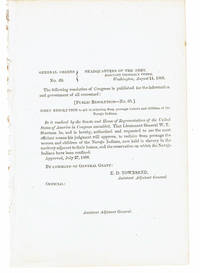
186895962Washington D.C. August 14 1868. 1868. Very good. - A 7-1/4 inches high by 4-5/8 inches wide broadsheet General Order issued as a "resolution of Congress" authorizing Lieutenant General W.T. Sherman "to use the most efficient means his judgment will approve to reclaim from peonage the women and children of the Navajo Indians now held in slavery in the territory adjacent to their homes and the reservation on which the Navajo Indians have been confined." The resolution adapted by Congress on July 27 1868 was distributed as a general order by "Command of General Grant" and signed in print by E.D. Townsend as Assistant Adjutant General. Removed from a bound collection in the distant past the broadsheet is lightly chipped with stab marks along the left edge. Very good. <p>Throughout the American Southwest and in this case New Mexico Spanish settlers and their ancestors pursued a flourishing slave trade from the 16th though the 19th centuries. Captive Native Americans who became known as "Genizaros" were sold as slaves to Hispanic families. This practice went on even after the United States came to govern New Mexico. Having abolished slavery through the 13th Amendment in 1865 Congress then passed the "Peonage Act" in 1867 when it became known that New Mexicans still owned hundreds maybe thousands of these "Genizaros" consisting mostly of Navajo women and children.<p>RARE. Washington, D.C., August 14, 1868. unknown
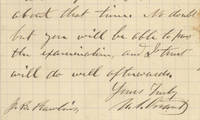
18752440305/06/1875. <blockquote><p>An uncommon handwritten letter as President showing Grant supporting Rawlins son after the General's death</p></blockquote><p>Ulysses S. Grant met John Rawlins in Galena Ill. where they both lived before the Civil War. Rawlins was a lawyer who did work for the Grant family business and the two men became close. When Grant was appointed brigadier general in August 1861 he immediately added Rawlins onto his staff as adjutant; Rawlins effectively acted as Grant’s chief of staff for the rest of the war. Rawlins rose to the rank of brevet major general by war’s end and during the conflict was Grant's chief defender. General James Harrison Wilson said of him ""John A. Rawlins all things considered was the most remarkable man I met during the Civil War…"" That is a remarkable statement from one who served under McClellan and Grant and was a cavalry leader in his own right. Some historians believe that without Rawlins Grant would not have soared to the heights he achieved in the war. He was appointed Secretary of War when Grant was elected President of the United States. He died in September 1869.</p><p>After Rawlins death Grant became guardian of his three children. Rawlins had a son James Rawlins who sought to follow his father's military footsteps deciding to go West Point where Grant himself had gone. Of the 39 West Point cadets who graduated in 1843 along with Grant four died in the Mexican-American War 15 became Union generals during the Civil War and 3 served as Confederate generals during the war. Ironically all three Confederate generals from the class of 1843 were from northern states. Young Rawlins entered the Military Academy.</p><p>On May 29 1875 Grant announced he would not run for a 3rd term a momentous announcement at the time.</p><p><strong>Autograph letter signed</strong> Long Branch NJ June 5 1875 to James Rawlins. <em>""Dear Jimmie Your letter of the 3rd instant was received yesterday. If I can go to West Point at all it will be about the 16th of this month. I do not know when your examination takes place but I think about that time. No doubt you will be able to pass the examination and I trust will do well afterwards.â€</em></p><p>Whether or not he passed the examination Rawlins decided on a different career path. Grant got him a job working for former New York governor Edwin Morgan.</p><p><img class=""alignnone wp-image-23729 size-post-window"" src=""https://cdn.raabcollection.com/wp-content/uploads/20231204152429/Folder-site-7-1600x1327.jpg"" alt="""" width=""1600"" height=""1327"" /></p> unknown
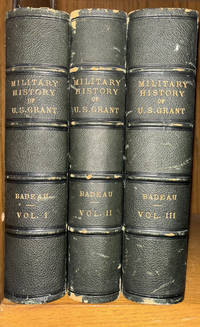
1881261Grant3<p><strong>MILITARY HISTORY OF ULYSSES GRANT. </strong></p><p><strong>FIRST EDITION. </strong></p><p><strong>PRINTED IN 1881.</strong></p><p><br /><br /></p><p><strong>Complete with all fold out maps in the rear pockets. </strong></p><p><br /><br /></p><p><strong>Complete in 3 massive volumes. </strong></p><p><strong>10 inches tall. </strong></p><p><br /><br /><br /></p><p><strong>These are the original leather bindings. </strong></p><p><br /><br /><br /><br /></p><p><strong>This set precedes his personal memoirs that were not published until 1885. </strong></p><p><strong>Hinges are all fully attached and sound. Set has some light external shelf rubs and abrasions. Early name on second blank end paper. Some light generalized usage wear. Maps may have some minor splits as is to be expected. In remarkable and highly presentable condition. Leather still supple. These would make an excellent gift or addition to any fine library. </strong></p><p><br /><br /></p><p>Military History of Ulysses S. Grant from April 1861 to April 1865 Leathe - Printed in 1881</p><p>by Badeau Adam</p><p>New York: D. Appleton and Company 1881. First edition as a complete set; First edition. Original bindings. Very Good or better. 3 vol. Large 8vo. 3 iv-xiii 3 1-683 1 4 pages of publisher's advertisements; 3 iv-x 3 2-591 1 2 pages of publisher's advertisements 2; 3 iv-ix 4 2-733 1 1-4 2 pages of publisher's advertisements pp. Half pebbled green leather over marbled paper boards spines lettered in gilt; all edges marbled. Marbled endpapers and pastedowns.</p><p>Volume one illustrated with a frontispiece and with 18 maps most of which are folding at the end of the volume with an additional map in the rear pastedown pocket of volume one.</p><p>Volume two illustrated with seven maps most of which are folding at the end of the volume and with one map in the rear pastedown pocket.</p><p>Volume three illustrated with eight maps most of which are folding and with three maps in the rear pastedown pocket.</p><p>Dornbusch 1994. Nevins I 22. Nicholson 51. Nevins lists this set as 1885 but each of our set's title pages states 1881. The true first edition of volume one was published independently in 1868. The first editions of volumes two and three were published in 1881. Our volumes two and three are first editions our volume one is the true first as a collected set and was published in 1881 uniformly with volumes two and three. Badeau worked for Grant as a military aide. Some rubbing to the boards' corners and to the leather else a lovely set. Highly worthy of gifting.</p><p><br /><br /><br /></p><p><strong>Each book will be individually wrapped and well protected for shipping. </strong></p><p><br /><br /><br /><br /><br /></p><p>26.1.i</p>
1885261Grant1<p><strong>The Personal History of Ulysses Grant. </strong></p><p><strong>Complete in one volume. </strong></p><p><strong>Printed in 1885. </strong></p><p><strong>First Edition. </strong></p><p><br /><br /><br /></p><p><strong>Bound in leather. </strong></p><p><strong>The original binding. </strong></p><p><strong>Printed on quality paper. </strong></p><p><br /><br /><br /></p><p>This is not Grant's Personal Memoirs.</p><p>This is not the more common 'shoulder strap series' two volume autobiography 'Personal Memoirs of U. S. Grant'.</p><p>That is a different work.</p><p>This is the work authored by A. Richardson.</p><p>This is complete in one volume.</p><p>This is a first edition on U. S. Grant.</p><p>If you are looking for Grant's self published Personal Memoirs this is not that set.</p><p><br /><br /><br /></p><p>Condition:</p><p><strong>Book has generalized usage wear. External wear as shown. Hinges strong but abraded as shown. External abrasions. Front pages are detached including the title page. As shown in the pictures. Rear marbled end paper is split in two as shown. This may be bothersome. Printed on quality paper. Book is good only and consistent with that book grade. External abrasion. Title page and front few pages are detached. Rear marbled end paper is torn in two pieces. Good only. </strong></p><p>Front pages are detached including the title page. As shown in the pictures.</p><p>Rear marbled end paper is split in two as shown in the pictures.</p><p><br /><br /></p><p><strong>This book will be well protected for shipping.</strong></p><p>26.1.i</p>
188110327Vienne Vienna: E.J. Savigné 1881. Fine. E.J. Savigné Vienne Vienna 1881 16 x 24.50 cm broché First edition printed on fine paper in a very small number and established from the manuscripts of Grenoble Montpellier & Vienna. Front board marginally sunned three tiny marginal lacks affecting the boards gift inscription handsome interior condition. E.J. Savigné hardcover
186568569Paris : A. Faure 1865. 180x120mm. XLIII - reliure demi-basane. Plats papier marbr. Auteur titre et filets dors au dos. Bon tat. 380 A. Faure unknown
1897CM11309Paris: Librairie de Firmin Didot 1897. Produced by the Societe des Anciens Textes; Brick cloth gilt spine title gilt cover vignette for the Society only top edge trimmed blue endpaper/pastedown & printed on lovely paper; A good ex library copy; 426 pages including Glossaire Errata & 3 pages of titles in this series. Size: 5.5"x8.75". Hardcover. Librairie de Firmin Didot Hardcover
1897190144Paris: Librairie De Firmin Didot. Very Good. 1897. Hardcover. Librairie De Firmin Didot hardcover
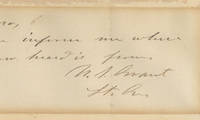
1864334181864. <blockquote><p>This letter has been for several generations in a private collection and is unpublished</p></blockquote><p>In January 1864 General Ambrose E. Burnside was asked to reorganize the IX Corps. He asked for and was granted permission by Secretary of War Edwin Stanton to form a division of “colored troops.†The 4th Division of the IX Corps infantry would be all black troops commanded by General Edward Ferrero.</p><p>The regiments were divided into two brigades; the first brigade was made up by the 27th 30th 39th and 43rd USCT. The second brigade was the 30th Connecticut Colored Infantry only 4 companies formed then consolidated into 31st USCT 19th 23rd 31st USCT. The 28th and 29th USCT regiments would be added to the second brigade. These regiments came from all across the North.</p><p>When the 4th Division of the IX Corps left Camp Stanton in Annapolis Maryland they were paraded in front of President Abraham Lincoln and General Burnside in Washington DC. The 23rd joined the division when the men marched across the bridge into Virginia.</p><p>In March 1864 Ulysses S. Grant was appointed by President Abraham Lincoln commander of the Union Armies. Grant developed a strategy to defeat the Confederacy by placing his army between the rebel capital of Richmond and Gen. Robert E. Lee’s Army of Northern Virginia. Grant moved southeast to try to create a wedge between Lee and Richmond but Lee's army successfully followed up the engagements by foiling that maneuver. Then Grant's assaults at Cold Harbor his most mistaken plan of the war and the one he most regretted resulted in a sharp defeat. Grant thus found that he was unable to take Richmond directly.</p><p>Next Grant focused on Petersburg due south of Richmond.</p><p>If Grant could take Petersburg then the Confederates would have to abandon Richmond. Grant's attempt to take it quickly failed so by mid-June 1864 Lee ended up in Petersburg with the Appomattox River protecting his back and surrounding the city below the river he built two lines of works that covered the entire area. Grant would besiege Petersburg and the IX corps played a part under General Ferrero.</p><p>The 23rd USCT became the first colored troops to fight in “directed combat†against Lee’s Army of Northern Virginia. The skirmish was fought at the intersection of Catharpin and Old Plank Roads originally Orange Plank Road on May 15 1864. The 23rd was at the Chancellorsville ruins when the Union 2nd Ohio Cavalry was chased by General Thomas Rosser’s Confederate Cavalry Brigade. The 2nd asked for assistance and the only soldiers nearby were General Edward Ferrero’s colored division. The 23rd USCT “double quicked†the two miles to the intersection and drove back Rosser’s cavalry as ordered by General Ferrero. The black soldiers were cheered by the 2nd Ohio who now gave chase to Rosser’s cavalry. This battle action proved to the white troops that black soldiers would fight against the Confederate army.</p><p>With the end of that campaign Grant ended up besieging the city and his Army of the Potomac built works from the river northeast of Petersburg down to south of the city as far as they could go. The Confederates controlled all the ground from Grant’s southern tip west up to the river. Grant’s main objective during the ten-month Siege of Petersburg was to extend his lines south and west to cut Lee’s railroad links and encircle him at the same time. Lee’s problem was that he was stuck in Petersburg and every Union successful extension west forced him to extend his lines. And every time he had to extend those lines became thinner.</p><p>In mid June as Grant prepared for his long assault on Petersburg Ferrero's black soldiers were now placed in the trenches with the other three divisions. The part of the line occupied by the IX Corps was very near the enemy's works and an incessant firing was kept up during the siege resulting in a daily loss of men killed or wounded. While there was a comparative quiet in front of the other corps positions the men of the IX Corps were subjected to the terrible strain of a constant watchfulness and deadly exposure. The enemy seemed to be excited to an undue activity by the presence of Ferrero's Colored Division.</p><p>In late July 1864 during the Battle of the Crater Ferrero's men had been trained for the attack on the Confederate line. However due to a last minute change by General George G. Meade the black soldiers were the last to enter the battle instead of the first. The three white divisions of the IX Corps did not follow General Burnside’s plan and delayed the attack. By the time the colored troops entered the battle the Confederates were ready to counterattack. Before being driven into the Crater the black troops advanced further than the white troops. The Confederate counterattack was a furious attack that won the day for the Confederate army. The black troops sustained the worst casualties. Ferrero initially accused of dereliction in this duty was cleared.</p><p><strong>Autograph letter signed</strong> no date but during the early siege perhaps mid to late June 1864 to General Ferrero. <em>""General Ferrero please inform me where the firing now heard is from.""</em></p><p>This letter has been for several generations in a private collection and is unpublished. We are not aware of another letter of Grant to Ferrero.</p><p><img class=""alignnone wp-image-25018 size-post-window"" src=""https://cdn.raabcollection.com/wp-content/uploads/20231204144051/Folder-site-11-1600x1327.jpg"" alt="""" width=""1600"" height=""1327"" /></p> unknown
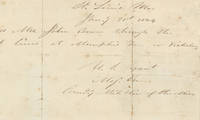
18643548131/01/1864. <blockquote><p>Written by Grant while on a visit to his family in St. Louis as he awaited his promotion to Lieutenant General</p></blockquote><p>His great victory at the Battle of Chattanooga in November 1863 made Major General Ulysses S. Grant the most prominent Union general. Soon legislation would be introduced in Congress to revive the rank of Lieutenant General—previously held only by George Washington and Winfield Scott—specifically to give Grant command of all Union armies. This Congress did on February 29 1864 and Grant would officially receive this promotion and the role of General-in-Chief on March 10.</p><p>In January 1864 Grant fresh from his victories in the West was still serving as the commander of the Military Division of the Mississippi overseeing Union operations in the Western Theater of the war. His activities that month focused on administrative and inspection tours of Kentucky and Tennessee and assessing supply lines. Finding the Cumberland Gap route for supplies unfeasible due to terrible road conditions he favored using the Nashville & Stevenson Railroad and the Tennessee River instead. More importantly he also concentrated on planning for the crucial 1864 spring campaign and the development of a grand strategy for the war. In a letter of January 19 to Gen. Henry Halleck demonstrating his proactive approach to ending the war Grant suggested a bold plan to invade North Carolina from New Bern to cut Confederate supply lines through Wilmington and capture Raleigh. Amidst all these activities Grant also took time to join his family in St. Louis for a short trip from January 27-February 3.</p><p><img class=""alignnone wp-image-35510 size-post-window"" src=""https://cdn.raabcollection.com/wp-content/uploads/20260125192231/Grant-Jan-31-1864-1-1600x664.jpg"" alt="""" width=""1600"" height=""664"" /></p><p>After his promotion Grant's subsequent strategy implemented from the field with the Army of the Potomac focused on simultaneous relentless pressure on Confederate forces leading to eventual victory.</p><p>Mrs. Bowen was the wife of Confederate general John Bowen a fine military commander who battled Grant and his armies in the final defense of Vicksburg. Bowen would die of disease just as the battle concluded in 1863. The Bowens were from St. Louis and when Gen. Bowen first left St. Louis to enter the war his wife Mary was by his side leaving their two young children at the family home to be cared for by Mary's mother. It is known that Mrs. Bowen passed through the lines after her husband’s demise and her passing back and forth to St. Louis and her access to Grant suggest this pass was almost certainly. for her.</p><p><strong>Autograph document signed</strong> St. Louis Mo. January 31 1864. <em>“Pass Mrs. John Bowen through the Federal lines at Memphis Tenn. or Vicksburg Miss.â€</em> It is signed <em>“U.S. Grant Maj. Gen. commanding Mil. Div. of the Miss.â€</em> Grant was known to be helpful to southern women so this would be consistent with his practice. This must be one of the few papers Grant signed while on the brief visit to his family.</p><p><img class=""alignnone wp-image-25018 size-post-window"" src=""https://cdn.raabcollection.com/wp-content/uploads/20231204144051/Folder-site-11-1600x1327.jpg"" alt="""" width=""1600"" height=""1327"" /></p> unknown
1876375056Washington D.C. 1876. 44th Congress 1st session Senate Ex. Doc. No. 81. 6pp. 8vo. Modern morocco backed marbled paper boards. 44th Congress 1st session Senate Ex. Doc. No. 81. 6pp. 8vo. Forwarding a report by General Terry this government document was the first official account Custer's defeat at the Little Big Horn. unknown
187610470Washington: Government Printing Office 1876. Hard Cover. Good binding. Octavo. 815 pp. First edition. In publisher cloth. Edgeworn with closed tear to the top of the spine; staining and discoloration to to the rear board as well as to the textblock edges; minor silverfishing to the front pastedown; contents evenly toned throughout. <br /> <br /> A fairly uncommon volume with General Alfred Terry's report of General Custer's defeat at the the Battle of Little Bighorn. Also reprinted is Major Marcus Reno's report. Both reports offer details related to the movement prior to the engagement information on which companies were involved and the losses. A larger than life individual Custer's mystique has been complicated and controversial in relation to the United States government's policies and actions related to the indigenous Americans throughout the 19th century. Government Printing Office unknown
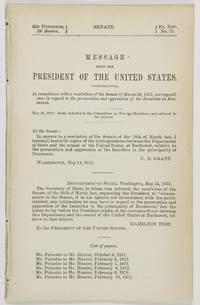
187255322Washington D.C.: United States Government Printing Office 1872. First edition. Softcover. vg. Octavo. 14pp. No wrappers with printed text starting on the first page.<br /> <br /> The printed text date May 14th 1872 relays an official Executive Communication from U.S President Ulysses S. Grant granting the United States Senate's Committee on Foreign Relations' previous request for information concerning the ongoing persecution of Jews in Romania and authorizing the transfer of said information from the U.S. State Department. The information here remitted to the Senate consists of a series of 14 pieces of correspondence dated October 6th 1871 - May 13th 1872 between the then U.S Consul to Romania Benjamin F. Piexotto 1834-1890 Second Assistant Secretary of State William Hunter Jr. 1805-1886 and U.S Secretary of State Hamilton Fish 1808-1893. The initial sections include the President's order the Secretary of State's introductory statement and a full list of correspondences included in chronological order.<br /> <br /> In the 1860s and 70s - following newly established autonomy from the Ottoman empire the unification of the Principalities of Moldavia and Wallachia and the ascendancy of the newly elected Prince Domnitor Alexandru Ioan Cuza - Romania saw a new extreme wave of anti-Semitic measures laws and attitudes. At the prompting of their respective Jewish citizens a number of countries in the international community voiced their opposition to these developments and sought to put pressure on the new Romanian government. In 1870 the United States entered the fray with the appointment of Jewish-American lawyer Benjamin F. Piexotto 1834-1890 as the new American consul in Bucharest. <br /> <br /> Piexotto served in Romania from 1871-1876 and was able to improve the conditions for Romania Jews during his tenure. He promoted the ideas of the Haskalah The Jewish Enlightenment and modernization to the community and among his numerous endeavors was responsible for improvements in modern Jewish education through the establishment of the Society for the culture of the Israelites in Roumania Societate Pentra Cultura Israelit Romania. Piexotto also funded the Roumänische Post in an effort to combat anti-Semitism in the Romanian Press. Ultimately his efforts are credited for strengthening Jewish community structures in the country and ultimately laying the groundwork for eventual Jewish emancipation as allowed for in the provisions of the 1878 Treaty of Berlin. <br /> <br /> Minor age toning and smudges to pages throughout. In overall very good condition. Protected in modern mylar. Full title: Message from the President of the United States Communicating In compliance with a resolution of the Senate of March 28th 1872 correspondence in regard to the persecution and oppression of Isrealites in Roumania.<br /> <br /> Resource: <br /> Gartner Lloyd P. Roumania America and World Jewry: Consul Peixotto in Bucharest 1870–1876. American Jewish Historical Quarterly Vol. 58 No. 1 September 1968 pp. 24-56 59-117. [United States Government Printing Office] unknown
1877101110<p>Washington D.C. Government Printing Office 1877. 1877. Fair. - Octavo 9 inches high by 5-3/4 inches wide. Softcover bound in printed self wraps. Once bound in with other pamphlets and removed the pamphlet is disbound with stab marks and remnants of stitching along the left edge. The cover pages are stained with chips along the edges. 49 pages. A fair complete copy of this RARE publication.</p><p>First edition.</p><p>President Ulysses S. Grant's message following the 1872 through 1876 joint boundary survey charting the U.S.-Canada border along the 49th parallel. The survey authorized by Congress was made up of both Canadian and U.S. surveyors who mapped the boundary placing monuments along the frontier line. The official report of the expedition was later compiled by U.S. Commissioner Archibald Campbell and the Chief Astronomer Captain William J. Twining.</p> Washington, D.C. Government Printing Office, 1877. paperback
187649942Washington: Government Printing Office 1876. 1876. First edition. First Edition. Disbound. 8pp. House of Representatives. 44th Congress 1st Session. Ex. Doc. No. 145. Merritt's report multiple causes starting with an under-allocation of actual needs combined with claims that the deficiency is caused by feeding visiting Indians who belong to other agencies and also some of the "northern wild tribes". Fine. [Government Printing Office], 1876. unknown
1875007280Washington: Government Printing Office 1875. Special Session Senate Ex. Doc. No. 2. March 17 1875.--Read and ordered to lie on the table and be printed. "Copies of papers relating to proposed emigration to the Black Hills country in the Sioux Indian reservation and measures taken by the military authorities in the matter." Discussion on background to the Little Big Horn massacre. 15 pp. Disbound government document. Spine edge is creased with chipping and small tears. Edges of document are darkened and last pages no text are quite brown and dark. Bottom edge is slightly rippled corners creased. Text is crisp and easily legible. Document in VG- condition. Paperbound. Very Good-. Size: Approx. 5 3/4" x 9". Native American. Government Printing Office Paperback