[Egyptology]Biblio.com
3 résultats
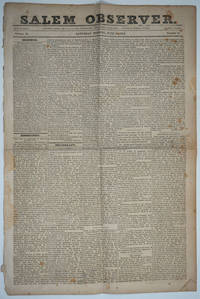
182425651Salem Mass: W. & S. B. Ives 1824. Very good overall. A detailed article in a Massachusetts newspaper reporting on the unwrapping of an Egyptian mummy recently brought to Paris in the year that the French scholar Champollion made his breakthrough in Western understanding of ancient Egypt by deciphering the Rosetta Stone. Much detail on the seven layers of wrappings and materials used 12 column inches.<br /> <br /> Followed by an article tilted 'The Island of Madagascar' describing a British naval officer's feast with a local Prince. 16 inches.<br /> <br /> Complete issue 13 x 20" 4pp. Period folds flattened split along spine not affecting text. W. & S. B. Ives unknown
1885EGYPTOLO001087George Gebbi Philadelphia. 1885. First edition. Small quarto. Many illustrations in the text by John Sartain who writes the introductory text. Two steel engravings by him. Pictorial green cloth gilt bevelled edges. Most of the book is taken up by an essay by Dr R. Schoener. Bound in at the rear is a separately printed essay 12 pages by Michael Iwanoff.Some spotting mainly in the latter part. Covers a bit rubbed at corners and head and tail of spine. Very good. George Gebbi, Philadelphia. hardcover
188968244London: Messrs. Trübner & Co 1889. Second edition. Hardcover. Good. Folio 32 cm 1/4 black cloth with printed tan paper over boards. Wear to the spine and boards. The cloth spine of the second book is torn with small losses from the spine ends. The second part has a couple of markings on the front cover and a previous owner's brief inscription in small pen on the front free endpaper. The pages are very occasionally uncut. The text blocks are sturdy. Part I: Frontispiece; 16 plates; 2 folding plates. Part II: 12 plates; 51 plates. Plate XXV comes after Plate XXVI. May require extra postage due to size and weight. British archaeologist and Egyptologist Sir William Matthews Flinders Petrie 1853-1942 made significant contributions to the techniques and methods of field excavation and invented a sequence dating method that made possible the reconstruction of history from the remains of ancient cultures. Petrie lived in a tent and a basic house at the Tanis site from February 4 until June 23rd 1884 in relative isolation. While excavating the Temple of Tanis Petrie discovered fragments of a mammoth statue of Ramses II. He was knighted in 1923. Messrs. Trübner & Co hardcover