69 résultats
1967201118-MB52California Trial Lawyers Association 1967. Very Good Hardcover 254 pages panel discussions from CTLA Second Annual Convention February 1967. First Edition. Hardcover. Very Good/No Dust Cover. California Trial Lawyers Association Hardcover
19762090502128900137play guide journal company 1976. Soft Cover. Fine. Number of pages: 116p Size: 21cm Number of books: 2 play guide journal company paperback
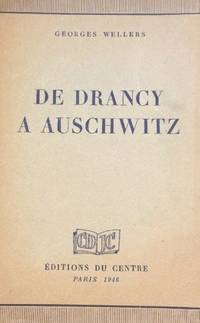
194642926Paris: Editions Du Centre 1946. Illustrated by 12 Plates Mostly Documents. 1st edition. Original printed paper wrappers 8vo 230 pages. Includes 12 plates as well as a map. 23 cm. In French. Title translates as "From Drancy to Auschwitz." Wolff # I: 1545. No. 6 in the "Edudes et monographies" series by the Centre de Documentation Juive Contemporaine. <br> <br> "Georges Wellers French biologist and historian worked for many years at Sorbonne where he held a position of Director of Research Laboratory of Medical Department. In 1941 he was arrested by the Nazis and spent more than three years in nazi concentration camps first in Drancy near Paris then in Auschwitz and Buchenwald. Despite all the deprivations during his captivity Georges lived a long and productive life. He excelled in a prominent scientific career was awarded the Legion of Honor Rosette as its officer was vice-president of the association of nazi-camp survivors of France and was the only French witness at the Eichmann war crime trial in Israel" Goodreads.<br> <br> "The Drancy camp was located in a northeastern suburb of Paris also called Drancy.<br> In August 1941 the Germans established an internment camp at Drancy following the arrest of more than 4200 Jewish men in Paris.<br> Beginning in summer 1942 Drancy became the major transit camp for the deportations of Jews from France. Until July 1943 French police staffed the camp under the overall control of the German Security Police and SD. In July 1943 the Germans took direct control of the Drancy camp and SS officer Alois Brunner became camp commandant.<br> Approximately 70000 prisoners passed through Drancy between August 1941 and August 1944. Except for a small number of prisoners mostly members of the French resistance the overwhelming majority were Jews. Approximately one thousand prisoners managed to obtain release during the first year of the camp’s existence" USHMM. <br> Early material on Drancy is scarce. <br> SUBJECTS: World War 1939-1945 -- Prisoners and prisons German. Guerre mondiale 1939-1945 -- Prisonniers et prisons des Allemands. Holocaust Jewish 1939-1945 -- France -- Personal narratives. Juifs -- Perse´cutions -- France -- 1900-1945. Shoah -- France. Internierungslager Drancy Konzentrationslager Auschwitz. OCLC: 11130195. Wear to spine front hinge repair paper browning but solid. Good Condition. B Holo2-162-29-CC. Editions Du Centre unknown
19832092902143902098Not Available 1983. Soft Cover. Fine. Volume: 1 Not Available paperback
19832092902143802134Not Available 1983. Soft Cover. Fine. Volume: 1 Not Available paperback
19852091202133209954Hizen Hasami Sake Promotion Association 1985. Soft Cover. Fine. Volume: 1 Hizen Hasami Sake Promotion Association paperback
19812092902143900353Not Available 1981. Soft Cover. Fine. The book is in fine condition. Not Available paperback
19812092902143800375Not Available 1981. Soft Cover. Fine. The book is in fine condition. Not Available paperback
1968250798Los Angeles 1968. unbound. Autographed first day Olympic Trial Covers signed in full by several athletes who went on to participate in the 1968 Summer Games in Mexico City. Each Trial Cover contains a black shadow figure engaging in the participant's sport as well as the athlete's signature. Signatures include George Foreman boxing Deborah Meyer swimming Spencer Heywood basketball Al Oerter discus and Sue Gossick diving. Twenty-one covers total each measuring 3.5 x 6.5 inches. Los Angeles California. Postmarked August 28 1968. Fine condition.<br/> <br/> unknown
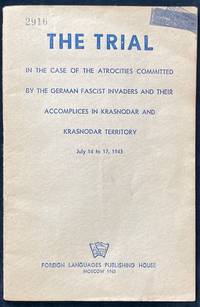
194342274Moscow Foreign Languages Pub. House 1943. Paperback. 1st English Language Edition. Original Wrappers. 8vo. 40 pages; 19 cm. Koppel Pinson's copy with gift bookplate. Contemporary account published in 1943 of the very first war crimes trial against Nazi defendants held following the Russians’ recapturing of Krasnodar From the Germans who had occupied it. SS-sonderkommando units massacred thousands of Russian citizens Jews and communists. The trials were held immediately in the summer of 1943 while the war against Hitler was ongoing. Includes transcript from the trial and gruesome photographs of the victims of the atrocities. SUBJECT S : War crimes -- Soviet Union. OCLC: 11136869. Small donation bookplate number on margin of final leaf otherwise Very Good condition excellent copy. Very important. B holo2-135-10-LWWEV-'mmacc. Moscow, Foreign Languages Pub. House paperback
19822090202122800132Mukuge-sha 1982. Soft Cover. Fine. Size: B5 Number of books: 2 Mukuge-sha paperback
19872092902143902218Not Available 1987. Soft Cover. Fine. Number of books: 5 Not Available paperback
19872092902143802254Not Available 1987. Soft Cover. Fine. Number of books: 5 Not Available paperback
194547189Krakow: Spóldzielnia Wydawnicza "Czytelnik" Czytelnik Publishing Cooperative 1945. First edition. Softcover. g to von-. Octavo 8 1/4 x 6". 93pp. 13 leaves of double sided photographic plates interleaved and unpaginated. Illustrated tan red and black wrappers with black lettering on the front cover. Photographic b/w frontispiece. Spóldzielnia Wydawnicza "Czytelnik."<br /> <br /> Possibly an earlier publication on lower quality paper compare to a slightly smaller publication by the "Library of the Union of Polish Patriots in the USSR" Biblioteczka Zwiazku Patriotów Polskich w ZSRR with the same text in different layout. That publication issued on higher quality paper and with twenty-eight photogravures three more than in this publication with twelve photographs appearing in both publications though in lesser quality here.<br /> <br /> Court Proceedings of the Polish-Soviet Special Criminal Court established in Lublin in August 1944 in order to investigate the crimes committed by the Germans in the Majdanek extermination camp. Despite the importance of this document it must be mentioned that the Commission made erroneous assumptions regarding the duration of the camp and the number of people killed at Majdanek. The Publishing cooperative "Czytelnik" was established behind Soviet front lines in 1944. It became the first post-World War II. publisher in Poland.<br /> <br /> The total numbers of the victims is still controversial: In this report 1.5 million victims of different nationalities were counted however according to the latest researches there were 79000 victims 59000 of whom were Jews See: Kranz T.: "Bookkeeping of Death and Prisoner Mortality at Majdanek." pp. 81-110. In: Silberklang D. Ed.: Yad Vashem Studies. Vol. 35:1. Jerusalem 2007.<br /> <br /> Illustrated with 25 pages of b/w photographic reproductions including a frontispiece on 13 double-sided interleaved plates altogether thirty-two photographs depicting members of the Commission Nazi guards now prisoners who used to run the camp and survivors alike testifying before the Commission. Also includes views of the actual concentration camp piles of suitcases Zyklon B poison gas pellets gas chambers ovens and survivors amid corpses.<br /> <br /> Wrappers with some chipping rubbing creasing and/or closed tears to extremities. Small stain on the back cover and side edge of book block. Verso of frontispiece with a vertical crease. Some pages throughout with some light age toning or small water spots. Overall text and images clear and vibrant. Wrappers in good interior in very good- condition overall. One of two editions of this work published in Moscow and Krakow in 1945. It is not certain which was released first. Each has different wrappers size pagination and publishers. Spóldzielnia Wydawnicza "Czytelnik" (Czytelnik Publishing Cooperative) unknown
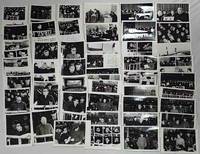
1981216885Beijing. Circa1981. A complete set of 50 black and white photographs of the trial of the Gang of Four during 1980-81. Images clearly show the judges the courtroom and the accused. In excellent condition each photograph is loosely inserted within an A5 polypropylene sleeve all contained in an archival-grade cardboard box. All images measure approximately 20.5 x 15cm. A fascinating series of photos from the trial of the Gang of Four and the remnants of Lin Biao's Central Cultural Revolution Group including images of the court physical evidence and the accused themselves - including though not limited to Jiang Qing Zhang Chunqiao Wang Hongwen and Yao Wenyuan. <br> <br>Included are photos of the accused - in clearly poorer physical health compared to their peak in 1976 - after having reputedly given emotive vitriolic and stubborn statements to the court. Though Jiang Qing and Zhang Chunqiao appear openly hostile or contemptuous to the court - both in their own unique way - Wang Hongwen Yao Wenyuan and the other defendants appear more subdued and mournful in their demeanour seemingly having resigned themselves to their fate. <br> <br>Of particular note is the inclusion of a single page of images of what appears to be the badly charred and broken corpse of Lin Biao as well as the wreckage of his ill-fated flight. These images were presumably supplied to the court by the KGB who had very controversially handled the investigation at the time of the crash despite it having taken place over and within the territory of the Mongolian People's Republic not the Soviet Union. Perhaps to further affirm the position that the corpse was indeed Lin's a forensic-like comparison is made between an image of the body's skull and his distinctive forehead and brow ridge. . unknown
19892080302106803074National Detainee Compensation Council 1989. Soft Cover. Fine. The book is in fine condition. National Detainee Compensation Council paperback
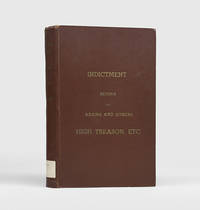
1956184698Pretoria: The Government Printer 1956. A major moment in South African history First edition of the indictment for the "Treason Trial" in which Nelson Mandela and almost the entire anti-apartheid leadership were prosecuted. One defendant Ahmed Kathrada has signed beside his name; the signature was acquired by a collector in recent years. "The core of the treason charge related to a momentous - and for the government disconcerting - event at Kliptown on the outskirts of Johannesburg on 25-26 June 1955. The delegates were drawn from the ranks of the Congress Alliance a coalition of race-based anti-apartheid groups - the ANC still Africans only the Indian Congresses the Coloured People's Congress and the white mix of communists and non-communists. They had come together to draw up the country's first democratic constitution. Out of the deliberations came the endorsement of a Freedom Charter which to western eyes was an unexceptionable statement of democratic principles and equal rights owing something to the UN Charter but virtually nothing to the Communist Manifesto" Herbstein pp. 28-9. In response 156 individuals who attended or were associated with the meeting were arrested under the 1950 Suppression of Communism Act. The trial helped unite the anti-apartheid movement and attracted worldwide support for the struggle and international condemnation of the South African government. The trial lasted over four years after which all the accused were acquitted. However soon after Mandela and other defendants were imprisoned following the Rivonia Trial. 3 vols bound in 1 as issued folio. Ex library of the South African embassy in Bonn with their stamp to the front free endpaper and their shelf label and number to spine; binding rubbed and slightly worn and shaken contents toned. A good copy. Denis Herbstein White Lies: Canon Collins and the Secret War Against Apartheid 2004. unknown
1914659851914. New York 1912-1914. Image in 30-1/2" x 24" frame. New York 1912-1914. Image in 30-1/2" x 24" frame. "His Famous Wig Composed Entirely of Split Hairs and Adorned with the Ceremonial Crimson Tape" Robinson Boardman 1876-1952. Becker-Rosenthal Murder Trial. Mr. Justice Precedent. New York 1914. 21" x 15-1/2" 53.3 x 39.4 cm gouache image on 26" x 19-1/2" 66 x 49.5 cm sheet image signed twice and inscribed by Robinson caption in pencil below image most likely in another hand laid down on illustration board. Image in 30-1/2" x 24" 77.5 x 60.9 cm wooden frame glazed. Light soiling a few minor stains and four crop-marks to margins outside of image which could be covered with a matte image fine. Several minor scuffs and nicks to frame. An exceptional unique piece of original artwork capturing a defining moment in American legal and criminal history. $3500. This striking original gouache was created to illustrate "Leaden Footed Justice in New York State" a feature article published in the Special Feature section of the New York Tribune on Sunday March 1 1914. The penciled caption reads:"Mr. Justice Precedent wearing his famous wig composed entirely of split hairs and adorned with the ceremonial crimson tape." The caricature was a scathing commentary on the notoriously protracted bureaucratically tangled legal proceedings of the Becker-Rosenthal Murder case which centered on NYPD Police Lieutenant Charles Becker who ran a massive protection racket targeting illegal Manhattan casinos. When gambling house owner Herman Rosenthal threatened to expose Becker's corruption to District Attorney Charles S. Whitman Becker hired a gang of underworld executioners including "Gyp the Blood" and "Lefty Louie" to gun Rosenthal down outside the Hotel Metropole. The investigation and subsequent trials completely dominated New York front pages. Becker's first trial began on October 7 1912 resulting in a conviction that was subsequently overturned on appeal by the New York Court of Appeals due to judicial bias. His highly anticipated second trial began on May 6 1914 just over two months after this cartoon appeared. Becker was convicted a second time and after his appeals were exhausted in 1915 went to the electric chair at Sing Sing-marking the first time in U.S. history a police officer was executed for murder. The case profoundly shook the public psyche and entered the cultural lexicon most. unknown
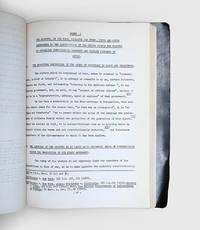
19511903891951. The failed appeal against the "trial of the century" One of very few copies of Emanuel Bloch's appeal seeking to overturn the prosecution of the Rosenbergs at their infamous trial signed by Bloch for submission to the Court of Appeals on the final page. Bloch 1901-1954 an attorney who focused on civil rights was known for defending clients associated with left-wing and communist causes. The Rosenbergs communists accused of sending atomic secrets to the Soviets chose Bloch to lead their defence. The court found the Rosenbergs guilty of espionage in March 1951 and sentenced them to death in April following a trial widely criticized as prejudiced and motivated by Cold War hysteria. J. Edgar Hoover dubbed the case which attracted worldwide attention "the trial of the century". The Rosenbergs were granted time to prepare the appeal which Bloch submitted to the Circuit Court on 5 November 1951. Comprising 143 pages of argument extensively referenced against other legal cases and with an index Bloch sets forth his legal case. It rests on three grounds: the government had not established definite guilt the Rosenbergs had not been granted a fair trial and the "cruel and unusual punishment" violated the eighth amendment. Besides the constitutional grounding Bloch emphasizes the "frantic atmosphere" in which the Rosenbergs were arrested placing the trial within the context of the panic caused by the Soviet Union's acquisition of the atomic bomb. The appeal was denied by the three judges on the court on 25 February 1952. They reported they had carefully examined the trial record against Bloch's appeal and had found the death sentence was constitutional and would stand. Following the defeat Bloch filed a further appeal with the Supreme Court which declined to review the case. A stay on execution was granted to appeal to President Eisenhower who denied the petition. Various other legal challenges the last of which reached the Supreme Court also failed. Despite an international campaign for clemency backed by the Pope and Albert Einstein the Rosenbergs were executed on 19 June 1953. Despite the failure of Bloch's appeal his brief greatly impressed the Rosenbergs. Julius wrote to Ethel on 4 November 1951 "I read the brief and I wrote Manny Bloch telling him what a stupendous job he did and how everlastingly grateful we are for his tireless efforts for us. Darling the brief is a legal masterpiece and in addition is a literary gem. Although I don't have the background to really pass on the legal fine points I can attest to its excellent organization its meticulousness in presenting in a fair light our case the devastating logic of his points and the tremendous assiduous effort Manny exerted in preparing this document. Believe me it's a priceless piece of work from a great man. How proud we are to be considered his friends. I intend to reread it a number of times so I'll be able to better understand some of the legal points raised" The Rosenberg Letters 2013 pp. 253-4. Bloch is often seen as a lawyer unsuited to the case more suited to civil rights work than a major criminal trial. His failure to interrogate properly the government's key witness Harry Gold has been much criticized. This appeal shifted more to Bloch's speciality of constitutional and civil rights probably constitutes a stronger legal case than that which he presented in the original trial. Nonetheless the Rosenbergs were very confident in him and he became a close friend. Bloch delivered the eulogy at their funeral and took guardianship of their sons though he died soon afterwards of a heart attack. This copy of the brief is evidently one of a small number produced for official use alongside the copies which each Rosenberg received. This copy was deposited in the Civil Rights Division of the American Jewish Committee - it is marked as their file copy and subsequently "withdrawn". It is unknown how they acquired the brief - the American Jewish Committee pointedly distanced themselves from the case likely to avoid the association of Jews with communism and treachery which the case did much to encourage among the public. An inscription on the first page reads "Return to Ted Leskes" - Theodore Leskes 1908-1964 was director of the legal division of the American Jewish Committee focusing on civil rights and discrimination. We trace only one other example of the brief at the University of Kansas and no other copy in commerce. Quarto 285 x 217 mm. Containing 154 mimeographed leaves printed recto only paginated comprising i-xi index 143 pages of contents firmly staple-bound in "Accopress binder" an early likely original binding printed title page mounted to front of binder. Housed in a black cloth flat-back box by the Chelsea Bindery. Stamps of American Jewish Committee to front cover and p. i verso. Chipping around title on front cover reinforced with tape at extremities slight wear to binder extremities contents a little toned else clean. A good copy. hardcover