[Murder] [Crime] [Charles Getter]Biblio.com
11 résultats
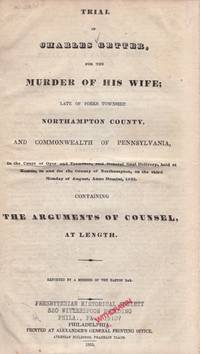
183335550Philadelphia: Printed at Alexander's General Printing Office 1833. First Edition. Hardcover. Good. Octavo. Hardcover. Ex-institutional copy. 72 pages. Original wraps without the outer covers bound in black cloth covered boards with copy of the title pasted down on the front cover. Gilt lettered title on the spine. New tan end sheets front and back. Page 1 is the title page and has two stamps at the bottom: Presbyterian Historical Society Philadelphia and a red withdrawn stamp. Print is small and contents are clean. <br /> <br /> McDade 335 - "Getter convicted of fornication and bastardy was given the option of marrying the girl he had wronged; six weeks later saddled with a wife he did not want he choked her to death.â€. From wikipedia:<br /> <br /> Getter's Island previously known as Abel's Island is a small island in the Delaware River in Easton Pennsylvania in the United States. It is best known as the location of the execution of Charles Getter the last person to be publicly executed in Pennsylvania. History edit Execution of Charles Getter edit The island is named after Charles Getter a farm hand who was hanged on the island in 1833 for the murder of Margaret Lawall a woman he married to avoid prosecution for impregnating her outside of wedlock. Getter's execution was initially scheduled to take place at Center Square in Easton but it was moved to the island - then known as Abel's Island - to accommodate the crowds.<br /> An estimated 15000 to 20000 people some of whom traveled hundreds of miles gathered in the town to view the execution. 12 An initial attempt to hang him failed forcing a second attempt which resulted in his death. A reporter who witnessed the scene was horrified at how little the crowd was affected by the execution and called on lawmakers to take action. 2 Governor George Wolf agreed with the reporter and signed a law banning public execution on April 10 1834. As a result Getter was the last person in Pennsylvania to be publicly executed. 2. Printed at Alexander's General Printing Office hardcover
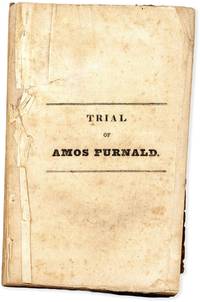
182588889Concord: Jacob B. Moore 1825. First Edition. Octavo. Sewn wrappers; 127pp. Lacking cover wraps if issued; half-title and title page quite worn with mended horizontal tears and nearly detached from text block; final text leaf crudely repaired by an early owner. A complete copy Fair to Good only.<br /> <br /> A case of filicide. The "father and stepmother were charged with the murder of a five-year-old child by neglect and starvation. The father was convicted of manslaughter" McDade. SABIN 96867. McDADE 328. Jacob B. Moore unknown
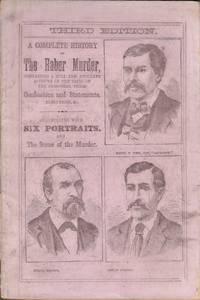
188035897Lebanon PA: C. M. Bowman 1880. Third Edition. Wraps. Fair. Stitched wraps. Approx. 8.25" x 6" light purple illustrated front paper cover. Illustrated back cover. 52 pages. Edge chips to the covers and spine. Light scattered foxing to title page and contents. Soiling to the back cover. Fair to good condition. <br /> <br /> McDade 782. C. M. Bowman unknown
187317803Baltimore Gazette Printers 1873. First Edition. soft cover. Very Good/No jacket. Baltimore Gazette Printers. 1873. 59pp. Wrps. McDade 1012. An excellent copy. Baltimore Gazette, Printers paperback
186436882np 1864. 4to. Written in ink and signed at the end by Royce on the verso of a single leaf. Several small holes text unaffected a few closed tears two archival tape repairs. Very Good. <br /> <br /> This unusual insightful document illuminates the laws of war applicable to the Civil War. Royce's Petition seeks justice for Confederate Captain Frank R. Gurley. Royce sent it to the Confederate Commission of Exchange. Its author Confederate Captain Moses Strong Royce was captured in Tennessee and imprisoned at Nashville. Gurley Royce's cell-mate had killed Union General Robert McCook of Ohio near Huntsville Alabama in August 1862. <br /> In October 1863 Union forces captured Gurley and charged him with murdering McCook. Gurley Union officials claimed was a guerrilla who shot McCook while the General was lying in an ambulance. Southerners claimed that Gurley was not a guerrilla but a regular soldier in the Confederacy's 4th Alabama Cavalry; and that he killed McCook according to the laws of war. <br /> Harper's Weekly and Frank Leslie's Illustrated Newspaper fanned the flames claiming that lawless Confederate guerrillas murdered the general; feelings ran high. "US General Grant wrote CS General Hardee in December of 1863 and said that although Gurley was a member of the Confederate army that did not preclude him from being tried for having committed a foul murder" online Huntsville-Madison County Public Library essay 'Frank B. Gurley's 1866 Diary'.<br /> Having escaped from prison in March 1864 Royce pleads Gurley's case. "He was confined in a cell for sixty-eight days and allowed only about one hour a day for exercise and was put upon trial for the killing of Genl. McCook. He was obliged to employ counsel to defend himself at an expense of 2500 dollars in greenbacks. The evidence produced completely exonerated him of anything like murder and the argument of his counsel was a complete vindication of his right as a soldier and an officer to do all that he did in bringing Genl. McCook to his death. <br /> "When the trial was nearly ended four communications by flag of truce were sent to the court and were there read - one from Lt. Col. Hambrick one from Genl. Forrest one from Genl. Hardee and one from Genl. Johnston" assuring that Gurley was not a guerrilla but a duly enrolled member of the Confederate military forces. Nevertheless Gurley was found guilty and sentenced to death.<br /> "The undersigned believes that if an effort were to be made by the Confederate Commission of Exchange to have Capt. Gurley exchanged the Federal authorities would immediately send him forward for that purpose and as a friend of Capt. Gurley the undersigned respectfully requests General Johnston to use his influence in procuring the exchange of Capt. Gurley. Respectfully submitted M. S. Royce." <br /> Even after War's end the dispute continued. Gurley having been released from prison in an administrative snafu was re-arrested charged but finally released and placed on parole in April 1866. unknown
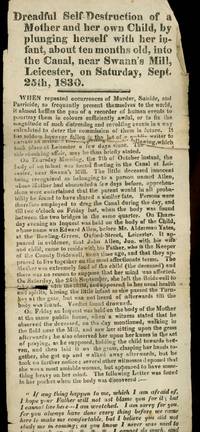
1830z011783Nottingham England: J. Plant 1830. other. Very Good. Clipped article from a Nottingham periodical recounting the lurid murder suicide of a Mrs. Allen and her infant son Edward whose bodies were dredged from the Canal at Leicester in a terrible state of decomposition in October of 1830- a minor local sensation as Mrs. Allen "never indicated the slightest symptoms of insanity". Clipping measures 5 by 14 inches printed on verso only. Very good. Creasing edge wear one inch perforation along crease else complete and unmarked. Digital images available upon request. RARE no copies available on OCLC. J. Plant unknown
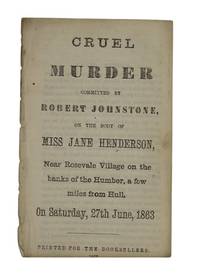
1863AQ33168Glasgow: Printed for the booksellers 1863. 8pp. Disbound. Title page shaved at foot with slight loss to imprint. A prose and verse chapbook recounting the brutal murder of Jane Henderson by her lover Robert Johnstone in 1863 on the outskirts of Hull. On 27th June Johnstone stabbed Henderson multiple times before disposing of her body in a nearby river. The pair had been conducting an illicit affair for a considerable time. Henderson had become pregnant and Johnstone desirous to be rid of her in favour of another woman conspired to murder. Henderson's corpse was soon discovered and upon a person a letter written by Johnstone to lure her to the place of her murder. Johnstone was swiftly arrested and imprisoned. His fate is unrecorded. 'Her throat then I cut while the blood flowed profusely Then she fell like a corpse most dreadful to view; My crime to conceal I drew her near the water And into the Humber her body I threw'. . 16mo. Printed for the booksellers unknown
18328608London Printed for the Proprietors and sold by W. Nute 1832. 1832 366 2 p. 5 plates one damaged. List of books recently published by Thomas Kelly. Contemporary half calf spine gilt and marbled boards. The front endpaper has been removed and p.171/172 partly in facsimile. A little rubbed on the edges and corners but still an attractive copy. London Printed for the Proprietors, and sold by W. Nute, hardcover
1824BB056Murder Trial<br /><br />Account of the Murder of the late Mr William Weare . the coroner's inquest the trials of the prisoners and the execution. By George Henry Jones.<br /><br />London 1824.<br /><br />With 3 landscapes 2 folding plates finely lithographed by C J Hullmandel.<br /><br />8vo iv344pp; half-leather marbled boards spine label "Thurtell's Trial" lightly scuffed very solid and clean throughout.<br /><br />First edition.<br /><br />William Weare was a solicitor of Lyon's Inn and a gambler. His killer was John Thurtell 1794–1824 a sports promoter amateur boxer a former Royal Marine officer and a son of the Mayor of Norwich. Thurtell owed Weare a gambling debt of £300 an immense sum at the time equivalent to £24500 in 20151. Thurtell believed Weare had cheated him of the money. Whatever the truth when Weare demanded payment Thurtell murdered him rather than pay up. He invited Weare to join him and his friends – Joseph Hunt a tavern landlord and William Probert a former convict and alcohol merchant – for a weekend of gambling at Probert's cottage at the site of Oaks Close off Gills Hill Lane subsequently popularly known as Murder Lane23 Radlett. On 24 October 1823 they journeyed from London in Thurtell's horse-drawn gig but Weare was killed in a dark lane just short of their destination. The gruesome and callous events created such public sensation that it attracted numerous ballads and theatre shows at the time along with comment by the essayist Babington Macaulay and the crime used variously in the work of Sir Walter Scott William Hazllitt and Robert Louis Stevenson. After the trial one of the accused was hanged and another Joseph Hunt was transported to Botany Bay Australia.<br /><br />Charles Joseph Hullmandel 1789–1850 studied art and printmaking and is considered amongst the most important figures in the development of British lithography. He developed a method for reproducing gradations in tones and for creating the effect of soft color washes which enabled the reproduction of Romantic landscape paintings of the type made popular by J. M. W. Turner. Hullmandel's essay <i>The Art of Drawing on Stone</i> 1824 was an important handbook of lithography issued the same year as this account of the trial.<br />
1836665381836. Concord NH 1836. Concord NH 1836. "Oh! Lust Accursed Lust! 'Twas This for Which I Did the Deed" Broadside. Murder. A Private Individual at the Bar. Abr'm Prescott's Confession Of the Murder of Mrs. Sally Cochran of Pembroke N.H.--June 23 1833. Concord NH.: S.n. 1836. 17" x 11-1/2" 43.2 x 29.2 cm broadside. Two columns of verse in twenty stanzas within woodcut ornamental border text headed by large woodcut vignette of a coffin. Light browning and a few minor stains faint horizontal and vertical fold line chipping to edges section lacking from bottom margin just touching bottom right corner of border a few tears along fold lines with no loss to text later repairs to verso. $1950. Abraham Prescott was convicted of the murder of Sally Cochran following two separate highly publicized trials held in Concord New Hampshire in September 1834 and September 1835. Despite a robust and well-crafted insanity defense mounted by his counsel Prescott was sentenced to death. Originally scheduled to be hanged in Hopkinton New Hampshire on December 23 1835 his execution was delayed and he was ultimately executed on January 6 1836. This rare broadside features a verse account that explicitly frames the murder as a crime of passion capturing the sensationalized public sentiment of the era: "Oh! lust accursed lust! 'twas this / For which I did the deed; / Forfeiting heaven and life and bliss / Forfeiting all I need." OCLC locates 7 copies American Antiquarian Society Brown Dartmouth Harvard Peabody Essex Museum University of Michigan Yale. See McDade The Annals of Murder 769. Burt American Murder Ballads 66-67. unknown
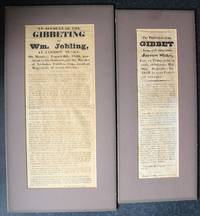
18321579<p>2 original printed text broadsides. "<em>An Account of the Gibbeting of Wm Jobling at Jarrow Slake On Monday August 6th 1832 pursuant to his Sentence for the Murder of Nicholas Fairles Esq resident Magistrate of South Shields" Printed by W. Boag of Newcastle</em> size approx. 14 1/4" x 6 3/4" and <em>"The Particulars of the Gibbet being stole away from Jarrow Slake Late on Friday Night or early on Saturday Morning September 1st 1832 by some Persons yet unknown" Printed by Douglas and Kent of Newcastle </em>size approx. 14 3/4" x 4 3/8". Affixed to the upper corners to thin cream card with brown thick board mounts. Good complete condition browned with evidence of previous horizontal folds. Previous auction lot details affixed to rear board.</p><p><em>Two rare original accounts of the hanging pitching and gibbeting of William Jobling a striking pitman who had been convicted as accomplice in the murder of Nicholas Fairles on the 11th June 1832. And of the subsequent disappearance of his body reputedly removed by Jobling's friends risking seven years transportation. The practise of gibbeting was abolished shortly afterwards in 1834. </em></p><p>Please Note : International postage costs outside the UK are likely to be more expensive than initially quoted by Biblio due to the oversize nature of this item</p> W. Boag Printer & Douglas and Kent Printers