45 résultats
1893H18436Berlin: Julius Springer 1893. First printing. Hardcover. Very Good. First edition in German. 8vo contemporary quarter red cloth gilt over patterned boards very good. 298 pp. Julius Springer hardcover
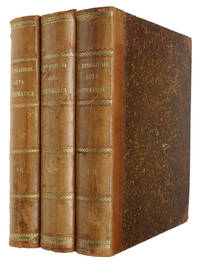
188460243Berlin Stockholm Paris F. & G. Beijer 1882-84. Large4to 272 x 230 mm. Three volumes uniformly bound in contemporary half calf with gilt lettering to spine. In "Acta Mathematica" volume 1-5. Light wear to extremities boards and spines with scratches. Stamp to verso of front board in all volumes. First three leaves in first volume detached otherwise internally fine and clean. Vol. I pp. 1-62; Pp. 193-294; Vol. II pp. 97-113; Vol. III. pp. 49-92; Vol. IV pp. 201-312; Vol. V pp. 209-278. <br/><br/><em>First publication of these groundbreaking papers which together constitute the discovery of Automorphic Functions. "Before he was thirty years of age Poincaré became world famous with his epoch-making discovery of the "automorphic functions" of one complex variable or as he called them the "fuchsian" and "kleinean" functions." DSB.These manuscripts written between 28 June and 20 December 1880 show in detail how Poincaré exploited a series of insights to arrive at his first major contribution to mathematics: the discovery of the automorphic functions. In particular the manuscripts corroborate Poincaré's introspective account of this discovery 1908 in which the real key to his discovery is given to be the recognition that the transformations he had used to define Fuchsian functions are identical with those of non-Euclidean geometry. See Walter Poincaré Jules Henri French mathematician and scientist.The idea was to come in an indirect way from the work of his doctoral thesis on differential equations. His results applied only to restricted classes of functions and Poincaré wanted to generalize these results but as a route towards this he looked for a class functions where solutions did not exist. This led him to functions he named Fuchsian functions after Lazarus Fuchs but were later named automorphic functions. First editions and first publications of these epochmaking papers representing the discovery of "automorphic functions" or as Poincaré himself called them the "Fuchsian" and "Kleinian" functions."By 1884 Poincaré published five major papers on automorphic functions in the first five volumes of the new Acta Mathematica. When the first of these was published in the first volume of the new Acta Mathematica Kronecker warned the editor Mittag-Leffler that this immature and obscure article would kill the journal. Guided by the theory of elliptic functions Poincarë invented a new class of automorphic functions. This class was obtained by considering the inverse function of the ratio of two linear independent solutions of an equation. Thus this entire class of linear diffrential equations is solved by the use of these new transcendental functions of Poincaré." Morris Kline.Poincaré explains how he discovered the Automorphic Functions: "For fifteen days I strove to prove that there could not be any functions like those I have since called Fuchsian functions I was then very ignorant; every day I seated myself at my work table stayed an hour or two tried a great number of combinations and reached no results. One evening contrary to my custom I drank black coffee and could not sleep. Ideas rose in crowds; I felt them collide until pairs interlocked so to speak making a stable combination. By the next morning I had established the existence of a Class of Fuchsian functions those which come from hypergeometric series; i had only to write out the results which took but a few hours.the transformations that I had used to define the Fuchsian functions were identical with those of Non-Euclidean geometry." </em> hardcover
188246049Berlin Stockholm Paris F. & G. Beijer 1882. Large4to. As extracted from "Acta Mathematica" no backstrip. With title-page and front free end-paper. In "Acta Mathematica" volume 1. Title pages with library stamp. A fine and clean copy. Pp. 6 62. <br/><br/><em>First publication of this groundbreaking paper which became Poincaré first paper in his much celebrated and famous six-paper series which together constitute the discovery of Automorphic Functions. "Before he was thirty years of age Poincaré became world famous with his epoch-making discovery of the "automorphic functions" of one complex variable or as he called them the "fuchsian" and "kleinean" functions." DSB.These manuscripts written between 28 June and 20 December 1880 show in detail how Poincaré exploited a series of insights to arrive at his first major contribution to mathematics: the discovery of the automorphic functions. In particular the manuscripts corroborate Poincaré's introspective account of this discovery 1908 in which the real key to his discovery is given to be the recognition that the transformations he had used to define Fuchsian functions are identical with those of non-Euclidean geometry.The idea was to come in an indirect way from the work of his doctoral thesis on differential equations. His results applied only to restricted classes of functions and Poincaré wanted to generalize these results but as a route towards this he looked for a class functions where solutions did not exist. This led him to functions he named Fuchsian functions after Lazarus Fuchs but were later named automorphic functions. First editions and first publications of these epochmaking papers representing the discovery of "automorphic functions" or as Poincaré himself called them the "Fuchsian" and "Kleinian" functions."By 1884 Poincaré published five major papers on automorphic functions in the first five volumes of the new Acta Mathematica. When the first of these was published in the first volume of the new Acta Mathematica Kronecker warned the editor Mittag-Leffler that this immature and obscure article would kill the journal. Guided by the theory of elliptic functions Poincarë invented a new class of automorphic functions. This class was obtained by considering the inverse function of the ratio of two linear independent solutions of an equation. Thus this entire class of linear diffrential equations is solved by the use of these new transcendental functions of Poincaré." Morris Kline.Poincaré explains how he discovered the Automorphic Functions: "For fifteen days I strove to prove that there could not be any functions like those I have since called Fuchsian functions I was then very ignorant; every day I seated myself at my work table stayed an hour or two tried a great number of combinations and reached no results. One evening contrary to my custom I drank black coffee and could not sleep. Ideas rose in crowds; I felt them collide until pairs interlocked so to speak making a stable combination. By the next morning I had established the existence of a Class of Fuchsian functions those which come from hypergeometric series; i had only to write out the results which took but a few hours.the transformations that I had used to define the Fuchsian functions were identical with those of Non-Euclidean geometry." </em> unknown
188245854Berlin Stockholm Paris F. & G. Beijer 1882-84. Large4to. As extracted from "Acta Mathematica" no backstrip. With title-page and the original wrappers. except for paper no. 3 and 5 which only has the title page. In "Acta Mathematica" volume 1-5. Title pages with library stamp. Internally clean and fine. Vol. I pp. 1-62; Pp. 193-294; Vol. II pp. 97-113; Vol. III. pp. 49-92; Vol. IV pp. 201-312; Vol. V pp. 209-278. <br/><br/><em>First publication of these groundbreaking papers which together constitute the discovery of Automorphic Functions. "Before he was thirty years of age Poincaré became world famous with his epoch-making discovery of the "automorphic functions" of one complex variable or as he called them the "fuchsian" and "kleinean" functions." DSB.These manuscripts written between 28 June and 20 December 1880 show in detail how Poincaré exploited a series of insights to arrive at his first major contribution to mathematics: the discovery of the automorphic functions. In particular the manuscripts corroborate Poincaré's introspective account of this discovery 1908 in which the real key to his discovery is given to be the recognition that the transformations he had used to define Fuchsian functions are identical with those of non-Euclidean geometry. See Walter Poincaré Jules Henri French mathematician and scientist.The idea was to come in an indirect way from the work of his doctoral thesis on differential equations. His results applied only to restricted classes of functions and Poincaré wanted to generalize these results but as a route towards this he looked for a class functions where solutions did not exist. This led him to functions he named Fuchsian functions after Lazarus Fuchs but were later named automorphic functions. First editions and first publications of these epochmaking papers representing the discovery of "automorphic functions" or as Poincaré himself called them the "Fuchsian" and "Kleinian" functions."By 1884 Poincaré published five major papers on automorphic functions in the first five volumes of the new Acta Mathematica. When the first of these was published in the first volume of the new Acta Mathematica Kronecker warned the editor Mittag-Leffler that this immature and obscure article would kill the journal. Guided by the theory of elliptic functions Poincarë invented a new class of automorphic functions. This class was obtained by considering the inverse function of the ratio of two linear independent solutions of an equation. Thus this entire class of linear diffrential equations is solved by the use of these new transcendental functions of Poincaré." Morris Kline.Poincaré explains how he discovered the Automorphic Functions: "For fifteen days I strove to prove that there could not be any functions like those I have since called Fuchsian functions I was then very ignorant; every day I seated myself at my work table stayed an hour or two tried a great number of combinations and reached no results. One evening contrary to my custom I drank black coffee and could not sleep. Ideas rose in crowds; I felt them collide until pairs interlocked so to speak making a stable combination. By the next morning I had established the existence of a Class of Fuchsian functions those which come from hypergeometric series; i had only to write out the results which took but a few hours.the transformations that I had used to define the Fuchsian functions were identical with those of Non-Euclidean geometry." </em> unknown
1895S6990Paris:: Georges Carre 1895. 1895. At head of title: Cours de la Faculte des Sciences de Paris . . . Cours de Physique Mathematique. 8vo. iv 316 pp. 33 figs. Modern brown buckram gilt spine. Fine. FIRST EDITION. DSB XI pp. 51-61; Gascoigne 6883.6; Parke Guide to the literature of mathematics and physics p. 167. Georges Carre, 1895. hardcover
189739134Berlin Uppsala & Stockholm Paris Almqvist & Wiksell 1897. 4to. No wrappers as extracted from "Acta Mathematica. Hrsg. von G. Mittag-Leffler." Bd. 21 pp. 83-97. <br/><br/><em>First edition. In this paper Poincaré arrives at a new theorem about canonical transformation and in his later "Methodes Nouvelles" he proved this theorem using a variiational principle of mechanics known today as the Hamilton principle. </em> unknown
189749621Berlin Uppsala & Stockholm Paris Almqvist & Wiksell 1897. 4to. Bound in contemporary half cloth with gilt lettering to spine. In "Acta Mathematica" Vol 21 1897. Entire volume offered. Stamps to title page otherwise a fine and clean copy. pp. 83-97; Pp. 331-341.Entire volume: 6 376 pp 4 plates. <br/><br/><em>First printing of this paper in which Poincaré arrives at a new theorem about canonical transformation and in his later "Methodes Nouvelles" he proved this theorem using a variiational principle of mechanics known today as the Hamilton principle.Also included is the first printing of Poincaré's principal address at the first International Congress of Mathematicians held in Zürich in 1897. </em> hardcover
188545788Stockholm Beijer 1885. 4to. As extracted from "Acta Mathematica 21. Band. No backstrip. Fine and clean. Pp. 83-97. <br/><br/><em>First printing of Poincaré's paper in which he developed the idea published by Fuchs in 1884. Fuchs established that the equation with fixed branch points can be made into a Riccati equation if its genus - the genus of the corresponding Riemann surface - with respect to u and du/dz is zero and can be integrated using elliptic functions if the genus is 1. </em> unknown
188745902Stockholm Beijer 1887. 4to. With the original wrappers in "Acta Mathematica 9:4. Band. No backstrip. Fine and clean. Pp. 321-380. Entire issue: Pp. 321-400 <br/><br/><em>First printing of Poincaré important - but partly unrecognized - paper which coined the term 'Poincaré lemma'. Even though it is named after Poincaré the discovery has by attributed to the Italian mathematician Vito Volterra who published a series of papers in 1889 on this subject. </em> unknown
189746182Berlin Stockholm Paris F. & G. Beijer 1897. 4to. Without wrappers as extracted from "Acta Mathematica. Hrdg. von G. Mittag-Leffler." Bd. 21. No backstrip. Fine and clean. Pp. 331-341. <br/><br/><em>First printing of Poincaré's principal address at the first International Congress of Mathematicians held in Zürich in 1897. </em> unknown
189839135Berlin Uppsala & Stockholm Paris Almqvist & Wiksell 1898. 4to. Without wrappers as extracted from "Acta Mathematica. Hrsg. von G. Mittag-Leffler." Bd. 22 pp. 89-178. <br/><br/><em>First edition. "As soon as he came into contact with the work of Riemann and Weierstrass on Abelian Functions and algebraic geometry Poincaré was very much attracted by those fields. His papers on these subjects occupy in his complete works as much space as those on automorphic functions their dates ranging from 1881 to 1911. One of his main ideas in these papers is that of "reduction" of Abelian functions. Generalizing particular cases studied b Jacobi Weierstrass and Picard Poincaré proved the general "complete reducibility" theorem."DSB. </em> unknown
188639132Berlin Uppsala & Stockholm Paris 1886. 4to. Without wrappers as extracted from "Acta Mathematica. Hrsg. von G. Mittag-Leffler." Bd. 8 pp. 295-344. <br/><br/><em>First edition. "The full recognition of the nature of those divergent series that are useful in the representation and calculation of functions and a formal definition of those series wer achieved by Poincaré and Stieltjes independently in 1886. Poincaré called these series asymptotic while Stieltjes continued to use the term semiconvergent. Poincaré took up the subject in order to further the solution of linear differential equations. Impressed by the usefulness of divergent series in astronomy he sought to determine which were useful and why. he succededed in islolating and formulating the essential property.Poincaré applied his theory of asymptotic series to diffrential equations and theree are many such uses in his treatise on celestical mechanics 'Les Methodes nouvelles de la mechanique céleste". Morris Kline. </em> unknown
188541900Stockholm F.& G. Beier 1885. 4to. Orig. printed wrappers to Acta Mathematica 4:3. Extracted from "Acta Mathematica" Vol. 4. Pp. 201-312. Clean and fine. <br/><br/><em>First appearance of a major paper on differential equations of the first order".the whole theory of automorphic functions was from the start guided by the idea of integrating linear differential equations with algebraic coefficients. Poincaré simultaneously investigated the local problem of linear differential equation in the neighborhood of an "irregular" singular point showing for the first time how asymptotic developments could be obtained for the integrals. A little later 1884 the paper offered he took up the question also started by I.L. Fuchs of the determination of all differential equations of the first order in the complex domain algebraic in y and y' and having fixed singular points; his rechearches was to be extended by Picard for equations of the second order and to lead to the spectacular results of Painlevé and his school at the beginning of the tweentieth century."DSB. </em> unknown
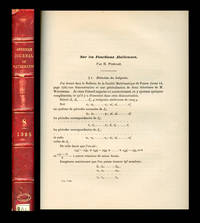
18861389Baltimore: John Hopkins University 1886. 1st Edition. FIRST EDITION OF POINCARE'S PROOF & A GENERALIZATION OF TWO THEOREMS OF KARL WEIERSTRASS a German mathematician frequently cited as the ‘father of modern analysis.' "Henri Poincaré 1854-1912 was a mathematician theoretical physicist and a philosopher of science famous for discoveries in several fields and referred to as the last polymath one who could make significant contributions in multiple areas of mathematics and the physical sciences" Stanford Encyclopedia of Philosophy. <br /> <br /> While the proof Poincare published here had appeared in a French journal Poincare wanted it placed in American Journal of Mathematic the journal offered here so that he could both reproduce and expand upon it. As with many of Poincare's work this one exists or involves the interaction between various branches of mathematics. <br /> <br /> A translation of the first paragraph of Poincare's paper reads: ""I have given in the Bulletin de la Societe mathematique de France t. 12 page 124 a proof and a generalization of two theorems of M. Weierstrass. I wish to reproduce them here succinctly by making some additions which are essential to the proof" Poincare 289. The paper proceeds under six headings respectively: Reduction of Integrals; Singular Case of Reduction; Generalization of the Theorem of Abel; Intermediary Functions; Transformation; Sum of Zeros" Poincare 289. <br /> <br /> Poincare's proof and generalization relates to Weierstrass's work on Abelian functions and algebraic geometry. In fact "as soon as he came into contact with the work of Riemann and Weierstrass on Abelian functions and algebraic geometry Poincare was very much attracted by those fields. His papers on these subjects occupy in his complete works as much space as those on automorphic functions their dated ranging from 1881 to 1911. One of the main ideas in these papers is that of "reduction" of Abelian functions. Generalizing particular cases studied by Jacobi Weierstrass and Picard Poincare proved the general "complete reducibility" theorem. Abelian varieties can be decomposed in sums of "simple" abelian varieties having finite intersection. Poincare noted further that Abelian functions corresponding to reducible varieties and even to products of elliptic curves that is Abelian varieties of dimension 1 are "dense" among all Abelian functions - a result that enabled him to extend and generalize many of Riemann's results on theta functions and to investigate the special properties of the theta functions corresponding to the Jacobian varieties of algebraic curves. Dictionary of Scientific Biography Vol. 11 p. 54. CONDITION & DETAILS: Full volume handsomely bound in half red leather and marbled boards scuffed and rubbed at the edges and spine; raised bands at the spine as well as gilt-lettering. Ex-libris bookplate front paste-down library "Due Date" label tipped-in rfep small library number sticker spine. No other library markings. 4to. Clean and bright throughout. Very good. John Hopkins University hardcover
188244432Leipzig B.G. Teubner 1882. 8vo. Original printed wrappers no backstrip. In "Mathematische Annalen. Begründet 1882 durch Rudolf Friedrich Alfred Clebsch. XIX. 19 Band. 4. Heft." Entire issue offered. Poincaré: Pp. 553-64. Entire issue: Pp. 435-594. <br/><br/><em>First printing of Poincaré's paper on his comprehensive theory of complex-valued functions which remain invariant under the infinite discontinuous group of linear transformations. In 1881 Poincaré had published a few short papers with some initial work on the topic and in the 1881 Klein invited Poincaré to write a longer exposition of his results to Mathematische Annalen which became the present paper. This however turned out to be an invitation to at mathematical dispute:"Before the article went to press Klein forewarned Poincaré that he had appended a note to it in which he registered his objections to the terminology employed therein. In particular Klein disputed Poincaré's decision to name the important class of functions possessing a natural boundary circle after Fuch's a leading exponent of the Berlin school. The importance he attached to this matter however went far beyond the bounds of conventional priority dispute. True Klein was concerned that his own work received sufficient acclaim but the overriding issue hinged on whether the mathematical community would regard the burgeoning research in this field as an outgrowth of Weierstrassian analysis or the Riemannian tradition." Parshall. The Emergence of the American Mathematical Research Community. Pp. 184-5.The issue contains the following important contributions by seminal mathematicians:1. Klein Felix. Ueber eindeutige Functionen mit linearen Transformationen in sich. Pp. 565-68.2. Picard Emile. Sur un théorème relatif aux surfaces pour lesquelles les coordnnées d´un point quelconque s´experiment par des fonctions abéliennes de deux paramètres. Pp. 578-87.3. Cantor Georg. Ueber ein neues und allgemeines Condensationsprincip der Singularitäten von Functionen. Pp. 588-94. </em> unknown
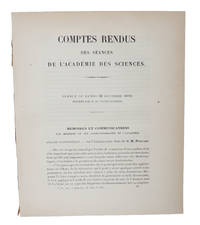
188249173Paris: Gauthier-Villars 1882. 4to. No wrappers. In: "Comptes Rendus Hebdomadaires des Seances de l'Academie des Sciences" Vol 94 No 4 15 17. Pp. 149- 184 pp. 997-- 1068 a. pp. 1139- 1214. 3 entire issues offered. Poincare's papers: pp. 163-168 1038-1042 a. 1166-67. <br/><br/><em>First appearance in print of the discovery of the automorphic forms which Poincaré named Fuchsian functions."One of Poincaré's first discoveries in mathematics dating to the 1880s was automorphic forms. He named them Fuchsian functions after the mathematician Lazarus Fuchs because Fuchs was known for being a good teacher and had researched on differential equations and the theory of functions. Poincaré actually developed the concept of these functions as part of his doctoral thesis. Under Poincaré's definition an automorphic function is one which is analytic in its domain and is invariant under a discrete infinite group of linear fractional transformations. Automorphic functions then generalize both trigonometric and elliptic functions." Wikipedia. </em> unknown
188247185Leipzig B.G. Teubner 1882. 8vo. Bound in recent full black cloth with gilt lettering to spine. In "Mathematische Annalen" Volume 37 1890. Entire volume offered. Library label pasted on to pasted down front free end-paper. Small library stamp to lower part of title title page and verso of title page. Fine and clean. Pp. 182-228. Entire volume: IV 604 pp. <br/><br/><em>First printing of Poincaré's paper on his comprehensive theory of complex-valued functions which remain invariant under the infinite discontinuous group of linear transformations. In 1881 Poincaré had published a few short papers with some initial work on the topic and in the 1881 Klein invited Poincaré to write a longer exposition of his results to Mathematische Annalen which became the present paper. This however turned out to be an invitation to at mathematical dispute:"Before the article went to press Klein forewarned Poincaré that he had appended a note to it in which he registered his objections to the terminology employed therein. In particular Klein disputed Poincaré's decision to name the important class of functions possessing a natural boundary circle after Fuch's a leading exponent of the Berlin school. The importance he attached to this matter however went far beyond the bounds of conventional priority dispute. True Klein was concerned that his own work received sufficient acclaim but the overriding issue hinged on whether the mathematical community would regard the burgeoning research in this field as an outgrowth of Weierstrassian analysis or the Riemannian tradition." Parshall. The Emergence of the American Mathematical Research Community. Pp. 184-5.The issue contains the following important contributions by seminal mathematicians:1. Klein Felix. Ueber eindeutige Functionen mit linearen Transformationen in sich. Pp. 565-68.2. Picard Emile. Sur un théorème relatif aux surfaces pour lesquelles les coordnnées d´un point quelconque s´experiment par des fonctions abéliennes de deux paramètres. Pp. 578-87. </em> hardcover
189239133Berlin Uppsala & Stockholm Paris 1892 a. 1897. 4to. Without wrappers as extracted from "Acta Mathematica Hrsg. von G. Mittag-Leffler." Bd. 16 and 20 pp. 297-339 and pp. 313-355. <br/><br/><em>First edition of these importent papers on the polarization of light. The geometrical representation of different states of polarization by points on a sphere are due to Poincare. The method shown to visualize the different states of polarization is given in these two papers and the method is called Poincare's Sphere. </em> unknown
189245849Berlin Uppsala & Stockholm Paris 1892 a. 1897. 4to. Without wrappers as extracted from "Acta Mathematica Hrsg. von G. Mittag-Leffler." Bd. 16 and 20. Fine and clean. Pp. 297-339 pp. 313-355. <br/><br/><em>First edition of these important papers on the polarization of light. The geometrical representation of different states of polarization by points on a sphere is due to Poincare. The method shown to visualize the different states of polarization is given in these two papers and the method is called Poincare's Sphere. </em> unknown
188541897Stockholm F.& G. Beier 1885. 4to. No wrappers as extracted from "Acta Mathematica" Vol. 7. Pp. 259-288. Clean and fine. <br/><br/><em>First appearance of one of Poincaré's main papers."Another famous paper of Poincar´we in celestial mechanics is the one he wrote in 1885 on the shape of a rotationg fluid mass submitted only to the forces of gravitation. Maclaurin had found as possible shapes some ellipsoids of revolution to which Jacobi had added other types of ellipsoids with unequal axes and P.G. Tait and W.Thomson some annular shapes. By a penetrating analysis of the problem Poincaré showed that still other "pyriform" shaoes exosted. One of the features of his interesting argument is that apparently for the first time he was confronted with the problem of minimizing a quadratic form in "infinitely" many variables."DSB. </em> unknown
188545787Stockholm Beijer 1885. 4to. As extracted from "Acta Mathematica 21. Band. No backstrip. Fine and clean. Pp. 259-380. <br/><br/><em>First printing of Poincaré's famous paper in which he proved that a rotating fluid such as a star changed its shape from a sphere to an ellipsoid to a pear-shape before breaking into two unequal portions. "This work which contained the discovery of new pear-shaped figures of equilibrium aroused considerable attention because of its important implications for cosmogony in relation to the evolution of binary stars and other celestial bodies." The Princeton Companion to Mathematics P. 786Another famous paper of Poincaré in celestial mechanics is the one he wrote in 1885 on the shape of a rotating fluid mass submitted only to the forces of gravitation. Maclaurin had found as possible shapes some ellipsoids of revolution to which Jacobi had added other types of ellipsoids with unequal axes and P. G. Tait and W. Thomson some annular shapes. By a penetrating analysis of the problem Poincaré showed that still other "pyriform" shapes existed. One of the features of his interesting argument is that apparently for the first time he was confronted with the problem of minimizing a quadratic form in "infinitely" many variables." DSB </em> unknown
189251648Paris: Gauthier-Villars 1892. 4to. No wrappers. In: "Comptes Rendus Hebdomadaires des Seances de l'Academie des Sciences" Vol 115 No 18. Pp. 633- 696. Entire issue offered. Poincare's paper: pp. 633-637. <br/><br/><em>First printing of a seminal paper in mathematics founding the field of ALGEBRAIC TOPOLOGY by announcing and setting the agenda for his 1895 paper. Analysis Situs describes the relative position between objects points lines surfaces without bothering about their sizes. </em> unknown
188749613Berlin G. Reimer 1887. 4to. Bound in contemporary half cloth with gilt lettering to spine. In "Acta Mathematica" Vol 10 1887. Entire volume offered. Stamps to title page otherwise a fine and clean copy. Pp. 310-12. Entire volume: 4 397 pp. <br/><br/><em>First printing of Poincaré's reply to Thomé's critique of an earlier paper by Poincaré. In his reply Poincaré "seems to have created a theory of asymptotic expansions where previously there had only been ad hoc techniques and to have opened the door for the return into rigorous mathematics of divergent series." Bottazzini Hidden Harmony. </em> hardcover
1900mon0003467618Gauthier-Villars 1900. Hardcover. Very Good. . Complete 4 Volumes in 3 Tomes - A Matched Set of 1/4 Dark Green Leather with 5 raised bands and gold stamped text to spines; Marbled Green and Black boards; yellow and red marbled end papers - Bound-in bookmarks - mild wear / rubbing to cover edges. Pages of Volumes: Vol1. XV 698 pp. ; Vol 2. 570 pp. ; Vol. 3. 619 pp 39 pages of ""Exposition Universelle . De 1900"" Vol. 4. 169 pp. Volumes 3 & 4 are bound as 1 - . A comprehensive review of contemporary scientific knowledge by a number of great figures of the day. - Articles figs. tables photos indexes. A VG Set. Gauthier-Villars hardcover
1900002881PARIS: GAUTHIER-VILLARS 1900. FIRST. . Hardcover. Very Good/NoNE. CHARTS DRAWINGS. YES WRITTEN IN FRENCH LEATHER SPINE AND QUARTER COVER BOOK IS SOLID AND CLEAN NICE GILT ON SPINE ONE CORNER BUMPED SOME CHIPPING ALONG SPINE FOUR RING SPINE DISCOLORATION TO ENDPAPERS NONE TO BOOK AMAZING SHAPE FOR 111 YEARS OLD EXTRA POSTAGE OUTSIDE U.S.A <br/> <br/> GAUTHIER-VILLARS hardcover