88 résultats
190249641Berlin Stockholm Paris Beijer 1902. 4to. Bound in contemporary half cloth with gilt lettering to spine. In "Acta Mathematica" Vol. 26 1802. Entire volume offered. Stamps to title page otherwise a fine and clean copy. pp. 99-132; Pp. 48-98. Entire volume: 4 400 pp. <br/><br/><em>First printing of these two important papers on the theory of quadratic number fields. </em> hardcover
191436808Leipzig u. Berlin Teubner 1914. Orig. full cloth. IV2283 pp. <br/><br/><em>First German edition. </em> hardcover
19272081402110001820Iwanami bunko 1927. Soft Cover. Fine. Number of books: 1 Iwanami bunko paperback
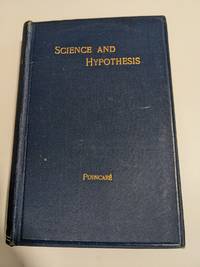
1907017051<p>New York: The Science Press 1907 Book. Good. Hardcover. Good / No Jacket; front hinge split but holding very light rubbing to corners po names on ffep; o/w clean & tight text.</p> The Science Press hardcover
1907000013575New York: The Science Press 1907. First American edition. Hardcover. Very Good. 8vo. 4 iii 1 1-147 1 pp. Navy cloth with a border in blind on each board gold lettering and two gold rules on the spine. Authorized translation with an introduction by George Bruce Halsted. With a special prefatory essay. Part of the Library of Philosophy Psychology and Scientific Methods series edited by J. McKeen Cattell. A moving work from the pioneering polymath. A small concavity to the spine a few pencil annotations. A bookseller's ticket from Ideal Bookstore which was on Amsterdam Avenue in New York City. The Science Press hardcover
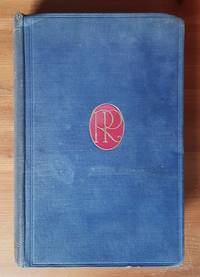
1922206080London UK: Cassell and Company 1922. First English Language Edition. Hardcover. Good/No Dust Jacket Issued. 8vo - over 7¾" - 9¾" tall. Written immediately after the end of the First World War by the former Prime Minister and President of France. Atudy of the long-term causes of the First World War. 276pp. Blue cloth boards with author's initials in gilt on upper board and gilt lettering to spine. Blue cloth boards faded to spine small nick to cloth at the head of the spine. Corners bumped and shelf wear to cloth. Ex-Farnborough Abbey library copy with stamp on fixed endpaper and name written on free endpaper. Heavy foxing to endpapers. Text block in very good order. . Cassell and Company hardcover
192212874London: Cassell and Company Limited 1922. fair ex-lib. 276 footnotes index boards weak lib stamps pocket & barcode binding shaken boards & spine scuffed stained & scratched. Board corners somewhat bumped library call number on spine board and spine edges worn small tears at top of spine. The author was President of the French Republic from 1913 to 1920. Cassell and Company, Limited hardcover
1922c27689Cassell 1922. Hardcover. Very Good. 8vo - over 7¾ - 9¾" tall. Cover faded on spine. Bookplate and matching Ink signature on fixed front endpaper. Some foxing to endpapers and prelims. <br/> <br/> Cassell hardcover
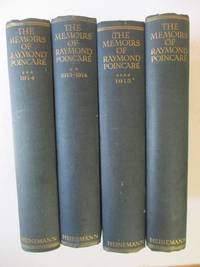
1926green161177William Heinemann. Very Good. . 1926 1st ed 4 volume set clean boards no dustjacket contents clean & bright no markings bindings tight Professional booksellers since 1981 . 1926. Hardcover. William Heinemann hardcover
1929170615Garden City New York: Doubleday Doran & Company 1929 & 1931. First US editions in English first printings presentation copies inscribed by the author on the half-title of each volume respectively "À Mr Aage Birger Nilsen R. Poincaré" and "À Monsieur Aage B. Nilsen Hommage de l'auteur R. Poincaré". Poincaré 1860-1930 served as President of France from 1913 to 1920. Prior to the war he was noted for his anti-German policy and shifting the Franco-Russian alliance to an offensive posture. During the war he maintained a belligerent position though from 1917 was increasingly sidelined by prime minister Clemenceau who led the Versailles negotiations. Poincaré's memoirs were published in French in 11 volumes. In total four volumes appeared in English: two volumes published in 1926 which covered 1912 and 1913 and these marked as volume III and IV taking the narrative through to the end of 1915. Although in French Poincaré's memoirs cover the entirety of the war these were the only volumes published in English. They were published in the US and UK the same years. The recipient Nilsen acquired the signatures of various prominent figures in the 1920s including Winston Churchill and George Gershwin; there are references to him as a military attaché and railroad executive. 2 vols octavo. Original blue cloth spines lettered in gilt. With dust jackets. Unclipped jackets with a hint of rubbing and soiling: fine copies in near-fine jackets. hardcover
19752344556New York: AMS Press 1975. Reissue. Hard Cover. Near Fine/No Jacket. Minimal cosmetic wear. 1975 Hard Cover. xii 371 5; viii 333 3; viii 2 319 7; xi 1 343 5 pp. 1975 reissue of the 1925 original. A biography by the French statesman who served as Prime Minister and President. This work covers his time patching up Russian relations as well as the July Crisis. AMS Press hardcover
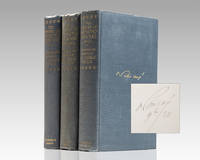
1926151171New York: Doubleday Page & Company 1926-1929. First American edition of this first-hand detailed account of French foreign policy diplomacy and the events leading to World War I. Octavo the first three volumes out of four original publisher's cloth with gilt titles to the spines facsimile signature of Raymond Poincaré stamped in gilt to the front panels tissue-guarded frontispiece to volume one. Boldly signed and dated 1928 by Raymond Poincaré on the front free endpaper of volume one. In very good condition. Translated and adapted by Sir George Arthur. Preface by the Duke of Northumberland K.G. The Memoirs of Raymond Poincaré translated and adapted into English by Sir George Arthur present the reflections of the French statesman who served as President of France from 1913 to 1920 during the critical years of the First World War. Originally written by Poincaré as a detailed political record of diplomacy wartime leadership and international negotiations the memoirs offer insight into the strategic decisions and alliances that shaped the conflict and its aftermath. Sir George Arthur’s English adaptation made these writings accessible to a broader readership preserving Poincaré’s account of French policy his interactions with Allied leaders and his interpretation of the diplomatic tensions that preceded the war. Doubleday, Page & Company hardcover
192970163Garden City N.Y.: Doubleday Doran & Company 1929. First edition. First printing stated. Hardcover. Fair. Cover has some wear staining and soiling. viii 319 1 p. Includes index. Errata slip present. Footnotes. From Wikipedia: "Raymond Poincare ​ 20 August 1860 15 October 1934 was a French statesman who served three times as Prime Minister and as President from 1913 to 1920. He was a conservative leader primarily committed to political and social stability. Trained in law Poincare was elected a Deputy in 1887 and served in the cabinets of Dupuy and Ribot. In 1902 he co-founded the Democratic Republican Alliance the most important center-right party under the Third Republic becoming Prime Minister in 1912 and President in 1913. He was noted for his strongly anti-German attitudes and twice visited Russia to maintain strategic ties. At the Paris Peace Conference he favored re-occupation of the Rhineland which he was able to carry out in 1923 as Prime Minister." Doubleday, Doran & Company hardcover
19075788331Kegan Paul Trench Trubner & Co 1907. This is an ex-library book and may have the usual library/used-book markings inside.This book has hardback covers. In good all round condition. No dust jacket. Please note the Image in this listing is a stock photo and may not match the covers of the actual item650grams ISBN: Kegan Paul, Trench, Trubner & Co hardcover
190546288Berlin Uppsala & Stockholm Paris 1905. 4to. Bound in contemporary half cloth. In "Acta Mathematica Hrsg. von G. Mittag-Leffler." Bd. 29. Entires issue offered. Fine and clean. Pp. 235-272. Entire volume: 4 433 pp. <br/><br/><em>Second of this paper in which Poincaré comments on the Swedish astronomer work.The offered issue contain many other papers by contemporary mathematicians. </em> hardcover
190549615Berlin G. Reimer 1905 4to. Bound in contemporary half cloth with gilt lettering to spine. In "Acta Mathematica" Vol 29 1905. Entire volume offered. Stamps to title page otherwise a fine and clean copy. Pp. 235-72. Entire volume: 4 433 pp. <br/><br/><em>First printing of Poincaré's final and most extensive paper on Gyldén's horistic methods. </em> hardcover
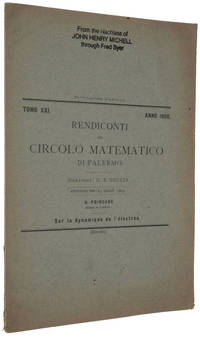
19064926Palermo: Tipografia Matematica 1906. First edition. <p>First edition extremely rare offprint of this crucial paper submitted in July 1905 which many historians believe entitles Poincaré to a share with Einstein and Lorentz of the credit for the discovery of special relativity. Poincaré shows that the Lorentz transformations form a group and that the Maxwell-Lorentz electron theory is invariant under this so-called 'Lorentz group'. Poincaré also puts forward a relativistic theory of gravity.</p>. THE SPECIAL THEORY OF RELATIVITY. <p>First edition extremely rare separately-paginated offprint of this crucial paper in the development of the special theory of relativity in which Poincaré showed that the Lorentz transformations form a group and that the Maxwell-Lorentz electromagnetic theory is invariant under this 'Lorentz group' when augmented by space and time translations it becomes what is now known as the 'Poincaré group'. "The development of mathematics in the nineteenth century began under the shadow of a giant Carl Friedrich Gauss; it ended with the domination by a genius of similar magnitude Henri Poincaré. Both were universal mathematicians in the supreme sense and both made important contributions to astronomy and mathematical physics . Poincaré was active in the discussions concerning Lorentz's theory of the electron from 1899 on; Poincaré was the first to observe that the Lorentz transformations form a group . and many physicists consider that Poincaré shares with Lorentz and Einstein the credit for the invention of the special theory of relativity" DSB. "In 1905 1906 and 1908 Poincaré published three important papers on the dynamics of the electron. Of these the first is a note in the Comptes Rendus submitted 5 June that summarizes the second paper submitted 23 July 1905 the offered paper in which Poincaré introduced the Lorentz group" Gray pp. 361-362. In these papers "Poincaré mentions the negative result of Michelson's experiment and concludes that 'this impossibility to prove absolute motion appears to be a general law of nature.' He then sets out to demonstrate that the transformations of the electromagnetic field equations which he calls 'the Lorentz transformations' form a group. But there is more: he closes his article by wondering about the effect of the Lorentz transformations on forces in general and in particular on gravitation. It is a question that Einstein would not ask until 1907 and which would lead him to general relativity. In that same article Poincaré assumes that gravitation propagates 'at the speed of light' and introduces the idea of a 'gravitational wave' . the Frenchman lays the foundations of a theory of gravitation that in his own words 'would not be altered under the group of Lorentz transformations' that is to say it would be 'Lorentz invariant.' Moreover in the same article Poincaré introduces time as a fourth imaginary coordinate as well as the four-dimensional approach which Minkowski would make precise in 1908 without mentioning Poincaré" Eisenstaedt p. 35. "Poincaré undoubtedly discovered many of the ideas that now form our mental picture of the theory of special relativity and associate with the name of Einstein. In his analysis of the relativistic nature of investigations into space and above all time he discussed how different observers can compare time measurements by exchanging light signals he called for a new physics in which the speed of light is an impassable limit and he came up with the Lorentz group - all of this independently of Einstein and mostly before him. He was indeed well ahead of Einstein in speculating about a truly relativistic theory of gravity" Gray p. 368. Poincaré's paper was the first to demonstrate the power of symmetry or invariance principles in physics. "One hundred years after Poincaré proposed the symmetry principle for all physical laws under uniform relative motion symmetry principles in physics have transcended both kinetic and dynamic properties and are at the very heart of our understanding of the universe" Hsu & Zhang p. xxii. We have located three institutional copies Deutsches Museum Max Planck Institut Rice University. No copies in auction records.</p> <br /> <p>"When in the early 1890s Hertz and Heaviside perfected Maxwell's electrodynamics of moving bodies they noted that it was incompatible with Fresnel's theory of aberration but decided to postpone further study of the relation between ether and matter. Unknown to them Lorentz had long ago reflected on this relation and reached conclusions that sharply departed from Maxwell's original ideas. Unlike Maxwell's British disciples Lorentz learned Maxwell's theory in a reinterpretation by Hermann Helmholtz that accommodated the continental interpretation of charge current and polarization in terms of the accumulation flow and displacement of electric particles" Darrigol 2005 p. 7.</p> <br /> <p>"By 1878 Lorentz had arrived at an understanding close to that upon which his later electron theory was founded: charged harmonic oscillators exist within ponderable molecules and the ether in intermolecular spaces retains the same properties as it has in a vacuum. Through the 1880s Lorentz continued to be concerned with molecular physics but chiefly in the context of the mechanical theory of heat. Prompted by Hertz's critique of Maxwell's theory as it applied to bodies in motion Lorentz returned to the foundation of electrodynamics in the early 1890s . In 1892 he published his first statement of the electron theory La theorie électromagnétique de Maxwell et son application aux corps mouvants" McCormmach pp. 461-462. </p> <br /> <p>According to Lorentz's theory the ether is stationary and is not dragged along by bodies moving through it so the earth has an absolute velocity relative to the ether. The question was whether or not the earth's absolute velocity is detectable through optical or electromagnetic effects of the accompanying ether 'drift' or 'wind'. The magnitude of the effects of the wind is measured theoretically by the ratio of the speed of the earth's motion v to the speed of light c. The ratio is small for the earth but not so small as to be beyond the reach of observation. The effects of this wind however were not observed and for his theory to be credible Lorentz had to explain their absence. Lorentz studied these questions in detail in his Versucheiner Theorie der electrischen und optischen Erscheinungen in bewegten Körpern 1895. "He showed that according to the theory an unexpected compensation of actions eliminates all effects of the ether wind to first-order approximation i.e. neglecting terms involving the very much smaller second and higher powers of v/c. He analysed the absence of first-order effects of the ether wind in phenomena such as reflection refraction and interference with the aid of a formal 'theorem of corresponding states'. The theorem asserts that to first-order accuracy no experiments using terrestrial light sources can reveal the earth's motion through the ether. By introducing transformations for the field magnitudes and spatial coordinates and a 'local time' Lorentz showed that to first-order approximation the equations describing a system in a moving reference frame are identical with those describing the corresponding system in a frame at rest in the ether for which Maxwell's equations hold exactly" Jungnickel & McCormmach pp. 233-235. "At the end of his treatise Lorentz acknowledged that his corresponding states theorem could not account for the second-order null effect of the Michelson-Morley experiment. He referred to his calculation earlier in the treatise of the influence of translation on the electric i.e. electrostatic force. If he argued the molecular forces are influenced in the same way as the electric force then a ponderable body such as the arms of Michelson's interferometer must contract in the direction of the earth's motion in a ratio of √1 - v2/c2 in order that its molecular configuration remain in equilibrium" McCormmach p. 471. This contraction was exactly what was required to explain the null result of the Michelson-Morley experiment.</p> <br /> <p>"Poincaré had been teaching electrodynamics at the Sorbonne for several years. After reviewing the theories of Maxwell Helmholtz Hertz Larmor and Lorentz he judged that the latter was the one that best accounted for the whole range of optical and electromagnetic phenomena. Yet he was not entirely satisfied with Lorentz's theory because he believed it contradicted fundamental principles of physics . the principle of relativity the principle of reaction and the principle of least action . Lorentz's theory satisfied Poincaré's relativity principle only approximately and did so through what Poincaré called two 'coups de pouce' 'fudges': the local time and the Lorentz contraction. Moreover it violated Poincaré's reaction principle . Lorentz took some of Poincaré's criticism seriously. In 1904 he offered a new version of his theory in which the invariance of optical phenomena held at every order in v/c without the 'coups de pouce' reproached by Poincaré" " Darrigol 2005 p. 9.</p> <br /> <p>"Poincaré reacted enthusiastically to Lorentz's memoir because he saw in it an opportunity to satisfy the relativity principle in a complete and exact manner. He published the results of the ensuing reflections under the title 'Sur la dynamique de l'electron' first as a short note of 5 June 1905 in the Comptes Rendus and as a bulky memoir in the Rendiconti of the Circolo matematico di Palermo for the following year" Darrigol 2005 pp. 9-12.</p> <br /> <p>"He first defined the 'relativity postulate' as follows:</p> <br /> <p>'It seems that the impossibility of experimentally detecting the absolute motion of the earth is a general law of nature; we naturally incline to assume this law which we shall call the Postulate of Relativity and to do so without any restriction.'</p> <br /> <p>"Correcting Lorentz's expression of the transformed source terms he then showed that the Lorentz transformations . left the Maxwell-Lorentz equations invariant . Poincaré showed that they formed a group . He noted that the coordinate transformations left the quadratic form x2 y2 z2 - c2t2 invariant and could thus be regarded as rotations in a four-dimensional space with an imaginary fourth coordinate. He obtained the relativistic law for the addition of velocities for which the combined velocity always remains inferior to the limit c.</p> <br /> <p>"Next Poincaré showed that a model of the contractile electron could be conceived in which the cohesive forces the so-called Poincaré tension preserved the Lorentz invariance. He thus retrieved Lorentz's expression for the momentum of the electron. Lastly he argued that in order to be compatible with the postulate of relativity gravitational interactions should propagate at the velocity of light; and he proposed modifications of Newton's law of gravitation that made it compatible with Lorentz invariance. </p> <br /> <p>"Thus there is no doubt that Poincaré regarded Lorentz invariance as a general requirement for the laws of physics and that he identified this formal condition with the principle of relativity" ibid. p. 12. </p> <br /> <p>In paragraph 1 of the Rendiconti paper Poincaré wrote Maxwell's equations in potential form and in units in which c = 1. He observed that if in one coordinate frame one has a sphere such as an electron moving at constant velocity then in a second frame moving at constant velocity relative to the first the sphere will be seen as an ellipsoid the shape of which depends on the velocity of the sphere. He next obtained the components of the electric and magnetic fields in the new frame and observed that Maxwell's equations were still satisfied. He also wrote down the new addition law for velocities. In paragraph 2 Poincaré stated a version of the principle of least action and used it to deduce a formula for the pressure on an electron. In paragraph 3 he then showed that a Lorentz transformation leaves the action unaltered and so re-obtained the Lorentz invariance of Maxwell's equations. In paragraph 4 Poincaré shows that the Lorentz transformations form a group. In paragraph 5 Poincaré used his theory of Lorentz transformations to rederive the Langevin waves that describe the electromagnetic field produced by a single moving electron. In paragraph 6 he considered the much-discussed topic of the Lorentz contraction of electrons. In paragraphs 7 and 8 Poincaré returned to the question of whether the contraction hypothesis makes it impossible to detect motion. He showed that the true reason that absolute motion cannot be detected using electromagnetic phenomena is that the Lorentz transformations form a group and that Maxwell's equations are invariant under it. In paragraph 9 he considered the possibility of detecting absolute motion using phenomena that were not of electromagnetic origin such as gravitation. He considered the effect of a Lorentz transformation on any function of time position and velocity. He further assumed that any suitable law of attraction would reduce to Newton's law for bodies at rest and would not disagree with astronomical observations of slowly moving objects. He looked for invariants under the Lorentz group and found that if speeds faster than light are allowed then time can pass negatively. He excluded this possibility and deduced that he was left with the proposition that gravity would travel at the same speed as light. He noted that as the deviations from Newton's laws are of second order in the ratio v/c they will be difficult to observe.</p> <br /> <p>"To sum up in 1905/6 Poincaré obtained a version of the theory of relativity based on the principle of relativity and the Lorentz group. He believed this symmetry should apply to all forces in nature. He exploited it to derive the dynamics of the electron on a specific model and to suggest a modification of the law of gravitation. He nevertheless maintained the ether as the medium in which light truly propagated at the constant velocity c and clocks indicated the true time. He regarded the quantities measured in moving frames as only apparent although the principle of relativity forbade any observational distinction between a moving frame and the ether frame. He understood the compatibility of the Lorentz transformations of coordinates with the optical synchronization of clocks and the invariance of the apparent velocity of light but hesitated on the physical significance of the Lorentz contraction and never discussed the dilation of time" ibid. pp. 14-15.</p> <br /> <p>Poincaré's achievements in this paper have led some to argue that he and Lorentz should be considered the true inventors of the special theory of relativity rather than Einstein. "By 1905 Poincaré's and Einstein's reflections on the electrodynamics of moving bodies led them to postulate the universal validity of the relativity principle according to which the outcome of any conceivable experiment is independent of the inertial frame of reference in which it is performed. In particular they both assumed that the velocity of light measured in different inertial frames was the same. They further argued that the space and time measured by observers belonging to different inertial systems were related to each other through the Lorentz transformations. They both recognized that the Maxwell-Lorentz equations of electrodynamics were left invariant by these transformations. They both required that every law of physics should be invariant under these transformations. They both gave the relativistic laws of motion. They both recognized that the relativity principle and the energy principle led to paradoxes when conjointly applied to radiation processes. On several points - namely the relativity principle the physical interpretation of Lorentz's transformations to first order and the radiation paradoxes - Poincaré's relevant publications antedated Einstein's relativity paper of 1905 by at least five years and his suggestions were radically new when they first appeared. On the remaining points publication was nearly simultaneous . The differences between the two theories of Einstein and Poincaré are sometimes regarded as implying different observable predictions even within the domain of electromagnetism and optics. In reality there is no such disagreement for Poincaré's ether is by assumption perfectly undetectable and every deduction made in Einstein's theory can be translated into a deduction in Poincaré's theory . In sum then Einstein could have borrowed the relativity principle the definition of simultaneity the physical interpretation of the Lorentz transformations and the radiation paradoxes from Poincaré" Darrigol 2004. </p> <br /> <p>"In 1919 the mathematician Mittag-Leffler wrote to Einstein asking him to contribute an article to the Acta Mathematica volume in honor of Poincaré. Four months later Einstein responded. The letter had reached him after a long delay and 'it might be too late' now. Mittag-Leffler replied that Einstein could still send a paper if he cared to do so. Two and a half months later Einstein replied that obligations and travel prevented him from contributing adding that his decision 'should be considered as nothing but high respect for the task'.</p> <br /> <p>"In December 1920 a New York Times correspondent interviewed Einstein in his home on the Haberlandstrasse in Berlin. In reply to a question about the origins of relativity theory Einstein said 'It was found that Galilean invariance would not conform to the rapid motions in electrodynamics. This led the Dutch professor Lorentz and myself to develop the theory of special relativity'. An additional mention of Poincaré's pioneering ideas might have been gracious. In an interview with Le Figaro in 1921 he expressed his great admiration for Poincaré however.</p> <br /> <p>"In the early 1950s I once asked Einstein how Poincaré's Palermo paper had affected his thinking. Einstein replied that he had never read that paper. I owned a copy and asked if he would like to borrow that. Yes he said he would. I brought it to him. It was never returned to me. Some time after Einstein's death I asked Helen Dukas if she would please look for it. It had vanished ." Pais p. 171.</p> <br /> <p>Darrigol O. 2004 'The Mystery of the Einstein-Poincaré Connection' Isis 95 2004 pp. 614-626. Darrigol 'The genesis of the theory of relativity' Séminaire Poincaré 1 2005 pp. 1-22. Eisenstaedt The Curious History of Relativity 2006. Gray Henri Poincaré: A Scientific Biography 2012. Hsu & Zhang Lorentz and Poincaré invariance. 100 Years of Relativity 2001. Jungnickel & McCormmach Intellectual Mastery of Nature. Theoretical Physics from Ohm to Einstein Vol. 2 1986. McCormmach 'H. A. Lorentz and the Electromagnetic View of Nature' Isis 61 1970 pp. 459-497. Pais Subtle is the Lord 1982.</p> <br/> <br/> 8vo 257 x 174 mm pp. ii 1 2-48 journal pagination 129-176. Original printed wrappers a little darkened at edges upper outer corner of rear wrapper creased former owner's private ink stamp on front wrapper. A very good copy. [Tipografia Matematica] unknown
190547065Paris Gauthier-Villars 1905. 4to. No wrappers. In: "Comptes Rendus Hebdomadaires des Séances de L'Academie des Sciences" Tome 140 No 23. Titlepage to vol. 140. Pp. 1497- 1572. Entire issue offered. Poincaré's paper: pp. 1504-1508. Titlepage with a stamp on verso. A bit of upper right corner gone. Leaves a bit fragile caused by the poor paperquality. Clean. <br/><br/><em>First printing of this famous paper delivered to the Academy of Paris on its session of June 1905 as the first Poincaré relativistic text "On the dynamic of electron" where Poincaré set forth the essential element of relativity and the "Lorentz Transformation". Poincaré concludes "It seems that this impossibility of demonstrating absolute motion is a general law of nature" !! and that Newton's law need modification and that there should exist gravitational waves which propagate with the velocity of light !! - This famous paper gave rice to the controversy about priority around the discovery of special relativity as Poincaré's paper is from June 5 and Einstein's first paper on relativity was received by the "Annalen" on June 30 both 1905."The official history tells us that Einstein without having read the works of Lorentz and Poincaré past 1895 and without any prior publication on the subject had written alone in Bern the "founder paper" of the Relativity in the last days of June 1905. For that reason and a few other of less importance the biographers of Einstein have called that year 1905 "Annus mirabilis" and its centenial is celebrated in 2005. However on June 5 1905 after many other papers on this subject Poincaré had presenteda note at the French Academy of Science a text that contains the essential elements of Einstein paper: the relativity principle and the "Lorentz transformation". This coincidence involves the suspicion of a possible plagiarism of Poincaré by Einstein." C. Marchal "Poincaré Einstein and the Relativity: the Surprising Secret." </em> unknown
190849616Berlin Stockholm Paris Almqvist & Wiksell 1908. 4to. Bound in contemporary half cloth with gilt lettering to spine. In "Acta Mathematica" Vol 31 1908. Entire volume offered. Stamps to title page otherwise a fine and clean copy. Pp. 1-64. Entire volume: 8 408 2 12 pp. <br/><br/><em>First appearance of Poincaré's important paper in which he presented the first solution to the problem of the uniformization of curves - now know as The Uniformization Theorem. Clebsch and Riemann tried to solve the problem of the uniformization for curves. "In 1882 Klein gave a general uniformization theorem but the proof was not complete. In 1883 Poincaré announced his general uniformization theorem but he too had no complete proof. Both Klein and Poincaré continued to work hard to prove this theorem but no decisive result was obtained for twent-five years. In 1907 Poincare in the offered paper and Paul Koebe independently gave a proof of this uniformization theorem.With the theorem on uniformization now rigorously established an improved treatment of algebraic functions and their integrals has become possible." Morris Kline. </em> hardcover
190739130Berlin Stockholm Paris Almqvist & Wiksell 1907. 4to. Without wrappers as extracted from "Acta Mathematica. Hrsg. von G. Mittag-Leffler" Bd. 31 pp. 1-63. <br/><br/><em>First edition. Clebsch and Riemann tried to solve the problem of the uniformization for curves. "In 1882 Klein gave a general uniformization theorem but the proof was not complete. In 1883 Poincaré announced his general uniformization theorem but he too had no complete proof. Both Klein and Poincaré continued to work hard to prove this theorem but no decisive result was obtained for twent-five years. In 1907 Poincare in the offered paper and Paul Koebe independently gave a proof of this uniformization theorem.With the theorem on uniformization now rigorously established an improved treatment of algebraic functions and their integrals has become possible." Morris Kline. </em> unknown
1930feb34263Ernest Flammarion 1930. Used. 1930; Romanian Edition of Science et methode; For more details please contact me Ernest Flammarion unknown
190714091907 Walter Scott/Charles Scribners first edition/1st printing<br /><br />A rather shabby and worn hardcover with <b>LOTS</b> of foxing to endpapers and preliminary pages. Textblock pages are largely free of foxing but for a few sporadic pages.<br /><br />Pages are age toned<br /><br />Though the binding is intact it is weak as shown by the last two photos above.<br /><br />The bookplate of noted mathematician and dean of the graduate school of the University of Wisconsin at Madison Charles S. Slichter is affixed to the front endpaper.<br /><br />No underlining highlighting or notes.<br /><br />2d5<br /><br /> Charles Scribners hardcover
19972080502106917074Not Available 1997. Soft Cover. Fine. The book is in fine condition. Not Available paperback
19872081402110002501Iwanami bunko 1987. Soft Cover. Fine. Number of books: 1 Iwanami bunko paperback
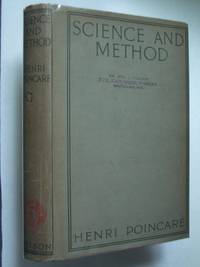
1914x1364London: Thomas Nelson & Sons 1914. Essays by the important French mathematician and philosopher of science published shortly after his death in 1912 - Russell's preface notes a 1913 publication and the rear jacket panel offers this book among others as "New Books published.on April 15 1914." Includes sections on the scientific method mathematical reasoning & logic new physics and its relation to radium optics astronomy; astronomical science. Hardcover in jacket as pictured. Light wear to book rubberstamp of long-time Waterloo Wisconsin doctor on title page & jacket front; jacket also shows light edgewear scuffing & stain to spine; minir spotting to page edges. Laid in is a gift card from the Jackson Clinic location uncertain. Text clean; 288 pages. First Edition in English. Hard Cover. Very Good/Good. Duodecimo. Thomas Nelson & Sons Hardcover