[Scotland] [Highland Potato Famine]Biblio.com
5 résultats
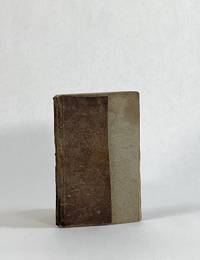
184897631848. Full Leather. Good binding. 5-1/4" x 3-3/8." 108 pp. Full brown leather over flexible boards. Vertical red rules for accounting printed on each page. 1-3/8" strip of leather neatly removed from the fore-edge of the front cover; occasional ink spotting and minor stains throughout; toned leaves with a few creases; faded pencil calculations to pastedowns. <br /> <br /> Interesting mid-19th century farm ledger apparently from eastern Scotland possibly Inverurie or Aberdeen recorded during the great famines in Ireland and the Scottish Highlands. The currency symbols at the top of the expense and income columns appear to be in pounds shilling and pence and various place and personal names which appear repeatedly in the text – i.e. Commercial Co. of Port Elfinston sic Aberdeen Wm. Duncan et al – lead to our deducing this locale. Although the ledger is anonymous the names of Robert Frasier Brach and James Dugard appear possibly as business clients as do the names of the recorder's many temporary workers. These workers usually hired around the planting and harvesting season are both male and female and include Mary Ellice Jas Marr George Dugard Wm. Duncan Alex Burr and many others. <br /> <br /> Extensively detailed and highly readable this ledger document the many expenses and income sources of a working farm showing precise amounts for equipment scythes and carts feature prominently horses bolls of meal barrels of lime whisky and various other sundries. The farm's produce relied heavily on grains especially corn and barley just as the Corn Laws were being heatedly debated in Parliament and its overall diversity demonstrates the crop diversity that allowed eastern Scotland and the Lowlands to evade the ravages of the potato blight; plots and crops for planting the "slack land" are also demarcated. Charts showing daily employee wages are also of special note. <br /> <br /> Overall a unique useful and well-maintained agricultural document concurrent with and standing in stark contrast to the devastation occurring in the western portion of the country and Ireland at that time. unknown
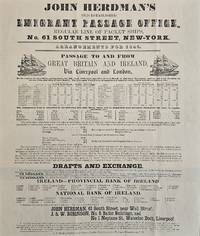
1845List2995New York City 1845. Two printed pages measuring 9 ¾ x 11 ½ inches one signed. Folded and slightly wrinkled near fine. A circular advertising passage between Great Britain and Ireland and numerous locations in the United States from Boston to New Orleans by a regular packet ship service managed by John Herdman and Company. The company also offered remittances whereby an individual in the US could send money to a friend or relative back across the Atlantic generally to pay for their passage to the States.<br /> <br /> The second sheet a signed letter offers a commission for finding customers: five percent of the passage fare and one percent of the remittance money. In 1845 the Great Famine in Ireland was just beginning and Ireland would lose a large proportion of its population not just to starvation but also to emigration. Earning commission on remittances could have been quite lucrative: the National Museum of Ireland estimates that the amount sent back to Ireland in remittances between 1845 and 1854—the height of the famine—reached $19 million. unknown
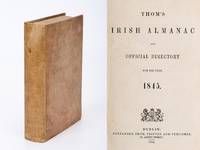
184529909AB1845. First Edition. Dublin Alexander Thoma 1845. Octavo 13 cm x 18.5 cm. VIII 906 pages. Original Hardcover Publisher's blindstamped cloth with gilt lettering and ornament to spine. Very good and firm condition with some minor signs of wear only. This is one of the most important and rarest sources for Statistics in Ireland in 1845 and one year prior of The Great Famine Gorta Mór / Irish Potato Famine. Thorough Statistics in Thom's Almanac for the Famine-years 1844 and 1845 in this Volume show for example: Page 180: "The Poor Law Act came into operation in 1839 but none of the Workhouses were opened for the reception of paupers till 1840 in which year 4 were opened in 1841 34 were opened in 1842 54 and in 1843 14 and in 1844 7; remaining to be opened prior to 1845: 17." Folding Tables show "Name Situation Extent Number of Electoral Divisionsand of Guardians in every Union in Ireland; also the Number for whom House Accommodation has been provided the Data of opening of every Workhouse with the number in each on 1st of January 1844 the average Number relieved daily etc. etc." Statistics show List of Articles Imported and Exported Net Produce of Molasses Hemp Rice as well as Exports of Corn Grain Lard Horses etc. The Statistics are detailed and thorough and list results from Skibbereen to Belfast. The Almanac also lists in detail for example: Tables for finding the rising and setting of Sun and Moon / Lighthouses on the Coast of Ireland / Fairs now held in Ireland / Stamp Duties / Corn Duties / Table of Irish and British Money / Bill Card for 1845 / Courts of Law / Governors of Colonies / Scotland Officers of Crown and State / Peerage / Peerage of Ireland with alphabetical Index / Knights of St.Patrick and Officers / Baronets of Ireland / Knights Bachelors in Ireland / Ancient Irish Titles retained by desendents / Foreign Titles borne by residents in Ireland / Knights of British & Foreign Orders in Ireland / Statistics of Ireland: Railways / Poor Law Statistics / Populations of Towns Skibbereen in West Cork showing for example: 4715 / Dunmanway: 3086 / etc. etc. hardcover
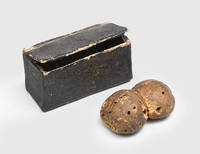
1817127400Germany: 1817. A relic from the Year Without a Summer This small "Hungersemmel" produced in German-speaking countries during the famine of 1816-17 illustrates the severity of the food shortage. It was kept as a memento of the hardship as the accompanying note explains: "This 2-penny bun is from the expensive time of the year 1817 stored here as a memorial on the 12th of July. Paid by Carl Weißenbach" our translation. The price of such famine buns remained unchanged throughout the period but their size decreased as the stock of flour dwindled. Bakers supplemented their scarce flour with inedible material such as sawdust straw and tree bark and added whiteners such as alum chalk gypsum and burnt bones Angerer p. 165. They were often passed through families to remember the dead although some public institutions such as churches and town halls also displayed them. The famine resulted in the first wave of German emigration in the 19th century with many fleeing to Poland Russia and the United States. "Hunger pastries" are scarce survivals. The Museum der Brotkultur in Ulm holds five similar examples. Four more are traced in the Historical Museum in Regensburg and two in the Gerätemuseum in Ahorn near Coburg Angerer p. 162. The note in German reads: "Diese 2-Pfennigsemmel ist von der theuren Zeit des Jahres 1817. Als Andenken hierin aufbewahrt am 12. July. Von Carl Weißenbach bezahlt". Dried bun 60 x 40 x 25 mm accompanied by a folded manuscript note in German. Housed in a contemporary black card box. Bun darkened and with some expected damage including insect; manuscript note browned finger-stained and with a 20 mm tear; box worn. In good condition. Birgit Angerer Gutes Wetter - Schlechtes Wetter 2013; Dorothee Bayer O gib mir Brot: Die Hungerjahre 1816 und 1817 in Württemberg und Baden 1966. unknown
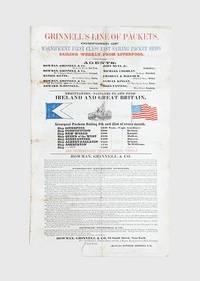
1850183852New York: Bowman Grinnell & Co. c.1850s. Fleeing to a new life in America An advertising poster assuring American patrons that Bowman Grinnell & Co. could be trusted to relocate their relatives from Ireland in comfort. The advertisement lists the addresses of the company's agents the names of their ships and the procedures for emigrating from Ireland. Throughout the Great Famine of 1845 to 1852 many companies took advantage of emigrants' desperation to force them to travel in overcrowded and understocked vessels and coffin ships or to scam them out of their money. As printed on this item "Bowman Grinnell & Co. have seen and witnessed with feelings of regret for a long time that something was necessary for the protection of the Irish people in the United States sending their remittances to their friends in Ireland. from the numberless disappointments they have lately met with and in many instances the heartless frauds that have been practiced on them by parties professing to bring them out on ships over which they had no control or with which they had no connexion". Bowman Grinnell & Co. was formed in the 1850s by William Bowman and Robert Minturn Grinnell of the Grinnell Minturn & Co. shipping line owners of the famous Flying Cloud clipper ship. It claims that their ships listed with their captains' names were fast well-ventilated and comfortably furnished that their drafts could be cashed anywhere in Ireland and that baggage would be transported for free. Single sheet 444 x 265 mm printed in red black and blue on one side only vignettes. Ink number on verso 19th-century pencil inscription on lower right corner. Sometime folded loss on lower left corner barely affecting printed area light toning and soiling especially on verso: a very good copy of an ephemeral item. unknown