[PARLIAMENTARY REFORM]Biblio.com
4 résultats
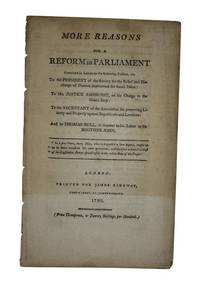
1793AQ34964London: Printed for James Ridgway 1793. 15pp 1. Disbound with title detached. Leaves browned light spotting and staining. The first edition thus which includes four anonymous letters which had previously been published in periodicals printed by political publisher and radical sympathiser James Ridgway 1755 – 1838. . First edition. 8vo. Printed for James Ridgway unknown
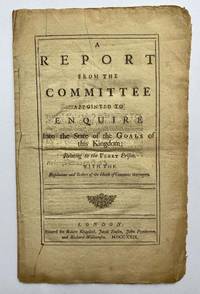
17292445<p><i>Folio 333 x 205 mm pp. 2 20 title-page in double ruled border E2 badly crumpled some light browning and a few pages a little dog-eared</i><i> uncut and stab-sewn as issued: generally a good copy in original state.</i></p><p>Issued as a parliamentary paper and ordered to be printed on 20th March 1729 this is one of three reports of the Committee set up to investigate the state of prisons. It was read and presented to the Commons by James Oglethorpe and was probably largely written by him. Oglethorpe was an important pioneer of prison reform whose name deserves to be remembered alongside that of his much better known successor John Howard.</p><p>The report shows that the Warden of the Fleet Prison disregarding the changes in the statute regarding the Fleet had continued to exercise 'an unwarrantable and arbitrary power' not only by charging exorbitant fees but by loading prisoners with chains in a manner more cruel and unjustifiable than that practised in the Star-Chamber. Money was extracted from prisoners at every opportunity: any prisoners who could not afford to pay for bedding were obliged to sleep on the floor in foul conditions and the warden would not attend to the forms necessary to discharge a prisoner unless he received the fees he demanded with the result that numerous prisoners were kept several years after they should have been discharged. </p><p>It was Oglethorpe's investigations into the state of prisons and his shocking findings that led him to study the social conditions of his day including unemployment and paved the way for his important Georgia Experiment a policy prohibiting the ownership of slaves in the Georgia Colony see Leslie F. Church Oglethorpe: a study of philanthropy in England and Georgia pp. 9-24.</p>ESTC t44667; Hanson 4022; Goldsmiths 6707 Robert Knaplock, Jacob Tonson, John Pemberton and Richard Williamson
177445029Leipzig Siegfried Lebrecht Crusius 1774. Bound in 2 very fine contemp. full calf raised bands richly gilt spines. Title-and tomelabels in leather on spines with gilt lettering. gilt border on all covers. Blindtooled decorations on covers in Cambridge-style "mirror-binding". Edges gilt. Stamp on foot of titlepages. 22312;16296 pp. and 11 folded engraved plates. Light browning to some quires and to top of titles otherwise fine. <br/><br/><em>Scarce first edition of the famous German educators mathematical textbook - his suggestion to how mathematics should be taught in his educational reform. Basedow’s views were based on the writings of men such as John Amos Comenius John Locke and Jean-Jacques Rousseau. His practical teaching methods were more expansive in their implications for education than those of any of his immediate predecessors in the field and by the early 19th century they had become a fundamental force in Germany’s public school systems.Basedow blev i 1753 ansat af J.H.E. Bernstorff ved Sorø Akademi som professor i moral og de skønne videnskaber. Her kom han bl.a. i forbindelse med den danske oplysningsforfatter og Sorø-professor Jens Schielderup Sneedorff hvis værker han oversatte til tysk. Sneedorff blev selv inspirereret af Basedows pædagogiske idéer. </em> hardcover
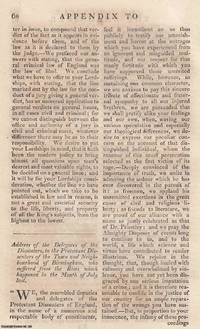
1792365038Annual Register London 1792. Booklet - Unbound Pages. Very Good Condition. The Birmingham Riots of 1791 also known as the Priestley Riots were a violent uprising that took place between July 14 and July 17 1791 targeting religious dissenters'most notably the scientist and theologian Joseph Priestley. The riots were fueled by tensions over support for the French Revolution as Priestley and other dissenters were outspoken in their advocacy for political reform.The violence began when a banquet in support of the French Revolution was held at the Royal Hotel in Birmingham sparking outrage among conservative factions. The rioters attacked Dissenting chapels homes and businesses including Priestley's own residence Fairhill which was burned down along with his scientific equipment and papers. Many rioters became intoxicated while looting and some even perished in fires they had started.The London Corresponding Society founded in 1792 was a radical political organization that sought universal suffrage and parliamentary reform. It was closely linked to the ideals of the French National Convention which had abolished the monarchy and established a republic in France. The British government viewed the society as a threat leading to crackdowns on political dissent and the eventual suppression of radical movements. 21 pages of contemporary reports of the Priestley Riot the trials of rioters and aftermath. Contained in the complete sections of The Chronicle for 1791 and 1792 the History of Europe and other selected relevant pages along with 30 pages regarding the LCS and the Society of the Friends of the People. This is a collection of original articles from The Annual Register not reprints or copy. Size: 13 x 21 cms. Category: Antiquarian & Rare; Special Features; Printed before 1800; Special Features. This item may require more postage than the rates shown for delivery outside the UK. If extra postage is required we will contact you before processing your order and you will be given the details and option to decline the extra cost. Annual Register unknown