Gibbon JohnABAA

35 résultats
1890WRCAM56663N.p. 1890. 19pp. plus an additional nine lines of manuscript note on two other slips of paper. Main text written on 9 3/4 x 7 1/2-inch sheets. Approximately 2500 total words. Several sheets with penciled cross-outs but very easily readable overall. Minor edge wear. Near fine. In a half green morocco and white cloth folding case spine gilt leather labels. An exceedingly interesting and important firsthand account of the planning leading up to the massacre at the Little Big Horn in June 1876 written by Gen. John Gibbon who was involved in the planning and operations and was one of Custer's superior officers. Gibbon and his troops were among the first to arrive at the scene of the battle and helped to bury Custer's dead and evacuate the survivors. <br> <br> A major question surrounding the Custer tragedy was whether or not Custer exceeded or ignored his orders in attacking the Sioux before the arrival of Gibbon and his reinforcements. This manuscript recounts the deliberations conducted by Gen. Alfred Terry and his officers including Custer and Gibbon and gives a great deal of information on the decision-making process the plans at which they arrived and the orders under which Custer was to operate. Gibbon wrote about his experiences in the Sioux Campaign in an 1877 article called "Last Summer's Expedition Against the Sioux and Its Great Catastrophe" which also appeared as a chapter in his posthumously published memoir ADVENTURES ON THE WESTERN FRONTIER. The information in the present manuscript is not included in either of those works however and to our knowledge the present manuscript is completely unpublished. <br> <br> Gibbon begins by explaining that on June 21 1876 he and his 7th Infantry troops were camped on the north bank of the Yellowstone River with Custer and his 7th Cavalry camped on the south bank. He relates that the two separate columns had already conferred three times and were about to meet for a fourth conference all under the supervision of commanding Gen. Alfred Terry. Gibbon writes that at the first conference with Terry he offered Terry the services of his trusted scout Mitch Bouyer who eventually died with Custer's men: "I little thought that I was sending poor faithful Mitch to his death." Gibbon also briefly discusses his second conference with Terry before describing a third conference which took place in Gibbon's tent. At that meeting Terry chastised Major Marcus Reno for "following the Indian trail up the Rosebud instead of at once returning & reporting what he had discovered; thus not only losing precious time but running the risk of being discovered by the Indians." <br> <br> Gibbon continues: <br> <br> "Shortly afterwards Custer's command made its appearance on the southern bank & I accompanied Genl. Terry on the ship Far West across the River & Custer found us on board.We sat down at a table & with a map before us discussed the situation. My Crow scouts had reported seeing smoke in the valley of the Little Big Horn and hence it was inferred there must be a camp of Indians somewhere along that stream. The question discussed was how to approach them & strike them to the best advantage.I think Genl. Terry had already made up his mind when the discussion took place to send Custer with a command to follow up the trail discovered by Reno.In the course of the discussion I proposed the question what would the Indians probably do when they were disturbed." <br> <br> Gibbon goes on to discuss the various questions that were posed and impressions that were given at the meeting. Among these was the presumption that the Sioux would attempt to "escape" rather than stand and fight. Gibbon notes that they were ignorant of the "desperate fight" that Crook had waged at the headwaters of the Rosebud just a few days earlier. <br> <br> Very importantly Gibbon writes: <br> <br> "I suggested it would be advisable for Custer to keep on up the Rosebud; instead of following the trail over into the Little Big Horn valley & after crossing over nearer to the mountains approach the supposed Indian camp from the south. This would not only interpose his force between the Indians & their refuge the Big Horn Mountains but would give my command the requisite time to get up as I had the longest distance to pass over. This was agreed to apparently on the part of all.Custer was directed to examine the head of that valley and endeavor to send a messenger down it to communicate to Genl. Terry news of his progress & any information of importance he may have gained. This was regarded as a matter of some considerable moment as it would bring us news of the other columns & might possibly cause a modification of our movement." <br> <br> Gibbon concludes by discussing Custer's failure to follow his orders and why he may have done so: <br> <br> "It is now a matter of history that Genl. Terry received no message from Custer.nor received any message from him of any kind nor ever saw him again. It is also well known that Custer did not follow the line of march marked out for him at the conference. It is difficult to account for Custer's failure to endeavor to communicate with Genl. Terry as desired.except upon the supposition that when in the vicinity of the head of that valley on the day he struck the Indians camp his mind may have been so engrossed by his preparations for the conflict before him as to cause him to overlook it for the time.His reasons for not conforming to the 'desires' of his Dept. Comdr. as expressed in the letter of instructions can never now be known.This is a case which forms no exception to the general rule which prevails in all well disciplined military bodies that the wishes of the commander are always when possible to be construed as orders." <br> <br> John Gibbon 1827-96 was born in the Holmesburg neighborhood of Philadelphia and attended West Point graduating in 1847. During the Mexican-American War he was stationed in Florida helping to keep the peace between American settlers and Seminole Indians and assisting the evacuation of Seminoles to Oklahoma Territory. This experience kindled in him a sympathy for American Indians that would last the rest of his life. Gibbon taught artillery at West Point and produced an influential treatise on the subject. Despite family ties to the Confederacy he fought for the Union during the Civil War and was involved in many important battles including Antietam. At Gettysburg he led forces against Pickett's Charge and was wounded on Cemetery Hill. Later Gibbon helped block the Confederate escape route at the Battle of Appomattox Courthouse and he was one of the three commissioners who received the Confederate surrender at Appomattox. After the Civil War he commanded an infantry unit in Montana Territory and took part in the 1876 campaign against the Sioux. Gibbon's men were among the first to arrive at the scene of the battle of the Little Big Horn and helped to bury Custer's dead and evacuate the survivors. The following year he led a bloody attack on the Nez Perce led by Chief Joseph at the Battle of the Big Hole. Afterward Gibbon and Chief Joseph would become friends. In 1885 Gibbon now a brigadier general took command of the Department of Columbia and placed Seattle under martial law during the anti-Chinese riots of 1886. Aside from his ARTILLERISTS MANUAL of 1859 Gibbon wrote two other books PERSONAL RECOLLECTIONS OF THE CIVIL WAR and ADVENTURES ON THE WESTERN FRONTIER both published posthumously. <br> <br> An exciting informative and unpublished firsthand account of the planning that preceded the massacre of Custer and his men at the Little Big Horn by one who was intimately involved in the process. hardcover books
1820226145London: Cadell and Davies 1820. hardcover. very good. 12 volumes. Handsome stipple engraved frontispiece portrait and 2 large folding maps. 8vo full contemporary olive green polished calf with green and tan spine labels. London: Printed for Cadell and Davies et al 1820. "A New Edition". A very good clean set in a handsome binding.<br/><br/> Cadell and Davies unknown books
1811161453Edinburgh 1811. hardcover. 12 volumes. Frontispiece portrait and 2 large folding map. Handsomely bound in contemporary full brown calf; gilt-stamped borders and spines with red leather labels; marbled endpapers and page edges leather is rubbed and a bit edgeworn in spots; hinge neatly repaired in two volumes still a quite attractive set. Edinburgh: Printed for Bell and Bradfute et al. 1811.<br/><br/> unknown books
186238586London: John Murray 1862. Hardcover. Very good/No jacket issued. London: John Murray 1862. With Notes by Dean Milman and M. Guizot. Edited with Additional Notes by William Smith. 8 vols. Bound by Bayntun. Illustrated with frontisportrait and maps. 415 425 433 410 415 428 412 434 pp. Hardcover. 8vo. 3/4 green crushed morocco over marbled paper covered boards. 5 raised bands gilt lettering in compartments. Heads heels and corners very lightly rubbed; spines lightly sunned; top edges gilt. interior clean and tight. A nice set. Very good/No jacket issued. Multiple volumes - extra shipping charges apply Insurance required to ship this item. John Murray hardcover books
1804867071804. GIBBON Edward. THE HISTORY OF THE DECLINE AND FALL OF THE ROMAN EMPIRE. Includes MEMOIRS OF THE LIFE AND WRITINGS OF EDWARD GIBBON ESQ. COMP0SED BY HIMSELF. In eight volumes. Philadelphia: William W. Birch & Abraham Small 1804-1805. First American edition. 8vo. Frontis in volume one three fold-out maps. Contemporary full calf with maroon labels with edge decorations. Ink signature of Samuel Trask on each flyleaf. All bindings are somewhat rubbed several have small nicks to the top of the spine spines a bit dry some hinges a bit tender; overall a very good appealing set of the first American edition of a of a landmark historical work in its original presentation. Shaw & Shoemaker 6381 Norton 48; p.102. unknown books
18153586London: A. Strahan and T. Cadell Jun. and W. Davies. 1796; John Murray London 1815. First editions. Quarto 3 volumes. Bound in full brown contemporary leather with gilt tooling and titles to the spine ruling to the front and rear panels inner dentelles. Marbled endpapers. Shortly following Gibbon's death his good friend and literary executor John Lord Sheffield undertook to edit and in 1796 published the first edition of the Miscellaneous Works of Edward Gibbon in order that the reading public have an opportunity to gain a broader insight into the historian and his overall body of work. A. Strahan and T. Cadell Jun. and W. Davies. 1796; John Murray, London hardcover books
18041504743Birtch and Small 1804. 1st Edition. Hardcover. Good/No Jacket. The first American edition of this epic history. 8 volumes. Usually described as 1805 but this has the first four volumes dated 1804 on the title pages. Some front covers detached but can be reattached by any book binder. Appear to be original boards. Spines very worn but could also be original. SHAW & SHOEMAKER 6381 8518. APPLETON'S CYCLOPÆDIA VI p.469. PRINTING AND THE MIND OF MAN 222 ref. NORTON THE WORKS OF EDWARD GIBBON 48. Birtch and Small hardcover books
1887403456London: John Murray 1887. 8 volumes 8vo. Frontispiece portrait in vol. 1 by Sir Joshua Reynolds 12 folding maps. Near-contemporary brown half morocco marbled boards top edges gilt by Little Brown & Co. A near-fine set with a few trifling areas of wear at ends of spines two bumps to board edges several minor creases to folding maps. Provenance: James Ford Rhodes 1848-1927 American industrialist and historian signatures on titles of vols. 1 and 2 dated 1897 annotations; Felix O. Matton bookplates. A FINE SET EXTENSIVELY ANNOTATED BY THE AMERICAN INDUSTRIALIST AND HISTORIAN JAMES FORD RHODES who signed the first two titles in pencil and dated them in 1897; he notes in several volumes that he completed reading them in 1898-99. Rhodes's pencilled underlinings in the text and densely written pencilled notes on the front and rear endleaves and on two titles show a close reading of this edition of Gibbon's text. There are in total 70 pages of notes on the endleaves all in the first six volumes as follows: v.1: 11pp; v. 2: 13pp and extensive notes on 7 pages of the table of contents; v.3: 14pp; v.4: 15pp; v.5: 7pp; v.6: 3pp all at end. The Cleveland-born Rhodes earned his fortune in iron coal and steel and retired from business in 1885 afterwards dedicating himself to historical research. His 8-volume 'History of the Civil War' won the Pulitzer Prize in 1918. Rhodes expressed his admiration for Gibbon in 1899 soon after his reading of this set: "To my mind one of the most charming things in historical literature is the praise which one great historian bestows upon another Gibbon speaks of 'the discerning eye' and 'masterly pencil of Tacitus-the first of historians who applied the science of philosophy to the study of facts' 'whose writings will instruct the last generations of mankind.' He has produced an immortal work 'every sentence of which is pregnant with the deepest observations and most lively images.' I mention Gibbon for it is more than a strong probability that in diligence accuracy and love of truth he is the equal of Tacitus. Gibbon's work has richly deserved its life of more than one hundred years a period which I believe no other modern history has endured. Niebuhr in a course of lectures at Bonn in 1829 said that Gibbon's 'work will never be excelled'" Rhodes paper presented at the annual meeting of the American Historical Association in 1899. Published in: Annual Report of the American Historical Association 1899 56-63. <br/><br/> John Murray hardcover books
1838282389London: Cadell 1838. hardcover. very good. A new edition in 8 volumes. Frontispiece portraits and 3 large folding maps. 8vo bound in full brown polished calf ornate gilt-decorated spines with orange & brown morocco spine labels t.e.g. somewhat rubbed. Volume 3 not uniformly bound but with a rustier color and chipped label. London: T. Cadell 1838. Very good.<br/><br/> Cadell unknown books
1828321601London: Printed for T. Cadell et al. 1828. 8 vols. 8vo. Bound in full contemporary polished speckled calf gilt spines neatly laid down. 8 vols. 8vo. Printed for T. Cadell et al. unknown books
1820L57-1630London: Printed for T. Cadell and W. Davies et al 1820. Hardcover. Good. Half calf and marbled paper gilt-stamped lettering on spine all edges marbled. With two nice bookplates on the front paste-down: that of Abel Berland and the armorial bookplate of Sir Francis Lynch Blosse Bar. A working set with lightly rubbed boards some scuffing along joints some cracking at spine tips and corners. <br/><br/> Printed for T. Cadell and W. Davies, et al hardcover books
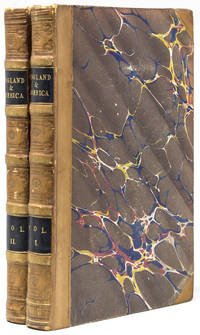
1833247284London: Richard Bentley New Burlington Street 1833. First Edition. xii 331 1; iv 341 1 pp. 2 vols. 8vo. Contemporary quarter tan calf and marbled boards. Ticket of R.E. Narby Bookseller & Printer Warminster. Bookplate. Fine. First Edition. xii 331 1; iv 341 1 pp. 2 vols. 8vo. Founder of the "New Colonization System". Following imprisonment Wakefield began to study colonial affairs of Australia with an eye towards immigration. Recognizing that the depressed condition of Australian affairs was due to a lack of efficiency and sensible handling he gathered his theories for correcting the problems and first published them in "A Letter from Sydney" London 1829 under the name Robert Gouger. It was so well done that the author was supposed to be an immigrant. He revised and refined these views for his "New Colonization System" in "England and America" as the chapter the "Art of Colonisation." The theories for his "System" were to abolish free grants of agricultural land requiring a fixed price which would be kept low enough so that a laborer would be able to purchase land after a few years this to reduce the number of ex-convicts laborers from receiving land for which they had no use to regulate immigration and to use tax monies from the rental of grants to bring laborers to the colonies. One of the main results of his publications and efforts was the founding of the National Colonization Society and then the South Australian Association the latter intended to be based upon Wakefield's theories. He was also a close advisor to the Molesworth Committee. On the appointment of Lord Durham to Canada in 1838 Wakefield became interested in that territory and is credited with having greatly assisted Durham with his famous "Report on the Affairs of British North America." He also acted as an adviser to Sir Charles Theophilus Metcalfe in Canada in the 1840's. In 1837 Wakefield had formed the New Zealand Association and spent most of years following directing the affairs of the association from England while his brother William Hayward Wakefield directed and managed it from New Zealand. Kress C3643; McCulloch's "Literature of Political Economy" 1845. p 94; Sabin 100976; Palgrave III p. 648; Goldsmiths' 27890 Richard Bentley, New Burlington Street unknown books
180465139Philadelphia: Published by William Y. Birch & Abraham Small Printed by Robert Carr 1804. First American edition. First published in 1776-1788. Frontispiece portrait engraved by Alexander Lawson after Joshua Reynolds trimmed along lower margin affecting imprint; folding map of "Parts of Europe and Asia adjacent to Constantinople" other map removed and lacking. 8 vols. 8vo. Contemporary sheep red morocco label. Wormholes and trails on a few of the bindings some rubbing light browning of text even lacking the map a very attractive copy in two cloth open end cases. First American edition. First published in 1776-1788. Frontispiece portrait engraved by Alexander Lawson after Joshua Reynolds trimmed along lower margin affecting imprint; folding map of "Parts of Europe and Asia adjacent to Constantinople" other map removed and lacking. 8 vols. 8vo. Lawson engraved plates for the first volume of Wilson's "Ornithology" and those in the continuation by Bonaparte. Norton 48 maps and portrait were bound in volumes one and two rather than as noted in Norton. PMM 222 for the first edition Published by William Y. Birch & Abraham Small, Printed by Robert Carr unknown books
185319237Washington: Robert Armstrong & A.O.P. Nicholson 18531854. 8vo 23.2 cm 9.1". 2 vols. I: 414 2 iii 1 pp.; 16 plts. II: x 2 339 1 pp.; 36 plts. <br><br>Original government issue of these "Minute accurate and very interesting accounts of the aborigines of the Andes and the Amazon and its tributaries" Sabin. These two volumes are parts I and II of Senate Executive Document no. 36 32d Cong. 2d sess. consisting of Lieut. Herndon's description of following the Amazon itself and Lieut. Gibbon's account of his travels along the Amazon's tributaries in Peru Bolivia and Brazil.<br>Â Â Â Â Many of the 52 lithographed plates are in duotone; some were done by Ackerman Lithography and some by P.S. Duval & Co. after views of scenery buildings and natives drawn by Lieut. Gibbon. Two volumes of maps not present here were issued separately. <br>Â Â Â Â <br>Â Â Â Â Sabin 31524; Palau 113897. Publisher's textured cloth covers blind-stamped spine with gilt-stamped title; vol. I with spine sunned and cloth chipped at spine extremities; vol. II with corners bumped cloth peeling away from spine and chipped at spine extremities spine with gilt dimmed and small area of unobtrusive discoloration from now-absent label. Front pastedowns each with pencilled owner's name and institutional rubber stamp no other markings; front free endpaper of vol. II starting to tear along inner margin. Mild to moderate foxing and spotting; a few text gatherings unopened. One plate in vol. I with short tear from outer margin turning into a narrow scrape extending about halfway into the upper portion of the image; one leaf in vol. II with tiny portion less than one word affixed to opposing plate. Not a perfect set but a perfectly fascinating one. Robert Armstrong & A.O.P. Nicholson hardcover books
1849WRCAM19970London 1849. xxiv512pp. plus 6pp. of advertisements and errata slip. Modern half calf and marbled boards leather label. Very good. A classic work in the theory of colonization the culmination of Wakefield's attempt at a theory of colonization based upon scientific principles. His ideas influenced colonial officials and practices in Canada Australia and New Zealand and in the latter place Wakefield was instrumental in establishing a permanent British colony. "The importance of Wakefield's achievements in colonial matters can hardly be overestimated. The tangible fruits of his labours are the least part of their result for all subsequent colonial development has followed the direction of his thought" - DNB. FERGUSON 5235. DNB XX pp.449-52. hardcover books
1854WRCAM32262Washington 1854. Two text volumes plus atlas. Text: 4417pp. plus sixteen plates; 12339pp. plus thirty- six plates and two folding maps. Atlas: Two large folding maps. Contemporary cloth gilt-lettered spines. Minor edge wear spines sunned gilt on spines rubbed. Spine of atlas split. Moderate foxing and dust soiling. Contemporary presentation inscription on front pastedown of first volume. Good. The first volume contains the report of Herndon and the second that of Gibbon. The two went to Lima together and Herndon went north to the Amazon while Gibbon navigated rivers in the south. They met in Serpa and sailed together down the Amazon to Para. ".Contains minute accurate and very interesting accounts of the aborigines of the Andes and the Amazon and its tributaries." - Sabin. "This is an excellent book on the regions cited" - Borba de Moraes. PALAU 113897. HILL 803. SABIN 31524. BORBA DE MORAES p.336. hardcover books
183321655London: Richard Bentley 1833. First edition. 331; 341pp. 2 vols. 8vo. Contemporary half calf. Binding wornboards detached but present browning of text some excisions in margins of a few pages including the title bookplates removed with an inscription on both volumes reading "1835/ To be returned in a Fortnight/ Mr. Adam President" else a very good copy. First edition. 331; 341pp. 2 vols. 8vo. Founder of the "New Colonization System". Following imprisonment Wakefield began to study colonial affairs of Australia with an eye towards immigration. Recognizing that the depressed condition of Australian affairs was due to a lack of efficiency and sensible handling he gathered his theories for correcting the problems and first published them in "A Letter from Sydney" London 1829 under the name Robert Gouger. It was so well done that the author was supposed to be an immigrant. He revised and refined these views for his "New Colonization System" in "England and America" as the chapter the "Art of Colonisation." The theories for his "System" were to abolish free grants of agricultural land requiring a fixed price which would be kept low enough so that a laborer would be able to purchase land after a few years this to reduce the number of ex-convicts laborers from receiving land for which they had no use to regulate immigration and to use tax monies from the rental of grants to bring laborers to the colonies. One of the main results of his publications and efforts was the founding of the National Colonization Society and then the South Australian Association the latter intended to be based upon Wakefield's theories. He was also a close advisor to the Molesworth Committee. On the appointment of Lord Durham to Canada in 1838 Wakefield became interested in that territory and is credited with having greatly assisted Durham with his famous "Report on the Affairs of British North America." He also acted as an adviser to Sir Charles Theophilus Metcalfe in Canada in the 1840's. In 1837 Wakefield had formed the New Zealand Association and spent most of years following directing the affairs of the association from England while his brother William Hayward Wakefield directed and managed it from New Zealand. Kress C3643; McCulloch's"Literature of Political Economy" 1845. p 94; Sabin 100976 Richard Bentley unknown books
1827233168London: Talboys and Wheeler; and William Pickering 1827. New edition. Illustrated with maps and a portrait. Printed by D.A. Talboys Oxford. 8 vols. 8vo. Full contemporary tan calf. Bookplate of Fred Robison-Herver. Vol. VIII split hinge several others started. Good only. New edition. Illustrated with maps and a portrait. Printed by D.A. Talboys Oxford. 8 vols. 8vo. Talboys and Wheeler; and William Pickering unknown books
1854207072U.S. Government 1854. hardcover. very good. Case Map. Color lithograph in original brown buckram case. Image measures 9.25" x 5.75".<br/><br/> Case map of two maps pertaining to the Amazon River and it's surrounding area with notes on gold and copper mining. Embossed cloth cover with gilt title. Some wear to spine but both maps are attached. First map is "Map of the Andes" a minimalist chart of altitudes measured by varying boiling points. Measures 17" x 19.75". Second map is "Map Drawn by Lieut. Lardner Gibbon to Accompany His Report" a beautiful map of South America including Bolivia parts of Brazil Argentina and Peru. Includes a side inset of the Rio Mamore in Northern Bolivia to Rio Madeira to Rio Amazon. Measures 18.5" x 28".<br/><br/> U.S. Government unknown books
1900318397Philadelphia: Henry T. Coates & Co 1900. A New Edition. Frontis. 5 vols. 8vo. Bound in contemporary polished tan calf gilt spine marbled sides. Almost fine. A New Edition. Frontis. 5 vols. 8vo. Henry T. Coates & Co unknown books
1840044214Paris: Baudry's Eureopean Library 1840. Early Edition. Hardcover Original Cloth. Good Condition. 8 volumes in brown cloth backed boards. Wear to the cloth with tears and loss on a few of the spines two of the spines laid back down bindings generally sound. Mild to moderate foxing throughout owner stamps on titles. 3 folding maps one with color. Light wear in a few spots tear in one gutter foxed. Size: Octavo 8vo. 8-volume set complete. Quantity Available: 1. Shipped Weight: Over 3 kilos. Category: History; Inventory No: 044214. <br/><br/> Baudry's Eureopean Library hardcover books
1827684591827. London 1827. London 1827. Contemporary Account of a Famous English Case of Forced Marriage Trial. Wakefield Edward Gibbon Defendant. Wakefield William Defendant. Wakefield Frances Mrs. Defendant. The Trial of Edward Gibbon Wakefield William Wakefield And Frances Wakefield: Indicted with One Edward Thevenot A Servant For a Conspiracy and For the Abduction of Miss Ellen Turner The Only Child and Heiress of William Turner Esq. of Shrigley Park in the County of Chester. London: John Murray 1827. xv 303 pp. Interleaved with de-acidifying paper. Octavo 7-1/2" x 4-1/4". Recent library buckram white-stamped title shelf number and library name to spine. Text notably fresh some browning to final leaf and title page which has library marks and stamps. $300. Only edition. The first account of the Shrigley Abduction an 1826 British case of forced marriage by Edward Gibbon Wakefield to the 15-year-old heiress Ellen Turner. The couple was married in Scotland and travelled to France before Turner's father was able to notify the authorities and intervene. The marriage was annulled by Parliament. Wakefield and his brother William were convicted and sentenced to three years in prison. Catalogue of the Library of the Harvard Law School 1909 II:1217. unknown books
1839WRCLIT52593London: John Murray 1839. xvi451112pp. Large octavo. Original publisher's cloth stamped in blind and lettered in gilt. Frontis portrait after Reynolds. Cloth lightly rubbed and soiled with a few faint old splashmarks blank fore-margin of portrait has a light discoloration small nick in inner hinge else a very good copy. First edition of the text as edited by Milman enhanced by his privileged access to the original manuscripts. A decent association copy perhaps with the armorial bookplate of Theodore Roosevelt Jr. on the front pastedown. NCBEL II:1723. NORTON p.196-7. John Murray hardcover books
18534192baWashington D.C: A. Hoen 1853. Book. Good condition. Hardcover. First Edition. Octavo 8vo. 23.3cm blind stamped brown cloth folder spine is tape repaired; no text; First map measures 16 3/4" x 20" topographical map of Andes 7 1/2" tear at fold small tear at other fold; Second map measures 18 1/2" x 28 1/2" folded map including south Peru Bolivia part of Argentina roughly folded 2 small tears at folds; also printed beside larger map 18 1/2" x 4 1/2" Brazil map showing rivers Madeira Mamone 4 1/2" tear at fold; ex libris. Exploration South America Cartography Maps. A. Hoen Hardcover books
187140718New York: Harper & Brothers Publishers 1871. 1st US edition. Not in Sadleir nor in Wolff though OCLC records 6 holding instituions. Original publisher's printed salmon paper wrappers sewn. Wear & soiling to wrappers with spine roll to volume. Spine paper worn with some paper loss & front wrapper nearly detached. A Good copy. 2 141 1 blank 2 pp. Text double column. Adverts first & last two pages. 8vo. 9-3/4" x 6-1/4" <br/><br/>A scarce novel by this British author who Sadleir tells us "was the sentimental counterpart of the sensational Farjeon and in his way as popular. Gibbon was of working class origin and by dogged self-education raised himself first to clerkship then to journalism and finally to the writing of successful fiction." Sadleir XIX C Fiction Vol I p. 139. Harper & Brothers, Publishers unknown books