CASANOVA & LAURENT, PierreBiblio.com
3 résultats
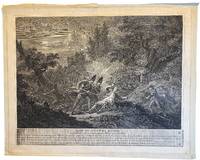
17775251Paris: Castrique 1777. A nice original copy of this antique engraving showing the death of Chevalier D'Assas. Designed by Casanova and engraved by Pierre Laurent. This scarce if rather sombre illustration appeared in two formats. We believe this to be the original format with a later edition dedicated to the King with different text below the engraved image is identical. 36.5cm x 45.5cm tipped onto a slightly larger backing paper. The engraving itself is in good condition. There is a light fold to the centre of the sheet and a small closed tear to the top 2cm of the engraving. Pin holes to the bottom right corner. Overall in clean condition front and verso. The backing sheet is a little tatty to the edges. It is only tipped on by the top edge and could be trimmed or removed. The Battle of Clostercamp Kloster Kampen was a French victory over an Anglo-German army during the Seven Years' War. . Bel exemplaire original de cette gravure ancienne représentant la mort du Chevalier D'Assas. Dessinée par Casanova et gravée par Pierre Laurent. Cette illustration rare quoique plutôt sombre a été publiée en deux formats. Nous pensons qu'il s'agit du format original avec une édition ultérieure dédiée au Roi avec un texte différent en dessous l'image gravée est identique. 365 cm x 455 cm collé sur un support légèrement plus grand. La gravure elle-même est en bon état. Il y a un léger pli au centre de la feuille et une petite déchirure fermée sur les 2 cm supérieurs de la gravure. Des trous d'épingle sont présents dans le coin inférieur droit. Dans l'ensemble le recto et le verso sont en bon état. La feuille de support est un peu abîmée sur les bords. Il n'est fixé que par le bord supérieur et pourrait être coupé ou enlevé. La bataille de Clostercamp Kloster Kampen est une victoire française sur une armée anglo-allemande pendant la guerre de Sept Ans. Castrique unknown
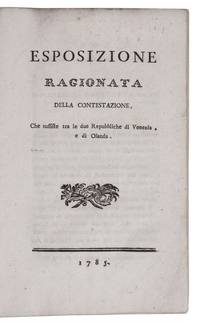
178585NGWX01U79OVienna or Venice 1785. Contemporary blue-grey marbled wrappers. 8vo. With a woodcut vignette on the title page. One of the rare first two Italian editions possibly by the same printer priority uncertain of a diplomatic pamphlet by Giacomo Casanova 1725-1798 famous for his romantic adventures. The work first appeared in French in 1785 with both Italian editions following the same year; Casanova likely translated it himself to publicise the affair and his own role in Venetian political circles.Casanova began his propaganda about the affair with Lettre historico-critique sur un fait connu dependent dúne cause peu connue Dessau 1784 then wrote the "much more extended" Rives Childs present pamphlet in 1785 but it is not clear whether it was published in Vienna or Venice. The French edition appeared under the title: Exposition raisonée du différent qui subsiste entre les deux républiques de Venise et d'Holland. There are two different 1785 Italian editions using much of the same printing materials Rives Childs says the text "appears to be identical" but with different collations: the present A-C8 D12 = 6 ll. LXX 2 blank pp. and the other A-C8 D6 = 30 ll. LX pp. but some catalogues do not distinguish them. Later the same year Casanova also wrote and published a Supplément.The spine is somewhat discoloured a pen marking on the back wrapper. The leaves are slightly creased. Otherwise in very good condition.l Pollio p. 119; Rives Childs Casanoviana XXXII.2 p. 74; WorldCat 3 copies this edition 3 another ed. & 2 ambiguous. unknown
1779ABC_50392Venice 1779. 8vo. Presso Modesto Fenzo Later gold-tooled brown morocco with the title lettered in gold on the spine gold-tooled board edges and turn-ins gilt edges marbled endpapers. With a woodcut illustration on the title page and 1 woodcut initial. 96 pp. Rare first edition of Giacomo Casanovas 1725-1798 sharply polemical booklet dedicated to Doge Paolo Renier 1710-1789 and written in the summer of 1779 while he was convalescing in Abano. Published the year after Voltaires 1694-1778 death the work critiques the celebrated French writer with a mixture of fascination and bitterness. Following point by point the traditional praises read to the French Academy by Voltaires successor Jean-François Ducis 1733-1816 and the Abbot of Radonvilliers 1709-1789 Casanova counters each with such intensity that the effect is often the opposite of praise.The Scrutinio reveals Casanovas complex relationship with Voltaire. Initially captivated by the French philosopher Casanovas admiration evolved into gradual disillusionment after his visits to Les Délices in 1760-61 culminating in the more aggressive critiques of the Confutazione in 1769. On his return to Venice in 1774 possibly acting on behalf of the Inquisitors Casanova openly criticised Voltaires works condemning them as impious morally unsound and even objecting to the way Voltaire had altered his name to include a noble particle. In his Mémoires Casanova reflected on this period with some regret acknowledging that for ten years he had been compelled to critique everything Voltaire produced although he still considered his criticisms justified.The text also provides personal insights into Casanovas life. During his visits to Voltaire in July 1760 he engaged in lively literary discussions including readings from Ludovico Ariostos 1474-1533 Orlando Furioso which he recalled as some of the happiest moments of his life. Although Voltaire was sometimes dismissive of him their exchanges reveal the depth of Casanovas engagement with literature and philosophy. They disagreed sharply on religion: Voltaire regarded it as mere superstition while Casanova maintained that a society without religion could not be happy as people need moral structure even if philosophers resist obedience.Nearly twenty years later while writing the Scrutinio in Abano Casanova reiterated this perspective. The work also presents a slightly different account of his 1760 visit to Les Délices including the episode of Merlin Coccai offering valuable documentary evidence that these meetings actually took place.With a black oval library stamp on the title page G. Romagnoli lid. Est. Bologna from the library of Giovanni Romagnoli 1893-1976 an Italian painter and sculptor from Faenza active in Bologna and internationally who exhibited widely and won several major prizes in the 1920s and 1930s the title page is slightly browned. Otherwise in very good condition.l Rives Childs no. XXIII pp. 43-45; WorldCat 42134255. unknown