7 résultats
1866HALL068301Hardback. 1866. among the Saints John Chrysostom Archbishop of Constantinople Done into English by John Covel John Glen King John Mason Neale and by The Anonymous Translator of 1866. Ed. & notes Stephen G.Hatherly. 128pp 1895. The 4 translations in parallel. VG . hardcover
1897237507Constantinople 1897. 10 x 7-3/4 inches. Mounted. Slightly faded. 10 x 7-3/4 inches. Photo/Wh/2/up unknown
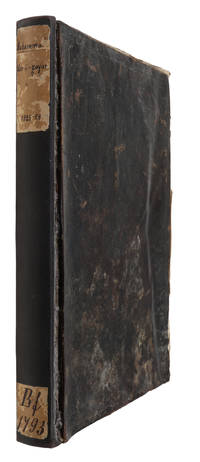
182330930C. H. F. Hartmann. 1823. Hardcover. Good in No Dust Jacket dust jacket. Books rebound in brown marbled boards. Gilt bands and lettering to spines. Ex-library copy with usual stamps. Spines has some edgewear with colour flecking off in places. Corners edgeworn. Some foxing. Ink initials to inner covers.; V1: XII 316 pp. ; V2: 317-750; 2 Volumes in 1 COMPLETE; 1-2; 750 pages . C. H. F. Hartmann hardcover
182851526Constantinople Matbaa-i Amire 1828 1243 h. Small 4to. 22 x 16 cm. Contemp. full calf. with flap. A tear in the flap. Rebacked. Blindtooling to covers and a medaillon on front and back. Covers a bit rubbed. 34259 pp. A small burnmark in inner margins of the last 8 leaves otherwise internally clean and fine. Printed arabic types in Turkish/ Ottoman Turkish. <br/><br/><em>First edition. Esad Effendi Turkish historian born 1790 dead 1848. The work deals with the armed forces hydrology etc. </em> unknown
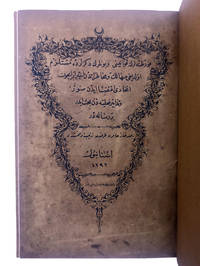
1875055260Constantinople Istanbul: Neologos Litografyasi - Votîra ve Sürekasi Matbaasi. AH 1292 1875. 1st Edition . Leather. Very Good. 8vo - over 7¾ - 9¾" tall. Contemporary 1/4 leather bdg. with marbled boards. Small 4to. 27 x 19 cm. 23 p. 11 p. in Ottoman script Old Turkish with Arabic letters; 12 p. in French with rare 4 folded maps. A very good copy. First and only edition of this extremely rare bilingual book in French and Ottoman Turkish including the first records on the formation and characteristics of storms to explain how storms and hurricanes occurred which route they followed and how they were conveyed to the regions that need to be warned by telegraph for the vessels sailing in the seas by French expert Coumbary who was founded the Rasathâne-i Âmîre i.e. Ottoman Imperial Observatory. Both the original French and Turkish translations of the work were published together in one volume. The work also included four maps which were drawn for this work only. The first map shows the movement of a storm that occurred on March 8 1865 the second one shows the occurrence between the Tropic Cancer and Capricorn whirlwinds storms in the Atlas and Indian oceans the movements in the Bay of Bengal the storms in different directions in the China Sea the Gulfstream Grönland and Azores. The second observatory in the Ottoman era was established for meteorology. Before this center was established beginning from the Reformation 1839 many meteorological observatories were built by foreigners in various cities such as Istanbul Smyrna Trebizond Tekirdag and Merzifon both as private and public establishments. The very first known temperature readings are the meteorological observations made by the Priest Dalmas at the St. Benôit monastery between 1839-1847. Later William Lane an Englishman who came to Istanbul during the Crimean War made observations at the British Cemetery at Haydarpasa. W. Noe director of the Mekteb-i Fünûn-u Sahane made observations at the house in Kalyoncukulluk where he lived until the Beyoglu Fire in 1848; and finally it is known that French engineer Ritter who was invited by the government for waterworks in Kuruçesme 1856-1860 also conducted meteorological observations. Observations on precipitation and humidity conducted between 1875-1892 by an amateur observer on the Thomson Farm in Erenköy are invaluable on the subject of Istanbul's climate. These observations have been published in Budapest in 1928. Excellent observations on heat pressure and humidity made in the summer residence of the Russian ambassador on Büyükada have also been published in Annales St. Petersburg. In 1858 the French government established the first observatory communicating data over the telegraph and in 1863 by compiling meteorological data in France the French National Meteorological Network started operations. In 1868 upon the recommendation of the French government the Rasathane-i Âmire was founded to convey meteorological forecasts to certain centers by telegraph. Instruments were purchased from leading European factories and operations started on top of a hill 74 meters high on Pera. The first director was Mr. Aristide Coumbray who came to Istanbul to renovate the telegraph network. Instruments commissioned from France were set up at Mr. Coumbary's home which stood at the garden of the Swedish Embassy. The observatory was later moved after its offices were prepared. Coumbary represented Turkey in the first international meteorology congress convened in Wien five years later in 1873. Rasathane-i Âmire worked by the same system as the National Meteorology Center in France. In the observation books of 1868 August-November names of affiliated stations are given to us Soulina Köstence Constantia Varna Burgaz Valona Elbasan Durazzo and Beirut. Later stations in Izmir Diyarbakir Baghdad and Fao were also added. The observatory founded by Aristide Coumbary in 1868 in Istanbul operated until the end of the First World War. Özege 5735.; TBTK 7688 10862.; Not in OCLC. <br/> <br/> Neologos Litografyasi - Votîra ve Sürekasi Matbaasi., [AH 1292] hardcover
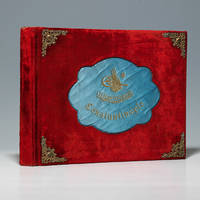
18901031341890. PHOTOCHROM ZURICH. Constantinople. Zürich: Photochrom Zürich circa 1890. Oblong folio 16 by 12 inches 30 photochrom images each measuring approximately 9 by 6-1/2 inches and mounted on heavy cardstock; original red velvet blue silk gilt-lettered title centerpiece on front cover brass cornerpieces. $4500.Rare photographic album of Constantinople circa 1890 by the renowned studio of Photochrom Zürich with 30 beautiful mounted vintage photochrom color prints offering exceptional views of majestic mosques palaces and plazas as well as the people of this great city in magnificent velvet binding with brass furniture.This splendid souvenir album of Constantinople contains exquisite color photographic prints of images taken at the turn of the 20th century produced by the revolutionary photochrom process. Photochrom also called the Aäc process is ""a very successful form of color photolithography developed in the late 19th century by the Swiss firm of Orell Füssli and used mainly for topographical views; photochroms have almost the appearance of color photographs but through a glass will show a delicate ink pattern which was achieved by a combination of photographic and manual work on grained i.e. lithographic stones being a forerunner therefore of modern screenless offset lithography"" Gascoigne 206. In this process black and white photographic negatives were directly transferred onto lithographic printing plates to produce color prints. These photographs are a high point in late 19th-century photography when albums such as these captivated a world newly spellbound ""by photography's capacity to 'take them there' and bring them directly in contact with the long ago and far away"" Parr & Badger I:18. Each image captioned with a four-digit number followed by ""P.Z."" for Photochrom Zürich and then the title of the scene in French. A few instances of marginal spotting to mounts; photochrom prints clean and fine with vivid colors. Binding splendid. An about-fine copy of this lovely album. unknown
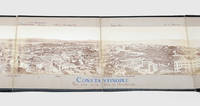
1875170484Constantinople c.1875. A superb photographic panorama A panoramic 360-degree view of the city. Towards the Golden Horn the Topkapi Palace and the city's great mosques can be seen including Hagia Sophia the Blue Mosque the Yeni Mosque and the Süleymaniye. Panoramas of this period usually favour the Galata Tower as a vantage point. The view is unsigned though likely from the studios of Pascal Sébah and Policarpe Joaillier or the Swede Guillaume Berggren. Both are renowned for their handsome panoramas of the city. In 1857 Sébah opened one of the first photographic studios in Constantinople. The business was taken over by his son Jean in 1883 who styled himself J. Pascal Sébah and went on to become a talented photographer in his own right. In 1888 he partnered with Policarpe Joaillier their firm becoming the official photographers of the Sultan. "From the 1870s Sébah and Joaillier were major suppliers of evocative imagery to the increasing number of people who undertook the Victorian Grand Tour" Hannavy p. 1261. Berggren moved to Constantinople in 1866 and opened his studio on Grand Rue de Pera in the early 1870s. His oeuvre included studio work a remarkable series of documentary portraits of working people and the eternalising of the construction of the Anatolian Railway. Oblong quarto concertina 290 x 255 mm. Comprising 8 mounted albumen prints each 165 x 248 mm together approximately 165 x 1984 mm mounts captioned in manuscript red and blue ink. Contemporary dark brown pebbled paper over bevelled boards later blue paper on verso of mounts. Minor loss to corners and edges of boards a few surface scratches; prints yellowed and faded in margins some a little creased at folds: a very good example. John Hannavy ed. Encyclopaedia of Nineteenth-Century Photography Vol. I 2005; Engin Özendes From Sebah & Joaillier to Foto Sabah: Orientalism in Photography 2004. hardcover