HOLOCAUST BROADSIDE IN DUTCHBiblio.com
129 résultats
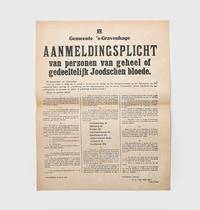
1941167943The Hague: City Legislative Board 31 January 1941. Laying the groundwork for the Holocaust in the Netherlands A significant step in the implementation of the Holocaust in the Netherlands - a broadside ordering all Jews in The Hague to register with the authorities. The broadside was issued in the name of The Hague mayor Cornelis Lodewijk van der Bilt on the order of the Reich Commissariat for the Occupied Dutch Territories. Similar orders were made by municipal bodies across the Netherlands. Headed in Dutch "Obligation to register persons of wholly or partly Jewish blood" it states that anyone with one Jewish grandparent must register by 21 February 1941. Each person will be issued with a certificate which must be shown to authorities on request. Those who do not register are liable to a five-year prison term and confiscation of assets. The move was part of an ongoing campaign against the Jews in the Netherlands that began shortly after the Nazi invasion in May 1940. Registration was with the mayor's office - the poster attests to the co-operation forced or otherwise of existing political structures. Almost all Dutch Jews did comply with the order. Deportations from the Netherlands began in Summer 1942 and was effectively completed by September 1944; less than a quarter of Dutch Jewry who fled the country or hid with supporters survived the Holocaust "The Netherlands" Holocaust Encyclopedia accessible online. Poster 280 x 229 mm printed in black verso blank. A couple of minor creases else very good. unknown
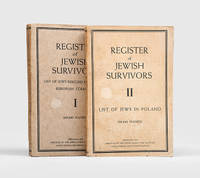
1945193462Jerusalem: Published by the Jewish Agency for Palestine / Search Bureau for Missing Relatives 1945. The search for the living First edition of the first major attempt to reunite Jewish families after the Holocaust listing 118000 survivors and their locations. Almost immediately after the war localized lists were published recording survivors from particular camps ghettos and countries. The Jewish Agency for Palestine established the Search Bureau for Missing Relatives to draw these efforts into a comprehensive register. The introduction notes it was published to "facilitate the re-establishment of contact between the remnants of Jewry in Europe and their relations in the Land of Israel and overseas. The Register contains the names of 60000 Jews of various countries saved from the camps and the ghettos who have been registered wherever they were were found following the liberation of Europe from Nazi servitude". It nevertheless cautions readers not to give up hope if a name is absent given the difficulty of compilation amid the chaos of postwar Europe. Lists also appeared in the weekly bulletin Lakarov Ulerahok while search requests were broadcast on Kol Yerushalayim in Jerusalem. Despite the suggestion of "forthcoming volumes" no further were produced. During its years of operation 1945 to 2002 the Bureau handled more than a million enquiries. The volumes are scarce on the market with most surviving copies held institutionally. They remain important reference works for those tracing relatives. 2 vols octavo. Original brown wrappers lettered in black. Contemporary Hebrew library stamps to title page of the Search Bureau for Missing Relatives; residue of removed labels to front covers. A little toned with minor wear remnants of the paper ties as issued to title pages wrappers of vol. I a little loose with some gatherings shaken. A good set of a fragile publication. unknown
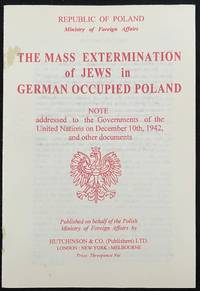
194343453London New York; Published on Behalf of the Polish Ministry of Foreign Affairs by Hutchinson & Co 1943. 1st edition. Original illustrated red and white paper wrappers. 8vo. 16 pages. 22 cm. National Government Publication. Printed in red and black ink. Includes a note by Polish Foreign Minister Edward Raczynski and speeches by Deputy Prime Minister Stanislaw Mikolajczyk.<br> The official 16-page diplomatic publication from December 1942 by the Polish Government-in-Exile in London marking a turning point in international understanding of the Nazi destruction of the Jews of Europe. <br> Jan Karski a courier for the Polish Underground had smuggled microfilmed evidence and intelligence out of occupied Poland to London. This raw intelligence gathered from his time secretly inside the Warsaw Ghetto and the Izbica transit camp formed the core of the facts published in the booklet.<br> <br> "In October 1942 at the height of the destruction of Polish Jewry Jan Karski born Jan Kozielewski was ordered to clandestinely go to the West and deliver a report on the situation of occupied Poland to the Polish government-in-exile in London. The situation of the Jews in Poland was to be one section of that report. Since the government in exile was concerned with the internal politics of Poland's underground parties Karski held meetings with the different factions including the Jewish Zionist and the Jewish Socialist Bund movements. <br> Thus shortly before his departure Karski met with two Jewish leaders who asked him to inform the world's statesmen of the desperate plight of Polish Jewry and of the hopelessness of their situation. Their message was: 'Our entire people will be destroyed.'<br> The Jewish leaders' appeals touched Karski and he decided to see things with his own eyes in order to make his report. With great risk to his life he was smuggled into the Warsaw ghetto and into a camp in the Lublin area. The horrors he witnessed marked him deeply and propelled him to become not only the messenger of the Polish underground but to concentrate on giving voice to the suffering of the dying Jews.<br> In November 1942 Karski reached London delivered the report to the Polish government-in-exile and set out to meet Winston Churchill other politicians journalists and public figures. Upon completing his mission Karski went on to the United States where he met with President Roosevelt and other dignitaries and tried in vain to stir up public opinion against the massacre of the Jews. In 1944 while in the United States Karski wrote a book on the Polish Underground Story of a Secret State with a long chapter on the Jewish Holocaust in Poland.<br> After the war Karski stayed in the United States where he was later appointed Professor at Georgetown University Washington DC.<br> On 2 June 1982 Yad Vashem recognized Jan Karski as Righteous Among the Nations" Yad Vashem. <br> <br> Leading Holocaust scholar Lucy Dawidowicz cites the booklet in her now classic work "The Holocaust and the Historians" Harvard 1983 p. 167; the report could not be more explicit in its description of the horrors nor in its plea for help: <br> "The new methods of mass slaughter applied during the last few months confirm the fact that the German authorities aim with systematic deliberation at the total extermination of the Jewish population of Poland and of the many thousands of Jews whom the German authorities have departed to Poland from Western and Central European countries and from the German Reich itself. The Polish Government considers it their duty to bring to the knowledge of the Governments of all civilised countries the following fully authenticated information received from Poland during recent weeks which indicates all too plainly the new methods of extermination adopted by the German authorities." <br> The report elaborates: "The actual process of deportation was carried out with appalling brutality. At the appointed hour on each day the German police cordoned off a block of houses selected for clearance entered the back yard and fired their guns at random as a signal for all to leave their homes and assemble in the yard. Anyone attempting to escape or to hide was killed on the spot. No attempt was made by the Germans to keep families together. Wives were torn from their husbands and children from their parents. Those who appeared frail or infirm were carried straight to the Jewish cemetery to be killed and buried there. <br> On the average 50-100 people were disposed of in this way daily. After the contingent was assembled the people were packed forcibly into cattle trucks to the number of 120 in each truck which had room for forty. The trucks were then locked and sealed. The Jews were suffocating for lack of air. The floors of the trucks were covered with quicklime and chlorine. As far as is known the trains were dispatched to three localities - Treblinka Belzec and Sobibor to what the reports describe as 'Extermination camps.' <br> The very method of transport was deliberately calculated to cause the largest possible number of casualties among the condemned Jews. It is reported that on arrival in camp the survivors were stripped naked and killed by various means including poison gas and electrocution. The dead were interred in mass graves dug by machinery." <br> <br> Read more about the singular importance of this publication at <br> en.wikipedia.org/wiki/The_Mass_Extermination_of_Jews_in_German_Occupied_Poland# . <br> In 2020 Polish Postal authorities chose this very publication to illustrate their official first day cover honoring righteous Poles who had saved Jews during the Holocaust see illustration. <br> <br> Subjects: World War 1939-1945 - Jews - Poland. World War 1939-1945 - Poland - Atrocities. Holocaust Jewish 1939-1945 - Poland. Jews - Poland. OCLC: 234118765. <br> Touch of staining at staples without the rust almost always seen in other surviving copies. Very Good condition. A copy with rust stains sold in 2018 at auction for over £6000. Rare and very important. BHOLO2-97-48-MMXRLADFACC. London, New York; Published on Behalf of the Polish Ministry of Foreign Affairs by Hutchinson & Co unknown
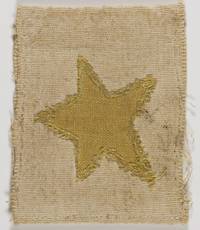
194353630Tunisia 1943. Nearly Fine. Five-pointed yellow cloth star sewn onto plain beige cloth 7.3 by 9 cm. Yellow dye somewhat faded else in fine state of preservation.<br /> <br /> Specimen of the yellow star imposed on the Jewish population of Tunisia in March 1943 as a mark of the slave laboror. Tunisia was the only Islamic country to come under Nazi rule at first indirectly through the Vichy regime in France between 1940 and its liberation by Allied forces on May 7 1943. In response to the Allied invasion of Algeria and Morocco German and Italian forces invaded Tunisia on November 9 1942. By the end of November the Germans took the first anti-Jewish move by arresting four of the community leaders including Moïse Borgel the president of the Jewish congregation. "In addition to the governor-general's sympathetic attitude -- and in some degree to the pro-Jewish attitude of Bey Sidi Mohammed al-Mounsaf -- the Italians also in practice interfered with the application of the anti-Jewish laws" E.H. The dignitaries were released after a week following the intervention of the mayor of Tunis and the Italian consul. Because of objections by the Italians the edict to wear the star does not appear to have been generally enforced with rigor and was only formally imposed in two cities Sfax and Tunis. While 5000 Jews had originally been put on forced labor in thirty locations and camps along the front line "at the time of the collapse and surrenter in early May 1943 only sixteen hundred Jews were employed on forced labor" E.H. Given the relatively small labor force and the lack of zeal in imposing the anti-Jewish ordinances it is clear why so few of these yellow badges have survived. References: I. Gutman ed. Encyclopedia of the Holocaust vol. 4 pp. 1521-23. unknown