69 résultats
1890131133532New York: The Humboldt Publishing Co 1890. Hardcover. Good. Second American edition. Crimson cloth front board stamped in black spine lettered in gilt. Good rubbing along front board bumped corners front hinge cracked rear endpaper missing name on front free endpaper some marginal bracketing in light pencil. Uncommon early American reprint of the first English-language translation by anarchist publisher Benjamin Tucker. The Humboldt Publishing Co hardcover
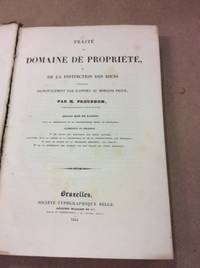
184183095Bruxelles : Societé Typographique Belge 1841. In-8 mezza pelle tracce d'uso titolo oro al dorso pp. 472. In buono stato good copy. Societé Typographique Belge, unknown
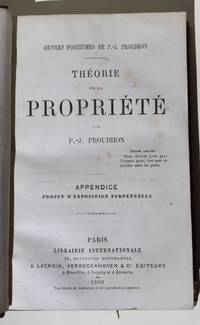
18661726Paris; Bruxelles etc.: Librairie Internationale; A. Lacroix Verboeckhoven & Cie 1866. First edition. In somewhat later half leather with gilt title on spine. Bookplate on pastedown. Slight rubbing at extremities lower corners bumped. Inside clean. Overall in fine condition. First edition. In somewhat later half leather with gilt title on spine. 4 iii 1 310 4 2 p. <p><br /> First edition of Proudhon posthumously published last essay.<br /> <p><p><br /> Proudhon’s last essay the "Théorie de la propriété" was posthumously published from an unfinished manuscript written around 1862 in the year of his death by friends. “What becomes clear from this work is that there is no significant change in Proudhon’s perspective on property and possession. The usual themes of his work are there such as the land as common property workers’ associations and the absolutist nature of property. His apparent new found support for ‘property’ is not for capitalist private property. Rather it is for property which combines ownership and use. As such rather than a conversion away from his previous ideas this work represented more a slight shift in his position. The vision expounded is the familiar Proudhonian one of and artisan peasant and workers co-operative based economy†McKay 2011. <br /> <p><p><br /> Bibl.: McKay I.: Property Is Theft! A Pierre-Joseph Proudhon Anthology. Edinburgh; Oakland CA: AK Press 2011. pp. 775–784.<br /> <p>. Librairie Internationale; A. Lacroix, Verboeckhoven & Cie unknown
1850002346Paris: Garnier 1850. Due volumi di 4-400; 4-400 pagine. Mezza pelle del tempo usure ai bordi dei piatti. 2a edizione di questa importante opera la prima è del 1846 alla quale Marx rispose colla sua "Miseria della filosofia". Garnier unknown
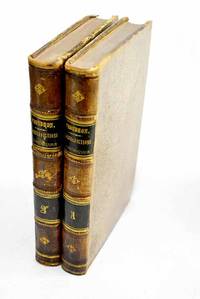
18673706139Paris.: A. Lacroix Verboeckhoven et Cie. 1867. Hardcover. Cubierta deslucida. Good. 18 cm. 2 v. Encuadernación en tapa dura artesanal en plena piel. Idioma frances. Proudhon Pierre-Joseph 1809-1865. Par Pierre-Joseph Proudhon. Economía . Cubierta deslucida. Economía 33 A. Lacroix, Verboeckhoven et Cie. hardcover
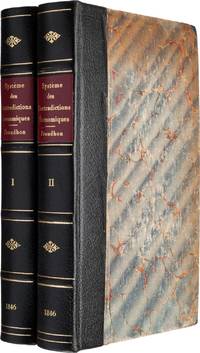
1846179<b>8vo. two volumes. Half-titles present in both volumes. 4 xliii 1 blank 435 1 Table; 4 531 1 Table pages. Rebacked in modern half blue levant morocco over contemporary marbled boards Spines stamped in gilt in compartments burgundy gilt morocco lettering labels five raised bands. Some minor rubbing to binding a bit of foxing in text with some marginal notations in pencil throughout. This is Proudhon's magnum opus his analysis of what he saw to be the economic contradictions of 19th-century capitalism which he felt would lead in time to an anarchist society. Proudhon the first self-proclaimed Anarchist coined the term "Property is Theft." Although a sometime correspondent with Karl Marx the two had a falling out after Marx vehemently criticized this work. </b> Chez Guilla umin et Cie hardcover
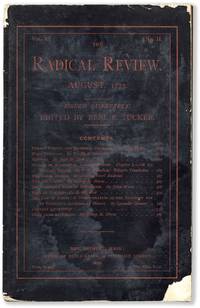
187781726New Bedford MA: Benj. R. Tucker 1877. First Edition. Octavo 23.5cm. Original black glazed wrappers printed and double-ruled in red; pp.206-3962. Wrappers oxidized chipped at margins and with a few closed tears but no substantial losses; text remains clean supple and unmarked; about Very Good overall. <br /> <br /> Tucker's first and scarcest literary and political journal described by Longa Anarchist Periodicals in English as ".the one organ in which the prominent pioneer expositors of American anarchism were united" p. 207. The Review ran for only four issues before folding due to lack of funds at which time Tucker spent three years as a reporter for the Boston Daily Globe in order to save enough money to start a new publication Liberty which would survive from 1881 to 1908 and cement Tucker's position as the leading exponent of Individualist Anarchism in America.<br /> <br /> Contributors to the current issue include Elisée Reclus "Female Kinship and Maternal Filiation"; Dyer Lum a poem "Nirvana"; Stephen Pearl Andrews "The Labor Dollar"; Lysander Spooner "The Law of Prices"; and the first part of Pierre-Joseph Proudhon's "System of Economical Contradictions" translated by Tucker himself and making its first appearance in English in these pages. The Proudhon contribution marks a significant first appearance: this essay originally published in 1847 is cited as the work that created a permanent rift between Proudhon and Marx engendering a bitter split between the Anarchist and Communist factions of the First International. Proudhon's essay also bore a strong influence on Tucker's own individualist anarchist philosophy and by extension much of American anarchism to follow. <br /> <br /> A truly rare survival from the formative years of American anarchist philosophy; we have seen only a few issues of Radical Review in original wrappers over more than thirty years of bookselling. LONGA pp.206-8. See also: Paul Avrich "Anarchist Portraits" 1988 p. 144; and Kathlyn Gay and Martin K. Gay "Encyclopedia of Political Anarchy" 1999 pp. 206-8. Benj. R. Tucker unknown
18636887Paris: E. Dentu 1863. Fine. E. Dentu Paris 1863 12 x 19 cm broché New edition. Some slight foxing otherwise a very good copy. E. Dentu unknown
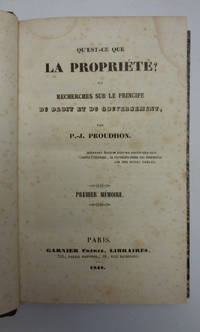
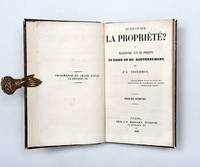
1848015760<p>Paris: Garnier 1848. Premier mémoire. Un volume 185 cm di XVI-252-2 pagine; fioriture e una gora angolare. In lingua francese. Legatura coeva in mezza pelle dorso liscio ornato e dorato; piatti e risguardie con carta marmorizzata. Il libro di Proudhon contro al proprietà privata che sarà all'origine assieme al Manifesto dei comunisti edito negli stessi giorni di un infinito dibattito la prima risposta da Thiers con De La Propriétè.</p> Garnier
1841BLR - HAY347931841 - 1848 - 1850 - seconde édition. Paris A la Librairie de Prévot 1841 - Garnier Frères Libraires 1848 et 1850. relié demi-cuir marbré de l'époque. Coins un rien frottés quelques pages mal coupées mais sans gravité ; quelques traces et faibles rousseurs très éparses sinon belle reliure intérieur très frais bon exemplaire. in-12 format poche. dos à 5 nerfs ornés de motifs floraux filets d'encadrements et titres dorés ; tête rouge. unknown
1840051<b>4 works in 1 volume Octavo. Contemporary quarter calf over marbled paper boards with decorative gilt motif on the spine & marbled endpapers. Half-titles present. a few minor interior blemishes but contents generally clean. A very good copy. Second edition of the French anarchist philosopher's notorious thesis together with the first editions of his two succeeding works the "deuxième" and "troisième" memoirs. Qu'est-ce que la propriété was first published in 1840 and shocked its readership with its famous assertion that "all property is theft" which remains widely cited among radical circles to this day. Proudhon himself referred to Qu'est-ce que la propriété as a "diabolical work which frightens even me" Correspondence I p. 296 and he was called to defend himself against insurrection charges at his local court immediately after its publication. The distinguished economist Blanqui 1805-1881 was appointed by the Minister of Justice to read Proudhon's inflammatory treatise and his review of it was partially reproduced by Le Moniteur on 7 September. Although he opposed the views that Proudhon adopted Blanqui's judgement was ultimately favorable because he believed Proudhon to be a philosopher and inquirer rather than a serious revolutionary. Blanqui's verdict helped to lessen the insurrection charges brought against Proudhon and it was only because of his support that Proudhon was permitted to keep his stipend. The second work in this volume is Proudhon's grateful response to Blanqui's review where he reacts to some of the reviewer's objections and offers some moderate revisions to his first work. Both works are scarce both institutionally and in commerce especially so bound together. Lastly the uncommon Explications Au Ministere Public 1842 is also bound in. Housed in a custom oatmeal colored cloth slipcase with chemise and leather label.</b> Librairie de Prévot hardcover
1840161495Paris: J.-F. Brocard 1840. A "diabolical work which frightens even me" Proudhon First edition one of 500 copies and correspondingly scarce in commerce of the French anarchist philosopher's notorious thesis which caused a scandal by equating all property with theft. In the wake of the social turmoil caused by the economic decline in France in 1839-40 and the July Monarchy's lapse into a "religion of property" Pierre-Joseph Proudhon 1809-1865 argued that - unlike freedom and equality - the right to property was not a natural right. Yet he also opposed collective ownership "as he was persuaded that only a society without government is able to establish social harmony. The First International was indeed destroyed in the great fight between those who supported a libertarian socialism of the kind Proudhon had advocated and those who followed the authoritarian pattern devised by Karl Marx. Kropotkin and Herzen were all his confessed disciples. Even Tolstoy sought him and borrowed the title and much of the theoretical background of his masterpiece War and Peace from Proudhon's book La guerre et la paix One can place Proudhon among the great socialist thinkers of the nineteenth century" Simons pp. 301-2. Proudhon himself referred to Qu'est-ce que la propriété as a "diabolical work which frightens even me" Correspondance I p. 296 and he was called to defend himself against insurrection charges at his local court immediately after its publication. Qu'est-ce que la propriété was followed in 1841 by his "Lettre à M. Blanqui sur la propriété Deuxieme mémoire" and "Avertissement aux propriétaires ou Lettre à M. Considérant sur une defénse de la propriété" often referred to as the "troisiéme mémoire". Duodecimo 168 x 105 mm. Binder's stamp Ateliers Laurenchet to front pastedown. Recent quarter calf marbled paper boards to style spine lettered gilt vellum tips sprinkled edges. Short marginal tear just entering text to page 93 repaired without loss pale marginal dampmark to head and foot final gathering with short marginal tear occasional light spotting withal a very good copy of a fragile publication. Not in Mattioli or Sraffa. See Correspondance de P.-J. Proudhon 1960-74; William Bradford Simons Private and Civil Law in the Russian Federation 2009. hardcover
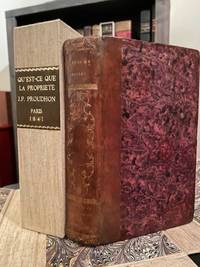
1841129328Paris: Librairie de Prévot 1841. All property is theft Second edition of the French anarchist philosopher's notorious thesis together with the first editions of his two succeeding works the "deuxième" and "troisième" memoirs. Qu'est-ce que la propriété was first published in 1840 and shocked its readership with its famous assertion that "all property is theft" which remains widely cited among radical circles to this day. Proudhon himself referred to Qu'est-ce que la propriété as a "diabolical work which frightens even me" Correspondance I p. 296 and he was called to defend himself against insurrection charges at his local court immediately after its publication. The distinguished economist Blanqui 1805-1881 was appointed by the Minister of Justice to read Proudhon's inflammatory treatise and his review of it was partially reproduced by Le Moniteur on 7 September. Although he opposed the views that Proudhon adopted Blanqui's judgement was ultimately favourable because he believed Proudhon to be a philosopher and inquirer rather than a serious revolutionary. Blanqui's verdict helped to lessen the insurrection charges brought against Proudhon and it was only because of his support that Proudhon was permitted to keep his stipend. The second work in this volume is Proudhon's grateful response to Blanqui's review where he reacts to some of the reviewer's objections and offers some moderate revisions to his first work. In the third work written in response to Victor Considérant's "Défense du Fourierisme" Proudhon warns property owners that the workers' revolution would soon come. Proudhon's pronouncement led to his home and printing office being raided and many copies of the book were seized. All three of the works are scarce both institutionally and in commerce and it is highly unusual to find all three bound together. Three works bound in a single vol. duodecimo 176 x 109 mm. Contemporary half calf rebacked red morocco label erroneous date of 1641 at base of spine marbled sides and endpapers. Half-titles present. Tips repaired with green calf a few minor interior blemishes but contents generally clean very light damp stain to last few leaves some pages short and opened a little crudely. A very good copy. unknown
1849EOU'EPRO55Paris: Garnier Frères 1849-48. 1849. 2 Volumes in 1. 18mo. pp. xvi 252 2; 155. with half-title. contemporary quarter roan extremities worn some foxing & browning throughout more pronounced in second part. Fourth and Second Edition respectively originally published in 1840 and 1841. Proudhon's most famous work "La propriété c'est le vol!" declared by Marx to be "the first decisive vigorous and scientific examination of property." cfGoldsmiths' 32492-93. cfKress C.5620-21. Coquelin & Guillaumin II pp. 478-79. Paris: Garnier Frères, 1849-48. unknown
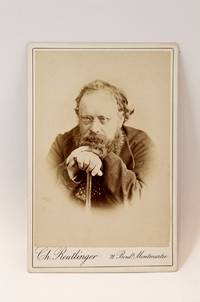
186471277Paris: Ch. Reutlinger 1864. Fine. Ch. Reutlinger Paris s. d. circa 1864 10.80 x 16.50 cm une photographie Original photograph of Pierre-Marie-Joseph Proudhon produced using the gelatin silver process mounted on cardboard from the Reutlinger studio in Paris. This photograph was taken in Charles Reutlinger's studio at the request of painter Gustave Courbet who was then creating a portrait of the philosopher now preserved at the Petit Palais museum in Paris. Proudhon died on January 20 1865 before posing for Courbet making this image one of the painter's only sources of inspiration for his posthumous portrait: ""go to Reutlinger and ask him on my behalf . for the large portrait he made of the philosopher according to my pose. I want to paint him at 146 rue Notre-Dame-des-Champs with his children his wife as befits the wise man of this time and the man of genius"" Letter to Jules Castagnary January 20 1865 cited in Chakè Matossian Saturne et le Sphinx : Proudhon Courbet et l'art justicier. Ch. Reutlinger unknown
1865002017Paris: Dentu 1865. In 8o di 69 pagine. Brossura editoriale cartacea con titolo alla copertina difetto al dorso. Prima edizione. Ultima opera pubblicata in vita da P. La tesi federalista lo fa polemizzare contro l'unità monarchica dell'Italia. Einaudi 4567. Dentu unknown
186562817Paris: E. Dentu 1865. Fine. E. Dentu Paris 1865 12 x 19 cm broché First edition. Printed peddler's stamps on the half-title page. Handsome copy. E. Dentu unknown
1900506670Paris : Société d'Éditions Littéraires et Artistiques Librairie Paul Ollendorff 1900. Book. Tres Bon. Hardcover. Société d'Éditions Littéraires et Artistiques, Librairie Paul Ollendorff Hardcover
189825797Paris: Montgredien et cie 1898. Cloth. A very good clean crisp copy some rubbing to extremities edges a bit browned. binding tight and crisp. lxxvi 271 pp. Adv.8. 8vo. Publis avec introduction et notes par Clement Rochel. Montgredien et cie hardcover
185717602Paris: Librairie de Garnier frères 1857. Broché. Etat moyen. in-12. 511 pp. 5ème édition mention de 4ème édition sur la couverture. Tampons de bibliothèque. Rousseurs. Une petite auréole d'humidité dans la marge des 1ères pages. Couverture salie. Déchirures et petits manques sur les coiffes. Mors inférieur fendu. Librairie de Garnier frères unknown
1857002015Paris: Garnier 1857. Cinquième edition. In 8° di 4-XII-511 pp. Buona mezza tela blu successiva. Fioriture. Garnier unknown
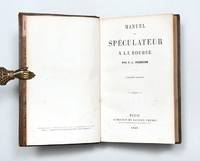
1857143950Paris: Librairie de Garnier Frères 1857. Fifth edition first 1854 of the most curious of Proudhon's works an account of the contemporary financial world commissioned by Garnier Brothers. "It was called The Stock exchange speculator's annual and consisted of a mass of statistical information collected with the assistance of George Duchêne on all the leading companies whose shares were offered for sale at the Bourse garnished with an introduction notes and 'final considerations' from Proudhon's own hand. Any genuine speculator who went to the Manual for a hot tip would be disappointed for not only did the authors condemn speculation itself but Proudhon also indulged in a lengthy analysis of the growth of the feudal structure in industry which was driving apart the bourgeois and the working class and acting inevitably to the detriment of the latter" Woodcock Pierre-Joseph Proudhon p. 191. Octavo 176 x 108 mm. Contemporary marbled sheep red morocco label smooth spine blocked in gilt covers bordered in gilt marbled endpapers. Early Rio de Janeiro bookseller's ticket to front pastedown. Light foxing to contents binding in very fresh condition; an excellent copy. unknown
1869041498Madrid: Imprenta a cargo de J. E. Morete 1869. No consta edición. Tapa blanda. Good. X 347 pp. 155 x 215 cm. Libro en buen estado aunque falto de lomo y cubiertas deslucidas. Imprenta a cargo de J. E. Morete unknown
185168629Paris Prison de Sainte-Pélagie Paris 1851. Fine. ""I still appear to many people as only the pure and simple negation of what is."" Paris Prison de Sainte-Pélagie Paris 12 Novembre 1851 13 x 20.50 cm une feuille Autograph letter signed on four pages dated 12 November 1851. 124 lines in black ink. This letter is presented in a chemise and slipcase with paper boards decorated with abstract motifs green morocco spine green suede doublure slipcase with morocco spine and matching paper boards signed by Thomas Boichot. Unpublished autograph letter on progress signed by Pierre-Joseph-Marie Proudhon major figure in French social thought and the father of anarchy. The philosopher imprisoned since 1849 develops his socialist convictions in a virulent and combative style condemning the absolutisms of his time. Extraordinary declaration of philosophical political and social faith from a marginal thinker who influenced Karl Marx Emile Durkheim and Benjamin Tucker. This unpublished and densely written letter is a passionate reflection close to an essay entitled De lidée de progrès written around ten days later that Proudhon published with another De la Certitude et de son criterium in the work Philosophie du progrès. This set of texts was composed only two weeks before the coup of Louis-Napoléon Bonaparte which he immediately opposed. Once released from prison in 1852 Proudhon published the two letters at Lebègue in Brussels in order to escape censorship which had prohibited the sale of the booklet on French territory. Already having been detained for two years in the jails of the future French emperor Proudhon writes to Romain-Cornut from Sainte-Pélagie prison. Journalist Romain-Cornut had just finished a series of articles on Auguste Comtes positivism Études critiques sur le socialisme October-November 1851. This letter must be viewed as an admirable four-page plea or more a confession of his socialist vision of progress a social positivism which is based on the reconsideration of the ancient order: we withdraw in the face of an intellectual negation which is the sine qua non condition of further progress. During the course of the letter he establishes a balance between his polemical soul and his desire for legitimacy striving to be no longer viewed as a mere agitator but as a true philosopher. We are indeed reminded of his famous saying Property is theft! his sympathy for the 1848 uprisings as well as his acerbic pamphlets in Le Peuple that consecrated his radical reputation: I have been until this day so foolishly judged even by the socialists . Because I led the criticism of the old principles as far as it could go . I still appear to many people as only the pure and simple negation of what is. Proudhon however maintains his intention to leave the shields of criticism leaving the argument of circumstance for the moment in my new studies and thus implies the writing of a new deeper work published under the title La Philosophie du progrès 1853 dedicated to the same Romain-Cornut. Proudhon an anarchist in favour of the abolition of the State and the government violently criticizes the system which is by definition anti-progressive: Yet it is unquestionable from this progressive point of view that our society as a whole monarchists democrats Catholics philosophers is still absolutist: what everyone wants is a charter a constitution a system a fixed and definitive legislation finally. In addition to political systems Proudhon picks up this same idealism in the philosophical thinking of his elders and does not refrain from giving a violent condemnation: Like Pascal like the Germans we want the absolute! . Spinoza Malebranche Leibnitz etc. all of whom operating on the categories of substance causality eternity unity plurality etc. have arrived at politically and intellectually immobile systems at the absolute. He noted the harmful effects of the political regimes and of the ph hardcover
186276220Bruxelles Brussels: Office de la publicité 1862. Fine. Office de la publicité Bruxelles Brussels 1862 14 x 23 cm relié First edition. Bradel binding in full caramel boards smooth spine decorated with gilt fillets green shagreen title label author's name in red shagreen slightly later binding signed in pen by Champs. Bound at the head of the work is an article by P.J.M. Proudhon entitled ""L'Empire et la Bohême"" and printed by the same publisher the journal of the Office de la publicité in which the work and the related law are discussed; namely the defense of intellectual property rights for each artist. Office de la publicité hardcover