EYAM PLAGUE VILLAGEBiblio.com
2 résultats
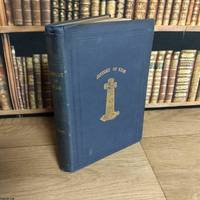
1865373230Richard Keene Derby Undated c.1865. 6th Edition. Hardcover. Very Good Condition. Eyam is best known for its remarkable decision to isolate itself in order to stop the spread of the bubonic plague after it was detected in the village. This tragic chapter in Eyam's history started in 1665 when a bundle of cloth infested with fleas was delivered from London to Alexander Hadfield the village tailor. The plague lasted for a duration of 14 months during which one report indicates that it claimed the lives of at least 260 villagers leaving only 83 survivors from an original population of 350. However this number has been disputed with some sources suggesting that there were 430 survivors from a total population of approximately 800. Additionally the church in Eyam maintains a record of 273 individuals who fell victim to the plague. Bound in blue contemporary cloth gilt lettered spine and gilt lettered & decorated upper board. A little wear at head of spine and a tiny piece missing from near foot. Colour photograph of Eyam Hall & Village Stocks to the reverse of the frontis engraving. Contents clean throughout and an attractive volume in the hand. Size: 12 x 18.5 cms. Category: Antiquarian & Rare; Hardback Books; This item may require more postage than the rates shown for delivery outside the UK. If extra postage is required we will contact you before processing your order and you will be given the details and option to decline the extra cost. Richard Keene hardcover
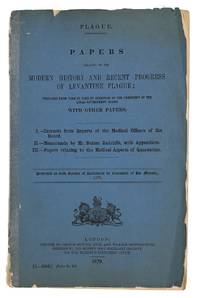
1879L4NBANWANWJDLondon: George Edward Eyre & William Spottiswoode 1879. Original publishers blue printed paper wrappers. Folio. With two folding lithographed maps one centered on the Middle East and the other detailing the seats of the plague in Mesopotamia and south-west Persia. Compilation of observational governmental reports on various outbreaks of the bubonic plague in the Middle East Persia and Egypt between 1853 and 1877. As stated in the introduction this publication was compiled to study the epidemic in detail in the hope that such learning might benefit Great Britain in the event of an outbreak of the plague in its own territories. The information in these reports proved to be of value during the intense study of the plague in the 1890s which led to the identification of the diseases origin in 1894. The compilation comprises three parts: the first contains extracts from reports of the medical officers of the local government board the second is a memorandum by Mr. Netten Radcliffe and the last contains a few papers considering the medical aspects of quarantine.Binding worn at the edges and the paper spine damaged at the head and foot. With the upper corner of the first few pages slightly soiled but still in good condition.l Creighton A history of epidemics in Britain 1965 I p. 162; Ethnographic plague: configuring disease on the Chinese-Russian frontier p. 166; Histories of post-mortem contagion: infectious corpses and contested burials p. 25. George Edward Eyre & William Spottiswoode, unknown