112 résultats
196688145Cambridge Massachusetts: The MIT Press 1966. First edition of this collection of essays on the "dilemmas of a managerial society" by former M.I.T. management professor Douglas McGregor. Octavo original cloth. Inscribed by one of the editors Edgar H. Schein on the half-title page "We must become better at asking and do less telling in a culture that overvalues telling. Ed Schein author of Humble Inquiry." Fine in a near fine dust jacket. Edited by Warren G. Bennis and Edgar H. Schein with the collaboration of Caroline McGregor Former President of Antioch College and Professor of Industrial Management at M.I.T. Douglas McGregor brought industrial psychology to maturity as a field of academic psychology and to practical applicability in the day-to-day tasks of business managers. Throughout his work McGregor's studies concluded that when basic economic needs are fulfilled higher motivations are allowed to come into play "Man lives by bread alone when there is no bread"- Douglas McGregor. The MIT Press hardcover books
1950406734New York: Abelard Press 1950. Jacket a bit worn and with a few soft chips/nicks and creases along edges spine toned lightly shaken. 8vo. xi 291 pages. Black-and-white plates. Original cloth; pictorial dust jacket. First edition presentation copy inscribed and signed by both authors on the front free endpaper: "To Joseph N. Frank / With all good wishes / James J. Rorimer / Gilbert Rabin." The recipient was the American literary scholar Joseph Frank a leading expert on the life and work of Fyodor Dostoevsky. A scarce title inscribed or not by one of the principle "Monuments Men." Rorimer an American museum curator and director of the Metropolitan Museum of Art was a primary force behind the creation of the Cloisters and during the Second world War served in the U. S. Army's Monuments Fine Arts and Archives Section tasked with recovering stolen artwork and protecting cultural sites. 'Survival' details the efforts to detect and stop Nazi looting of art and their systematic spoiling of Allied treasures. Rorimer made contact with the French Underground and was prominent in the steps made by the Allied armies to prevent damage to historic cathedrals castles and palaces in the path of the War. The book also tells the story of the Einstatstab Reichsleiter Rosenberg the ERR the far-flung powerful Nazi organization involved in the looting and how Goering amassed his huge personal collection of art. <br/><br/> Abelard Press hardcover books
196873791Pasadena California: California Institute of Technology 1968. First Edition. Hardcover. Very good. Emil Herzog's set with his ink signature to the front flyleaf in the first volume. A pioneering work based on extensive research conducted at Caltech and Palomar Observatory. While the delineation of the clusters on the 48-inch Palomar Schmidt plates was Zwicky's work all the measurements of the tens of thousands of individual galaxies were Herzog's: photographing each field with the 18-inch Palomar Schmidt measuring coordinates and preparing finding charts. In addition he determined the apparent magnitudes of the brighter galaxies by schraffier guided plates and a flyspanker. For the fainter objects where the schraffier images were too washed out to be manageable he found that his nearsightedness made schraffier images unnecessary. His familiarity with the 48-inch Schmidt plates led him to be one of the first to be aware of the character of the large-scale distribution of galaxies. Later the Swiss-born Herzog 1917-98 taught astronomy at the University of Southern California and mathematics at Cal Poly Pomona serving as department chair from 1974 to 1980. Quarto six volumes. Original blue buckram bindings with gilt titles. Mild fading to the spines with a small spot to the front board of the first volume; otherwise a very good set. California Institute of Technology hardcover books
192461389Lutherville MD: Chesacroft Kennels 1924. First edition apparently the first book devoted solely to the Chesapeake Bay Retriever. 12mo. 31 pp. Illus. from photos; 3-pages of show records from Chesacroft dogs 1922-1923. Not in Jones "Bibliography of the Dog" listing only two titles on the Chesapeake Bay Retriever the earlier from 1933. OCLC locates one copy Mariners Museum Newport News VA. Very good copy of a rare book. Original decorated brown wrappers stapled. #8436. <br/><br/> Chesacroft Kennels unknown books
197932838Atlanta: Nexus Press 1979. Hardcover. Very good. 60cc. 15pp contained in cloth backed wooden boards with string tie. . Few small stains to boards and title leaf contents have some handling wear but all are present and in very good condition. One of the more uncommon productions from the press and one that if used to its full potential will result in inevitable destruction of the object itself. <br /> <br/><br/>From directions for Use: "This book contains 15 leaves of different materials including the printed leaves. These leaves plus the covers can be played in different ways by: striking scraping rubbing engraving crumpling tearing breaking snapping etc.A performance may begin with one or more books with or without adding other instruments voices or actions." Nexus Press hardcover books
194684Providence: Buffalo Book Company 1946. First Edition. Hardcover. Near fine/very good. 1st edition preceded only by the novel's appearance as a 3 part serial in Amazing Stories magazine. Smith's first book Just 500 copies were published Hadley's 1947 edition is a reprint. Near fine in a very good dustjacket. Ref: Anatomy of Wonder 1995 2-114 "The archetypal pulp space opera.". Although earlier snippets of science fiction imaginary voyages and futuristic military fiction touched the concept of what is now called space opera The Skylark of Space is the modern template the first significant science fiction sub-genre development since H. G. Wells and one of monumental effect encompassing among its themes the vast interstellar stage horrific alien civilizations the despotic circumstance and ongoing battles with arch-enemies possessing advanced technologies laying the baseline for the likes of Asimov's Foundation Herbert's Dune Roddenberry's Star Trek Lucas' Star Wars and all those that followed and will follow in their wake. Buffalo Book Company hardcover books
195838022New York: John Wiley & Sons 1958. First edition of this classic in management science. Octavo original cloth. From the library of Nobel Prize-winning economist John Harsanyi with his signature on the front free endpaper . 'Outside the Carnegie group we should like to acknowledge especially our many hours of fruitful work and discussion with Robert A. Dahl on the subject of influence measurement and the help and guidance that John C. Harsanyi provided for our treatment of the relation between game theory and other theories of conflict' p. vi. 'Simon was attracted to the exciting intellectual environment emerging at the Carnegie Institute of Technology in Pittsburgh. After moving to Carnegie in 1949 Simon stayed there for more than five decades. At Carnegie Simon collaborated on work that established the field of organization theory. The founding work was a major study done with James G. March published as Organizations. The book continued the argument that decision makers are not able to act in an objectively rational manner; rather they are constrained by both cognitive and external limitations. So instead of assuming that each decision maker scans all possible alternatives and chooses the one that maximizes expected utility Simon argued that decision makers instead use 'satisficing' as a criterion for making decisions; they choose the first alternative that looks 'good enough.' March and Simon wrote in Organizations 'Most human decision making whether individual or organizational is concerned with the discovery and selection of satisfactory alternatives; only in exceptional cases is it concerned with the discovery and selection of optimal alternatives.' . . . One of Simon's insights was that the observed complexity of human behavior arose from simple and general underlying mechanisms that were applied to a complex task environment. Simon illustrated this with his famous metaphor of 'the ant on the beach.' The ant's goal is to reach some distant food. While the ant's path to the food seems very complex twisting and turning most of the apparent complexity is due to the grains of sand to be traversed. The complexity of the environment rather than the complexity of mechanism within the decision maker gives rise to the observed behavior. 'In solving problems' March and Simon wrote 'human thinking is governed by programs that organize myriads of simple information processes - or symbolic manipulating processes if you like - into orderly complex sequences that are responsive to and adaptive to the task environment and the clues that are extracted from that environment as the sequences unfold' ' Mie Augier & Edward Feigenbaum 'Herbert A. Simon: 15 June 1916 - 9 February 2001' Biographical Memoirs Proceedings of the American Philosophical Society Vol. 147 No. 2 June 2003 pp. 196-7. Fine in a near fine dust jacket. Rare and desirable with a noted provenance. John Wiley & Sons hardcover books
192425607Garden City NY: Doubleday Page & Company. Good. 1924. First Edition. Hardcover. no dust jacket sound but worn copy bumping/exposure of boards at all corners light dampstaining to spine; the tipped-in folding map between pages 10 and 11 is present and in excellent condition. 3 color plates 6 halftones 9 photogravures INSCRIBED and SIGNED by the author on the half-title page: "To Paul Bern / with the good wishes / of the author / Robert Flaherty / New York City / Jan 4th 1927." Flaherty's 1922 film NANOOK OF THE NORTH was the most acclaimed documentary of its time -- a time before "documentary film" even existed as a defined genre. Although the passage of time and the revelations of scholarship have diminished and somewhat tarnished Flaherty's reputation NANOOK itself remains an impressive cinematic achievement even if OK some scenes were staged. Three of the book's four sections deal with Flaherty's earlier expeditions into the Hudson Bay region as an explorer and prospector in the employ of the Canadian Pacific Railway during which time he learned about the lands and people and conceived the idea of capturing them on film. Parts I-III are: The Discovery and Exploration of the Belcher Islands; Winter on Wetalltok's Island; The Exploration of Northern Ungava. Only Part IV entitled "Films" is specifically about the making of NANOOK which began in 1913 but was beset with difficulties including the destruction by fire in 1916 of 30000 feet of Flaherty's already-exposed film. His account here is somewhat thin on specifics like dates as he chose instead to concentrate largely on his interactions with the Eskimos specifically Nanook himself whose name wasn't actually Nanook at all but never mind. The book's inscribee Paul Bern 1889-1932 has misfortunately gone down in Hollywood history as Jean Harlow's suicidal husband but prior to that he was one of Irving Thalberg's right-hand men his personal assistant in fact and later a producer at M-G-M. In January 1927 Bern was nearing the end of a two-month sojourn in New York on assignment for Thalberg; per a contemporary press report he "saw every current Broadway play during his visit conferred with many noted writers and entered into negotiations for the screen rights of several stories and novels." Flaherty for his part had been in demand following the great box-office success of NANOOK then as now nothing quite caught Hollywood's attention as strongly as an unexpected money-maker and had dipped his toe in the movie colony's pool turning out a South Seas-set narrative documentary MOANA for Paramount; by the time of its release in January 1926 he had moved to New York where he was working when presumably Bern came calling. Whether or not securing Flaherty's services for M-G-M was a specific agenda item it's quite possible that one of the novels to which Bern nailed down the rights was Frederick O'Brien's 1919 book "White Shadows in the South Seas" and it was that very project later in the year for which Flaherty did indeed return to Hollywood -- albeit briefly before M-G-M shipped him off to Tahiti to shoot the film from which production he was later fired but that's another story. Whether these events actually link up neatly in a single chain is open to speculation but in any case the inscription in this book represents a notable crossing of paths by one of the cinema's towering figures -- the father of the documentary film more or less -- and one of Tinseltown's most tragic figures who would a few years later die by his own hand purportedly after just two months of marriage to the luminous Jean Harlow. Bern was known to be a cultured and well-read man with an extensive library; this particular book ended up probably after Bern's death in the hands of his friend and fellow M-G-M producer Carey Wilson from whose estate we obtained the book. Signed by Author . Doubleday, Page & Company hardcover books
1972220279Wilmington Delaware: Privately Printed 1972. First edition one of 50 copies. Illustrated. 46 pp. 1 vols. 8vo. Quarter black cloth and boards. The endpapers are a map of the Vosso River Western Norway. Some fading along top edge of covers. First edition one of 50 copies. Illustrated. 46 pp. 1 vols. 8vo. Inscribed to His Brother. Privately printed and second in the series of books on Salmon fishing done by Sportsman Alfred Bissell in a very limited edition<br/><br/>This copy is inscribed on the half-title "For my brother John who may discover from these pages why we pursue the Atlantic salmon year after year and why it is rated one of the greatest game fish in the world. Affectionately Chas. L. Reese Jr." Much salmon fishing in Norway at "Oddsbu" a fishing lodge on the picturesque Voss near Bolstadøyri whose principal revenue comes from cutting hay and renting river rights to sportsmen and where the party fished on five beats and caught fish weighing up to 29 pounds: included are interesting Norway photos. There was also an abortive Salmon trip to Siberia. Bibliotheca Salmo Salar 5 (Privately Printed) unknown books
194195094New York: Reynal Hitchcock Inc 1941. First limited edition of French adventurer Gontran de Poncins' classic account of his solo unsupported journey in the Canadian Arctic. Octavo bound in three quarters morocco over cloth covered boards with gilt titles and tooling to the spine. One on only 550 copies this is number 81. Boldly signed by the author on the front free endpaper "Before I disappear for good!.I remain your friend 'Eskimo Miki' de Poncins." With the original Publisher's Note laid in which explains "The Vicomte Gontran de Poncins author of KABLOONA called out of the Arctic to join the colors of his country disappeared in the debacle of the French Republic following the fall of Paris. It has therefore been impossible to obtain his signature for this limited edition." Poncins did in fact survive and this is one of the scarce copies that he signed. Written in collaboration with Lewis Galantiere Gontran de Poncins' Kabloona recounts the French aristocrat's solo unsupported journey in the Canadian Arctic where he lived with the Inuit for nearly 15 months between 1938 and 1939. Bored with the business world curiosity drew de Poncins to exotic areas throughout the world; his unique technique in relaying his observations of the cultures he discovered was not scientific but provided stylized personal points of view and descriptions. Initially describing the Inuit way of life as primitive and inferior de Poncins soon experienced a deep spiritual awakening after undergoing weeks of hardship in the Arctic and became so well-adapted to the lifestyle he was essentially adopted by the Inuit. Reynal, Hitchcock, Inc hardcover books
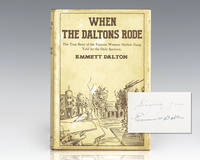
1931112417Garden City NY: Doubleday Doran & Company Inc 1931. First edition of Emmett Dalton's autobiography. Octavo original cloth with smoking gun vignette to the front panel pictorial endpapers frontispiece portrait of Emmett Dalton after a photograph taken in 1892. Signed by the author on the half-title page "Sincerely yours Emmett Dalton." Near fine in the rare original dust jacket with light rubbing. The Dalton brothers led one of the last gangs of horseback outlaws. Ironically three of them - Bob Grant and Emmett - started their careers as deputy marshals. They soon decided that more money could be made from horse rustling and in 1888 they organized a band that carried on a thriving trade. When they came under suspicion toward the end of 1890 the brothers went to California where on February 6 1891 at the small station of Aila they held up a Los Angeles-bound passenger train. The robbery failed when the baggage clerk excaped and the Daltons were unable to break into the safe. Grat was captured and sentenced to twenty years in prison but escaped from the train carrying him to Folsom. The gang resumed operations in Oklahoma where during the next two years they robbed three trains before turning to the more lucrative trade of bank robbery. Modeling their plans on the James brothers the Daltons struck the two banks at Coffeyville Kansas on October 5 1892 hoping as Bob said "to beat anything Jesse James ever did - rob two banks at once in broad daylight." However the identical fate that befell the James gang at Northfield Minnesota awaited the Daltons. Confronted with a large crowd of armed townsfolk the gang attempted to shoot its way to safety; in the battle Bob Gat and two other gang members were killed and Emmett was severely wounded and captured. It is the basis for the 1940 film directed by George Marshall and starring Randolph Scott Kay Francis and Brian Donlevy. Doubleday, Doran & Company, Inc hardcover books
1931104057Garden City NY: Doubleday Doran & Company Inc 1931. First edition of Emmett Dalton's autobiography. Octavo original cloth with smoking gun vignette to the front panel pictorial endpapers frontispiece portrait of Emmett Dalton after a photograph taken in 1892. Signed by Emmett Dalton beneath his frontispiece portrait. In near fine condition. The Dalton brothers led one of the last gangs of horseback outlaws. Ironically three of them - Bob Grant and Emmett - started their careers as deputy marshals. They soon decided that more money could be made from horse rustling and in 1888 they organized a band that carried on a thriving trade. When they came under suspicion toward the end of 1890 the brothers went to California where on February 6 1891 at the small station of Aila they held up a Los Angeles-bound passenger train. The robbery failed when the baggage clerk excaped and the Daltons were unable to break into the safe. Grat was captured and sentenced to twenty years in prison but escaped from the train carrying him to Folsom. The gang resumed operations in Oklahoma where during the next two years they robbed three trains before turning to the more lucrative trade of bank robbery. Modeling their plans on the James brothers the Daltons struck the two banks at Coffeyville Kansas on October 5 1892 hoping as Bob said "to beat anything Jesse James ever did - rob two banks at once in broad daylight." However the identical fate that befell the James gang at Northfield Minnesota awaited the Daltons. Confronted with a large crowd of armed townsfolk the gang attempted to shoot its way to safety; in the battle Bob Gat and two other gang members were killed and Emmett was severely wounded and captured. It is the basis for the 1940 film directed by George Marshall and starring Randolph Scott Kay Francis and Brian Donlevy. Doubleday, Doran & Company, Inc hardcover books