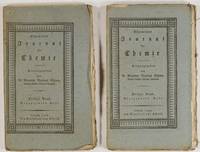
Vauquelin, Louis NicolasBiblio.com
Sur une nouvelle substance métallique contenue dans le plomb rouge de siberie et qu'on propose d'appeler chrôme a cause de la propriété qu'il a de colorer les combinaisons ou il entre and sur la terre du béril pour servir de suite au premier mémoire sur meme objet Vauquelin in Annales de Chimie Vol. 25 & 26 Bound as one: pp. 21-31 and Vol. 26b pp. 170-177 AND D'un mémoire de klaproth sur un nouveau métal nommé tellurium Klaproth n Annales de Chimie Vol. 25 1798 pp. 273-281
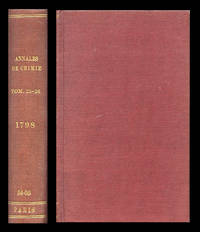
1798799Paris: Chez Fuchs et Guillaume 1798. 1st Edition. FIRST EDITION OF TWO PAPERS BY VAUQUELIN REPORTING THE DISCOVERY OF BERYLIUM. <br /> <br /> Louis Nicolas Vauquelin 16 May 1763 - 14 November 1829 was a French pharmacist and chemist who reports in this paper his discovery of a new ‘earth' obtained by pulverizing gemstone emerald before melting with three times its mass of potassium hydroxide" Walsh Beryllium Chemistry 7. In beryl beryllium aluminum silicate he found an earth oxide that superficially resembled alumina aluminum oxide but was insoluble in alkali and did not form alum. At the suggestion of the editors of Annales de Chimie Vauquelin named it glucina from the sweetness of its sulfate but when first isolated in 1828 by Friedrich Wohler and independently Antoine Bussy it was renamed beryllium DSB Vol. 13 p. 597. <br /> <br /> Though both Beryl and emerald were known as early as 77 A. D. they were not thought to be identical in any way. In 1797 the French mineralogist René Just Haüy noticed that the crystallographic structure of the two minerals seemed similar. Haüy urged Vauquelin to fully determine the chemical composition of each. <br /> <br /> As to the import and uses of Beryllium the national laboratory at Los Alamos states: "Beryllium is used as an alloying agent in producing beryllium copper which is extensively used for springs electrical contacts spot-welding electrodes and non-sparking tools. It is applied as a structural material for high-speed aircraft missiles spacecraft and communication satellites. Other uses include windshield frame brake discs support beams and other structural components of the space shuttle. Beryllium is used in nuclear reactors as a reflector or moderator for it has a low thermal neutron absorption cross section. It is used in gyroscopes computer parts and instruments where lightness stiffness and dimensional stability are required. The oxide has a very high melting point and is also used in nuclear work and ceramic applications" Periodic Table of Elements LANL Los Alamos National Laboratory Portal. <br /> <br /> ALSO INCLUDED: Martin Heinrich Klaproth report on the discovery of tellurium. Additionally Klaproth discovered or co-discovered zirconium 1789 titanium 1792 strontium 1793 chromium 1797 mellitic acid 1799 and cerium 1803 DSB Vol. 7 p. 394. CONDITION & DETAILS: Paris: Chez Fuchs et Guillaume. 8vo. 8.25 x 5.5 inches 206 x 137mm. Volume 25: 335 pages 1 plate. Volume 26: 340 pages 1 plate. Ex-libris with NO spine markings and very minimal interior markings small stamp on title page and blank front flyleaf. Tightly and very solidly bound in maroon cloth with a gilt-lettered spine; minor scuffing to the edge tips. Very slight toning to the preliminaries otherwise bright and very clean throughout. Very good condition. Chez Fuchs et Guillaume hardcover
Atticus Rare Books · États-Unis325,00 $US≈ 274,98 €