118 résultats
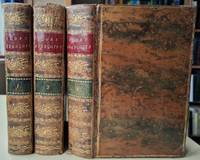
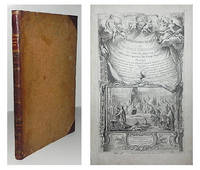
176014266Amsterdam 1760. Boards. Good. Four volumes in uniform period leather bindings. 12mo 6 1/2 x 4 inches. Spines with gilt decorations raised bands and leather labels. Clean internally. Bindings are worn but fundamentally sound.<br /> <br /> Tome Premier: III-XVI 727 pages. Tome Second: 2 743 pages. Tome Troisieme: 2 648 pages. These three volumes comprise a set and contain the indices of the Royal Academy of Sciences of Paris for the years 1699-1734 inclusive. Headband of Tome Second torn. Marbled pastedown endpapers with plain flyleaves. Published in 1741 by Chez Pierre Mortier. These three volumes contain a general table of the matters contained in the Royal Academy of Sciences of Paris from 1699 to 1734 inclusive.<br /> <br /> Tome Quatrieme: 8 404 XXXVI 372 2 III-VIII 256 pages. This volume has a paper label with manuscript notations at the head of the spine. Marbled endpapers. Published in 1760 by Chez J. Schreuder Et Chez Pierre Mortier le Jeune. The first section 8 404 pages is a general table of the matters contained in the Royal Academy of Sciences of Paris from 1735-1751 inclusive. BOUND WITH XXXVI 372 pages the "Histoire de L'Academie Royale Des Sciences Centie'me ou Dernier Volume De La Premiere Centurie. Contenant un Abregd Historique de chaque Sceince. Avec une liste generale des Memoires de Mathematique & de Physique jusqu'a l'annee 1751. inclusivement." History of the Royal Academy of Sciences Hundredth or Last Volume of the First Century. Containing an Historical Summary of each Science. With a general list of Memoirs of Mathematics & Physics up to the year 1751 inclusive. BOUND WITH III-VII 256 pages "Memoires de L'academie Royale Des Sciences. Jusqu'a L'Année MDCCLI. Inclusivement. Contenus dans la premiere Centurie des Volumes de l'Edition de Hollande." Memoirs of the Royal Academy of Sciences. Up to the Year MDCCLI. Inclusively. Contained in the First Century of Volumes of the Holland Edition. This last section has no title page. Boards. unknown
1795ZB1254671Academie des Sciences Paris 1795. Price HAS BEEN REDUCED by 10% until Monday June 29 SALE item 10 volumes bound in modern green buckram minor library markings else very good. - If you are reading this this item is actually physically in our stock and ready for shipment once ordered. We are not bookjackers. Buyer is responsible for any additional duties taxes or fees required by recipient's country. Photos available upon request. Academie des Sciences, Paris hardcover
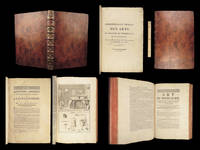
176726614<p><strong>1767 ARTS & Science BAKING Breads Cooking Recipes Illustrated Farming Millers</strong></p><p>An exceedingly rare and desirable 18th-century arts and sciences study by the Acadmie Royale des Sciences. This enormous tome focuses primarily on sciences relating to baking and food preparation – planting crops and farming irrigation details on millers and milling vermicelli and noodle making baking and cooking. Also includes milling wig-making hat-making and growing/processing indigo. It includes recipes and techniques for making soups baking breads and so much more!</p><p>Item number: #26614</p><p>Price: $795</p><p>Academie Royale des Sciences</p><p><strong><em>Description des arts et meÌtiers</em></strong></p><p>Paris: 1767. 1st edition</p><p><u>Details</u>: </p><p><!-- if !supportLists-->· <!--endif-->Collation: Complete with all pages; </p><p><!-- if !supportLists-->o <!--endif-->Meunier – iv 340</p><p><!-- if !supportLists-->o <!--endif-->Perruquier – vi 44</p><p><!-- if !supportLists-->o <!--endif-->Faire des Chapeaux – 2 94</p><p><!-- if !supportLists-->o <!--endif-->L'Indigotier – 2 118</p><p><!-- if !supportLists-->o <!--endif-->32 engraved plates</p><p><!-- if !supportLists-->· <!--endif-->Language: French</p><p><!-- if !supportLists-->· <!--endif-->Binding: Leather; tight and secure</p><p><!-- if !supportLists-->· <!--endif--><strong>Size: </strong><strong>~17.25in X 11.75in 44cm x 30cm</strong></p><p>Our Guarantee:</p><p>Very Fast. Very Safe. Free Shipping Worldwide.</p><p>Customer satisfaction is our priority! Notify us with 7 days of receiving and we will offer a full refund without reservation!</p><p>26614</p><p>Photos available upon request. </p> hardcover
1723000459Paris: de l'imprimerie Royale 1723. First Edition. . Hardcover. See Description. 4to. pp. 6 108 324. Engraved frontispiece and 16 fold-out plates 3 of which are maps 2 maps of the Caspian Sea region and 1 map showing the retreat of the Greek Ten-Thousand from their expedition against Persia. Other plates contain botanical geometrical and mechanical illustrations. Occasional diagrams are also printed with the text. Re-backed preserving original mottled calf boards leather is well-worn rubbed and crackling but treated to prevent further deterioration; board edges are restored. Some of the gilt outer border on front and rear boards is restored. Interior is generally clean with some scattered light marginal foxing. Several pages show moderate toning / foxing. Occasional minor marginal chips; tiny marginal tear on frontis neatly sealed; 50 mm tear carefully sealed on one of the Caspian map plates. One plate edge overlaps the text block. Provenance: Appears to be the gilt coat of arms of John 2nd Duke of Montagu on both the front and the rear covers. The arms incorporate those of his wife Lady Mary Churchill daughter of Sir John Churchill the 1st Duke of Marlborough. Montague was a member of the Royal Society and Knight of the Garter. Photos on request. Library ticket on verso of front end paper. Annual publication of the French Academie Royale des Sciences for the year 1721. Includes articles on physics anatomy chemistry botany algebra geometry astronomy geography and mechanics by leading scientists of the time i.e. Jean Jacques Mairan Jacques Cassini Pierre Varignon Jacques Eugene de Louville Rene Antoine Reaumur Sebastien Vaillant and others. <br/> <br/> de l'imprimerie Royale hardcover
1742SS13441London:: Printed for John and Paul Knapton. . . 1742-53. 1742. 5 volumes. 8vo. Vol.1: 4 x 11-456 16; Vol.2: 2 407 15 10; Vol.3: 2 422 16; Vol.4: 2 410 14 11-26; Vol.5: 2 426 14 pp. The first 10 pages of the "Addenda" are bound at the end of vol.2 pp.11-26 are bound at the end of vol.4. 44 of 45 engraved plates mostly folding I: 17; II: 6; III: 6; IV: 6; V: 9 of 10 plates pl. 10 supplied in facs. see p. 422 TOTAL: 44 2 folding tables vol. I tables some folding addenda indexes; 2nd wasp plate vol. V with small scrape effecting some of the image. Original speckled calf; rebacked and with later endleaves vols. I III & V with joints gently mended with kozo. PROVENANCE: Bookplates of Henry and Carol Faul mounted on top of the following engraved bookplate for the American Academy of Arts & Sciences: "Sub libertate Florent" dated 1780 "The Gift of . . ." -- also with their gilt-stamp applied to the foot of the later spines "American Academy"; Rubber stamps discarded of the Linda Hall Library Kansas City MO. Very good. HENRY FAUL'S COPY -- WORKED FOR ENRICO FERMI & BIKINI ATOLL TEST. A collection of early scientific papers from leading figures all belonging to the Royal Academy of Sciences at Paris the French equivalent to the Royal Society of London. The abridged papers all appeared between 1699 and 1720 and include diverse topics such as anatomy apiculture astronomy incl. Moon chemistry electricity entomology gases geography geology herpetology invertebrates magnetism medicine meteorology mineralogy monsters music mollusks natural history optics physics scientific instruments including the barometer microscope zoology and more. / AMONG THE NUMEROUS CONTRIBUTORS OR NOTABLES MENTIONED: Agricola Amontons Baert Juan de Barros Bernoulli Bignon Borelli Bouvet Robert Boyle Carre Cassini Chazelles Chevalier Coronelli Dampier Descartes Dodart Fermat Fontenay Fontenelle Galileo Gandolphe Gassendi Gesner Gouye Halley Van Helmont de la Hire du Hamel Huygens Jeaugeon Kepler Kircher Leibnitz Lemery Leuwenhoek Malpighi de Marca Mariotte Mollard Gregory Nazianzen Isaac Newton de Nointel Ortelius Parent Picard Renau Riccioli Sanctorius Strabo Tournefort Varignon etc. PROVENANCE: 1 American Academy of Arts & Sciences bookplate: The Academy seal features Minerva the goddess of wisdom science and trade and the arts. Her temple on the Aventine Hill was a meeting place for skilled craftsman writers and actors. She is also depicted as a warrior a symbol appropriate for an organization created in the midst of the American Revolution. Around Minerva are representations of the new country—on her right a field of Indian corn a stand of oaks and the outline of a town; at her feet a hoe a plow and a sickle; on her left a quadrant and a telescope a ship heading for shore and the sun completely risen above the cloud. Over the whole is the motto SUB LIBERTATE FLORENT which suggests that arts and sciences flourish best in. -- 2 Rubber stamps discarded of the Linda Hall Library Kansas City MO. -- 3 Henry and Carol Faul. Henry Faul was a geologist working on Enrico Fermi's team at the University of Chicago. He was responsible for prospecting uranium ore in Colorado and Utah. He also travelled to Manhattan Project sites at Los Alamos and in Washington DC. Following the war Faul continued to work on nuclear projects and participated in the Bikini Atoll test. He received his M.S. from the University of Chicago during the war and went on to get his Ph.D. from the Massachusetts Institute of Technology. ESTC T131275. Printed for John and Paul Knapton. . . , 1742-53. unknown
176226629Berlin Stettin und Leipzig Johann Heinrich Rüdigern 1762-75. 4to. Bound in 13 fine uniform full calf raised bands gilt backs. Remains of paperlabels on backs. Top of spine on one volume frayed. Small rubber stamp on titles. A few brownspots. A good copy. Having in all 374 of 585 fine engraved plates 1 plate supplied in xerox-copy. Plates measure around 37x24cm. <br/><br/><em>First German edition of one of the main works of the 18th century in the fields of crafts and technology as it is a translation of the famous series "Description des Arts et Metiers" issued by Academie Royale des Sciences 1760-75. The French edition was published in folio. Band 1: Kohlenbrennen Lichtziehen Ankerschmieden Nadler Papiermacher. 31 plates and 1 table;Band 2: Eisenhämmer. Teil 1-2 Wachsziehen Pergamentmachen Leder-Vergoldung Schieferbrüche. 22 plates; Band 3: Eisenhämmer. Teil 3-4 Spielkartenherstellung Seidenfärberei Pappenmacher. 29 plates 1 plate supplied in xerox-copy; Band 4: Böttcherkunst Weißgerber Ziegelstreichen Zuckersieden Silber affinieren. 30 plates; Band 5: Messingherstellung Tuchmacherkunst Lohgerberei. 33 plates. Band 6: Tuchfrisierkunst Saffianleder-Herstellung Leder auf ungarische Art Weißgerber Hutmacher Dachdecker. 19 plates; Band Band 7: Tapetenweberei Kalkbrennerkunst Ziegelstreichen in Holland Ziegelhütten Ball- und Raquettenmacher. 30 plates and 1 table; Band 8: Perückenmacherkunst Müller Nudelmacher und Bäcker. 15 plates; Band 9: Schuster Schlösserkunst. 48 plates; Band 10: Steinkohlenbergbau Indigobereiter. 22 plates; Band 11: Eisenbergwerke und Hüttenwerke in der Steiermark Leimsiederei Fischerei Teil 1. 25 plates and 1 table; Band 12: Fischerei Teil 2. 50 plates; Band 13: Fischerei Teil 3 Porzellanherstellung. 23 plates and 1 engr. frontisp.; Band 14: Glasmalerei und Glasarbeiten. Mit 13 von 14 Tafeln; Band 15: Wollenzeugfabrikant. 17 plates; Band 16: Seifensider Leinwandhandel Schneiderhandwerk Leinenmanufaktur Tabaksmanufaktur. 27 plates; Band 17: Bleiarbeiter mathematische und astronomische Instrumente Baumwoll-Samtfabrikation. 38 plates; Band 18: Stickerkunst Siebmacher Riemer und Sattler mit Kutschenbau Drahtzieherei Stahlblattmacher. 51 plates Band 19: Schiffbaukunst. 18 plates and 1 engr. frontisp.;Band 20: Zinngießerkunst. 32 plates; Band 21: der Strumpfwirkerstuhl und sein Gebrauch. 14 plates. </em> hardcover
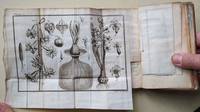
1759021234Avignon: Louis Chambeau 1759. Small 12mo measures 153mm x 92mm pp 156 a little browned and age-toned but very sound internally two folding engraved plates a little frayed and creased at the margins and again age-toned full contemporary calf worn at corners the spine dull joints a bit worn but still very sound. A delightful provenance - with the bookplate of C. Harman Payne author of The Florist's Bibliography. This is the only book I have seen from what must have been a notable library. Also with the bookplate of the naturalist Edward Heron-Allen. The plates are great fun showing florists' tools as well as hyacinths a bulb vase and something which looks more like a crocus planter. "Jean Paul Rome d' Ardène retired about 1750 from his duties as 'supérieur' of the college at Marseilles to the Château d' Ardène diocese of Sisteron where he created a botanical garden and gave himself to the study of flowers" - Hunt Catalogue. D'Ardene wrote similar works dealing with Ranunculus Tulips and Carnations It is interesting that Hunt had copies of those three but only mention this work in passing - they did not have a copy. Indeed it seems extremely rare - I can only trace three copies two in WorldCat and the Lindley Library copy. First Edition. Full Leather. Good. Louis Chambeau Hardcover
1731018259Paternoster Row & St Paul's Churchyard London: J & J Knapton; A Bettesworth & C. Hitch; J. Pemberton & D. Browne 1731. Sixth edition. The title pages to parts II and III are dated 1730 as is Hereforshire Orchards;the title page to the appendix is 1731. Thick octavo pp xiv 608 25 with an engraved frontispiece and thirteen engraved plates of which eight are folding several plates are folded awkwardly and several have frayed margins but only one has very slight loss of the engraved surface and it is this one which protrudes slightly from the fore-edge some age-toning occasional small splash marks a little wear throughout light early manuscript notes on the front endpapers contemporary full calf a bit worn and marked but perfectly sound lacking tiny pieces at head and tail of the spine the remains of a contemporary manuscript label on the spine. A reasonably good copy of one of the most influential of eighteenth century gardening books. Blanche Henrey 503. Little is known about Bradley's childhood aside from an early interest in gardening and the fact that he lived in the vicinity of London a city at the time with many amateur naturalists. Though Bradley lacked a university education his first publication Treatise of Succulent Plants gained him traction with influential patrons like James Petiver and later Hans Sloane. With their support he was proposed and elected a Fellow of the Royal Society in 1712 at the age of 24. Two years later Bradley visited the Netherlands and took an interest in horticulture. He spent the next decade back in England writing treatises on topics related to this central interest like weather fertiliser productivity and plant hybridisation. In recognition of his work in the field and with the thereafter unfulfilled promise that he would found and fund a university botanical garden the University of Cambridge named Bradley its first professor of botany in 1724 a position he would hold until his death. As Bradley was not a wealthy man in his later life and as this was an unsalaried position the newly minted academic continued to focus most of his efforts on making a living through publishing. According to his rival and successor John Martyn as well as his successor son Thomas Martyn Bradley did this at the expense of his students whom he reportedly neglected to even lecture to. Bradley made notable innovations and discoveries across a wide array of disciplines. For example this work included directions for the making and use of a rudimentary kaleidoscope to aid in formal garden design and layout. He also wrote about cooking and was the first to publish recipes in the English language using the then-exotic pineapple as the main ingredient. His History of Succulent plants was the seminal treatise on the topic and his studies of tulips and auriculas helped further accurate theories of plant reproduction. Bradley was also a pioneer in the examining of fungal spore germination and the pollination of plants by insects. His publications additionally contained information on how to build and use greenhouses early theories regarding agricultural productivity and pond ecology. . Sixth edition. Half-Leather. Fair. J & J Knapton; A Bettesworth & C. Hitch; J. Pemberton & D. Browne Hardcover
17836835053B. White 1783. This is an ex-library book and may have the usual library/used-book markings inside.This book has hardback covers. In poor condition suitable as a reading copy. No dust jacket. Octavo leatherbound very worn covers both covers detached raised bands on spine gold stamped gilt lettering and bands first three pages detached foxing library stamps on first pages pen writing opposite title page split but attached down spine. Please note the Image in this listing is a stock photo and may not match the covers of the actual item650grams ISBN: B. White hardcover
1783020924Horace's Head in Fleet Street London: B. White 1783. Octavo pp xvi 379 i 14 slightly age-toned pages 130 - 145 have a light waterstain but generally extremelyclean and tight internally with the armorial book plate of Edward Duke on the front endpaper contemporary half calf and marbled boards later re-backed with new leather spine the binding eubbed and age-toned but still quite firm. A pleasing copy. The title page also lists the sunject headings - "ranged under Eleven General Heads Viz. Esculent 1 Roots 2 Shoots Stalks etc. 3. Leaves 4 Flowers 5 Berries 6 Stone-fruit 7 Apples 8 Legumens 9 Grain 10 Nuts 11 Funguses.". Blanche Henrey 528. An early work to embrace Linnean nomenclature. Half-Leather. Good. B. White Hardcover
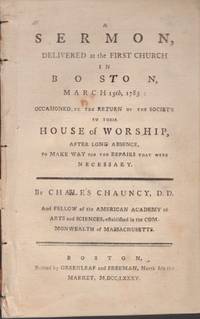
178532851Boston: Printed by Greenleaf and Freeman 1785. First Edition. Wraps. Good. Disbound wraps missing the half title page. 3-23 pages 1 page blank. Stitched trimmed wraps with title on page 3. Previous owner ink inscription of "Capt A Bailey Concord" partially trimmed located at the top edge of page 23. "A Bailey" written top of page 5. <br /> <br /> Rev. Chauncy is retiring after nearly 60 years of work. He writes "I am now grown old and unable through manifold infirmities to go on with the work of the sacred ministry."<br /> <br /> Evans 18953. Printed by Greenleaf and Freeman unknown
180089187London: C. Cooke. Poor; The book is very worn torn aged and spotted. It is missing . thelast 50 or more pages everything past page 720. circa 1800. Hardcover. Vol. 2; Charts & Graphs; 8vo 8" - 9" tall; 720 pages . C. Cooke hardcover
1769017255Vienna: Krauss 1769. Two volumes bound in one quarto illustrated with 18 folding engraved plates age-toned the final plate a littlre frayed at the fore-edge and neatly repaired at the folds two main title pages six sub-title pages to the fascicles and six dedication pages all with engraved vignettes several engraved tail-pieces pp xii 508 8 a little age-toning throughout occasional spotting and foxing but otherwise sound smartly bound in a fairly modern half-calf slightly rubbed.As usual it is the second printing of the first volume and the first edition of the second. The first title page has the blind stamp of Isaac Bayley Balfour. As well as Regius Keeper of Edinburgh Botanic Garden Balfour had the distinction at various times of being Professor of Botany at Glasgow Oxford and Edinburgh. Crantz was a botanist but primarily a physician lecturing in obstetrics. As an extremely sharp-sighted and sensible observer - and in a scientific dispute with his contemporaries Jacquin and Linnaeus - he discovered and named for example the genus Camelina and many new species such as Pedicularis rostratocapitata Veronica orchidea Veronica dillenii. Potentilla crantzii and Noccaea crantzii = Thlaspi alpestre are named for him. The six fascicules are dedicated to different botanical societies or natural historians including Saverio Manetti Albrecht von Haller and the Dane Petrus Ascanius a pupil of Linnaeus. Hunt 603; Pritzel 1954. . Half-Leather. Good. Krauss Hardcover
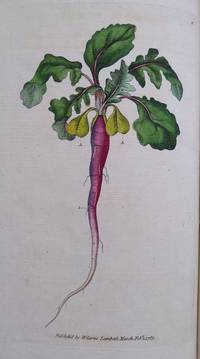
1788019842The Botanic Garden Lambeth-Marsh: Published by the author 1788. Octavo pp 33i eight hand coloured engraved plates with slight age-toning the last twoplates with slight foxing also each plate has a descriptive explantikon page opposite twentieth century boards with cloth spine the upper cover a little faded but otherwise very good. RARE. Designed to illustrat a series of public lectures given by Curtis at his Botanic Garden only two parts each of four plates were ever published. The garden was in Lambeth Marsh near to what is now Waterloo Station. First Edition. Cloth-backed boards. Good. Published by the author Hardcover
1791017068St Paul's Churchyard London: J. Johnson 1791. Two volumes bound in one. Volume 1 - Second edition 1791. Volume 2 - Third edition 1791. Blanche Henrey 470 . Illustrated with two engraved allegorical frontispieces 18 engraved plates one of them folding - the Cypripedium plate which is often lacking - and two hand-coloured quarto pp xii 214 126 ii; x 197 both frontispieces and title pages browned and with some offsetting from plate to title the plates of the Portland Vase and the Fertilisation of Egypt similar this last plate by Blake after Fuseli; the remaining botanical plates clean lacking the corner of page 171/2 a relevant pencilled note at the base of one page a few pages with foxing but otherwise very clean and sound internally with the armorial bookplate of the Dowdeswell family Pull Court Worcestershire on the front endpaper together with a shelf label and a small newspaper clipping; the hand-colouring on the two plates is particularly attractive and there is also an extra engraved plate fixed to the verso of the first titlepage - a portrait of Darwin engraved by Haughton after Rawlinson - this has caused a little waving of the paper; contemporary full calf a little rubbed and scuffed rebacked the old spine laid down and with some wrinkling. Still a good sound copy. The first poem The Economy of Vegetation celebrates technological innovation scientific discovery and offers theories concerning contemporary scientific questions such as the history of the cosmos. The more popular Loves of the Plants promotes revises and illustrates Linnaeus's classification scheme for plants. One of the first popular science books the intent of The Botanic Garden is to pique readers' interest in science while educating them at the same time. By embracing Linnaeus's sexualized language which anthropomorphizes plants Darwin intended to make botany interesting and relevant to the readers of his time. Darwin emphasizes the connections between humanity and plants arguing that they are all part of the same natural world and that sexual reproduction is at the heart of evolution ideas that his grandson Charles Darwin would later turn into a full-fledged theory of evolution. This evolutionary theme continues in The Economy of Vegetation which contends that scientific progress is part of evolution and urges its readers to celebrate inventors and scientific discoveries in a language usually reserved for heroes or artistic geniuses. Darwin's attempt to popularize science and to convey the wonders of scientific discovery and technological innovation through poetry helped initiate a tradition of popular science writing that continues to the present day. Full Leather. Good. J. Johnson Hardcover
1791018452Turici Helvetorum Zurich: Ziegleri & Filiorum 1791. Octavo pp xvi; lxxx 526 light foxing and blemishing with some light pencil marginalia contemporary full calf rubbed and scuffed with wear at the corners marbled endpapers. Edited by the Swiss botanist Paul Usteri and published within two years of the first edition. This copy was owned by the Scottish botanist and plant collector George Don - 1798-1856 - with his signature on the first blank. The pencil notes though look to be by another hand. In this study of flowering plants Jussieu adopted a methodology based on the use of multiple characters to define groups an idea derived from naturalist Michel Adanson. This was a significant improvement over the "artificial" system of Linnaeus whose most popular work classified plants into classes and orders based on the number of stamens and pistils. Jussieu did keep Linnaeus' binomial nomenclature resulting in a work that was far-reaching in its impact; many of the present-day plant families are still attributed to Jussieu. Morton's 1981 History of Botanical Science counts 76 of Jussieu's families conserved in the ICBN versus just 11 for Linnaeus for instance. Writing of the natural system Sydney Howard Vines remarked "The glory of this crowning achievement belongs to Jussieu: he was the capable man who appeared precisely at the psychological moment and it is the men that so appear who have made and will continue to make all the great generalisations of science.". Second edition. Full-Leather. Good. Ziegleri & Filiorum Hardcover
1750015882Leyden & Amsterdam: Samuel Luchtmans & Meynard Uytwerf 1750. Illustrated with 13 finely engraved plates one with a tear and one with tears along the folds one full page plan within the text small quarto pp xxiv 6 412 32 contents a little age-toned but otherwise remarkably clean pages unpressed lacking the half-title contemporary full calf rather worn particularly at the corners joints cracked lacking the lower panel of the spine and a small piece at the head original marbled endpapers. LACKING one plate. "French edition of the first treatise in Dutch to provide a theoretical basis for garden design. It also addressed various practical issues including the cultivation of plants propagation and stove and hothouse technology the latter presumably embodying the knowledge held within the family - the author's father having grown the first pineapple at Meerburg in 1658" - Patrick Taylor . Full-Leather. Good. Samuel Luchtmans & Meynard Uytwerf Hardcover
1778021546Paris: L'Imprimerie Royale 1778. First edition. Three volumes pp cxx 132 xxix; iv 660; 654 xx i eight folding engraved plates a folding table very clean internally contemporary binding of an unusual full calf gilt-lined on the covers full gilt spines each with a red and a black label slightly rubbed and slight surface wrinkles but overall very attractive marbled endpapers marbled edges. With a stamp on the title pages of the Bibliothek Graf Spangensche an unidentified contemporary signature in the verso of the endpaper and the bookseller's label on the front paste-down endpqper of the first volume - "Cet Ouvrage se trouve ainsi que beaucoup d'autres chez La veuve Mangot Libraire sur le Hof im blauen Haus N. 312 im 3 ten Stock" "This work can be found along with many others at La veuve Mangot bookseller on the Hof im blauen Haus N. 312 im 3 ten Stock". With the bookplate in each volume of Kenneth Lazenby on of the founding members of the Alpine Garden Society. Flore française is a book by Jean-Baptiste Lamarck and Augustin Pyramus de Candolle that was published in 1815 in Paris. It is a work on botany classification and the plants of France. Lamarck designed the book to help identify plants using dichotomous keys which are classification tools that help users choose between opposing pairs of morphological characters. Lamarck was a botanist who became a prominent figure in French science after studying with de Jussieu and the publishing this work. He was mentored by Georges-Louis Leclerc Comte de Buffon a leading French scientist at the time. Lamarck's work was well-respected by scholars and helped him gain membership to the French Academy of Sciences in 1779. He later became a founding professor at the Musee National d'Histoire Naturelle where he was an expert on invertebrates. First Edition. Full-Leather. Very Good. L'Imprimerie Royale Hardcover
1760047649Paris: Chez Charles-Antoine Jombert Libraire du Roi pour le Genie & l'Artillerie a l'image Notre Dame 1760. Fourth Edition . Hardcover. Very Good/No Jacket. Folio - over 12 - 15" tall. Quarto. 8 482 6 pages. Hardcover bound in original speckled calf with raised bands on the spine. The binding is worn but sound. Splitting to the front hinge running up about 3 inches from the foot to the lowest band. Spine a bit dry with some flaking and nicks to the leather. The binding is rubbed and has some scuffs. A sound copy. All edges red. Marbled endpapers. Text is generally clean. Collates complete with 49 copperplate engravings most which are folding. A decent example. First published in 1709 this is the Fourth edition and is the most expansive and heavily illustrated editions of this work. Text is in French. <br/> <br/> Chez Charles-Antoine Jombert, Libraire du Roi pour le Genie & l'Artillerie, a l'image Notre Dame hardcover
1784000285Etienne Charpentier 1784. Hardcover. See Description. Tall folio 385 mm. The entire book including the text was printed from engraved copper plates 60 plates an illustrated title page plate 29 anatomical plates and 30 calligraphic letterpress plates. Bound in a contemporary or near contemporary binding with calf spine and decorative paste paper boards - rubbed edges shelf worn old ink stain on rear cover. Both the upper portion of the spine and the tail cap are carefully restored. Board corners are neatly repaired. Interior contains an occasional minor spots of marginal foxing; a couple of tiny holes or paper defects are present on the text plate opposite plate 20. The leaves are otherwise generally clean. Francois-Michel Disdier 1708-1781 was a professor of surgery and a drawing master at the Academy of Painting in Paris. His "Tableaux anatomiques" a deluxe anatomy book for physicians was first published in 1758. Many of the plates were done by Crepy and Charpentier some after the style of Vesalius and others following Eustachi. The engraved title page designed by François Bouchet depicts students in an anatomy class studying a cadaver. The whole scene is framed in ornate baroque style. Blake NLM p. 122; Heirs of Hippocrates 894 listing 1778 edition; Hirsch II p. 190. <br/> <br/> Etienne Charpentier hardcover
1784biblio48vo 190 x 120mm. pp. 18 511 with 3 engraved plates. Original calf gilt spine; lightly rubbed else fine. First edition. Marks of previous owner. Pictures on demand. Please contact me ramrozzi@yahoo.fr<br /> Cuchet
1761016590Paris: C.J.B. Bauche 1761. Illustrated with an engraved folding map 19 attractive engraved plates octavo half-title title page pp xviii 585 ii a little age-toning and slight staining internally a contemporary signature on the title page the occasional neat manuscript note otherwise good and sound internally twentieth century half morocco lightly scuffed raised bands to the spine. RARE. Withe bookplate of Kenneth Lazenby a founding member of the Alpine Garden Society . "The book is important because it contains an early attempt at a natural system prior to Adanson ignored by A-L de Jussieu influenced to some extent by Linnaeus's Ordines Naturales" - Stafleu & Cowan. First Edition. Half Leather. Very Good. C.J.B. Bauche Hardcover
1761017305Paris: C.J.B. Bauche 1761. Illustrated with an engraved folding map 19 attractive engraved plates octavo half-title title page pp xviii 585 ii a little age-toning and slight staining internally hinge at the front slightly weak but otherwise good and sound internally full contemporary calf worn at the corners a little rubbed generally the upper joint with slight wear lacking a small piece at the head of the spine marbled endpapers. RARE. From the library of the nurseryman Will Ingwersen with his signature on the first blank and his bookplate on the front endpaper. "The book is important because it contains an early attempt at a natural system prior to Adanson ignored by A-L de Jussieu influenced to some extent by Linnaeus's Ordines Naturales" - Stafleu & Cowan. . First Edition. Full-Leather. Good. C.J.B. Bauche Hardcover
1738019442At the West-End of St Paul's London: W. Innys & R. Manby 1738. Third edition with amendments. Small octavo pp xiv 376 illustrated with 19 engraved plates small octavo pp xiv 376 slight signs of age-toning and dustiness but generall quite clean internally the front endpaper detached contemporary full calf poor the covers nearly detached. In Vegetable Staticks Hales studied transpiration - the loss of water from the leaves of plants. He estimated the surface area of the leaves of the plant and the length and surface area of the roots. This allowed Hales to compare the calculated influx of water into the plant with the amount of water leaving the plant by transpiration through the leaves. He also measured 'the force of the sap' or root pressure. Hales commented that "plants very probably draw through their leaves some part of their nourishment from the air". He prefigured the cohesion theory of water movement in plants although his ideas were not understood at the time so he did not influence the debate on water transport in plants in the 19th century. He also speculated that plants might use light as a source of energy for growth i.e. photosynthesis based on Isaac Newtons suggestion that "gross bodies and light" might be interconvertible. He also describes experiments that showed that "air freely enters plants not only with the principal fund of nourishment by the roots but also thro the surface of their trunks and leaves". While Hales work on the chemistry of air appears primitive by modern standards its importance was acknowledged by Antoine Lavoisier the discoverer of oxygen. Hales invention of the pneumatic trough to collect gases over water is also considered a major technical advance. Modified forms of the pneumatic trough were later used by William Brownrigg Henry Cavendish and Joseph Priestley in their research. Blanche Henrey 779. Full-Leather. Good. W. Innys & R. Manby Hardcover
1738015037At the West-End of St Paul's London: W. Innys & R. Manby 1738. Third edition with amendments. Small octavo pp xiv 376 illustrated with 19 engraved plates fore-edge a little thumbed but otherwise very clean and crisp internally marbled endpapers contemporary full polished calf a thin decorated gilt line around the borders a little marked and worn the spine gilt decorated with raised bands lacking the top 25mm of the spine and lacking small portions at the top of each joint the joints cracking slightly. still an attractive copy. In Vegetable Staticks Hales studied transpiration - the loss of water from the leaves of plants. He estimated the surface area of the leaves of the plant and the length and surface area of the roots. This allowed Hales to compare the calculated influx of water into the plant with the amount of water leaving the plant by transpiration through the leaves. He also measured 'the force of the sap' or root pressure. Hales commented that "plants very probably draw through their leaves some part of their nourishment from the air". He prefigured the cohesion theory of water movement in plants although his ideas were not understood at the time so he did not influence the debate on water transport in plants in the 19th century. He also speculated that plants might use light as a source of energy for growth i.e. photosynthesis based on Isaac Newtons suggestion that "gross bodies and light" might be interconvertible. He also describes experiments that showed that "air freely enters plants not only with the principal fund of nourishment by the roots but also thro the surface of their trunks and leaves". While Hales work on the chemistry of air appears primitive by modern standards its importance was acknowledged by Antoine Lavoisier the discoverer of oxygen. Hales invention of the pneumatic trough to collect gases over water is also considered a major technical advance. Modified forms of the pneumatic trough were later used by William Brownrigg Henry Cavendish and Joseph Priestley in their research. Blanche Henrey 779. Full-Leather. Good. W. Innys & R. Manby Hardcover