8 résultats
1887045260Boston: Cupples Upham and Company 1887. Book. Very Good. Hardcover. Owner name on fly. Blue ribbon-bound cloth binding. Cupples, Upham and Company Hardcover
188975793Cincinnati: Robert Clark & Co. 1889. Second edition. Octavo. Allegorical frontispiece 54 pp. Publisher's blue cloth with gilt spine lettering and floral endpapers. Very attractive. Robert Clark & Co. hardcover
1895046854London United Kingdom: Theosophical Publishing Society 1895. Book. Good. Hardcover. Bookplate inside cover from the Torbay Lodge Lending Library with lodge name penned in cursive on title page moderate soiling to cloth age toning to endpapers. Mustard cloth with gilt spine lettering. Theosophical Publishing Society Hardcover
188675774Cincinnati: Robert Clark & Co. 1886. First edition. Small square octavo. 42 pp. including a full page allegorical illustration. Printed green wrappers Excellent.Jirah Dewy Buck received his medical training at Cleveland Homeopathic Medical College completing the program in 1864. He began practice that year in Cincinnati as a homeopathic physician in general practice. He also taught medicine at Cleveland Medical College and became Dean of the Pulte Medical College in Cincinnati until it was merged into Ohio State University. In 1890 Dr. Buck became President of the American Institute of Homeopathy. He practiced medicine for over 40 years. Dr. Buck became active in the Theosophical Society in 1879. In 1880 he was a member of the General Council of the Theosophical Society. On May 13 1884 he was appointed by Col. Olcott to be a member of the Board of Control of the Theosophical Society's activities in the United States. In Mahatma Letter 140 written in March 1886 Madame Blavatsky gave A. P. Sinnett an indication that Dr. Buck was being "helped" by the Mahatmas to make the Society "a grand movement" in America. The Cincinnati Theosophical Society was formed on May 9 1886 at the Buck home on Oak Street. Cincinnati was one of the earliest centers of theosophical adherents in the US and Buck was their patriarch. The first edition is signed lightly in pencil by a woman in his inner circle.Madame Blavatsky quoted an essay of his in The Key to Theosophy and commented "No living theosophist has better expressed and understood the real essence of Theosophy than our honoured friend Dr. Buck". She also referred to him as "a true Philaletheian" in her book quoting from an article he published in The Theosophist September 1883 p. 327 titled "The Ethics of Theosophy." Robert Clark & Co. unknown
188375773Madras: C. Foster and Co. 1883. First edition. Small octavo. 47. 1 pp. Publisher's printed buff wrappers. Some dust-soiling to wrappers else and excellent copy. Only four copies located by OCLC.We in the West tend to think of the Theosophical Society as a new religion practiced almost entirely in Europe and America but in fact there was a very large contingent of Indian Theosophists. Row a Vice-president of the Madras Branch of the the Theosophical Society explains the importance of the movement to him an Indian practitioner and why he joined. C. Foster and Co. unknown
186975650Cincinnati: Robert Clark and Company 1869. First edition. Octavo. 85 1 pp. Original wrappers expertly restored.J. Ralston Skinner was a man of tremendous and far-reaching learning. A denizen of Cincinnati he was deemed an expert on a great many matters. This book his first concerns Newtonian physics gone astray. The theory of Newton that every particle of matter attracts all other particles of matter in right lines joining their centers and in an inverse ratio to the squares of their distances b yvirtue of an inherent force called gravity accounted for the motions of the planets so satisfactorily that it has been almost universally adopted by subsequent physicists as a natural law. In this book he calls into doubt this firmly held theory/"The theory of Newton that every particle of matter attracts all other particles of matter in right lines joining their centers and in an inverse ratio to the squares of their distances bj"virtue of an inherent force called gravity accounted for the motions of the planets so satisfactorily that it has been almost universally adopted by subsequent physicists as a natural law. The latterof the essay in which it is attempted to sustainthe theory are as the author claims merely suggestive; the first part being devoted to the attempt to demonstrate mathematically that the theory of Newton is untenable" Scientific American 1869. J. Ralson Skinner was a die-hard mason and published numerous books of esoteric wisdom; Madame Blavatsky though very highly of him/ "H. P. Blavatsky’s hitherto unpublished letter to James Ralston Skinner is one of great consequence. Despite its relative obscurity evidence of its existence has been previously alluded to by J. D. Buck Modern World Movements and Boris de Zirkoff BCW VIII 220. Blavatsky herself mentioned the recipient of the letter on numerous occasions clearly revealing her admiration of his great learning as demonstrated in his â€wonderfully clever and erudite volume The Source of Measures†BCW XIII 258. Indeed it is no accident that Skinner is “constantly mentioned†in The Secret Doctrine. In his overview of letter’s recipient Assistant Editor Jerry Hejka-Ekins has observed that both the author and his Source of Measures are mentioned more often in The Secret Doctrine than any other author with the exception of Plato a remarkable observation given the relative obscurity of both Skinner and his work. It is no surprise that John Drais considered the book important enough to compile his Index of Hebrew and Numerical Terms contained in The Source of Measures by J. Ralston Skinner." Theosophical History January 2023. Robert Clark and Company unknown
188476074Madras: Madras Christian College Magazine 1884. First edition of this infamous report. Extracted from the November 1884 issue of the Madras Christian College Magazine one suspects that this article comprised the entirety of the issue. Octavo. 112 pp. entirely devoted to this report by Emma Coulomb which severely damaged the Theosophical movement. Contemporary ersatz binding of plain brown wrappers with lighter brown taped for spine front cover with a paper label bearing the title in manuscript. Hinges reinforced. With the bookplate of noted 20th century magician Stanley Collins.A very good copy of the exceedingly rare publication.Blavatsky met Emma and Alexis in 1871 in Cairo. They founded the short-lived Societe Spirite. In August 1879 Emma and Alexis contacted Blavatsky because they had financial problems. They were stranded in Sri Lanka and Blavatsky helped them to get to Bombay and tried to find a job for them. As she could not find a job for them she provided them with a position in the Theosophical Society where they did various chores such as cooking and gardening. In February 1884 Blavatsky and H. S. Olcott travelled to Europe. Prior to their departure Emma had occasion to see what she considered to be fraud on the part of Blavatsky. Blavatsky was rightly famous for introducing the concept of Hidden Masters and their importance in Mankind's crawl toward apotheosis. Traditionally celebrants would seek the advice of a revered Ascended Master through Blavatsky. When Blavatsky asked a question the illuminati would send an answer down apparently originating in midair. Emma claimed to have gone to the room above where Blavatsky was hosting a seeker and she said she saw Blavatsky's assistant in that room dropping little slips of paper through a crack in the ceiling. After their departure a conflict between the Coulombs and the Theosophical Society escalated. The Coulombs tried to blackmail and threaten Blavatsky whereupon Blavatsky dismissed them.After the Coulombs were dismissed they went to their Christian missionary friends of the Free Church of Scotland and gave them letters that were allegedly written by Blavatsky to Emma. These letters suggested that Blavatsky was a fraud. The chaplain George Patterson published extracts from these letters in the Madras Christian College Magazine presented here The incident became well known all over India and also in America and Europe. Blavatsky immediately published a reply in several newspapers. Blavatsky and Olcott then traveled back to India at the end of 1884. Soon afterwards the Hodgson Report was published which further damaged Blavatsky's reputation. The Hodgson Report was an 1885 report by the Society for Psychical Research SPR on Helena Blavatsky and purportedly fraudulent Mahatma Letters. According to OCLC there is not record for the copy here presented. After wading throuh a miasma of red tape we think that there was a report issued in London in 1885 with a title page reading "Some account of my Intercourse with Madam Blavatsky" that followed the original report issued by the Madras Christian College Magazine in 1884 an obvious extract with the title page reading "Some Account of My Association with Madame Blavatsky. In either case it is exceeding rare with no copy ever ever having come up at auction and none ever offered in the trade that we could find. Madras Christian College Magazine unknown
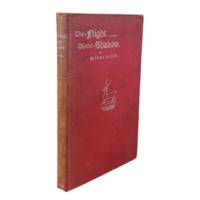
18995896Cincinnati: The Editor Publishing Co 1899. First edition. 17x11cm 128pp. Red cloth boards with vignette illustration and lettering in silver. Spine toned some soiling and bumping to boards. Scattered foxing else clean and sound internally. Very good. <br /> <br /> Unquestionably rare copy of this supernatural occult novel from Laura M. Dake née Wright 1844-1932. Likely published in a very small number we find little mention of the title save for a short review in the Columbia Missouri Herald August 11 1899 under the heading "Books by Home Folks:"<br /> <br /> <br /> "To lovers of the occult 'The Flight of the Shadow.' will appeal with fine fascination. It is a well-written argument for the astral world - a phrase which the theosophists are fond of employing. A gallant young Confederate officer is stricken almost unto death. In his delirium he is confronted by the spirit of a young man of his own age dead many years before. The latter tells his story which is strikingly like the events of the former's life and weaves through it the arguments of occultism. A note of love and mystery runs through the pages and makes of the volume a most charming one even aside from the queer theories it advances or supports."<br /> <br /> The short novel in part takes place on a plantation in Charleston and is steeped in the Southern culture of the time including slave dialect. <br /> <br /> The above review also gives clues as to the author's identity she being a resident of San Diego formerly of Columbia MO and wife of a Charles T. Dake. OCLC lists Dake as the author of a religious novel In the Crucible and an anti-Mormon novel which would make some sense given her upbringing in Missouri called A Man O' Wax published in San Francisco 1902. <br /> <br /> Interestingly an audiobook of this title was recently released. Otherwise we identify just the copy at the Library of Congress. A true rarity of the genre. <br /> <br /> Not in Bleiler not in Locke not in BAL. The New Sabin 9317. <br /> <br /> . The Editor Publishing Co unknown