ART DECOBiblio.com

3 résultats
1925851881925. ART DECO THE JOHN PLAIN BOOK 1925. Chicago: The John Plain Company 1925. 97 pp. 4to. quarter brown cloth with brown paper covered boards color pastedown label to front cover. Spine worn at heel and crown with small tear to top section. Light wear and a few pale spots to boards; label rubbed corners slightly bumped. Title and last page slightly foxed; the rest of the text is fine. Laid in are a Dealer letter on company letterhead; a ring size chart; four printed envelopes addressed to the company; one printed post card addressed to the company; three Dealer's Standard Conditional Sales Contracts blank; a Dealer's Confidential Price List; and a promotional flyer printed in dark brown on stiff brown paper: "Ask to see our complete showing of top quality diamonds men's and ladies' watches rings pins jewelry silverware clocks bags pearls ivory dresser sets." B/w illustrations of ladies' and men's diamond rings in the Deco style buttons brooches watches and watch cases belt buckles mantel clocks pens more. Page 45-46 has a short closed tear at the top edge not affecting text or images. Some pages are printed in two three or four colors - pp. 83-90 are in full color and feature pearls from L. Heller & Son of Paris and New York. Very good overall. unknown
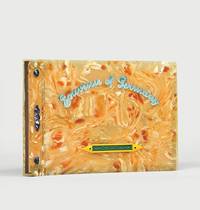
1930135058Germany: c.1930s-40s. Plastic fantastic A flamboyant example of Bakelite - or possibly casein plastic - being used to eye-catching effect for a souvenir album here repurposed and comprising illustrations of art deco furniture and interiors: a perhaps incongruous use for a binding redolent of the marbling in Bavarian baroque churches. Few such fragile and fascinating albums could have survived repeated handling. Bakelite a synthetic resin was invented in 1907 by Belgian-born American chemist Leo Hendrik Baekeland. It was widely used in the 1920s and by the 1930s "enjoyed a vogue in colourful costume jewellery and novelties" Ency. Brit. Casein plastics - the product of formaldehyde and the milk protein casein - readily absorbs dyes and can therefore often be coloured. "It can be made translucent and opaque and is used mainly for jewellery buttons brushes and handles for example umbrellas. In the early 20th century it served as an imitation of natural materials such as ivory tortoiseshell and horn" Plastic Identification Tool website. The single smaller half-tone print present here bears the logo of "AVVR" presumably a Spanish furniture company and is titled "Comedor No. 63" "Dining room No. 63". In commerce we trace a similar binding being used as a photograph album by GIs in early 1950s Germany differing in colour and labelled "Murnau-Bavaria". Landscape octavo album 195 x 272 mm. With 14 hand-coloured photographs of drawings printed on white card 166 x 228 mm numbered in pencil mounted on recto of 14 brown card leaves with cobweb-pattern tissue guards remaining leaves blank the whole wite-stitched; half-tone photographic illustration 122 x 167 mm mounted on verso of first leaf. Original marbled Bakelite post binder front cover marbled in orange back cover in greens and browns lettered "Souvenir of Germany" on front cover in raised blue-green Bakelite below this lettered "Bavaria" on a dark green label within a yellow Bakelite ornamental frame both mounted with adhesive stitched at the spine with orange plastic twine posts with marbled dark blue and orange Bakelite caps. Large pictorial Bakelite device sometime removed from front cover a couple of chips to front larger chip to fore edge repaired with adhesive rear board lifting at foot where adhesive has dried; prints a little toned creased and finger-soiled the odd tear to guards some repaired with opaque tape: a very good example. unknown
1933134251Chicago Illinois: Century of Progress International Exposition Committee Kaufman-Fabry Photographers 1933. By far the most beautiful" souvenir of the Century of Progress Exposition First and only edition of this spectacular highly limited-issue souvenir album for the Century of Progress exposition an event which was to have a profound influence on modernist architects for decades to come and served more generally as an invaluable "repository" of Art Deco motifs. A small number of these presentation albums were created as gifts for the Board of Trustees Officers and Founder Members for the Exposition by the official photographers. World Cat. records only 15 copies at 12 locations all but a couple with identifiable recipients; just a handful of copies at auction. This copy from the library of Orville J. Taylor 1885-1969 noted Chicago Attorney Century of Progress Trustee World War I veteran who served as Major with the 86th Division of the A.E.F. but unfortunately is also remembered as the author of the whitewash "Taylor Report" on the black market activities of US personnel after World War II. The remarkable images include the spectacular Grand Fountain at night; aerial views across the grounds by night and day; the facade of the Paul Philippe Cret-designed Hall of Science which typifies the linear geometric Art Deco style of the Fair together with an image of the interior of the Great Hall where smartly dressed crowds scurry past wall text announcing Planck's Quantum and Einstein's Relativity theories; the Electrical Building with a shot of the circular court the central Electrical Fountain with its chromed canopy reflecting the iridescent jets of water playing below; the stunning Transportation Building at night with its sunrise façade brightly illuminated from within and by day showing the cables from which the domed roof was "flown"; a night time view of the lowering Adler Planetarium which contained the only Zeiss projector in America at the time; a selection of views of the national "villages" - Black Forest Belgian English Colonial Italian and the Streets of Shanghai - and a shot of Italo Balbo's squadron of Savoia-Marchetti SM 55X flying boats overflying Lake Michigan. Founded around 1910 by Charles D. Kaufmann 1888-1948 a Bohemian-American and Herman Fabry c.1879-1955 German-American Kaufmann & Fabry was a Chicagoan commercial photographic studio specialising in architectural photography. The firm is perhaps best remembered for its work recorded here as official photographers to the 1933 Century of Progress World's Fair. They were not only awarded the rights for publishing and distributing photographs and for the publication of photo illustrations they also operated a highly lucrative camera shop and film processing lab on the Exhibition grounds for the duration of the Exposition. "Surprisingly little has been written about Kaufmann & Fabry - either the business or the men themselves. They claimed to have the most thoroughly equipped photographic plant in America. We are lucky in the next century to have this splendid sample of their artistry and a magnificent souvenir of the Century of Progress. of the thousands of printed books and souvenirs produced around the fair Kaufmann & Fabry's album of photographs is by far the most beautiful" Chicago by the Book p.127. Folio 347 x 295 mm original full blue-grey morocco by Arthur Hertzberg gilt ruling and Art Deco lettering including the recipient's name on front cover and spine blue moiré silk endsheets. 52 unnumbered leaves mounted on white linen hinges the first with a silver gelatin photo title the recipient's name added calligraphically followed by 51 warm sepia-toned original silver prints 278 x 203 mm each captioned in pencil in an attractive cursive hand. A touch rubbed front hinge starting toward the head but remains a excellent exemplar. unknown