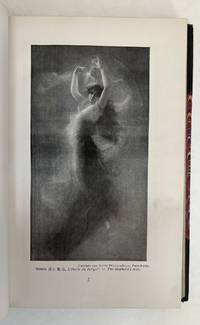
Societe Nationale des Beaux-ArtsBiblio.com
13 résultats
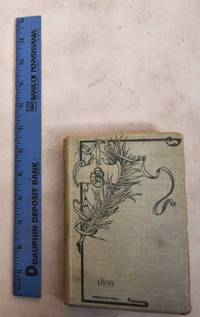
1899189458Evreux: Herissey 1899. Hardcover. Good scuffing and soiling to boards internal hinges are loose and torn pages age toned but otherwise clear. Gray cloth boards with green illustration and lettering; 350 12 pp; illustrations only in advertisements in beginning and rear of book. Text is in French. An annual publication ; Catalog of Works of Painting Sculpture Drawings Engraving Architecture and Works of Art from 1899. Herissey hardcover
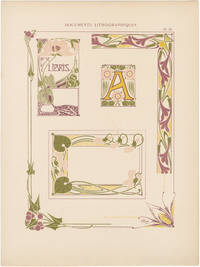
1900157232Paris: Librairie Centrale des Beaux-Arts 1900. Vintage Documents Lithographiques design sheet plate 16 with a "Wm. J.C. Klamm" provenance stamp on the verso. Art Nouveau color lithograph design sheet featuring margin designs a drop cap design and a book plate for use by designers and typographers in the arts and industry published by the Librairie Central des Beaux-Arts Paris circa 1900. <br /> <br /> 11 x 15 inches. Very Good plus with some light foxing edgewear and faint toning at the extremities. Librairie Centrale des Beaux-Arts unknown
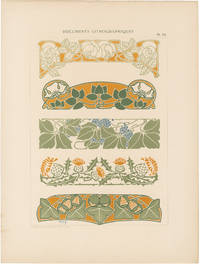
1900157231Paris: Librairie Centrale des Beaux-Arts 1900. Vintage Documents Lithographiques design sheet plate 26 with a "Wm. J.C. Klamm" provenance stamp on the verso. Art Nouveau color lithograph design sheet featuring five headers for use by designers and typographers in the arts and industry published by the Librairie Central des Beaux-Arts Paris circa 1900.<br /> <br /> 11 x 15 inches. Very Good plus with a small amount of light splashing to the far left bottom margin and faint toning at the extremities and light edgewear. Librairie Centrale des Beaux-Arts unknown
189569945Paris:: Typographie Chamerot et Renouard 1895. First edition. publishers decorative wrappers printed in gold and tan. Some light use to wrappers; a very nice copy. 8vo. Illustrated from photographs. Typographie Chamerot et Renouard, unknown
1876188629Paris France: Du Ministere De L'Instruction Publique Et Des Beaux-Arts 1876. Hardcover. VG rubbing to board edges; corners rubbed to boards w/ green discolorization. leather rubbed at spine ends & edges w/ some deeper rubs to surface. pgs have instances of speckled & spotted foxing primarily isolated to edges w/ some pages having higher concentrated foxing. black & red marbled boards w/ quarter red leather spine; gilt printed & decorative spine. marbled pastedowns & endpapers. 732 pgs w/ occasional bw figures & 5 bw plates. text in French. A handsome rebound. Ex-libris plate to front endpaper; pencil description to front endpaper. Du Ministere De L'Instruction Publique Et Des Beaux-Arts hardcover
1889118807Imprimerie Nationale 1889. Paperback. <b>Livre en français</b>. Couverture souple. Préface de Ferdinand Buisson. Broché. 16 x 24 cm. Couverture factice. En partie non coupé. 615 pages. <i>ref. 118807</i> Imprimerie Nationale paperback
1900101161Paris: Ludovic Baschet 1900. Hardcover. All volumes tight and clean with slightly varying color leather bindings; overall very good with modest sunning and chafing to spine heads. A consecutive run of 10 volumes. Octavos in half leather and marbled paper boards; illustrations; 24 cm. Approx. 300 page per volume; chiefly b&w illustrations. Marbled edges. In French. Handsome leather bindings. Original issues; not reprints. The series ceased in 1914 and purportedly comprised at least 16 volumes. Postage cost billed at our cost. Please inquire. Set weighs 15 lbs. ¶ Salons; Art -- France -- Paris -- Exhibitions. Art. Beeldende kunsten. Line blocks. Collotypes prints Exhibition catalogs. Ludovic Baschet hardcover
18508857Paris 1850. Pencil pen and wash drawing with numerous detailed measurements. A fascinating and beautiful drawing--or "rendu"--of an ancient Roman sarcophagus.<br/> <br/> A fine drawing from an architectural student at the Ecole des Beaux-Arts in Paris the most influential architectural school in existence during much of the 18th century the whole of the 19th century and the first part of the 20th century. 'Students were eligible for the Ecole if they were at least fifteen years old or under thirty. They began with the seconde classe in which they competed in the concours d'émulation. These alternated between an esquisse --a rough sketch for which up to twelve hours was allowed--and a rendu --the large-scale finished drawing for which one to three months were allowed.Two to four years were usually required for a student to accumulate enough credits to enter the première classe. The same system was followed again usually for two to three years after which the student should have accumulated enough credits to compete for the Grand Prix de Rome. The winner of the Grand Prix was entitled to five years study under the auspices of the French Academy in Rome. For each of his first three years he was required to submit an analytical study of an ancient monument. For his fourth year he had to submit a complete reconstruction of a major classical work. For his fifth year he was required to submit an original work designed to a program of his own invention. "This study of the sarcophagus of Lucius Cornelius Scipio Barbatus was part of an Ecole de Beaux Arts student's portfolio. The sarcophagus was one of many in the Scipio family tomb on the Via Appia just outside of Roma and it dates from c. 290 B.C. The obituary text reads English "Lucius Cornelius Scipio Barbatus son of Gnaeus a valiant gentleman and wise whose fine form matched his bravery very well was aedile consul and censor among you he conquered Taurasia and Cisauna in fact Samnium he overcame all the Lucanian lands and brought back hostages."<br/> <br/> Arthur Drexler The Architecture of the Ecole des Beaux-Arts. New York MoMA 1977. unknown
185020700Paris 1850. Pencil pen and wash drawing with numerous sub-titles in ink signed "J. Litoux" A fascinating and beautiful architectural drawing - or 'rendu' of basic elements of house construction in cluding walls floors doorways roofs and ceilings.<br/> <br/> A fine drawing from an architectural student at the Ecole des Beaux-Arts in Paris the most influential architectural school in existence during much of the 18th century the whole of the 19th century and the first part of the 20th century. 'Students were eligible for the Ecole if they were at least fifteen years old or under thirty. They began with the seconde classe in which they competed in the concours d'émulation. These alternated between an esquisse - a rough sketch for which up to twelve hours was allowed - and a rendu - the large-scale finished drawing for which one to three months were allowed. Two to four years were usually required for a student to accumulate enough credits to enter the première classe. The same system was followed again usually for two to three years after which the student should have accumulated enough credits to compete for the Grand Prix de Rome. The winner of the Grand Prix was entitled to five years study under the auspices of the French Academy in Rome. For each of his first three years he was required to submit an analytical study of an ancient monument. For his fourth year he had to submit a complete reconstruction of a major classical work. For his fifth year he was required to submit an original work designed to a program of his own invention. In the seconde classe the student was required to attend a variety of lectures in theory history and construction and learned to prepare construction drawings. Work was done at ateliers located outside the precincts of the Ecole des Beaux-Arts. These were rented and organized by the students themselves and the students had the right to invite a teacher of their own choice to serve as their maître. The teacher himself did not have to be a member of the faculty of the Ecole nor - at least in principle - did he have to be a practicing architect.' Arthur Drexler. The Architecture of the Ecole des Beaux-Arts. New York MoMA 1977 p.8-9<br/> <br/> Arthur Drexler The Architecture of the Ecole des Beaux-Arts. New York MoMA 1977. unknown
189239123Paris France: Librairie D'Art L. Baschet. As New. 1892. Hardcover. FREE UPGRADE to Courier/Priority Shipping Upon Request IN STOCK AND IMMEDIATELY AVAILABLE FOR SHIPMENT - TEXT PRISTINE - 108 pages. Text in French. Contains portraits of 24 artists including F. A. Bridgman Francais W. Gay Guillaume and Raffaelli; also includes more than 70 photogravure illustrations of works by Jules Breton Bartholdi Puvis de Chavannes; A. Stevens Bonnat Lamy & many others. Red coverboards embossed with a gold palette and brushes. -- with a bonus offer--; Folio - over 12" - 15" tall . Librairie D'Art L. Baschet hardcover
189235864Paris France: Ecole Nationale Des Beaux-Arts. As New. 1892. Paperback. FREE UPGRADE to Courier/Priority Shipping Upon Request IN STOCK AND IMMEDIATELY AVAILABLE FOR SHIPMENT - Near mint condition. Text in French; 255 works catalogued none illustrated. Includes photo of Pelouse as frontispiece. Rare. -- with a bonus offer-- . Ecole Nationale Des Beaux-Arts paperback
189255572Paris France: Lemercier & Cie. As New. 1892. Hardcover. FREE UPGRADE to Courier/Priority Shipping Upon Request IN STOCK AND IMMEDIATELY AVAILABLE FOR SHIPMENT - AS NEW THE TEXT BLOCK IS PRISTINE CLEAN UNMARKED AND IN EXCELLENT CONDITION - - Text in French. Well illustrated in black and white -- with a bonus offer-- . Lemercier & Cie. hardcover
189539124Paris France: Librairie D'Art L. Baschet. As New. 1895. Hardcover. FREE UPGRADE to Courier/Priority Shipping Upon Request IN STOCK AND IMMEDIATELY AVAILABLE FOR SHIPMENT - TEXT PRISTINE - 96 pages. Text in French. Contains portraits of 10 artists including Harpignies Carolus-Duran and Beyle; also includes 82 photogravure illustrations of works by Jules Breton Paul Quinsac Gerome Gervais Lhermitte Fremiet & many others. Red coverboards embossed with a gold palette and brushes. -- with a bonus offer--; Folio - over 12" - 15" tall . Librairie D'Art L. Baschet hardcover