134 résultats
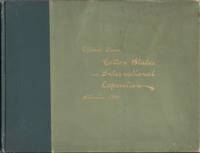
189531889St. Louis: C. B. Woodward 1895. First Edition. Hardcover. Fair. Oblong quarto. 48 leaves. Illustrated with photographs by C. D. Arnold. Dual colored cloth hardcover with gilt stamped title on the front cover. Floral decorated end sheets. Cloth covers lightly soiled shelf worn and scratched. Interior contents have light foxing and or soil to a few of the photographs. Hinges are cracked but the text block is still secure. Contents include various buildings and exhibits including "Receiving the Liberty Bell"; "United States Infantry Camp"; various views of buildings around the lake "Atlanta Brewing and Ice Company"; "Shooting the Chutes"; "Indians on the Midway" and much more. The Cotton States Exposition was held on the grounds of current day Piedmont Park. A fair or better copy. C. B. Woodward hardcover
189534282Atlanta: Walter G. Cooper 1895. First Edition. Broadside. Good. Folio broadsheet. Approximately 13.5" x 7.75." Multiple folds. Three columns with 25 paragraphs of information regarding the upcoming Cotton States Exposition in Atlanta. Small torn section midway down the third column with some missing print. Broadside includes an illustrated Atlanta Cotton States Exposition envelope with stamp ca. 1895 addressed to the Narragansett Herald Narragansett Pier R. I. These promotional piece informs editors of newspapers on the progress and planned events for the Exposition to be held from September 18 to December 31 1895. <br /> <br /> The Cotton States and International Exposition was a world's fair held in Atlanta Georgia United States in 1895.1 The exposition was designed "to foster trade between southern states and South American nations as well as to show the products and facilities of the region to the rest of the nation and Europe."1 The Cotton States and International Exposition featured exhibits from six states including various innovations in agriculture and technology and exhibits about women and African Americans.1 President Grover Cleveland presided over the opening of the exposition remotely by flipping an electric switch from his house in Massachusetts on September 18 1895.1 The event is best remembered for the "Atlanta Compromise" speech given by Booker T. Washington on September 18 promoting racial cooperation.1. Walter G. Cooper unknown
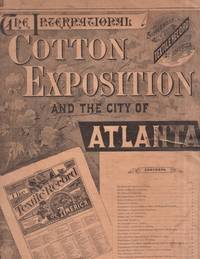
188136186Philadelphia: Nagle & Ryckman 1881. First Edition. Wraps. Fair. Folio sized wraps approximately 14" x 10." 24 pages. Illustrated. Two page illustration in the middle. Original illustrated covers with contents printed on the front. Fragile condition. Fair condition. Very old tape repairs to the covers and pages 1 and 2 with old tape stains upper corners first 3 pages. Front cover chipped on the edge. Pages have some creasing and small edge tears. Contents generally clean. Atlanta businessman H. I. Kimball was the Director General of the International cotton Exposition. This exposition preceded the more famous Atlanta Cotton States exposition in 1895. From the New Georgia Encyclopedia:<br /> <br /> Atlanta held its first exposition named the International Cotton Exposition in Oglethorpe Park in 1881. The city then had fewer than 40000 residents and the primary sense in which the first exposition was “international†was the display of cotton plants from around the world. Nevertheless Atlantans were eager to host the 1881 exposition to promote investment and to help the city toward its goal of becoming an industrial center which was a primary component of Grady’s “New South†concept. Although attendance was lower than expected fewer than 200000 in paid attendance during its two-and-a-half-month run city leaders demonstrated that they could work together to host a major event and that Atlanta was serious about its role in textile production at a time when the North was beginning to grow dissatisfied with the efficiency of southern cotton processing. The exposition displayed new crop planters and cotton seed cleaners along with a model of Eli Whitney’s original cotton gin and speakers addressed the crowds about agricultural technology and political reforms. Nagle & Ryckman unknown
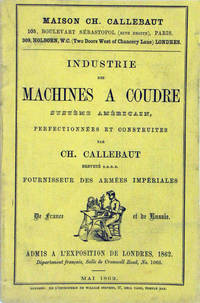
1862100967AParis & London Mai 1862. 8vo. 182 x 120 cm. 31 pp. Illustrated with woodcuts including 2 full-page.<br /><br /><b>Published for the London World Fair 1862 </b>with map of the exibition halls on the inside front cover. The "Expositions Universelles" or World Fairs were intended to show the latest innovations and inventions. The earliest of these fairs were held in France but were national. The first one of 1798 was the start of eleven national fairs. Sewing machines were invented during the first Industrial Revolution to decrease the amount of manual sewing work performed in clothing companies. Callebaut shows different models and explains the technqiue of them. Both full page illustrations of the factory show us what factories looked like at the time. At the 1862 exhibition about 50 types of sewing machine were on show on over 20 stands. M. Callebaut from Paris showed 'several modifications of shuttle sewing machines of the Singer type.' Callebaut was the Singer licencee in France the only occasion on which the Singer Co granted a licence rather than manufacturing itself. Callebaut patented these modifications in France and Britain in his own name. Most of them apply to the Singer No. 2 machine and enabled it to have a reversible wheel feed for finishing seams and to produce a 'herring-bone stitch' zigzag by moving the top feed presser foot from side to side. Another machine had twin needles on the same needle bar for making two lines of stitches on the top side and a zigzag on the underneath with a single shuttle thread. Not content with all these variants M Callebaut exhibited some glove making machines of fearsome complexity using detached lengths of thread!
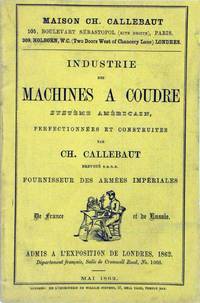
18621009671862. Paris & London Mai 1862. 8vo. 182 x 120 cm. 31 pp. Illustrated with woodcuts including 2 full-page. Published for the London World Fair 1862 with map of the exibition halls on the inside front cover. The "Expositions Universelles" or World Fairs were intended to show the latest innovations and inventions. The earliest of these fairs were held in France but were national. The first one of 1798 was the start of eleven national fairs. Sewing machines were invented during the first Industrial Revolution to decrease the amount of manual sewing work performed in clothing companies. Callebaut shows different models and explains the technqiue of them. Both full page illustrations of the factory show us what factories looked like at the time. At the 1862 exhibition about 50 types of sewing machine were on show on over 20 stands. M. Callebaut from Paris showed 'several modifications of shuttle sewing machines of the Singer type.' Callebaut was the Singer licencee in France the only occasion on which the Singer Co granted a licence rather than manufacturing itself. Callebaut patented these modifications in France and Britain in his own name. Most of them apply to the Singer No. 2 machine and enabled it to have a reversible wheel feed for finishing seams and to produce a 'herring-bone stitch' zigzag by moving the top feed presser foot from side to side. Another machine had twin needles on the same needle bar for making two lines of stitches on the top side and a zigzag on the underneath with a single shuttle thread. Not content with all these variants M Callebaut exhibited some glove making machines of fearsome complexity using detached lengths of thread! hardcover
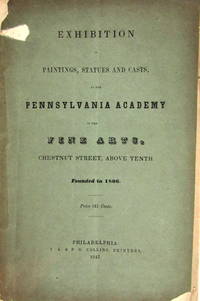
1847101635Philadelphia T.K. and P.G. Collins printers 1847. 32 pp. Original printed green paper wrappers sl. dam. Heavy foxing throughout. Catalogue listing 543 items. Pages 28 & 29 contain an index artists and pages 30 & 32 contain a publicity and the constitution of the Art-Union of Philadelphia fro the promotion of the arts of design in the United Stated incorporated 1844. The Pennsylvania Academy of the Fine Arts is a museum and art school in Philadelphia Pennsylvania. It is the first and oldest art museum and art school in the United States.
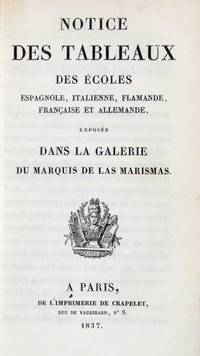
1837101397<p>1837. Paris imprimerie Crapelet 1837. 95 pp. 363 items described. Wrappers. <strong>The first 21 pages of the present catalogue contain a notice on Spanish painting. </strong>Don Alejandro María Aguado y Ramírez de Estenoz 1st Marquis de Las Marismas del Guadalquivir Seville June 29 1784 Gijon April 14 1842 Spanish banker was born of Old Christian parentage originally from La Rioja at Seville. He began life as a soldier fighting with distinction in the Spanish War of Independence first against French then on the side of Joseph Bonaparte. After the Battle of Baylen 1808 he entered the French army in which he rose to be colonel and aide-de-camp to Marshal Soult. He was exiled in 1815 and immediately started business as a commission-agent in Paris where chiefly through his family connections in Havana and Mexico he acquired in a few years enough wealth to enable him to undertake banking. The Spanish government gave him full powers to negotiate the loans of 1823 1828 1830 and 1831; and Ferdinand VII. rewarded him with the title of marquis the decorations of several orders and valuable mining concessions in Spain. Aguado also negotiated the Greek loan of 1834. In 1828 having become possessed of large estates in France including the Château Margaux famous for its wine he was naturalized as a French citizen. He died at in Spain on April 14 1842 leaving a fortune 'computed at 60000000 francs and a splendid collection of pictures which at his death was sold by auction.</p>
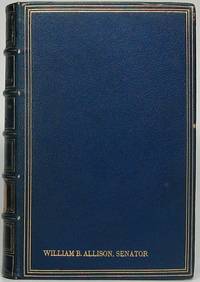
190049488Paris: Société Anonyme des Imprimieres Lemercier 1900. Hardcover. Small 8vo. Full blue calf with gilt spine rules/lettering in compartments gilt board rules and inner dentelles. 560pp 31pp 23pp 56pp pictorial ads. All edges gilt. Illustrations marbled endpapers sewn-in red/green/yellow page marker. Near fine. Spine only faintly shellacked a turn-of-the-century practice with hand-lettered paper shelf label near foot. Exceptionally handsome tight first edition of this detailed guide to American participation of this world's fair to end all world's fairs held in Paris between 12 April and 12 November 1900. Like all world's fairs its intention was to celebrate mankind's accomplishments and advances in every field imaginable -- but with the debut of the new century it was felt appropriate to celebrate accomplishments of the preceding century as well. This remarkable copy bears a red-bordered 4½" X 3/4" colophon slip typed in blue tipped to an inner flyleaf noting that "Twenty-five copies of this catalogue have been bound in this form for special distribution. This copy is numbered 11." Recipients of this specially-bound edition were likely important politicos of the day. The name of this special recipient has been giltstamped on the front board: "WILLIAM B. ALLISON SENATOR." From the collection of William B. Allison 1829-1908 the powerful Iowa Republican who as U.S. senator from that state 1873-1908 was one of the "big four" who controlled the Senate; as chairman of the Senate Appropriations Committee for most of those years he championed tariff legislation and co-authored the Bland-Allison Act of 1878; as member of the Senate Finance Committee he was often courted by U.S. presidents to hold cabinet positions. Early 20th century bookplate on front pastedown notes "This book is part of Allison Memorial Collection Gift of Mrs. Jennie A. Brayton" and until deaccessioned was part of Allison's non-circulating collection at his hometown public library across the street from his Dubuque residence. According to Leland L. Sage in his 1956 biography "William Boyd Allison: A Study in Practical Politics" Allison owned "hundreds of books on government economics history banking finance and the tariff as well as volumes of American and English literature. An omnivorous reader Allison doubtless read most of these volumes if only for relaxation from the strain that accompanied his efforts to solve the many problems facing the Nation. Alexander Hamilton was his guidepost in finance Robert Burns his favorite poet and 'The Cotter's Saturday Night' his favorite poem." A superb copy of this rare edition with gilt as fresh and bright as the day applied. Société Anonyme des Imprimieres Lemercier hardcover
189220220575Excelsior 1892 . Columbian Edition. Flexible covers. Very Good. 18mo black leather wallet- lacking the pencil from the pencil-holder. The title-page depicts the Administration Building of the World's Columbian Exposition. <br/><br/>William Hughes was a farmer near Quincy Hillsdale County Michigan. Hughes made pencilled notes effectively every day. There are accounts of his activities his crops his purchases and with notes on the endpapers. Dybwad ANNOTATED BIBLIOGRAPHY OF THE WORLD'S COLUMBIAN EXPOSITION 1893 #839. Excelsior unknown