134 résultats
189220220575Excelsior 1892 . Columbian Edition. Flexible covers. Very Good. 18mo black leather wallet- lacking the pencil from the pencil-holder. The title-page depicts the Administration Building of the World's Columbian Exposition. <br/><br/>William Hughes was a farmer near Quincy Hillsdale County Michigan. Hughes made pencilled notes effectively every day. There are accounts of his activities his crops his purchases and with notes on the endpapers. Dybwad ANNOTATED BIBLIOGRAPHY OF THE WORLD'S COLUMBIAN EXPOSITION 1893 #839. Excelsior unknown
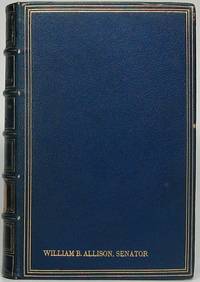
190049488Paris: Société Anonyme des Imprimieres Lemercier 1900. Hardcover. Small 8vo. Full blue calf with gilt spine rules/lettering in compartments gilt board rules and inner dentelles. 560pp 31pp 23pp 56pp pictorial ads. All edges gilt. Illustrations marbled endpapers sewn-in red/green/yellow page marker. Near fine. Spine only faintly shellacked a turn-of-the-century practice with hand-lettered paper shelf label near foot. Exceptionally handsome tight first edition of this detailed guide to American participation of this world's fair to end all world's fairs held in Paris between 12 April and 12 November 1900. Like all world's fairs its intention was to celebrate mankind's accomplishments and advances in every field imaginable -- but with the debut of the new century it was felt appropriate to celebrate accomplishments of the preceding century as well. This remarkable copy bears a red-bordered 4½" X 3/4" colophon slip typed in blue tipped to an inner flyleaf noting that "Twenty-five copies of this catalogue have been bound in this form for special distribution. This copy is numbered 11." Recipients of this specially-bound edition were likely important politicos of the day. The name of this special recipient has been giltstamped on the front board: "WILLIAM B. ALLISON SENATOR." From the collection of William B. Allison 1829-1908 the powerful Iowa Republican who as U.S. senator from that state 1873-1908 was one of the "big four" who controlled the Senate; as chairman of the Senate Appropriations Committee for most of those years he championed tariff legislation and co-authored the Bland-Allison Act of 1878; as member of the Senate Finance Committee he was often courted by U.S. presidents to hold cabinet positions. Early 20th century bookplate on front pastedown notes "This book is part of Allison Memorial Collection Gift of Mrs. Jennie A. Brayton" and until deaccessioned was part of Allison's non-circulating collection at his hometown public library across the street from his Dubuque residence. According to Leland L. Sage in his 1956 biography "William Boyd Allison: A Study in Practical Politics" Allison owned "hundreds of books on government economics history banking finance and the tariff as well as volumes of American and English literature. An omnivorous reader Allison doubtless read most of these volumes if only for relaxation from the strain that accompanied his efforts to solve the many problems facing the Nation. Alexander Hamilton was his guidepost in finance Robert Burns his favorite poet and 'The Cotter's Saturday Night' his favorite poem." A superb copy of this rare edition with gilt as fresh and bright as the day applied. Société Anonyme des Imprimieres Lemercier hardcover
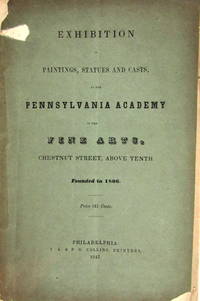
1847101635Philadelphia T.K. and P.G. Collins printers 1847. 32 pp. Original printed green paper wrappers sl. dam. Heavy foxing throughout. Catalogue listing 543 items. Pages 28 & 29 contain an index artists and pages 30 & 32 contain a publicity and the constitution of the Art-Union of Philadelphia fro the promotion of the arts of design in the United Stated incorporated 1844. The Pennsylvania Academy of the Fine Arts is a museum and art school in Philadelphia Pennsylvania. It is the first and oldest art museum and art school in the United States.
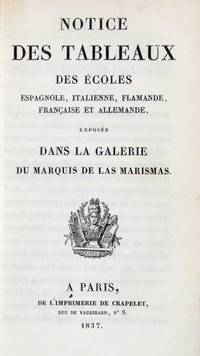
1837101397<p>1837. Paris imprimerie Crapelet 1837. 95 pp. 363 items described. Wrappers. <strong>The first 21 pages of the present catalogue contain a notice on Spanish painting. </strong>Don Alejandro María Aguado y Ramírez de Estenoz 1st Marquis de Las Marismas del Guadalquivir Seville June 29 1784 Gijon April 14 1842 Spanish banker was born of Old Christian parentage originally from La Rioja at Seville. He began life as a soldier fighting with distinction in the Spanish War of Independence first against French then on the side of Joseph Bonaparte. After the Battle of Baylen 1808 he entered the French army in which he rose to be colonel and aide-de-camp to Marshal Soult. He was exiled in 1815 and immediately started business as a commission-agent in Paris where chiefly through his family connections in Havana and Mexico he acquired in a few years enough wealth to enable him to undertake banking. The Spanish government gave him full powers to negotiate the loans of 1823 1828 1830 and 1831; and Ferdinand VII. rewarded him with the title of marquis the decorations of several orders and valuable mining concessions in Spain. Aguado also negotiated the Greek loan of 1834. In 1828 having become possessed of large estates in France including the Château Margaux famous for its wine he was naturalized as a French citizen. He died at in Spain on April 14 1842 leaving a fortune 'computed at 60000000 francs and a splendid collection of pictures which at his death was sold by auction.</p>
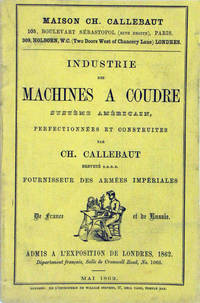
1862100967AParis & London Mai 1862. 8vo. 182 x 120 cm. 31 pp. Illustrated with woodcuts including 2 full-page.<br /><br /><b>Published for the London World Fair 1862 </b>with map of the exibition halls on the inside front cover. The "Expositions Universelles" or World Fairs were intended to show the latest innovations and inventions. The earliest of these fairs were held in France but were national. The first one of 1798 was the start of eleven national fairs. Sewing machines were invented during the first Industrial Revolution to decrease the amount of manual sewing work performed in clothing companies. Callebaut shows different models and explains the technqiue of them. Both full page illustrations of the factory show us what factories looked like at the time. At the 1862 exhibition about 50 types of sewing machine were on show on over 20 stands. M. Callebaut from Paris showed 'several modifications of shuttle sewing machines of the Singer type.' Callebaut was the Singer licencee in France the only occasion on which the Singer Co granted a licence rather than manufacturing itself. Callebaut patented these modifications in France and Britain in his own name. Most of them apply to the Singer No. 2 machine and enabled it to have a reversible wheel feed for finishing seams and to produce a 'herring-bone stitch' zigzag by moving the top feed presser foot from side to side. Another machine had twin needles on the same needle bar for making two lines of stitches on the top side and a zigzag on the underneath with a single shuttle thread. Not content with all these variants M Callebaut exhibited some glove making machines of fearsome complexity using detached lengths of thread!
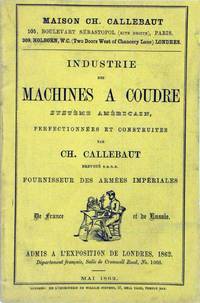
18621009671862. Paris & London Mai 1862. 8vo. 182 x 120 cm. 31 pp. Illustrated with woodcuts including 2 full-page. Published for the London World Fair 1862 with map of the exibition halls on the inside front cover. The "Expositions Universelles" or World Fairs were intended to show the latest innovations and inventions. The earliest of these fairs were held in France but were national. The first one of 1798 was the start of eleven national fairs. Sewing machines were invented during the first Industrial Revolution to decrease the amount of manual sewing work performed in clothing companies. Callebaut shows different models and explains the technqiue of them. Both full page illustrations of the factory show us what factories looked like at the time. At the 1862 exhibition about 50 types of sewing machine were on show on over 20 stands. M. Callebaut from Paris showed 'several modifications of shuttle sewing machines of the Singer type.' Callebaut was the Singer licencee in France the only occasion on which the Singer Co granted a licence rather than manufacturing itself. Callebaut patented these modifications in France and Britain in his own name. Most of them apply to the Singer No. 2 machine and enabled it to have a reversible wheel feed for finishing seams and to produce a 'herring-bone stitch' zigzag by moving the top feed presser foot from side to side. Another machine had twin needles on the same needle bar for making two lines of stitches on the top side and a zigzag on the underneath with a single shuttle thread. Not content with all these variants M Callebaut exhibited some glove making machines of fearsome complexity using detached lengths of thread! hardcover
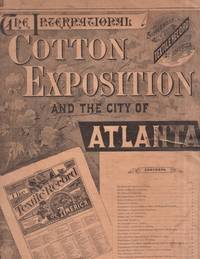
188136186Philadelphia: Nagle & Ryckman 1881. First Edition. Wraps. Fair. Folio sized wraps approximately 14" x 10." 24 pages. Illustrated. Two page illustration in the middle. Original illustrated covers with contents printed on the front. Fragile condition. Fair condition. Very old tape repairs to the covers and pages 1 and 2 with old tape stains upper corners first 3 pages. Front cover chipped on the edge. Pages have some creasing and small edge tears. Contents generally clean. Atlanta businessman H. I. Kimball was the Director General of the International cotton Exposition. This exposition preceded the more famous Atlanta Cotton States exposition in 1895. From the New Georgia Encyclopedia:<br /> <br /> Atlanta held its first exposition named the International Cotton Exposition in Oglethorpe Park in 1881. The city then had fewer than 40000 residents and the primary sense in which the first exposition was “international†was the display of cotton plants from around the world. Nevertheless Atlantans were eager to host the 1881 exposition to promote investment and to help the city toward its goal of becoming an industrial center which was a primary component of Grady’s “New South†concept. Although attendance was lower than expected fewer than 200000 in paid attendance during its two-and-a-half-month run city leaders demonstrated that they could work together to host a major event and that Atlanta was serious about its role in textile production at a time when the North was beginning to grow dissatisfied with the efficiency of southern cotton processing. The exposition displayed new crop planters and cotton seed cleaners along with a model of Eli Whitney’s original cotton gin and speakers addressed the crowds about agricultural technology and political reforms. Nagle & Ryckman unknown
189534282Atlanta: Walter G. Cooper 1895. First Edition. Broadside. Good. Folio broadsheet. Approximately 13.5" x 7.75." Multiple folds. Three columns with 25 paragraphs of information regarding the upcoming Cotton States Exposition in Atlanta. Small torn section midway down the third column with some missing print. Broadside includes an illustrated Atlanta Cotton States Exposition envelope with stamp ca. 1895 addressed to the Narragansett Herald Narragansett Pier R. I. These promotional piece informs editors of newspapers on the progress and planned events for the Exposition to be held from September 18 to December 31 1895. <br /> <br /> The Cotton States and International Exposition was a world's fair held in Atlanta Georgia United States in 1895.1 The exposition was designed "to foster trade between southern states and South American nations as well as to show the products and facilities of the region to the rest of the nation and Europe."1 The Cotton States and International Exposition featured exhibits from six states including various innovations in agriculture and technology and exhibits about women and African Americans.1 President Grover Cleveland presided over the opening of the exposition remotely by flipping an electric switch from his house in Massachusetts on September 18 1895.1 The event is best remembered for the "Atlanta Compromise" speech given by Booker T. Washington on September 18 promoting racial cooperation.1. Walter G. Cooper unknown
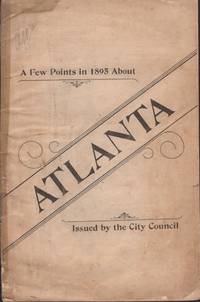
189536095Atlanta: Atlanta City Council. American Pub. & Eng Co. Atlanta 1895. First Edition. Wraps. Fair. Stapled wraps. 24 pages. Illustrated with photograph of the 1895 Cotton States Exposition Fort Walker at Grant Park View on North Pryor Street Grant Park Views State Capitol and downtown views. Fair only. Spine is taped. Piece of old tape on the frontispiece and top of page 24. Toning and light creases to the paper. A promotional brochure highlighting the advantages of living and working in Atlanta with special attention paid to the Cotton States Exposition. Atlanta City Council. American Pub. & Eng Co., Atlanta unknown
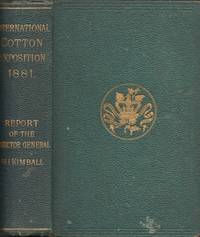
188235602New York: D. Appleton and Company 1882. First Edition. Hardcover. Good. Octavo. 1 vi 610 pages 3 pages advertisements 1. Errata page located between pages 342 343. Green cloth hardcover with illustrated gilt title inside a gilt circle on the front cover. Gilt title on the spine. Some rubbed spots to the cloth covers and spine. Light edge wear to the cloth extremities. The frontispiece is vertically creased and foxed. Pages 7 and 8 are loose. Binding cords visible in several sections but no other loose pages. Hinges are in good condition. Small piece of tape on the edge of pages 321 and 327. Light toning to the text. <br /> <br /> Illustrated with frontispiece engraved portrait of H. I. Kimball 4 plates in text folding "Plat of the Grounds and Buildings International Cotton Exposition Atlanta" engraved plate - "The Compound Tubular Steam Boiler Gold Medal Awarded." 2 more engraved plates a few illustrated advertisements and a folding plan - "Model of the Willimantic Company's Works at Willimantic Conn." Detailed contents make up this comprehensive report including history speeches reports agricultural sections a variety of forms and documents lists of groups awards committee members and much more. <br /> <br /> A nice inscription written on the front blank end sheet from Samuel Inman one of Atlanta's leading citizens of the period Inman Park in Atlanta is named after Samuel Inman. Inscription reads - "Henry S. Cave Compliments of Saml M. Inman Treasurer Atlanta Ga. June 23 1884." H. S. Cave from Atlanta inscription is written on the verso of the frontispiece. Another owners name in pencil on the front paste down "Augusta Wylie King." A later owner's address mailing label located in the upper left corner front paste down. From the New Georgia Encyclopedia:<br /> <br /> Atlanta held its first exposition named the International Cotton Exposition in Oglethorpe Park in 1881. The city then had fewer than 40000 residents and the primary sense in which the first exposition was “international†was the display of cotton plants from around the world. Nevertheless Atlantans were eager to host the 1881 exposition to promote investment and to help the city toward its goal of becoming an industrial center which was a primary component of Grady’s “New South†concept. Although attendance was lower than expected fewer than 200000 in paid attendance during its two-and-a-half-month run city leaders demonstrated that they could work together to host a major event and that Atlanta was serious about its role in textile production at a time when the North was beginning to grow dissatisfied with the efficiency of southern cotton processing. The exposition displayed new crop planters and cotton seed cleaners along with a model of Eli Whitney’s original cotton gin and speakers addressed the crowds about agricultural technology and political reforms. D. Appleton and Company hardcover
189531889St. Louis: C. B. Woodward 1895. First Edition. Hardcover. Fair. Oblong quarto. 48 leaves. Illustrated with photographs by C. D. Arnold. Dual colored cloth hardcover with gilt stamped title on the front cover. Floral decorated end sheets. Cloth covers lightly soiled shelf worn and scratched. Interior contents have light foxing and or soil to a few of the photographs. Hinges are cracked but the text block is still secure. Contents include various buildings and exhibits including "Receiving the Liberty Bell"; "United States Infantry Camp"; various views of buildings around the lake "Atlanta Brewing and Ice Company"; "Shooting the Chutes"; "Indians on the Midway" and much more. The Cotton States Exposition was held on the grounds of current day Piedmont Park. A fair or better copy. C. B. Woodward hardcover
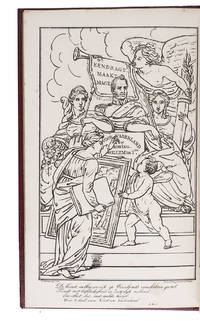
183189CDS100LSGIAmsterdam 1831. 8vo. Christiaan Andersen Spin Slightly later neoclassical gold- and richly blind-tooled long-grained red morocco gilt edges. With a lithographed frontispiece. 2 76 8 pp. Very rare and remarkable catalogue of artworks exhibited in Amsterdam to raise funds for the Dutch army. It lists 1985 artworks not only paintings but all kinds of crafts: miniatures drawings engravings lithographs glass painting etc. All works were to be sold in a lottery to raise funds for the 10-day Campaign Tiendaagse veldtocht on 2-12 August 1831 by King Willem I in order to suppress the Belgian uprising. The catalogue includes a lithographed allegorical frontispiece depicting the nation in the form of a bust of King Willem I supported by art. This was designed by court artist Nicolaas Pieneman 1809-1860 and is accompanied by a poem by Jan de Breet. The present copy is the second expanded and final edition published shortly after the first. It lists all the artworks including the later additions. The first edition lists only 1706 items while the present second edition lists 1985. The frontispiece was slightly revised for the 2nd edition. The catalogue is very rare the Dutch union catalogue NCC lists only 1 copy Rijksmuseum 2nd ed. WorldCat also records a copy in the Frick collection. The RKD has a copy of each edition.Minor rubbing on the extremities otherwise in very good condition.l NCC 1 copy; RKD 283621; WorldCat 2 copies. ABE CAT Art History unknown
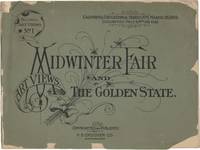
1894171109San Francisco: H.S. Crocker 1894. Nos. 1 and 2 in the California Educational Series published in March and May of 1894 and issued as Sunday supplements by the "San Francisco Chronicle" in conjunction with the California Midwinter International Exposition a World's Fair held from January 27 through July 5 1894 in San Francisco's Golden Gate Park.<br /> <br /> Each volume features 12 color lithograph illustrations accompanied by descriptive captions.<br /> <br /> Both volumes side-stapled in wrappers. No. 1 Good only moderate loss to the wrapper edges with wrappers and several leaves detached from the binding. No. 2 Very Good plus with some light wear to the bottom right corner of the final leaf and rear wrapper. H.S. Crocker unknown
189460784San Francisco CA: Harvey Whitcher & Allen Publishers to the California Midtwinter International Exposition 1894. 12mo. 69 3 d pp. Including the 4 page added “Additional List.†Printed & illustrated tan sofcovers lettering in red & black edgewear chipping ghosting from old tape repairs archival tape repair to spine still G- copy. First edition of this very scarce handbook catalogue to the fine arts on display at the 1894 California Midwinter International Exposition the first International Fair held in Golden Gate Park San Francisco which lists featured artwork from California the rest of the U.S. Canada England France Germany Italy Poland Russia & Spain. California artists displayed included R.D. Velland William Keith L.Z. Sleeth John Stanton Ernest Narjot Ernest Peixotto and more. Harvey, Whitcher & Allen, Publishers to the California Midtwinter International Exposition, unknown
1894008457San Francisco: H. S. Crocker 1894 Book. Fine. Hardcover. MIDWINTER FAIR. Oblong quarto. 10x13 inches. Three parts bound together. Illustrated with 8 full-page lithographed color plates by Dickman-Jones Co. of San Francisco plus the full set of 24 full-page lithographed color plates by H. S. Crocker Co. plus over 213 full-page black & white photographs with extensive descriptive text including 13 of 14 double-page panoramas. Publisher's binding of three-quarter brown morocco darker cloth sides gilt lettering and pictorial element on cloth cover gilt-lettered spine. Outer hinges and spine ends rubbed 3 corners show light wear. A fine clean copy. First edition. With the bookplate of Thomas Wayne Norris and included in the famous Norris Catalogue. An incredibly scarce tile with the full complement of 24 full-page color lithographs Series I & II of scenes and buildings at the Midwinter Fair also issued by H. S. Crocker Co. and the addition of the souvenir grouping Glimpses of the Midwinter Fair issued by Dickman-Jones Co. to their customers with 8 full-page color lithographs of the Fair bound in with its original wrappers. Sunset City and Sunset Scenes is usually found only with the Taber black & white reproductions. We have never had a copy bound with the full series of color lithographs although over the years we've seen a few odd plates. The large number of black and white photographic reproductions include a number of views of the buildings and grounds of the Midwinter Fair held in Golden Gate Park; they are interspersed with select views of the natural wonders of the State. Nearly all the photographs are by Isaiah W. Taber official photographer of the Fair. The text for the non-Fair images was written by J. M. Hutchings; the twenty-four lithographs issued by Crocker were drawn by the famous western artist H. W. Hansen. Norris Norris Catalogue this copy: 3493; Rocq Glimpses of the Midwinter Fair: 11355; Rocq Sunset City: 11359; no Auction Records that include the color plates. . H. S. Crocker hardcover
189461007San Francisco: H.S. Crocker Co. 215-219 Bush St. 1894. Fifteen parts in one vol. Oblong folio. 14.5 x 10.75 in. 240 pp unpaginated. 227 photo plates 13 double-page. Recent black cloth Portfolio No. 7 cover mounted on front cover as title endpapers renewed all fascicles were bound in adjustable slide post-binder as evidenced by discrete slits at gutter margin some occasional minor tears slight edgewear to textblock from thumbing still a VG copy from the library of Prof. Marvin Nathan. First edition of this exceptional and complete photographic souvenir series capturing the California Midwinter International Exposition which was the first World’s Fair in San Francisco’s Golden Gate Park prior to the Earthquake & Fire. Taber 1830-1912 was the official photographer of the Fair and he has captured with vividness the excitement and variety of the events in the Fair with night shots of the Electric Tower piercing the darkness the action in the Forty-Niner Mining Camp which featured “Monarch†the stuffed Grizzly Bear who was showcased in the venue along with logging scenes at Lake Tahoe Hopfields in Ukiah CA the bedraggled Apache confined to the “Arizona Indian Village†along with a portrait of a Chinese Opium Den in San Francisco’s Chinatown. H.S. Crocker Co., 215-219 Bush St., hardcover
189461008San Francisco: H.S. Crocker Co. 215-219 Bush St. 1894. Fifteen parts in one vol. Oblong folio. 13.5 x 10.25 in. 240 pp unpaginated. 227 photo plates 13 double-page. Recent black cloth Portfolio No. 13 cover mounted on front cover as title endpapers renewed all fascicles were bound in adjustable slide post-binder as evidenced by discrete slits at gutter margin some occasional minor tears slight edgewear to textblock from thumbing textblock cropped poorly diagonally when originally bound still a VG- copy from the library of Prof. Marvin Nathan. First edition of this exceptional and complete photographic souvenir series capturing the California Midwinter International Exposition which was the first World’s Fair in San Francisco’s Golden Gate Park prior to the Earthquake & Fire. Taber 1830-1912 was the official photographer of the Fair and he has captured with vividness the excitement and variety of the events in the Fair with night shots of the Electric Tower piercing the darkness the action in the Forty-Niner Mining Camp which featured “Monarch†the stuffed Grizzly Bear who was showcased in the venue along with logging scenes at Lake Tahoe Hopfields in Ukiah CA the bedraggled Apache confined to the “Arizona Indian Village†along with a portrait of a Chinese Opium Den in San Francisco’s Chinatown. H.S. Crocker Co., 215-219 Bush St., hardcover
188060949Montreal Canada: Imprime par J.B. Laplante 245 rue St. Jacques 1880. Two vols. 68 16; 15 1 pp. Blue-tinted printed softcovers for both vols. black lettering on front covers minor age toning slight chipping very minor creasing still both VG copies w/ presentation slip of Major. L.A. Huguet-Latour of the Prince of Wales Regiment of Rifles Montreal Canada noted bibliophile and manuscript collector ink inscription on 2nd piece at upper fore-edge. First editions of these uncommon original catalogue and the official list of contributing schools colleges and educational institutions to the 1880 Canada Dominion Exhibition held in Montreal for 10 days and also featured displays of industrial machinery farm products flowers along with horse racing lacrosse tournament and Highland games. The Dominion Exhibition was held annually in Canada from 1879-1913 and every year the location changed to assorted Provinces typically to coincide with local Fairs. It ceased at the outset of World War I. These catalogues detail all of the Catholic and Protestant schools convents monasteries colleges and universities appeared in Montreal often with samples of their student’s achievements in arithmetic geography literature history & art. Worldcat locates 7 copies of 1st Canada Archives U of Montreal Bibliotheque Nat. Strasbourg NYPL Cambridge Queens Univ. U of ONT IT; 4 copies of 2nd York U Lib. Leiden U of Torino Archives Nationales Quebec. Imprime par J.B. Laplante, 245 rue St. Jacques, paperback
187660907Philadelphia & Buffalo NY: Clark & Co. Manufacturers of Builders’ Hardware Potsdamer & Co. 1876. Oblong 12mo. 5.5 x 3.25 in. One colour-chromolithographed trade card w/ illustrations of Buildings on recto emulating a stage with a central Birds-eye image of the Exposition advertising for the firm in English French German & Spanish on verso slight shelfwear very minor age toning still NF copy from the library of Prof. Marvin Nathan. A fantastic chromolithograph birds-eye promotional trade card issued by the Clark & Co. Hardware from Buffalo New York who embraced the international flavor of the 1876 Centennial by advertising in four different languages. Potsdamer & Co. operated from the mid 1870’s until Ketterlinus acquired the firm in 1885 and has as stage framing the miniature birds-eye the Machinery Hall Government Building Agricultural Building Art Gallery Women’s Pavilion and the expansive Main Building. No copies in Worldcat. Clark & Co., Manufacturers of Builders’ Hardware, Potsdamer & Co., unknown
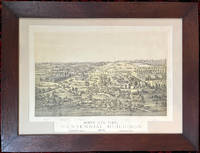
187560874Philadelphia PA: H.J. Toudy 621 & 623 Commerce Street 1875. One oblong atlas folio hand-coloured lithograph sized 25 x 20.5 in. still retaining fairly wide borders printing below centered image colour-tinted border to image some very minor age toning dustsoiling still an excellent copy preserved in the original quarter-sawn oak wood frame 33.5 x 25.5 in. retaining the original glass newly backed in archival foam core framed w/ archival matting. First edition of this impressive first edition birds-eye view of the buildings and sites Centennial International Exhibition with the fairgrounds set above the Schuykill River. This view depicts the Exposition before it was completed and the Halls featured include the Main Building Machinery Hall Memorial Hall Horticultural Hall and Agricultural Hall. Once the construction was complete Toudy issued another version with fuller buildings as well as some changes to the foreground and center of the image. Toudy fl. 1865-1878 first established with William Toudy his lithography firm at 503-505 Chestnut and later merged with Geroge Wl. Ward & Co. in 1872 lasting less than 2 years. Henry became the sole owner by 1875 and were well known for their atlases maps and city views and he worked on several Stone & Stewart County Atlases from 1866-1877 as well as many of the Mid-Atlantic general surveys. They also managed to outlast a lawsuit over a print based on the drawing by Hermann Schwarzmann architect of the Centennial grounds entitled “Bird’s Eye View†after copyrighting this image in 1875. Firm was destroyed by fire in 1878. Worldcat locates 2 copies AAS DLC another version located at Library Company of Philadelphia. H.J. Toudy, 621 & 623 Commerce Street, unknown
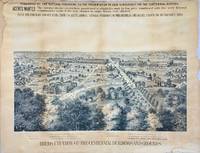
187657711Philadelphia PA: National Publishing Co. 1876. One oblong atlas folio hand-coloured lithograph sized 26 x 20.5 in. still retaining fairly wide borders printing above & below centered image w/ hand-coloured border some minor toning & aging from original backing minor tidemark to upper left corner edgewear slight tears very minor predation scuffing to blank right margin still a nice strong image retaining some of the original colouring. First edition variant issue of this scarce birds-eye view of the buildings and sites at the first World’s Fair in the United States celebrating the Centennial. This depicts the trees grass shrubs pedestrians horse-drawn carriages and walking paths with labels below for the Horticultural Hall Main Exhibition Building Memorial Hall Agricultural Hall Ladies Pavilion Machinery Hall and others. These beautiful birds-eye views were presented to subscribers of the “Centennial History†by sales agents who were also sent extra circulars and liberal commissions as indicated in the margins. These were apparently issued in different sizes and formats with the Huntington hand-coloured copy containing all the text including the imprint at the lower fore-edge and both the Huntington and American Antiquarian Society copies have smaller margins. Bourquin 1808-1897 was a Swiss-American pioneering Philadelphia lithographer who specialized in county maps and atlases but also was known for his innovative lithography and by 1876 maintained between 6 and 20 skilled lithographers to produce portraits and prints. National Publishing Co., unknown
187761009New York: D. Appleton & Co. Publishers 1877. Folio. 10.25 x 13 in. iv 164 pp. plus 6 pp. illustrated publisher’s ads. With woodcut engraved illustrations throughout woodcuts in ads as well. Emerald green publisher’s cloth over beveled boards decorative gilt & black borders & lettering on front cover paper spine label w/ manuscript title a.e.g. minor edgewear minor bumping slightly shaken ex-lib markings on endpapers & title still VG- copy. First edition of this wonderfully illustrated depiction of the furnishings artworks silver American cut glass stained-glass windows and more all displayed at the 1876 Centennial International Exhibition in Philadelphia. Following the lead of the 1851 & 1862 Exhibitions the 1853-54 New York Exhibition and others the Centennial served as a vast space for thousands of vendors and manufacturers to display their wares. Many American artists were featured and these World’s Fairs served as key influences on designers decorators artists architects and the arts. Copies of this are surprisingly uncommon with nearly all listed in Worldcat as electronic or microfilm versions rather than physical. D. Appleton & Co., Publishers, hardcover
187660872Philadelphia: n.p. 1876. Oblong folio. 28.25 x 22.75 in. One woodblock-engraved printed linen scarf decorative borders large lozenge medallions for halls sewn at fore-edges minor age toning some spotting & soiling very slight foxing old pin-holes at corners still a VG exemplar. First edition of this wonderfully woodblock printed souvenir linen scarf for the 1876 Centennial International Exhibition held in Philadelphia that year. The large lozenge medallions feature the Main Exhibition Building which covered 21.5 acres constructed of wood & iron framework on 672 stone piers; the Horticultural Hall epitomized floral achievement in gardening and was designed in a Moorish style to be a permanent tribute to the Crystal Palace of London’s 1851 Great Exhibition -- it survived until severely damaged by Hurricane Hazel in 1954; and finally the Art Gallery now known as Memorial Hall and the only large exhibit building still standing on the Exposition site. President’s Washington & Grant anchored the upper corners with Centennial Medallions in the lower corners. [n.p.], unknown
1876757111876. CENTENNIAL EXHIBITION. Masterpieces of the Centennial International Exhibition. Volume I: Fine Art by Edward Strahan. Volume II: Industrial Art by Professor Walter Smith. Volume III: History Mechanics Science by Joseph M. Wilson. Phila.: Gebbie & Barrie 1876. 1st ed. 4to. Three vols. Profusely illus. with engraved plates and reproductions. 366; 521; 375pp. A very good set in cloth. unknown
1876154861876. CENTENNIAL EXHIBITION. The Masterpieces of the Centennial International Exhibition. Volume I: Fine Art by Edward Strahan. Volume II: Industrial Art by Professor Walter Smith. Volume III: History Mechanics Science by Joseph M. Wilson. Phila.: Gebbie & Barrie 1876. 1st ed. 4to. Three vols. Profusely illus. with engraved plates and reproductions. 366; 521; 375pp. A very good set in orig. 3/4 leather. unknown