[Lactance]Livre Rare Book
9 résultats
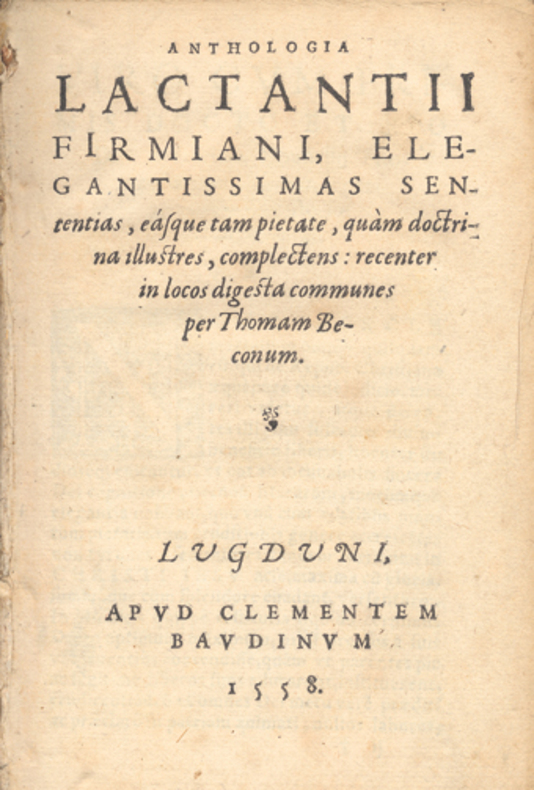
15581254Lyon, Clément Baudin, 1558, in-8 ; plein veau bordeaux foncé, dos à nerfs orné de fleurs de lys, double filet doré d'encadrement des plats avec quatre grandes fleurs de lys dorées en écoinçons, toutes tranches dorées (reliure du XVIIIe) ; (16) ff., le dernier blanc, 246 pp., (5) ff. dont 3 blancs.
150255451502 Pleine reliure carton, très bon état,150x220, 399 gr, 145 pages, contient 4 véritables pantacles, illustrations, ISBN: 2703301472
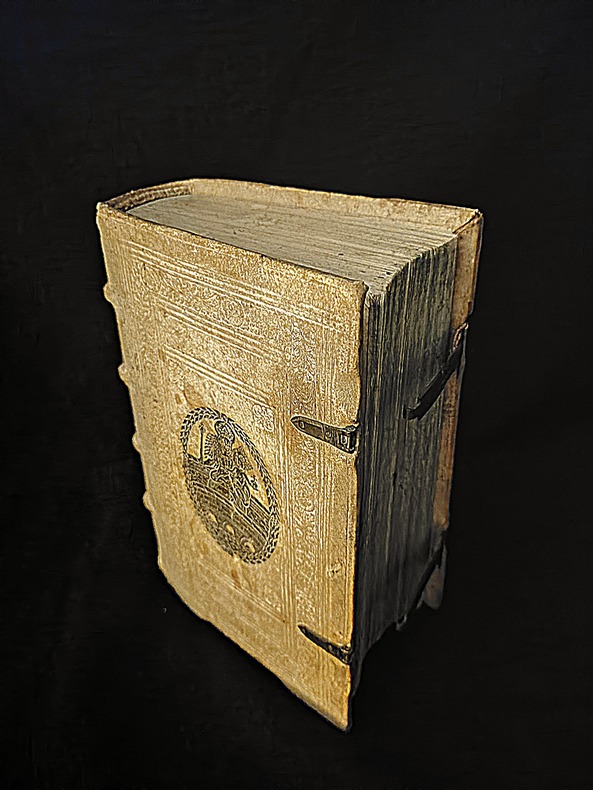
1581GEJ-8Ingolstadt, apud Davidem Sartorium, 1581. pp. [80] 542 p. Book in Latin. In-8. Beautifull ornamented white blind stamped calf. Additionally black engreved to front cover. Two original clasps. Fist and last blank leaf missing. Title page in black. 80 unnumbered and 542 numbered pages. Blue paper edges. Clean endpapers with small pencil annotation on the first back cover. Nice ornameting, wide margins and initial letters. Very clean and bright interior. Franziskaner Kloster Dettelbach stamp and hand-written anotations on the title page. Complete. Very good condition. 2nd rare edition (First, 1580) of interesting and influential work on heresy. Very uncommon issue on the market. Rare in any edition. "Hammer of Heretics" is a Catholic counter-reformation text by Georg Eder, published in Ingolstadt, that defends Catholicism against Protestant doctrines, particularly Lutheranism and Anabaptism. It is distinct from the 1487 Malleus Maleficarum (witch-hunting manual), focusing instead on combating heresy through theological argumentation. Eder was a lawyer and Catholic theologian (1523 - 1587), Imperial Court Councillor and advisor to Emperors Ferdinand I, Maximilian II, and Rudolf II. Best known for his theological polemical writings. "His oratorical and literary talent, the decidedly Catholic orientation from his Bavarian homeland, which deepened in Cologne and, in Vienna, where he immediately sought contact with the Jesuits, manifested itself in tireless activity, making Eder a champion of Catholicism struggling for its existence in Austria" (NDB IV, 311 f.). "Eder's writings from this period all deal with the question of church confession with regard to the differing and opposing positions of the Protestants" (ADB V, 318). Bibliography: USTC No. 674751, VD16 E 541, Stalla 1413, Adams E 64. Provenance: Franziskaner Kloster Dettelbach.
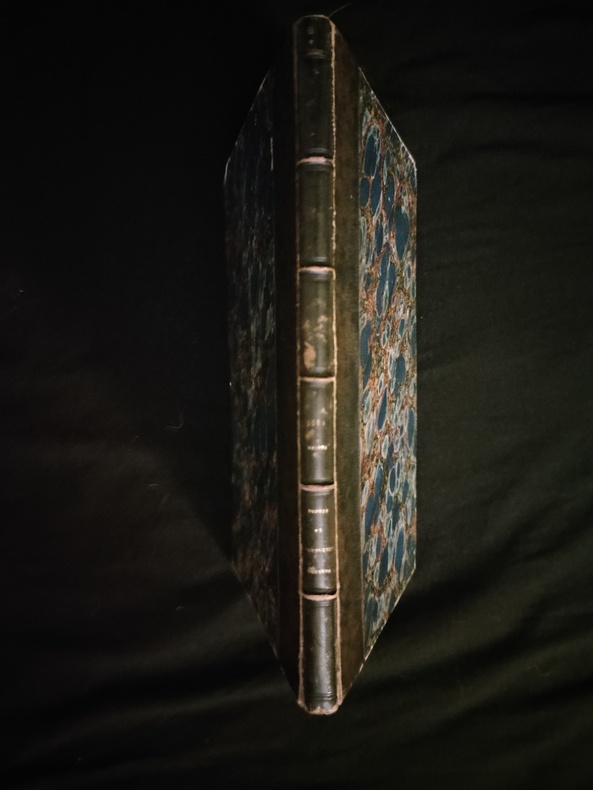
1555GEJ-11Pescia: Lorenzo Torrentino, 1555, 4to, [13] 18-126 [1] of colophon 1 blank. Book in Italian. 1st Italian Edition (2nd overall) of this rare demonology tratise. Later (18/19 .century) later half morocco with gold lettered spine and blank pages. Marbled endpapers. Architectural woodcut border on title-page with a small view of Florence and with Medici coat of arms. Woodcut initials, woodcut vignette on verso of A4. Colophon leaf at end. Very ginuine interior, clean, without marks, annotations, stamps and ex libris. No foxing and stains. Complete. First Italian edition and the first translation from the 1523 Latin original by Turino Turini, marking the earliest book on witchcraft printed in the Italian vernacular. While the dialogue format reinforces the grim theological framework of the Malleus Maleficarum and contemporary inquisitorial manuals regarding sabbaths and demonic pacts, it stands apart for its erudition. By sophisticatedly weaving classical and pagan citations into medieval scholastic precepts, Pico della Mirandola effectively pioneered the "humanistic literature of witchcraft," bridging Renaissance intellectualism and counter-reformation demonology. The work embodies the Renaissance approach to demonology, demonstrating how a humanist could substantiate the reality of witchcraft, transvection, and the sabbath using classical sources alongside scripture and inquisitorial manuals. Ultimately, the early modern obsession with demonology is presented not as an irrational residue of a rational age, but as a foundational conceptual nexus essential to understanding sixteenth-century philosophy. Bibliography: Censimento 16 CNCE 34704; Riccardi II, 281; Moreni, Annali della tipografia di Lorenzo Torrentino, s. 394; Sander 5688; Graesse V, 283; USTC No. 848435; Caillet 8654; Encyclopaedia of Witchcraft 2006.
158720901Lyon Pillehotte 1587 in-12 plein-veau 1 volume, reliure plein veau raciné moucheté et coloré havane petit in-douze (binding full calfskin in-12) (12,5 x 8,6 cm), RELIURE D'EPOQUE, dos à nerfs (spine with raised band) décoré "or" (gilt decoration) à filets et roulettes "or" (gilt line), titre et tomaison frappés "or", pièce de titre et de tomaison (label of title and volume numbering) sur fond bordeaux avec double filet "or" en encadrement, roulette "or" en place des nerfs avec un filet"or" de part et d'autre des nerfs, entre-nerfs à fleuron "or" dans un encadrement à double filets "or" avec fleuron "fleurette" "or" aux angles, roulette "or" en tête et en pied, la coiffe inférieure manque, plats décorés "or" d'une roulette "chaînette" "or" en encadrement, toutes tranches lisses rouges, Texte en Latin, sans illustrations (no illustration) excepté une marque de l'Editeur en bas du titre gravée sur bois en noir avec la devise : "nomen domini laudabile" (le nom du Seigneur soit loué) + orné de bandeaux et lettrines historiées (and illuminated of headpieces and dropped initials) gravés sur bois en noir, [Liber I : 322 + Liber II : 150 + Liber III : 200 (de la page 151 à la page 350) + i ff. blanc + 31 ff. d'Index , privilège et errata] pages, 1587 Lugduni : apud J. Pillehotte Editeur,
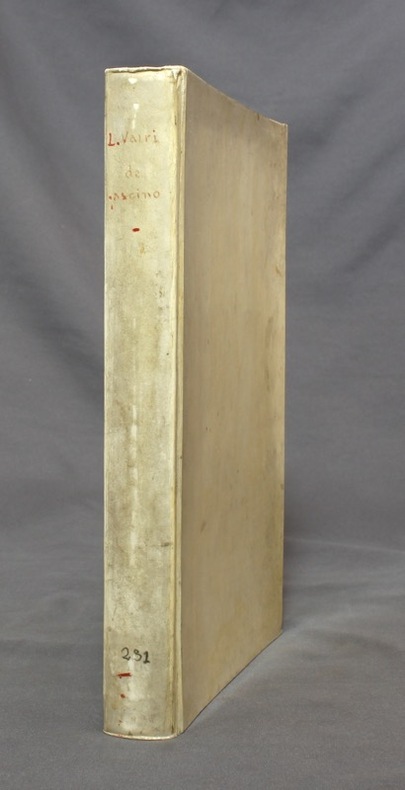
1575GEJ-14Romae (Rome), In Aedibus Populi Romani, 1575. [24], 262, [2] pp. In-4°. Book in Latin. The work is adorned with a woodcut printer’s device on the title page, fine ornamental initials, and an extensive, enlarged index preceding the main text. Old handwriten title letering to spine. Full original vellum binding and endpapers. XXth century bookplate with the initials J.B to front pastedown. Some early shelf-mark on first blank leaf and annotaions on the last pastedown. Foxing, worholes and some discolorations. Otherwise good and complete copy. This volume represents the important and rare second edition of De strigimagarum, daemonumque mirandis (“On the Marvels of Witch-Magicians and Demons”), a landmark early modern treatise on witchcraft, demonology, and inquisitorial procedure. First published in Rome in 1521 by Antonio Blado, the text was reissued in this substantially revised edition more than fifty years later. As noted on the title page, this 1575 printing was meticulously corrected and purged of the countless typographical errors that plagued the earlier publication. The author, Silvestro Mazzolini da Prierio (ca. 1456–1527), known as Prierias, was a distinguished Dominican theologian, inquisitor, and Master of the Sacred Palace under Pope Leo X. Famously remembered as one of the earliest Catholic theologians to publicly challenge Martin Luther, Prierias skillfully combined scholastic theology, canon law, and his extensive personal inquisitorial experience to address the contemporary socio-religious crisis of witchcraft. The treatise is organized into three distinct books. The first explores the theoretical, theological, and philosophical foundations of demonology, examining the nature of the soul, angels, and demons, alongside the limits of their influence on the physical world. The second book focuses directly on the witches themselves (strigimagae), providing a detailed contemporary account of diabolical pacts, harmful magic (maleficium), nocturnal flight, and the reality of the witches' Sabbath. Historically, Prierias's work is of paramount importance due to its radical reinterpretation of the medieval Canon Episcopi. While that traditional authority dismissed the nocturnal journeys of women as mere demonic illusions, Prierias argued that early modern witchcraft had evolved into a far more dangerous threat. In his view, the witch was not merely suffering from delusions, but was actively guilty of heresy, superstition, apostasy, and deliberate maleficium. This pivotal intellectual shift effectively bridged older canon-law precedents with the increasingly aggressive sixteenth-century prosecution of witchcraft. The third book shifts entirely to a juridical framework, treating witchcraft strictly as a form of heresy. It serves as a practical manual for magistrates and inquisitors, offering concrete guidance on investigating accusations, evaluating evidence, conducting formal trials, and determining punishments. This pragmatic approach is explicitly signaled in the title: una cum praxi exactissima, et ratione formandi processus contra ipsas (“together with a most exact practice and method for conducting proceedings against them”). While developing its arguments within a strict Dominican and Thomistic framework, the work belongs to the same influential tradition of judicial demonology as the Malleus Maleficarum. Ultimately, De strigimagarum stands as a crucial transition point in European history, mapping the evolution from late-medieval theological theory to the highly systemic, institutionalized judicial demonology that fueled the great witch trials of the sixteenth and seventeenth centuries. This 1575 edition remains an indispensable primary source for the study of Renaissance demonology and early modern jurisprudence. Bibliography: USTC 841748; OCLC 79459438; Folger Shakespeare Library, BF1520 .M2; Robbins Collection, University of California, Berkeley, BX1713 .M39 1575; Caillet, Caillet 8974; Graesse V, p. 442; Bibliotheca Magica 833; Michael Tavuzzi, Prierias: The Life and Works of Silvestro Mazzolini da Prierio, 1456–1527, Durham & London, 1997. Provenance: Old Ex libris with initials J.B. - (library ?) or Private Collection (?).
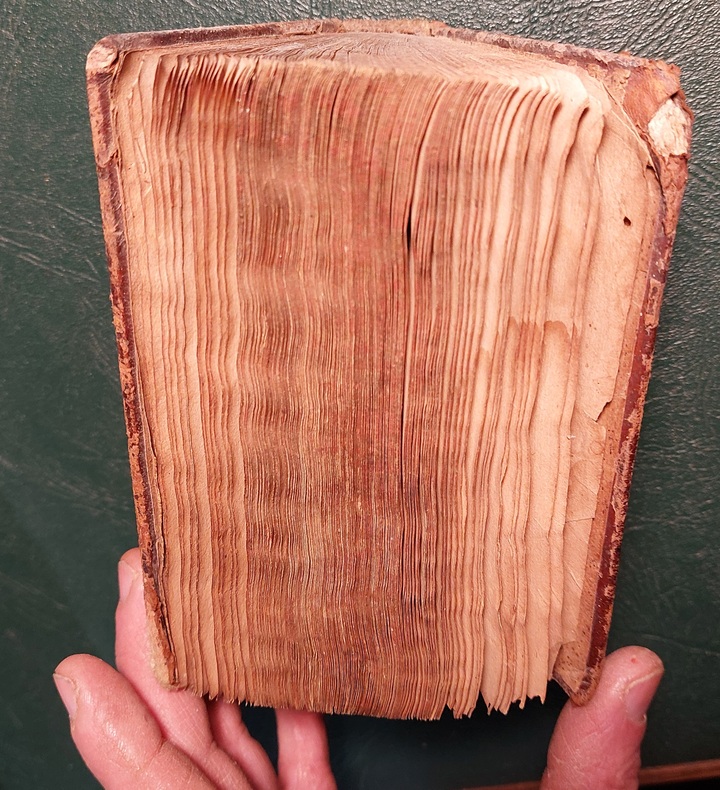
1578ZPJ-151578 - seconde édition - complet en 378 pp, auxquelles s'ajoutent le titre, l'epistre, la préface, les approbation, les privilèges la table des chapitres et des sections - in 12 (14 cm) - reliure d'époque plein cuir très usée - traces d'humidité importantes n'empêchant pas la lecture - par contre le texte est touché par le travail des vers p371 à 378 -
1561GEJ-10Paris, apud Gilles Corrozet, 1561, [1], 40, [1] pp, 8°. Book in Latin. RARE AND UNCOMMON ON THE MARKET FIRST PARISIAN PRINTING! 17/18 century full calf binding, gold lettered spine, marbled endpapers, owner's ex libris of Emeric Bigot (?) on title page. Good antiquarian condition, woodcut printers device to title, woodcut initials. Few stains and discolorations. Complete. Published in Paris by Gilles Corrozet in 1561, this rare edition of Ulrich Molitor’s Tractatus de lamiis et pythonicis stands as a definitive cornerstone of early occult literature and a fascinating, skeptical counterpoint to fanatical witch-hunting manuals like the Malleus Maleficarum. Written by a prominent German jurist, the treatise is historically significant for its early skepticism, as Molitor boldly argued that supernatural acts like shape-shifting or flying to sabbaths were merely illusions and dreams induced by the Devil rather than physical realities. This text is equally famous for containing the earliest printed depictions of witches, establishing the modern iconography of the occult through striking woodcut imagery that includes scenes of witches brewing storms in cauldrons, a wizard riding a wolf, and the Devil corrupting a woman. Composed as a direct response to Europe's rising witchcraft hysteria, this treatise introduces cold legal logic and canonical jurisprudence into a debate previously dominated by religious fanaticism. Moving away from dry academic lecturing, the text adopts the dynamic structure of a scholarly dialogue between three real historical figures: Archduke Sigismund of Austria, the ruler of Tyrol, who acts as the voice of skepticism by raising logical doubts and challenging the validity of witch trials; Conrad Schatz, the magistrate of Constance, who champions the strict, traditional view by defending the physical reality of witchcraft and demanding harsh punishments; and Ulrich Molitor himself, the author, who serves as the impartial arbiter utilizing Roman and Canon law to systematically resolve the disagreements between his interlocutors. Ulrich Molitor (c. 1442–1507) was a pioneering German jurist, humanist, and diplomat who shaped early modern legal thought. After studying humanities in Basel, he earned a prestigious doctorate in civil and canon law from the University of Pavia, positioning him at the forefront of Renaissance jurisprudence. He spent the pinnacle of his career as a trusted legal advisor to Archduke Sigismund of Austria in Innsbruck and later served as chancellor to the Bishop of Worms. Molitor’s enduring legacy is his 1489 masterpiece, Tractatus de lamiis et pythonicis, which stands as one of history's earliest legal critiques of witch-hunt fanaticism. By utilizing rigorous Roman and Canon law to argue that witchcraft was largely a demonic illusion, he became a vehement opponent of judicial torture, forever marking his place as a trailblazer of European rationalism. Provenance: Emeric Bigot (?) - Ex Libris: Emeric Bigot (1626–1689) was a prominent French humanist, bibliophile, and a central figure in the 17th-century European intellectual network known as the Respublica Literaria (Republic of Letters). Born and based in Rouen, he used his substantial wealth to amass one of the most legendary private libraries in Europe, renowned for its rare Greek and Latin manuscripts and early printed books. Though he published little under his own name—focusing primarily on editing early Christian texts—Bigot served as an indispensable international scholarly coordinator. He maintained a vast correspondence with major thinkers like John Milton and Nicolas Heinsius, utilizing his unparalleled bibliographic expertise to source texts, verify translations, and generously assist scholars across the continent in preparing their own monumental works for print. Bibliography: Herbert M. Adams, M 1573; USTC, 153205; Pettegree i Walsby, 153205, only found in one US institution (Yale University, Beinecke Library), Not in VD 16, Yve-Plessis, Dorbon-Aîné and Bibliotheca Esoterica; Caillet, II, 7641; Grässe, p. 55; Bibliotheca Daemonologica (Robbins).
158312463Paris, Nicolas Chesneau, 1583. In-4 de [8]-275-[37] pages, plein vélin à rabats, dos lisse. Reliure fin XIXe, 2 ex-libris modernes. Note manuscrite sur un feuillet blanc XIXe, citant Yve-Plessis.