[MAGIC - MENTALISM] JACQUES OZANAMBiblio.com
1 résultat
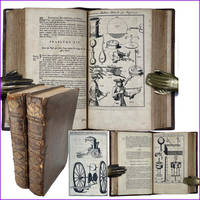
169628<p>the forerunner of mathematical recreations and its use in the art of illusionism and magic</p><p>an early manual for the first "mentalists"</p><p>Ozanam Jacques<strong>.</strong> <em>Recreations mathematiques et physiques VOL I. </em>Amsterdam: Gallet 1696.</p><p>Togheter with</p><p>Ozanam Jacques<strong>.</strong> <em>Recreations mathematiques et physiques VOL II. </em>Paris : Jombert 1696.</p><p>2 volumes in 8vo 188x120 mm contemporary calf with gilt decorations at spine pp. 16 265 1; 266-583 25 the last is blank. Engraved title-page.</p><p>Second edition of the forerunner of modern books on mathematical recreations including illusionism mentalism fireworks conjuring sundials and clocks.</p><p>84 engraved folding plates 45 first Vol. 39 second that support the solution of mathematical arithmetic geometric optical or cosmographic problems or that visualize the mechanism of a clock.</p><p>Scarce second edition 1st published in 1694 of the first work on recreational mathematics. This is one of the most popular books on the subject dealing among the other subjects with fireworks conjuring and presenting in vol. 2 a translation of Domenico Martinelli's treatise on clocks printed in Venice in 1663 p. 473</p><p>The volumes are divided into 9 topics</p><p>Vol 1: 1 Arithmetic 2 Geometry 3 Optics 4 Gnomonics and 5 Cosmography.</p><p>Vol 2 6 Mechanics 7 Pyrotechnics 8 Physics and 9 the translation Martinelli treatise on Watches.</p><p>For each topic Ozanam presents a series of problems with the various possible solutions described and often illustrated</p><p>Among the problems of mechanics Ozanam describes and illustrate a form of transport that foreshadows the automobile: behind the driver who holds reins in his hands stands a valet who activates with his feet two spring-loaded boards giving the carriage its impetus playing the role of a modern engine.</p><p>Most of the chapter about arithmetic is dedicated to the art of illusionism and mathematical games. A long chapter is dedicated to magic squares from pp. 36 on but many are the tricks described always in the form of a problem/solution which today are attributed to a kind of illusionism called <strong><em>mentalism</em></strong> a form of illusionism whose practitioners through techniques such as <em>cold reading</em> or <em>hot reading</em> give the illusion of being able to read others 'minds demonstrating supernatural or at least highly developed mental and intuitive ability.</p><p>In their performances mentalists give the impression of being able to exercise telepathy clairvoyance divination precognition psychokinesis mediumship mind control hypnosis prodigious memory and rapid mental calculation.</p><p>Among the games described in the text that can be accounted under this category we remember for example:</p><p>Problem XII: Thrown two dice how to guess the values on the top two sides without looking at them.</p><p>Problem XIV: Guessing a number that someone has chosen by asking him questions</p><p>Problem XVI: Guessing a number someone has chosen without asking them questions</p><p>problem XX: Guess how many coins a spectator hides in his hands</p><p>Problem XXVIII: Given three known playing cards and three spectators guess which card each one has chosen.</p><p>problem XXXI: Among different cards arranged on three decks how to guess which one the spectator has chosen</p><p>and many others.</p><p>Jacques Ozanam 1640 - 1718 was a French mathematician.</p><p>Although his father pushed him toward an ecclesiastical career he was much more attracted by science and mathematics that continued to study as a self-taught. At the age of 15 he was able to write a treatise on mathematics but his father induced him to enroll in courses in theology despite his little inclination for the priestly life. After four years of theological studies his father died and he returned to scientific studies.</p><p>In 1670 he published trigonometric and logarithmic tables more accurate than the existing Ulacq Pitiscus and Briggs works and numerous and well received mathematical publications.</p><p>In particular he had great success with <em>Dictionnaire mathématique</em> the five volumes of the <em>Cours de mathématiques</em> and <em>Récréations mathématiques et physiques </em>; his manuscript entitled <em>Les six livres de l'Arithmétique de Diophante augmentés et reduits à la spécieuse</em> received commendations from Leibnitz himself.</p><p><em>Récréations mathématiques et physiques</em> was also successful in the English translation and is still well known and looked after today.</p><p>He was elected a member of the <em>Académie Royale des Sciences</em> now <em>Académie des Sciences </em>in 1701. The death of his wife plunged him into deep sorrow and the loss of his foreign pupils through the War of the Spanish Succession reduced him to poverty.</p><p>Conditions: light marks of use at bindng in general very good condotions</p><p>Provenance: Paper ex-libris pasted at title page of both volumes " Engeg. Gio Battisa Carraca.</p>