26 résultats
1596412Antwerp: Ex Officina Plantiniana Apud Viduam & Joannem Moretum 1596. 2 parts in one. 8vo. 1973pp. Complete with the final leaf with the large woodcut printer's device. 19th century mottled calf. Preliminary leaves with an old faded waterstain. Some repairs to worm ing at lower margins of a number of leaves aff ecting just a few letters. Adams B505. Ex Officina Plantiniana, Apud Viduam, & Joannem Moretum unknown books
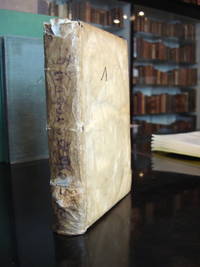
15966042Frankfurt: Andreae Wecheli Heredes Claudium Marnium & Joann. Aubrum 1596. 4to. 2 volumes in 1. 16464;5502pp. Indices. Woodcut device of Wechel on both titles and verso of final leaf otherwise blank. In this copy all of the devices have been hand colored old coloring. Old plain vellum somewhat worn. Title and text with some old moderate water stains. Free endpapers lacking. Not a particularly attractive copy but quite useable. Later 16th century edition of Horace edited by the great scholar Dionysius Lambinus. Dibdin in his GREEK AND LATIN CLASSIC 4th ed. Vol II p.45 makes reference to two editions printed by Wechel a 1577 folio and our 1596 4to. Andreae Wecheli Heredes, Claudium Marnium & Joann. Aubrum hardcover books
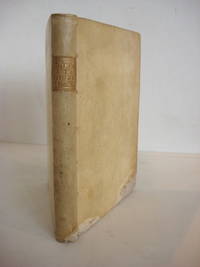
15679576Basel: P. Perna suis & H. Petri 1567. Vellum. good . 62050pp. Index. Contemporary vellum. Front & rear free-endpapers lacking. Modern ink ownership inscription on blank portions around the imprint on title. Historical work on the Kingdom of Naples with 2 texts one by Facius and another by J.J. Pontanus. B.L. German p.297. P. Perna suis & H. Petri hardcover books
1566160Basel: P. Perna suis & H. Petri 1566. 62050pp. Index. Contemporary vellum. Front & rear free-endpapers lacking. Modern ink ownership inscription on blank portions around the imprint on title. Note: the colophon is dated 1567. Historical work on the Kingdom of Naples with 2 texts one by Facius and another by J.J. Pontanus. B.L. German p.297. Adams F207 under "Fazio". VD16 #F545. (P. Perna suis & H. Petri) hardcover books
15984716Cologne: In Officina Birckmannica 1598. 12mo. 725895pp. 17th cent. vellum soiled. Two paper labels on spine. Popular handbook edition of this often reprinted work of religious instruction containing meditations for the seven days of the week. It first appeared in 1554 in Salamanca under the title LIBRO DE LA ORACION Y MEDITACION. The first Latin edition appeared in Cologne in 1586. Not in Adams or BL German STC. VD16 #L3244. Palau 107537. In Officina Birckmannica hardcover books
1576393Lyons: J. Quadratius for A. de Harsy 1576. Sm. 8vo. 80424pp. With the final 2 blank leaves. Index. Cont. vellum soiled. One leaf with a marginal repair touching a shoulder note. The 12 books of medicine of Alexander of Tralles was a 6th century classic and was often reprinted in both Greek and Latin. Our Latin translation by Johann Gunther first appeared at Strasbourg in 1549. Wellcome Medical Library I #214. See Stillwell. AWAKENING INTEREST IN SCIENCE 1450-1550 III #265. BL French STC p. 10. (J. Quadratius, for) A. de Harsy hardcover books
15679512Basel: P. Perna suis & H. Petri 1567. Vellum. Very good. 62050pp. Index. Contemporary vellum hand lettered spine. Small portion of top edge of front cover 1/4" x 2" chipped. Tipped in ahead of the title are 3 pages of a previous early owner's manuscript biographical notes on Facius. Historical work on the Kingdom of Naples with 2 texts one by Facius and another by J.J. Pontanus. B.L. German p.297. (P. Perna suis & H. Petri) hardcover books
15517506Venice: Per Giovanmaria Bonello 1551. First edition thus. Vellum. Very Good. Sm. 8vo. ff.8239. Lacking the final blank leaf. Title page with a large woodcut printer's device with initials Z.M./B.V. at bottom. Cont. vellum a bit soiled a few minor chips ties lacking. Some old soiling including some discoloration to blank fore-edge of a few final leaves. A collection of aphorisms and apothegms selected chiefly from Cicero's correspondence. Per Giovanmaria Bonello hardcover books
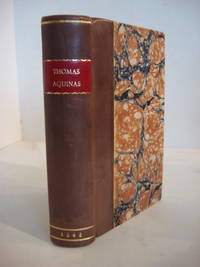
15439601Paris: Joannis Boulle 1543. Full calf. Very good. 8vo. ff.82394. 20th century tan calf with red morocco spine label over modern boards. The first 4 leaves have an old round embossed stamp of a seminary in Granby Mass. Title page also with an inked Catholic stamp of some order otherwise a nice clean copy. This work has been falsely attributed to Saint Thomas Aquinas. Apparently the author/editor is Nicolaus de Gorra or spelled Nicolas de Corran. Adams B1852. Joannis Boulle unknown books
15867398Bologna: Per Alexandrum Benatium 1586. First edition. Hardbound. Very Good. 4to. 42 blank leaves2602 blank leaves64pp. Index. With a beautiful title page illustrated with a large woodcut depicting St. Petronius the patron saint of Bologna and 2 smaller woodcuts of the arms of the city and of a bishop. Cont. limp vellum some light soiling hand lettered paper spine label chipped some old library lettering at foot of spine. Old private library bookplate on front pastedown. This book by the historian Sigonio 1524-1584 gives short biographies of the bishops and archbishops of Bologna from St. Zama 270 to Gabriele Paleozzi 1566. Not in Adams. BL Italian STC p. 627. Per Alexandrum Benatium hardcover books
15548113Paris: Jacobum Kerver 1554. Second printing. Vellum. Very Good. 8vo. 64416pp. Woodcut portrait of the author on title. Orig. limp vellum somewhat soiled and spine a bit chipped at top. Some text soiling. Front free endpaper lacking. French legal scholar's 1488-1558 treatise on the aspect of Roman law pertaining to inheritance and succession. It was first printed in 1550. Jacobum Kerver hardcover books
15779612Venice: Gabriel Giolito de' Ferrari 1577. Firdt Italian trans. 2nd issue. Vellum. Very good -. 4to. 202671pp. Large woodcut device on title and verso of final leaf. Text illustrated with 28 text woodcuts most within a decorative woodcut border. Cont. vellum part of the bottom edge and one corner rat gnawed exposing the boards under the vellum; some light text soiling. Still a decent copy. The first Italian translation second issue with the 1577 date rather than 1576 of contemporary theologian Luis de Granada 1504-1588. See Bonghi. GIOLITO DE'FERRARI II pp. 357-358. Gabriel Giolito de' Ferrari hardcover books
15876166Cologne: Joannem Gymnicum 1587. 8vo. 16430pp. With the final blank. Small woodcut device on title. Cont. vellum. Minor worming to blank margin of a few final leaves. An uncommon edition. Not in Adams or BL German STC. VD16 #C1481. Joannem Gymnicum hardcover books
15737394Bologna: Ex Typographia Joannis Rosii 1573. First edition. Vellum. Very Good . 4to. 864pp. Woodcut device on title. Modern vellum lightly soiled hand lettered spine. A work on oratory inspired by orations of Demosthenes. All that is known of Carlo is that he was Professor of Greek at Bologna University between 1571 and 1582. Not in Adams or BL Italian STC. OCLC records 1 copy in the U. S. Ex Typographia Joannis Rosii hardcover books
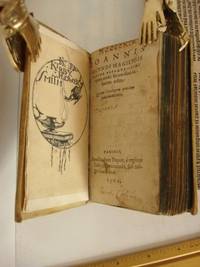
15617610Paris: Jacobum Dupuis 1561. Second edition. Vellum. Very Good. 16mo. ff.172. BOUND WITH: Marullo Michele or Marullo Tarcaniota Michele. EPIGRAMMATA & HYMNI. Paris: Jacobum Dupuis. 1561. ff.92. Title with outer margin restoration 1/2" vertical strip of later paper with a few letters of title & imprint in manuscript. 2 pages of cont. manuscript notes in German at back. Both works bound togetherin cont. vellum soiled. Large bookplate of American classical scholar Kirby Flower Smith 1862-1918. I: The second edition of the works of Secundus. Also found with the variant imprint of A. Wechelum as in both Adams S838 and BL French STC p. 397. II: Uncommon edition of the Greek scholar and Neo Latin poet Marullo 1458-1500. Not in BL French STC. Adams T145 under "Tarchaniota" and with the variant imprint of Wechelum. Jacobum Dupuis hardcover books
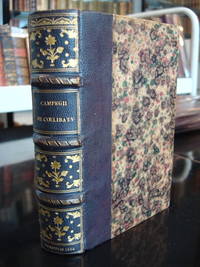
15546266Venice: Ad Signum Spei 1554. First edition. Very Good. Sm. 8vo. 1696pp. Title page with a large allegorical woodcut vignette. BOUND WITH: Campeggi Tommaso. OPUS. DE AUCTORITATE & POTESTATE ROMANI PONTIFICIS & Alia Opuscula Quae Indicantur in Sequenti Pagina. Venice: Apud Paulum Manutium Aldi F. 1555. Sm. 8vo. ff.12223. Lg. woodcut anchor & dolphin printer's device on title. Both works nicely bound together in 19th century brown morocco gilt decorated spine over marbled boards. Bookplate of James Stevens Cox on front pastedown. First editions of two of Campegii's main works. The first is his tract on celibacy the second is his treatise on the power of the Pope ff.1-116 followed by 19 other theological treatises. I. BM STC Italian p. 142. Not in Adams. II. BM STC Italian p. 142. Adams C477. Renouard ALDUS p. 164. Ad Signum Spei hardcover books
15616593Basil: Henricum Petri et Petrium Pernam 1561. First collected edition. Vellum. Very Good. 8vo. 2 parts in 1 each with its own title page see below. 16240;18010pp. With the final leaf of errata and colophon. Orig. limp vellum inner hinges reinforced with linen cloth strips. Later endpapers. The first part is a description of England Scotland Ireland the Hebrides and the Orkney Islands with a long English historical chronicle. The second part separately collated is the author's "Moschovia in qua Situs Regionis Antiquis Incognitus." a description of Moscow but it also includes his description of Lake Como the place of the author's birth and a text on Italian fish. VD 16 G2058; BL German STC p. 360; not in Adams. Henricum Petri et Petrium Pernam hardcover books
15557297Strassburg: Wendelinus Rihelius 1555. First edition. 17th century boards. Very Good. Folio. ff.44691. Final leaf a blank. Colophon at bottom of f.469. Large woodcut device on title page. 18th century red boards morocco spine label spine and extremities somewhat rubbed but quite sound. Front free endpaper lacking. Old rubber stamp at lower blnk margin of title. Some minor marginal worming. Some early marginal annotations in a few sections. The scarce first edition of this famous history of the German Reformation. It was immediately controversial. The Schaff-Herzog RELIGIOUS ENCYCLOPEDIA states "Storms of protest arose against it on every side both Roman Catholic and Protestant." There are 2 issues of this work VD S6668 ours and VD S6669 which differs in having the last leaf numbered 470 and leaf 463 has an errata printed on the recto. In VD S6668 there are 469 numbered leaves and leaf 463 is blank without errata and not numbered. Wendelinus Rihelius hardcover books
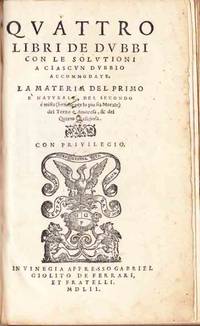
15526331Venice: Gabriel GIolito de' Ferrari 1552. First edition. Very Good/The title promises four sets of "questions and their solutions" and indeed that was the plan. Lando wrote Q&A on four topics: medical questions including dietary and aging functions ethical questions questions about religion and questions about love and sex. It was the love and sex part that raised the eyebrows of the censors and neither Lando or his publisher Giolito could get permissions to print it as the book was going to press. As Giolito himself declares in a postscript to the reader: "I promised you four books of doubts but since I haven't yet been granted a license for the doubts about love I'm forced to give you only three. Be well and enjoy as much of the book as I could give you." The license came later and the text appeared in later editions. This unfinished text with its publisher's apology represents a fascinating birthmark on the 16th-century book trade. The Q&A ranges over hundreds of topics calling upon the author's medical training much involved with the humors and temperaments associated with various organs objects and creatures his classical erudition and his training in the Augustinian order. The three sections together provide comprehensive insight into 16th century medicine and popular religious and moral thought. The odd matter of two versions of the dedication page leaf A ii is not easily explained. We suspect with some justification that Lando sought patronage for the same work in different locations knowing that Protestant Germany rarely spoke with Catholic Italy and vice versa. He might have found different backers in different markets. We know that to be the case with at least one other book of Lando's the "Sermoni Funebri" 1549 where some copies are dedicated to Fugger and others to Niccolo degli Alberti. That case is known and recorded. We find no recorded instance of the alternate dedication of "Quattro libri dei dubbi" to Fugger and no record of the author being identified by signing the dedication letter in any other copy. The "Quattro libri de dubbi" was quickly translated into French Lyon 1558 and by William Painter into English entitled "Delectable demaundes and pleasaunt questions with their severall aunswers." 1566 and again 1640. . Octavo 16 cm; 318 2 pages. Woodcut device on title page and on last page. Woodcut initials. Bound in recent vellum in period style yapp edges titled in ink on spine. Early 20th-century bibliographical note bound in. Marginal annotations in contemporary hand. Leaf a ii the dedicatory letter present in two states the cancel addressed to Johann Jakob Fugger closing with Lando's name and the original leaf addressed to Christoph Mielich and not signed as usual. Small perforation in the cancel affecting a word. Occasional light stains darker on last leaf. References: Bongi I 368; Melzi II 391; BM Italian 377 1556 ed.; Fontanini II 117. Gabriel GIolito de' Ferrari hardcover books
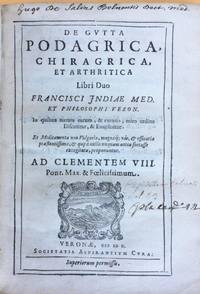
1600M13168Verona: Societatis Aspirantium cura 1600. 1600. Two parts in 1. Small 4to. xxiv 118 1 pp. Printer's woodcut device 5 snakes over landscape woodcut initials and tailpiece rear errata & colophon; old ink marginalia p.36 underlining pp. 97-99. Original vellum; lacks ties. Ownership inscription on title: Hugo De Salins Belnensis Doct. Med. d.1659 and another signature obscured. Bookplate of Château de Montrevost Cuisery France. EARLY SEVENTEENTH CENTURY WORK ON GOUT & RHEUMATOID ARTHRITIS: : HUGUES DE SALINS' COPY. First edition of this rare work on the nature cause and treatment of rheumatoid arthritis and gout. The status of gout in the late sixteenth century was such that gout was said by Turberville to be found in "horses capons and falcons." p. 64. John Gerard's Herball 1597 stated that Gout-wort or Herba Gerardi was a native herb that could be used with some benefit supported further by Culpeper. According to Copeman Thomas Sydenham 1624-1689 suffered from gout and wrote the classic description of the disease and was the first to be able to differentiate between rheumatoid arthritis and gout. The present work was written decades earlier. Francesco India cites Galen Chap. 1 Ambroise Pare Chap. 12 and Jean Fernel Chapters 5 7 8. India makes two 15-page tables of causes which he uses to organize his data. <br /><br /> PROVENANCE: Hugues de Salins: The British Library catalogue lists a "Hugues de Salins; see: Jean Baptiste de Salins Defense du vin de Bourgogne 1704." This may be a descendent. See: Societe d'Histoire d'Archeologie et de Litterature de l'arrondissement de Beaune Memoires annee 1890 Volumes 15-16 Beaune 1891 pp. 75 177. Mentions the wife of Hugues de Salins as buried in 1626 and Hugues de Salins buried in 1659. <br /><br /> Francisci Indiae an Italian philosopher and physician who is little known wrote the present work and two others: Hygiphylus: sive de febre maligna dialogus 1593. Hygiophilvs Tertivs Vel De Symptomatvm Febri Malignae Svper 1599. See: Frederic Paulhan Catalogue des legs Gide & Teissier-Rolland 1892 p. 212. Showing a copy of Strabo's Strabonis rerum geographicarum libri XVII 1571 with the same provenance inscription is this book. This inscription must date prior to 1892. <br /><br /> Copeman W.S.C. A Short History of the Gout and the Rheumatics Diseases pp. 53 64. Locations: British Library; Edinburgh University; Middle Temple Library; Wellcome Library. Societatis Aspirantium cura, 1600. hardcover books
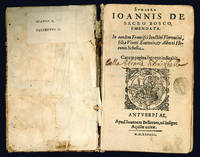
158273<p>COPY CONTAINING THE MINUTE OF A LETTER ADDRESSED BY GIORGIO RAGUSEO TO HIS COLLEAGE OF THE UNIVERSITY OF PADUA GIROLAMO PALLANTIERI</p><p>8vo 153x93 mm. 16 327 1 pp. and 1 folding plate with the movable parts to be cut out and the instructions on how to assemble them. Collation: †8 A-V8 X4. Printer's device on title page and several woodcut diagrams and illustrations in text. On the front pastedown label with the shelf mark "Scansia N. G10 Palchetto N.". On title page is the ownership's entry "Della libraria di Brisighella" and an old faded stamp. Contemporary binding made with a manuscript vellum leaf datable to the 12th-13th century inked title on spine and on the upper edge round worm holes and small losses to the panels heavier loss to the bottom part of the spine lacking ties and front flyleaf. Leaves †6 and †7 stained and with minor losses of paper and occasionally also of text small hole in the middle of quire M affecting a few letters other hole in the lower blank margin of ll. V3-X4 with no loss of text uniformly browned throughout first quire slightly loose. A genuine copy.</p><p>On back flyleaf recto is a manuscript note containing the minute of a letter presumably autograph by Giorgio Raguseo d. 1622 dated "Patavi ex academia nostra V. Non. Marti 94" 3 March 1594 and addressed to the "Admodum Rev.do ac Ecellentiss.o Patri Magistro Hieronimo Palanterio in almo Patavino Gimnasio theologiam publice proficienti" in which Raguseo thanks his colleague and professor of theology Girolamo Pallantieri 1533-1619 and asks his permission to print some not better specified academic "conclusiones ex variis doctoribus scholasticiis" which he thinks are worth publishing. It is also not clear which academy he is referring to in the letter.</p><p>On the verso of the same leaf is another note by the same hand quoting as a reminder the 1566 Giovanni Battista & Marchiò Sessa edition of <i>Le nuove teoriche de i pianeti</i> by Georg Peurbach in the translation by Orazio Toscanella.</p><p>RARE EDITION published in Antwerp of Sacrobosco's famous astronomical treatise accompanied by notes of Francesco Giuntini 1523-1590 Elie Vinet 1509-1587 and Albert Hero d. 1589 which appeared for the first time in the Lyon edition of 1562.</p><p>"Sacrobosco's <i>Sphaera</i> written in Paris around 1220 enjoyed a long popularity as the leading introduction to spherical astronomy. First printed in 1472 it went through at least a score of editions in the fifteenth century and something over 100 in the sixteenth … Publishing Sacrobosco entered a new and different phase in Wittenberg in 1531. Prior to that year all the editions were folio or quarto that is large often quite beautiful and presumably expensive volumes. In 1531 the Lutheran University of Wittenberg apparently sponsored a version cheap enough to become a required textbook for the astronomy course. It is fully illustrated with didactic figures and comes with a preface in praise of astronomy by Philipp Melanchthon … Demand for the small Sacrobosco textbook remained high at Wittenberg and a new edition was issued every few years. In 1538 a revised revision appeared: for the first time three of the diagrams incorporated moving parts. This proved to be such a popular feature that virtually every octavo Sacrobosco from the 1540s on – regardless of whether it was printed in Paris Antwerp Cologne or Venice – included these same identical volvelles. Incidentally these volvelles were not pre-cut and pasted by the printer. They were issued on ancillary sheets together with instructions for assembling them. Hence it is possible to find copies of these text books with no sign that the volvelles were ever in place and very occasionally the original sheet with the instructions and cutouts can still be found with the book" O. Gingerich <i>Sacrobosco as a Textbook</i> in: "Journal of History of Astronomy" 19 no. 4 Nov. 1988 pp. 269-273.</p><p>The letter contained in the present copy is particularly interesting as it connects two prominent figures of the University of Padua at the end of the 16th century highlighting their academic and professional ties. It is also worth noting that Raguseo wrote a commentary on Sacrobosco's <i>Sphaera</i> <i>Expositio super spheram Ioannis de Sacrobosco</i> Milan Biblioteca Ambrosiana manuscript N.207 sup. which has remained unpublished.</p><p>Giorgio di Ragusa or Raguseo as he was called after the name of his hometown today's Dubrovnik in Dalmatia was born on an unspecified date in the second half of the 16th century. He spent his youth in Venice where he was educated in mathematics by his father in the letters by L. Natali and in astrology his favourite discipline by Osvaldo da Gent and F. Barozzi. He then studied and graduated at the Studio of Padua first in the arts the exact date is not known then in 1592 in theology and in 1601 in medicine. In the meantime he took the minor orders and gained a certain reputation as an expert in Lull's art taking part in two public disputes over theological conclusions exposed according to R. Lull's method one in Venice in 1594 and the other in Padua in 1595. In 1599 he set off on a journey that kept him away from Venice for two years. In Pisa he met G. Mercuriale while in Naples he made the acquaintance of G. Della Porta. When he returned to Padua in the spring of 1601 he was appointed to the second ordinary chair of natural philosophy at the local Studio replacing C. Cremonini recently promoted to the first chair. In the following years he was deeply involved in all academic activities not only in teaching. His name in fact is one of those that most often appears in the commission that conferred the doctorate titles according to the practice of the Palatine counts and in this capacity on April 25 1602 he conferred the title of doctor in philosophy and medicine to W. Harvey. In 1613 in Venice he published twenty-four Aristotelian disputes under the title of <i>Peripateticae disputationes</i>. Around 1618 Raguseo took part in the discussions raised by the appearance of a comet. Despite his academic Aristotelianism he expressed an original position in the debate supporting the need for critical scrutiny by the senses and experience. From a letter of 1611 we also know that he used the telescope to verify some of discoveries announced by Galileo in the <i>Sidereus nuncius</i>. Raguseo died in Padua on 13 January 1622 cf. C. Preti <i>Giorgio da Ragusa</i> in: "Dizionario Biografico degli Italiani" LV 2001 s.v.; see also L. Thorndike <i>A history of magic and experimental science</i> VI New York 1941 pp. 198-202; M. Josipovic <i>Il pensiero filosofico di G. Raguseo</i> Milan 1985; and G.F. Tomasini <i>Gymnasium Patavinium</i> Udine 1654 pp. 309 and 445 for Ragueseo and p. 284 for Girolamo Pallantieri professor of theology from 1580 to 1603.</p><p>Bernardino Pallantieri was born in Castel Bolognese in 1533. In 1547 at the age of fourteen he entered the order of friars minor conventual taking the name of Girolamo. In Ferrara he studied philosophy with the theologian Filippo Braschi and the famous philosopher Vincenzo Maggio. He then continued his studies in Bologna under the guidance of Giovanni Antonio Delfini and Franceschino Visdomini. At first appointed regent of the Studio of Pavia in 1566 Pallantieri took up the chair of theology at that university. In 1568 he was called to Milan by St Charles Borromeo archbishop of that city who appointed him as preceptor of the candidates for priesthood and as his personal theologian. Pallantieri remained in Milan for 5 years then in 1573 he resumed his teaching in Pavia. Between 1575 and 1581 he was in Rome at the service of Cardinal Felice Peretti as his personal advisor and theologian. In 1581 he was called back to Bologna and in 1582 he was elected minister provincial of the friars minor of the province of Bologna. He was also a member of the Accademia degli Infiammati of Parma with the name of "Solingo". When his three-year mandate in Bologna expired in 1585 Pallantieri was called by the Reformers of the Studio of Padua to occupy the chair of theology and at the same time he was appointed superior of the convent of the Saint Anthony the patron of the city. Girolamo remained in Padua for ten years until about 1595. In 1603 he was appointed bishop of Bitonto by Pope Clement VIII but he moved to his diocese only in 1605. Pallantieri died in Bitonto in 1619 at the age of eighty-six cf. E. Papagna <i>Pallantieri Bernardino</i> in: "Dizionario Biografico degli Italiani" LXXX 2014 s.v.</p>Houzeau-Lamcaster no. 1658; L. Desgraves <i>Elie Vinet</i> Genève 1977 no. 125. Jean Bellère books
15384474Venice: Per Agostino de Bindoni 1538. Sm. 8vo. 344pp. Illustrated with a large woodcut vignette on title page verso of title and colophon with devices and 78 woodcuts of hands keyed to the text. Nicely rebound in faux period calf gilt tooled spine in 3 compartments. Small chip and tear into blank upper margin of B1 and small printing flaw at bottom corner of A2 verso. An early Italian language edition of one of the most popular works on chiromancy of the 16th century. Tricasso 1491-c.1550 was a disciple of Barthelemy Cocles. At variance with Cocles on a number of points he set out in this work to analyze the significance of 78 configurations of hands as well as to outline the supposed astrological implications. His work is frequently cited by many later writers on the subject. As with other copies cited in OCLC the date at the conclusion of the author's preface is misprinted "1635" it should be "1535" the date of the first Italian edition of this title. Brunet V:945; STC of Italian Books p. 680. Caillet 10830. Per Agostino de Bindoni unknown books
15386173Venice: Per Agostino de Bindoni 1538. Sm. 8vo. 344pp. Illustrated with a large woodcut vignette on title page verso of title and colophon with devices and 78 woodcuts of hands keyed to the text. Cont. vellum with manuscript spine lettering. Light browning and soiling including title page but overall a very nice copy in a contemporary binding. An early Italian language edition of one of the most popular works on chiromancy of the 16th century. Tricasso 1491-c.1550 was a disciple of Barthelemy Cocles. At variance with Cocles on a number of points he set out in this work to analyze the significance of 78 configurations of hands as well as to outline the supposed astrological implications. His work is frequently cited by many later writers on the subject. As with other copies cited in OCLC the date at the conclusion of the author's preface is misprinted "1635" it should be "1535" the date of the first Italian edition of this title. Brunet V:945; STC of Italian Books p. 680. Caillet 10830. Per Agostino de Bindoni hardcover books
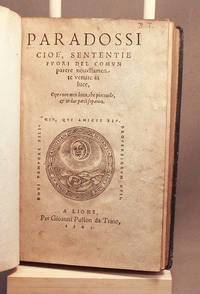
15436296Lyon: per Gioanni Pullon da Trino" i.e. Jean Pullon dit de Trin 1543. First edition. Very Good/Exquisitely rare first printing of Ortensio Lando's most famous book his first in a modern language that in later editions and in translations became a 16th-century best seller. Lando's name does not appear on the title page or anywhere in the book except in code. His real name shows up on no edition published in the 16th century. A dedicatory leaf after the colophon attributes the text to "M.O.L.M" interpreted generally as "Messer Ortensio Landi Milanese." More cryptically there is a phrase printed after the telos "SVISNETROH TABEDVL" mirror writing for "ludebat Hortensius" Ortensio has played. It is serious play. The Paradossi undertakes in the key of popular "world upside down" folklore to prove black what is commonly accepted as white. For instance it is better to be poor than rich better ugly than handsome better drunk than sober and so on. Biographical sketches of Lando are remarkable for how little information about him is available. Peer of Aretino and Doni friend to Etienne Dolet later incinerated for heresy he was a non-believer who nevertheless took Augustinian orders and later deserted them. Member of a prestigious literary club L'accademia degli elevati he was above all an outsider. All of his books landed on the Index of Prohibited Books and "I paradossi" in particular was widely banned and copies of it were confiscated. Probably the first book printed by the obscure Italian printer working in Lyon Giovanni Pullone da Trino later called "Jean Pullon de Trin". Following Pullon's modest press run the text was quickly taken up and reprinted badly by Bindoni and others in Venice twice in 1544 1545 1563 1594 etc. and translated into Latin into French by Charles Estienne 1553 and into English 1596. If you Google "Jean Pullon" you will get dozens of pages advertising pull-on jeans. . Octavo 17cm; 112 leaves signed A-O8. Printer's device on title page Ferraris 1 showing a human-faced moon in the sky reflected on the surface of the land. Bound in later 18th-century or 19th-century dark green leather in neoclassical style with gilt central losenge within gilt borders on both boards; gilt-tooled spine with leather title label. Joints reinforced but tender; light marginal stain along bottom edge; O7 torn and repaired remains of tape. Early marginalia trimmed close. Later c19 notes in French on endleaves. Pages not bright. All in all a very good copy of a very rare book. References: Ferraris "Giovanni Pullone e altri stampatori trinesi a Lione" in "Trino e l'arte tipografica nel XVI secolo." 2014 #1; USTC 116008 BM Italian 399; Grendler "Critics of the Italian World" #8; Gültlingen "Bibliographie des livres imprimés à Lyon." vol. X p. 7; Bongi "Catalogo delle opere di M. Ortensio Lando" p. xxxvi "eseguita in bel carattere rotonde cui la originalità e la bellezza danno il pregio sopre le ristampe"; not in Adams; not in Baudrier. per Gioanni Pullon da Trino" (i.e., Jean Pullon dit de Trin) hardcover books
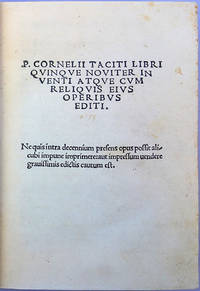
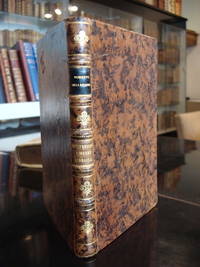
151742431Milan: Alessandro Minuziano 1517. <p>Tacitus Publius Cornelius ca. 56 - ca. 120 C.E. P. Cornelii Taciti libri quinque noviter in venti atque cum reliquis eius operibus editi. Small 4to. 20 233 3ff. Signatures H-K bound in reverse order in this copy. Milan: Ex officina Minutiana 1517. 192 x 127 mm. Full morocco tooled in gilt and blind in antique style. Occasional faint dampstaining but a fine copy. Engraved armorial bookplate of Count Dmitri Petrovich Boutourlin 1790-1849.</p> <p> First Minuziano Edition and the First Example of a Challenge to a Copyright. In 1508 Pope Leo X formerly Cardinal Giovanni de'Medici purchased the only surviving manuscript of the "lost" first six books of Tacitus's Annals which had earlier been stolen from the monastery of Corvey in Westphalia. Six year later Leo granted the Vatican librarian humanist Filippo Beroaldo the younger the exclusive right or privilegio to issue a printed edition the complete works of Tacitus including the previously unpublished "lost" books from the Corvey manuscript. Violators of the privilegio were threatened with excommunication. Beroaldo's Tacitus printed in Rome by Stephanus Guilleretus de Lotheringia was published in 1515.</p> <p> At the same time the Milanese printer Alessandro Minuziano undaunted by the fear of papal displeasure began preparing a word-for-word reprint of the Beroaldo Tacitus probably bribing one of Lotheringia's employees for sheets of the work as it was being printed. It is likely that Minuziano intended to issue his pirated edition around the same time as the legitimate one but the Pope got word of his scheme and the subsequent dispute over the privilegio forced Minuziano to suspend publication until the matter was resolved. The matter was serious especially as Leo X actively involved himself in issues of publication and censorship. The case was eventually resolved in Minuziano's favor and he added an appendix to the edition containing the key documents pertaining to the case. These included the papal privilege of November 14 1514 Minuziano's "supplication and prayers" to Leo X of March 30 1516 in which he defended himself remarkably by claiming ignorance of the Pope's privilegio and the papal letter of pardon dated September 7 1516 reiterating Minuziano's defense and granting Minuziano permission to publish his edition.</p> <p> This copy of the Minuziano Tacitus bears the bookplate of Dmitri Petrovich Boutourlin or Buturlin a Russian general statesman and military historian who became director of the Russian Imperial Public Library in 1843. A catalogue of Boutourlin's extensive private library was published in 1831.</p> . $12500 rebound by Sean Richards. Alessandro Minuziano unknown books