22 résultats
1688WRCLIT56757London: Impensis B. Griffin & Sam keble 1688. 82pp. Small quarto. Extracted from nonce pamphlet volume. Small loss at blank corner of title at gutter else very good and crisp. First London printing of this work by the Bishop of Winchester first printed in Strasburg in 1557. Lowndes alludes to this printing but describes it as a translation into English which of course it is not. WING P2804A. ESTC R10516. Impensis B. Griffin & Sam keble unknown books
16843938Amsterdam: Apud Henricum Wetstenium 1684. 2 parts in 1. 4852595;11218pp. Indices at end of each part. Added engraved title. Title-page printed in red & black. Cont. speckled calf some rubbing small chip at head of spine & label lacking but quite sound. Apud Henricum Wetstenium unknown books
1681001379Amsterdam: Apud Janssonio Waesbergios 1681. Full Calf. Very Good. 330 6 pp. 12mo with copper engraved title page by Giovanni Van Den Avele. Pharsalia is considered a masterpiece and possibly the masterpiece of the Silver Age of Ancient Roman poetry. The epic poem concerns the Roman Civil War at the time of Caesar and most particularly the extended struggle between Caesar and Pompey the Great. Lucanus writing a century later during the reign of Nero far from glamorizing the warfare took a jaundiced view of the fraticidal battle and his portrait of both Caesar and Pompey was far from flattering. His "epic poem" therefore is epic in terms of length scope and ambition not in its portrayal of the principals. Because of the subject matter the popularity of "Pharsalia" has crested at times when a society still steeped in the Classical canon of literature descended into civil strife when the themes and point-of-view of Lucanus really resonated. Never was this more the case than in the seventeenth century when this copy was printed. First there was the final emergence of the Netherlands from under the yoke of Habsburg rule and then there was the English Civil War just to mention two instances both highly germane to the edition at hand. Thus the notes by Grotius and Modern calf with a black spine label and marbled endpapers. The work is incomplete and breaks off during the tenth book which Lucanus was still working on when he was forced to commit suicide. The binding is tight. Some leaves with more toning than others but overall quite clean. There are leaves in which the margins are parlously tight or the header is even close to being partially cut-off -- this is the upshot of the compact size of the copy and was the way the copy was issued over three centuries ago. This particular edition is not mentioned in Brunet. <br/><br/> Apud Janssonio Waesbergios unknown books
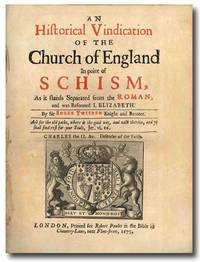
1675WRCLIT67247London: Printed for Robert Pawlet . 1675. 81982pp. Quarto. Extracted from binding. Title in red and black Royal Coat of Arms on title slight tanning and faint foxing R2-3 with clean tears in from foremargin no loss otherwise a very good copy. Third edition of one of Twysden's most widely read antiquarian works first published in 1657. It is a "detailed account of the increase of papal powers over England from the Saxons to the Reformation . arguing . that it was the Church of England rather than Rome which had held fast to the true faith. Twysden denied that the English church 'made a departure from the Church which is the ground and pillar of truth' p. 196. This temperate and urbane argument placed Twysden within the tradition of earlier apologists for the Church of England such as Richard Hooker and Thomas Fuller" - DNB. ESTC R15191. WING T3554. McALPIN III:717. Printed for Robert Pawlet ... unknown books
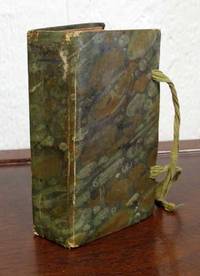
162926858Coloniæ Agrippinæ: Bernardi Gvalteri 1629. Later green marbled vellum boards with green cloth ties & title hand-inked to spine. Overall VG minor rubs to extremities. 4 504 66 pp. Printer's device to t.p. 12mo: 2 A - Z12 2A9. <br/><br/> Bernardi Gvalteri hardcover books
163769657Lugd. Batavorum Leiden: Elzevirios 1637. Hardcover. Very good. Presumed to be the first edition thus: Elzevier produced two editions in 1637; in this example pages 207 and 209 are erroneously numbered 107 and 109 which according to Willems #452 and others indicates the earliest printing. "Barclay's Euphormionis Lusinini Satyricon 1603-7 - a severe satire on the Jesuits the medical profession and contemporary scholarship education and literature - is modeled on the style of the Roman satirist Gaius Petronius Arbiter; it is an urbane and facile mixture of prose and verse. Filled with villians and rogues it contributed to the later development of the picaresque novel" EB. 717 p. with an engraved title page. 12mo. Period full vellum binding with holographic titles on the spine. Some minor soiling to the vellum; else very good. Elzevirios hardcover books
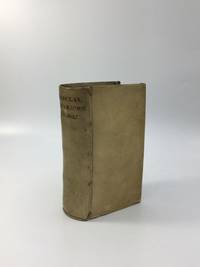
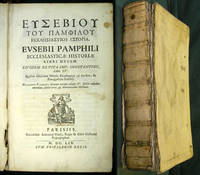
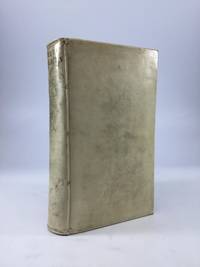
165926670Parisiis Paris: Excudebat Antonius Vitre 1659. First edition thus. Vellum blind stamped with device and rules raised bands. Spine curled and partially detached at the bottom boards soiled and worn front board endpaper first blank and half-title loose a few notations to title page and occasionally in text some light scattered foxing small chips to the lower corners of three leaves not affecting text otherwise quite clean. 4 48 14 665 12 320 7 pp. Engraved device on title page engraved initial letters and head pieces. Folio 33 cm. Title also in Greek: Eysebioy toy Pamfiloy Ekklesiastike istoria. Collation: a'4 e'4 i'4 o'4 u'4 aa4 ee2 4 4 A-Pppp4 Qqqq2 a-rr4 ss2 t1 Rrrr1. Folio. 14 3/8 x 9 inches. Double columns in Greek and Latin. Eusebius bishop of Caesarea b.260-70 and contemporary with Constantine the Great is rightly called the Father of Church History. "The position of Eusebius at the close of the period of persecution and in the opening of the period of the imperial establishment of Christianity and his employment of many ancient documents some of which have since been lost give these works a peculiar value" CE. The work was later added to by others including Socrates Sozomen Theodoret and Evagrius. The best and most important edition is that of Henri de Valois Valesius who published his first edition of the Greek text with a new Latin translation and with copious critical and explanatory notes at Paris in 1659 which also included Eusebius' Vita Constantini the remainder of the collection of the early Greek historians of the Church was published in two subsequent folio volumes ending in 1673. "For the elucidation of Eusebius' History we owe more to Valesius than to any other man. His edition of the text was an immense advance upon that of Stephanus and has formed the basis of all subsequent editions while his notes are a perfect storehouse of information from which all annotators of Eusebius have extensively drawn. Migne's edition Opera II 45-906 is a reprint of Valesius' edition of 1659" Schaff Post-Nicene Fathers 98. ABPC shows only one copy has come up at auction in the last 40 years at Quaritch in 1984. Institutional bookplate on the free front endpaper noting the book was a gift of Michael J. O'Farrell the first Bishop of the Diocese of Trenton with his bookplate on the half title. Brunet 1110. Excudebat Antonius Vitre hardcover books
169568499Lipsiae Leipzig: Thomas Fritsch 1695. Hardcover. Very good. Silius c.28-c.103 was consul in 68 and governor of the province of Asia in 69; he sought no further office but lived thereafter on his estates as a literary man and collector. He revered the work of Cicero whose Tusculan villa he owned and that of Virgil whose tomb at Naples he likewise owned and near which he lived. His epic Punica in 17 books on the second War with Carthage 218-202 BC draws heavily on Livy's account. Conceived as a contrast between two great nations and their supporting gods championed by the two great heroes Scipio and Hannibal his poem is written in pure Latin and smooth verse filled throughout with echoes of Virgil above all and other poets. Includes supplementary material by the German classicist Christoph Cellarius. 22 586 52. Frontispiece engraving with a title page decoration and six folding maps. 12mo. In a contemporary full vellum binding. Typical mild browning to the contents with a negligible spot to the top edge. Minor soiling to the vellum; otherwise very good. Thomas Fritsch hardcover books
16176779Basel: Ludovici Regis 1617. Later printing. Full pigskin. Very Good. Thick 8vo. 9694272pp. Indices. Printer's woodcut device on title. Orig. roll-tooled pigskin somewhat rubbed. Fore-edge clasps. Small hole at outer blank edge of title & next two leaves. The author's d. 1524 often reprinted work on numerous topics of ancient history. This edition has additions by L. Geoffroi and L. G. Giraldi and is edited by Johann Jakob Grasser. Ludovici Regis unknown books
166023678London: Printed by John Redmayne for Philip Chetwin 1660. 1st edition Abbott W. Bib. of O. Cromwell #1060; Halkett and Lang IV 107 attributing the work's publication to Fiennes; Wing W-1988. Period full calf. A Gd copy minor worming to spine/A2 partially detached lower portion/lower corner lacking from leaf E3 does not affect text. Occasional period marginal annotation. 6 112 pp 8vo: A4 -A1 presumed a blank B - 4U4 4X - 4Z2. <br/><br/>Whitelocke's account of the Committee deliberations in which Cromwell ultimately declined to assume the mantle of 'king'. Printed by John Redmayne for Philip Chetwin unknown books
16933937London: Printed for Jacob Tonson 1693. Folio 12-3/4" x 8-3/4". 2 parts in 1 each with a title-page. Each of the satires is preceded by its own half-title and followed by explanatory notes. Orig. speckled calf worn rebacked orig. brown morocco spine label laid back down. Repair to the fore-margin of the title affecting the ruled border and one letter. Tiny bookplate on front pastedown. The first edition of the John Dryden 1631-1700 translation. Wing J1288. Printed for Jacob Tonson unknown books
160927318Frankfurt Hanover & Hanover: Apud Andrea Wecheli heredes Claudium Marnium & Joann Aubrium; Parts 2 & 3 Typis Wechelianis apud Claudium Marnium & Heredes Joan. Aubrii 1609. First published 1591-94. 1 vols. Sm. 8vo. Three parts in one volume. Vellum. Some soiling and browning of vellum and text ties lacking else a very good copy with bookplate of Alfred Jerome Brown. First published 1591-94. 1 vols. Sm. 8vo. This work was ultimately completed in seven parts. <br/> 'The Polish-German physician was the personal physician to both Emperor Ferdinand and Maximilian II in Austria. He wrote several medical works and was a follower of the Galenic school of medicine. He was one of the first to study the contagiousness of certain diseases. "Sixteenth Century Books in the National Library of Medicine" 1077 for the 1591-94 edition; Osler 2387 & 2388 earlier editions Apud Andrea Wecheli heredes, Claudium Marnium & Joann Aubrium; [Parts 2 & 3] Typis Wechelianis, apud Claudium Marnium & Heredes unknown books
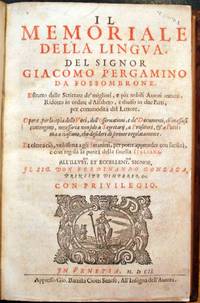
16024955Venice: Giovanni Battista Ciotti 1602. First edition. Leather. Very Good/The first methodical Italian dictionary based on literary examples il Memoriale della lingua appeared ten years before the Accademia della Crusca issued its famous dictionary. Gamba points out that Pergamino who was a friend of Tasso utilized examples that the Crusca missed such as Tasso's dialogues Guido Cavalcanti Ludovico Dolce and Gian Giorgio Trissino. The first edition is quite scarce absent from recent auction records with copies scattered in a few important libraries. Gamba himself saw only the second edition of 1617. A third edition appeared in 1656. Folio 31 cm; 12 524 395 i.e. 375 lacks two unnumbered leaves errata at end. Title page in red and black. Printer's device on title page and colophon. Text printed in two columns. Woodcut head pieces; initials. Rebacked in period style retaining eighteenth-century boards in flecked calf gilt with double fillets. Title page and colophon a little worn but contents generally clean and bright. Few marginal worm trails. Discrete 19th-century library blindstamp on title page colophon and few other leaves. Reference: Bruni & Evans 4042; Michel VI 97; Fontanini I80 "il primo Vocabolario pieno e metodico"; Gamba 2757 1617 ed.; Vinciana 3839 1656 ed. "uno dei migliori vocabolari italiani pubblicati prima della Crusca." Giovanni Battista Ciotti hardcover books
166527468London: Printed for the Authour and are to be sold by Robert Butler 1665. 1st edition Wing M-334A. Recent dark-brown full speckled calf binding executed in a period style with gilt spine lettering. Binding - Fine. Text block - VG usual browning to paper/top edge occasionally closely trimmed infrequently affecting running title/faint prior owner blindstamp to preliminary blank. 10 132 pp. T.p. printed in red & black. Headpiece. Decorative initial capital letter to p. 1. 8vo: A - I8. 6-5/8" x 4-1/4" <br/><br/>Fairly scarce work by this divine author attribution from Wing- OCLC lists only microform copies & none at auction these last 30 years. . Printed for the Authour, and are to be sold by Robert Butler unknown books
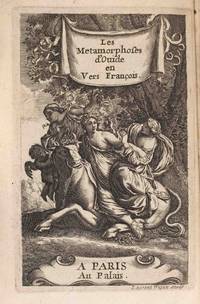
16691149Paris: Claude Barin 1669. <br/><br/>Corneille Thomas 1625 1709 translator. Ovid 43 B.C. 17 or 18 A.D. Les metamorphoses d'Ovide Traduites en vers Francois par T. Corneille. Paris: Claude Barin 1669. Original edition of the first two books of Ovid translated by Thomas Corneille. The full translation was not published until 1697. <br/><br/>12mo. Contemporary calf gilt spine with raised bands. Rubbed. Leaf with engraving on verso; leaf of title verso blank; 8pp. ded. to La Dauphin signed T. Corneille; 4pp. Av lecteur; 234pp. text with one engraving for book II on I viverso; 12pp. priv. dated 12 Aout 1668/31 Jan 1669. Collation: 1 a6 A-T6 V3 . STC French 1601-1700 O-236. An elegant edition with beautiful typography and ornamentation. <br/><br/>Thomas Corneille 1625-1709: playwright poet. To distinguish himself from his brother Pierre Corneille Thomas was known as “Monsieur Corneille.†He was one of the leading authors who began to produce plays during the Fronde and brought out even more plays than his brother Pierre: thirty-eight plays composed alone or in collaboration. His first tragedy Timocrate 1656 helped to restore the genre to popularity after the troubles of the Fronde. Although he was more attractive in manner and in conversation than Pierre he lacked Pierre's genius. Still "with Quinault he filled the interval in the history of the French drama between the zenith of Pierre Corneille and the advent of Racine" Harvey and Haseltine. <br/><br/>Although not as important a playwright as his brother Thomas wrote with great facility. He is credited with perfecting the French language as can be evidenced by this translation of Ovid begun shortly after he left school his notes to Claude Favre Vaugelas Remarques su la langue Francais 1647 his compilation of a dictionary of arts and sciences for the Academie Francaise 1694 and his editorship of Mercure galant with Donneau de Vise. <br/><br/>The artist of the two engravings fronting the books is the son of Hermann Weyen or Weyher Laurent Weyen 1643-1672 a Flemish engraver who died in Paris. Laurent also engraved illustrations for the works of Moliere. <br/><br/>Provenance: Goodspeed's Bookshop/Arthur and Charlotte Vershbow. Claude Barin hardcover books
1609WB17560London: Print. for Math. Lownes 1609. Hardcover. Very Good. 2 parts in one volume folio 286 x 188mm. Pagination: 8 1-7 1-204pp. i. e. 208; 1-218pp. 2 with final blank. Signatures: A4 3 frontis. B-R6 S5 Cc4 B-V6 some signatures missigned. Engraved title of architectonic frame pair of Roman soldiers and at top portrait of Henry Frederick Prince of Wales; through the arch a military camp on either side of a river with shore in the foreground and hills in the background Imprint details are an after addition. Full-page woodcut oval portrait frontispiece of Julius Caesar wearing laurel wreath inscribed Ivlivs Caesar Dictator Perpetvvs Veni Vidi Vici Aestatis Svae 56 present and bound in before the note to the Reader A1. 12 engraved plates of various battles military formations and encampments of Caesars Roman army including Battles with the Helvetii Ilerda and the Gallic wars one labeled Cicero Besieged all but 2 double-page or folding. Woodcut engraved chapter head and tailpieces. Dedicated to the soldier Sir Francis Vere d. 1609. Verses by William Camden Joshua Sylvester Samuel Daniel and Ben Jonson. Contemporary calf gilt scrolling arabesque centerpiece on covers manuscript binders waste remnants in front hinge; extremities somewhat rubbed spine chipped at top and missing bottom compartment lacking ties and front endpapers; light marginal dampstaining some folding plates closely cropped some marginal fraying of title and two preliminaries small crack in inner portion of plate facing p. 86 in the first part later marginal note in ink on p. 190 in second part; overall a solid copy with all plates present. Later signature of Rebecca Ayre on title verso; a person seemingly untraceable it is notable at least this name suggests female ownership over some point in the life of the volume. <br/><br/>First published in 1600 in London by Peter Short dwelling on Bredstreet hill at the signe of the Starre two new editions of the Observations upon Caesars Commentaries appeared in 1604 one issued for Mathew Lownes and one for William Ponsonby and again three more editions appeared in 1609 two are linked to the printers office of Mathew Lownes ESTC S121465 as here and ESTC S91812 and the third ESTC S121472 indicates no publisher. All of the 1609 issues have variations in the titles and imprints as common. Mathew Lownes was a prominent bookseller in London at the Bishops-head in Pauls Church-yard from at least 1595 to 1625; Lowness activity is associated with several important publications on Roman imperial history between 1604 and 1623 which likely put him into the milieu of the author Sir Clement Edmondes d. 1622 who was by 1600 also an influential government official in the House of Commons and City of London. Edmondes wrote his observations on Caesars Commentaries the Gallic and Civil Wars to propagate the ways he believed ancient Roman military tactics might aid contemporary warfare. ODNB and larger scholarship notes that Edmondes carefully molded his remarks and included additional subjective material which was later seen as an attempt to influence the readers experience. This is an important publication thus for exemplifying the intent of some Roman histories written in the early Stuart years. It was popularly received in his time and Edmondes believed his efforts to draw out the true heroism of an ancient republic would help among other ideas the question of how to deal with an invasion of England. ESTC S121465. Print. for Math. Lownes hardcover books
164724501London: Printed by M. S. for H. Blunden at the Castle in Corne-hill 1647. 1st Edition variant issue Wing B-3408A. Another issue of the same year has the printer's name "Matth. Simmons. in the yeare 1647". Period full leather with modern rebacking to style. Red morocco title label in second spine compartment. Modern eps. An overall VG copy text paper beginning to brown at edges with some associated chipping/repaired hole to lower right quarter of E2 affects last few words of two lines on p 25 and first few words of four lines on page 26/occasional po marginal pencil annotation a/o check mark. 18 155 7 28 4 pp. Separate t.p. for "Clavis". Last 4 pp: 2 pp 'Catalogue of Bookes' viz. bibliographical list by Behmen 1 pp of "Faults Escaped in Printing" & a blank. Inserted table & plate imperfect lacking 'folded' left side approx. 1 - 1.5". 4to: ¢4 -¢1 a half-title a2 a3 B1 A4 -A1 C - 2B4 2C2. <br/><br/>Bohme a German philosophical mystic who had a profound influence on such later intellectual movements as idealism and Romanticism. Born of poor parents in Goerlitz Germany as a boy he tended cattle later becoming a shoemaker marrying & fathering 4 children. Boehme at the robust age of 37 in 1612 wrote his first treatise Aurora oder Die Morgenroete in Aufgang. In 1613 an unauthorized copy of the manuscript was copied and circulated by Karl von Ender. Its reception "raised him out of his homely sphere and made him the centre of a local circle of liberal thinkers considerably above him in station and culture." However the local pastor primarius of Gorlitz Gregorius Richter leveled a charge of heresy. The local muncipal council administered an admonishment to no further "meddle in such matters." This charge Boehme publicly followed for 5 years. In 1618 Boehme again started writing expository & polemical treatises. The majority of his works were written though not formally published from 1619 - 1624. A second major work Der Weg zu Christo was published in 1624 and signaled a renewal of clerical hostility. Boehem however was destined to suffer but a short period of this second persecution; he died of an illness on 17 November 1624. Boehme has been said to have a "fertility of ideas" and a "trasncendent greatness of religious insight." Boehme was studied by Sir Isaac Newton and influenced the work Henry More as well as and especially William Law 1686 - 1761. Xl Questions concerning the Soule was translated by the English mystic John Sparrow in collaboration with John Ellstone & financed by Humphrey Blunden. This the first of several works by Boehme that Sparrow & Ellstone were to translate into English between 1644 - 1662. Boehme proved to be highly popular in England where there were regular societies of Behmenists at the time. This work XL Questions went into a second edition in 1648 and a third edition in 1665. 11th EB. A scarce title in the Boehme canon. We find no copies currently offered via the major on-line databases OCLC records but 4 institional cc and the work has only appeared at auction 3 times in the last 25 years the last in 1989. Printed by M. S. for H. Blunden, at the Castle in Corne-hill hardcover books
169619590Lugduni Batavorum: Hackium Boutesteyn Vivie Vander AA & Lucthmans 1696. Two volumes bound in one of this first collected edition of Giraldi's works; 20 772 26 928 30 pages Index Rerum et Verborum 1 page Catalogus Amicorum Lilii Quorum Meminit in epistola Direptionis Urbanae.; paginated in two columns except for the 'Varia' section; collated complete; text printed double-column; engraved illustrated frontispiece 7 full page and 2 double-page plates beautifully accomplished by Avele after Botard superb engravers' work with full and lively compositions realistically posed and drawn with action; title page with publishers' woodcut ornament and printed in red and black; the text with title and endpiece ornamentation and initial ornamentation as well nicely printed and with good wide margins; 11th ed. Britannica cites Giraldi Giglio Gregorio Lilius Gregorius Gyraldus 1470-1552 Italian scholar and poet born at Ferrara ".where he early distinguished himself by his talents and acquirements. he removed to Naples hwere he lived on familiar terms with Jovianus Pontanus and Sannazaro; and subsequently to Lombardy where he enjoyed the favour of the Mirandola family. At Miland in 1507 he studied Greek under Chalcondylas; and shortly afterwards at Modena he became tutor to Ercole afterwards Cardinal Rangone. About the year 1514 he removed to Rome where under Clement VII he held the office of apostolic protonotary; but having in the sack of that city 1527 which almost coincided with the death of his patron Cardinal Rangone lost all his property he returned in poverty once more to Mirandola whence again he was driven by the troubles consequent on the assassination of the reigning prince in 1533. The rest of his life was one long struggle with ill-health poverty and neglect; and he is alluded to with sorrowful regret by Montaigne in one of his Essais i. 34 as having like Sebastian Castalio ended his days in utter destitution. He died at Ferrara.a man of very extensive erudition; and numerous testimonies to his profundity and accuracy have been given both by contemporary and by later scholars. His Historia. marked a distinctly forward step in the systematic study of classical mythology; and by his treatises De Annis et Mensibus and on the Calendarium. he contributed to bring about the reform of the calendar which was ultimately effected by Pope Gregory XIII.Giraldi was also an elegant Latin poet."; approximately 15" tall by 10"; bound in full probably contemporary leather; seven raised spine bands gilt floral roll tool rectangles with fruit & leafy spray devices at corner of inner box surrounding a heavily-impressed and complex gilt central device with heroic figure surrounded by winged angel figures & cherubs figure holding a spear and a book shield below with cross device and the motto Sic Itur Ad Astra onward to the heavens; all edges tinted red; spine leather covering 1/3 gone very charred and worn; both boards still attached and the binding firm; first leaves a bit maladjusted at the inner margin from the heaviness of the binding pulling at them; text block with some spotting and darkening section at back with old bit of creasing at top corners; nevertheless mostly very fresh and clean free from markings or wear; in good condition and worthy of a rebacking or rebinding. First Edition. Leather Binding. Good. Hackium, Boutesteyn, Vivie, Vander AA, & Lucthmans books
167535334London: William and John Leake 1675. Two parts in one 8vo. 28 148; 16 159 1pp. Contemporary mottled calf covers ruled in blind rebacked to style flat spine ruled in blind red morocco lettering piece<br/> <br/>Provenance: F. H. early initials on the title<br/> <br/>The final edition complete with both parts of among the most influential English gardening books of the 17th century.<br/> <br/>"Sir Hugh Platt 1552-1608 held by Richard Weston to be 'the most ingenious husbandman of the age he lived in' . devoted his life to literary work and to the study of husbandry and gardening. He was also interested in all kinds of inventions and experiments and in consideration of his services in this field was knighted by James I on 22 May 1605 . His work on gardening entitled Floraes paradise . appeared in 1608 the year of his death . He wrote his book from his own practical experience as well as from information supplied to him by other gardeners . Floraes paradise continued to be published after the author's death but with the new title of The Garden of Eden and edited by Charles Bellingham . In 1660 was issued The second part of The Garden of Eden . Readers who questioned the authenticity of this work were invited to 'see the original manuscript under the authors own hand.'" Henrey. Styled on the title as the sixth edition it is the second combined edition of both parts and the final edition published in the 17th century. The second part includes its own title and pagination.<br/> <br/>Fussell pp.15-16; Henrey 299; Hunt 340; Wing P2388; ESTC R31801. William and John Leake unknown books
1636D6036Rome: Typis S. Cong de propag: Fide 1636. Hardcover. Very Good. 4to 230 x 170mm. xxiv 338pp. ii. Illustrated throughout with woodcut tables and charts of Egyptian characters and hieroglyphs. Contemporary vellum; intermittently browned occasional spots. <br/><br/>Father Athanasius Kircher was a 17th-century German Jesuit scholar and polymath who published around 40 works most notably in the fields of oriental studies geology and medicine. He was heralded as possessing the secret of deciphering hieroglyphics and was widely regarded as the physical embodiment of all the learning of his age. He had over 760 correspondents including scientists Jesuit missionaries and world potentates and wrote about an enormous range of interests ranging from optics to music from Egyptology to magnetism. Perhaps best known of his correspondents is Jan Marek Marci of Kronland 1595-1667 for sending Kircher a mysterious illustrated manuscript written in an unknown script famously known today as the Voynich Manuscript. In 1635 Kircher began to write his book Prodromus Coptus Introduction to Coptic Language and in the autumn of 1636 the book was printed. Kircher saw the ancient languages as an essential foundation for any pious philosophy. Kircher envisioned Rome as a unique center within to unlock the mysteries of Hermetic knowledge inscribed on the obelisks. The project of restoring Egyptian wisdom entailed nothing less than an effort to renovate the lost arts of communication that linked divine and human languages. Unfortunately while in other disciplines he made valuable discoveries his explanation of hieroglyphs was absolutely incorrect. We can probably explain it by his passion that might have sometimes blinded his reasoning. Yet Kirchers Prodomus remains an important study from a most respected scholar. Brunet III 668; Caillet II 5790. Typis S. Cong de propag: Fide hardcover books
16711002105London: E.T. and R.H. for H. Brome B. Tooke and T. Sawbridge 1671. First edition in English of the complete Colloquia Familiaria of Erasmus first published in 1518 and expanded by Erasmus over the next fifteen years a lively collection of Latin dialogues that found a readership far beyond the Renaissance schoolroom. Originally intended to model colloquial conversation for students of Latin the dialogues feature pointed free-thinking exchanges on modern political religious and philosophical questions. In "Of the Abbot and Learned Woman" an ignorant abbot tries and fails to get the better of the classically educated Magdalia a character almost certainly based on Thomas More's eldest daughter: "I think thou art some sophistress thou protest so wittily." Magdalia: "I will not tell thee what I think thou art." And later: "I have often heard it usually spoken that a wise woman is twice a fool." Magdalia: "Indeed it useth to be said so but by fools." The Colloquia Familiaria was widely read and debated across Europe drawing immediate notice for its anticlerical satire: "its influence on the dialogues of Reformation Germany and Tudor England is a critical commonplace" Zlatar Reformation Fictions 11. The original purpose of the Colloquies as a text for teaching Latin postponed its direct translation; this first complete English edition was published more than 150 years after the work's first appearance. The edition opens with a short life of Erasmus and concludes with the first appearance in English of De utilitate colloquiorum Erasmus's 1526 defense of the Colloquies published after the Sorbonne condemned the book for impiety. In response Erasmus makes a case for the educational value of his dialogues' humor: "I cannot tell whether any thing be learned more successfully than that which is learned in playing." Despite his efforts the Colloquies would remain on the Papal Index of banned books through the end of the nineteenth century. Wing E-3190; PMM 53. A very good copy of a humanist landmark in a handsome contemporary binding. Octavo measuring 6.5 x 4.25 inches: 8 555 1. Contemporary Cambridge-style full speckled calf boards ruled and ornamented in blind raised bands red morocco spine label lettered and decorated in gilt top edge stained black. Engraved frontispiece portrait of Erasmus. Final leaf containing second page of bookseller catalogue excised. Joints and spine head expertly repaired; evidence of bookplate removal on front pastedown; effaced signature on title page; some running titles shaved. E.T. and R.H. for H. Brome, B. Tooke, and T. Sawbridge unknown books
16113462Latin manuscript on vellum with large 6 in diameter suspended black wax seal of James I of England and autograph of Anne of Denmark dated July 23 1610 granting title to Corrodownan Manor in County Cavan Ulster to one John Browne Gent. of Gorgiemill near Edinburgh and his descendants during the Plantation i.e. colonization of Ulster under James I beginning in 1609. The colonists were settled on land confiscated from the Irish inhabitants following the conquest of Ulster 1594-1603 under James's predecessor Elizabeth I. The Plantation was intended to consolidate royal control of Ulster and repress rebellion by importing a substantial Protestant population. Like John Browne and indeed James himself many of the new colonists were Scottish. Some of these families went on to form the backbone of the Protestant Ascendancy in the province. John Browne and his heirs however were not among them. Sir George Carew sent by the king in 1611 to report on the progress of the Plantation noted that "he Browne . sent an agent who took possession set the lands to the Irish returned to Scotland and . performed nothing." The land was sold in 1613 to another Scottish colonist Archibald Acheson. Acheson's descendants were raised to the peerage of Ireland in 1806 as Earls of Gosford and still owned the property in the late nineteenth century. The first nineteen lines of the document grant the Scottish Browne the rights and privileges of James's English and Irish citizens. Especially notable are the requirement that the grantee maintain an adequate supply of arms for defense against the king's enemies lines 77-80 the attempt to encourage the growth of towns 74-76 and the ban on sale of the property to "mere Irish" or to anyone who failed to acknowledge the sovereign as head of the church thus excluding all Catholics by swearing the Oath of Supremacy 114-121. See Rev. George Hill The Conquest of Ireland. An Historical Account of the Plantation of Ulster at the Commencement of the Seventeenth Century 1608-1620 Belfast 1877 308; idem Plantation Papers. Containing a Summary Sketch of the Great Ulster Plantation in the Year 1610 Belfast 1889 188-190; F.J. McCaughey Arvagh. Sources for a Local History Arvagh 1998 16.; Moiré chemise lined with exact recess for seal housed in handsome ruled red morocco clamshell case with gilt title to front cover and raised bands gilt particulars and decoration to spine; gilt rolled edges. Two leaves 65 x 81 cm; the first illuminated with a portrait of the king. Stain to upper left see image.; 65 x 81 cm; 1 pages; Signed by Notable Personage Related; All shipments through USPS insured Priority Mail. . hardcover books