[California Gold Rush]Biblio.com
307 résultats
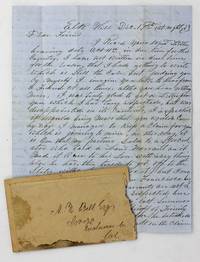
18534788Elk Hill Ca: December 17 1853. Very good. 3pp. on a folded folio sheet. Old folds light wear and soiling. With original mailing envelope. An informative letter sent from a miner in Gold Rush-era California to a friend in Tuolumne County primarily concerning a mining claim but also providing many interesting local details. The author writes "I managed to keep a claim for you which is joining to mine in this way it is one that my partner sold to a speculator who laid a land warrant on it." He discusses the process of the land warrants and how he made the man title the claim properly in San Francisco. "This claim was jumped last summer by W.H. Dixon first sheriff of Trinity City who died the day before he intended to occupy the house he built on the claim. He shot himself accidentally and never spoke." The author immediately stepped in and nabbed it for his friend but it was short-lived. "The claim is cheap at $2000 as soon as I made it known that I should not administer it was jumped by 3 in one day before 9 o'clock. So much for your not coming as I told you I could not keep them off any longer and you would not come if I had." He further mentions that he is digging potatoes which he deems the finest in the world discusses issues with the crop and further talks about new arrivals in the area. December 17 unknown
18522473San Francisco: October 4 1852. Very good. 2pp. with integral address leaf. Old folds mild staining and soiling three-inch closed tear to address leaf. An interesting letter documenting the family side of the California Gold Rush in which a San Francisco man writes to his brother offering to send his wife and daughters to Placerville as helpers. Interestingly at first Phillips addresses the letter to his brother in Ohio then scratches it out and writes in "Cal;" this most likely indicates the Phillipses hailed from Ohio and trekked to California along with scores of others in hopes of untold riches in the California gold fields. In his letter Phillips writes that his wife who has long been in San Francisco looking after a sick friend can now leave as he is better "And if you think best she will come up with the little girls and fix your carpets and superintend your affairs for a month or two untill your wife comes." The formerly sick friend Mr. Gardner could also accompany them apparently as "He is coming up to P. and he wants you to give him work for a short time. Mr. G. is a good sailsman sic having been in the dry goods business." While not overtly concerned with gold mining the correspondence is nevertheless interesting for providing details on family routines during the Gold Rush era when numerous families uprooted their lives and moved not only to places like San Francisco and Placerville but between such locations during the years of speculation. A nice example of history from below particularly notable for its domestic implications during the time of the great California Gold Rush. October 4 unknown
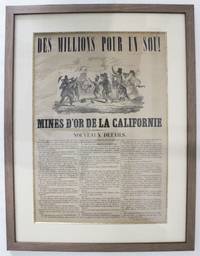
18495043Paris: Typ. Schneider Rue d'Erfurth 1 1849. Very good. Broadside approximately 18 x 13 inches. Matted and framed. A pair of short closed tears repaired at lower edge. Even toning and light creasing. Contemporary manuscript annotation under caption title. A wonderful illustrated faux news broadside published in Paris as gold fever coursed through Europe in 1849. The headline promises "nouveaux détails" of the gold mines in California but the text is in fact a humorous description and light-hearted admonishment of the multitudes thoughtlessly giving up their livelihoods for the hardscrabble life of a gold digger in the California wilderness. The first section runs through a litany of types who are abandoning their lives for adventure and advises them not to consider the difficulties of the journey:<br /> <br /> "En route pour les mines d'or de la Californie! Partez! Il n'est pas néccessaire que vous preniez de lourds baggages : une cassette et une bonne pioche vous suffriont. Ne vous laissez pas décourager par la peur d'une navigation de cinq mois. elle sera peut-être périlleuse. mais le résultat est si consolant : de l'or!. toujours de l'or!. Qu'importent la colique et les fièvres doublées d'un mal de mer brutal. de l'or!. toujours de l'or!. Qu'importe d'être noir ou jaune en mourant du moment qu'on se repose dans un linceul d'or pour l'éternité! Partez!"<br /> <br /> The remainder of the text somewhat sardonically describes life in California and warns prospective travelers not long for the comforts of home but rather to concentrate on their sought-after riches:<br /> <br /> "Par example ne vous attendez pas à jouir de toutes les douceurs de la vie. Vous n'y trouverez ni biftecks au beurre d'anchois ni dinde truffées; car les aliments y sont rares. Mais les racines y sont en grande abondance. Vous vivrez un peu à la manière des anachorètes pour un temps. seulement vous déterrerez de l'or. ce qu'ils ne faisaient pas que l'on sache."<br /> <br /> The illustration which occupies approximately the top third of the broadside depicts men and women from all walks of life carrying pickaxes on their shoulders and racing for a ship about to depart. The image carries the printed signature of "B. Netter;" a contemporary manuscript note under the caption identifies the publication date as February 17 1849. The Bibliothèque Nationale de France estimates that as many as 40000 French men and women made their way to California between 1848 and 1856. The present broadside is an excellent document of California gold fever in France and the pervasive interest in gold rush news in Europe during the mid-19th century. Rare we locate just four copies at Berkeley UCSD California Historical Society and the BNF. Typ. Schneider, Rue d'Erfurth, 1 unknown
189553540Chicago & New York: Rand McNally & Co. 1895. 8vo. 333 1 pp. Red linen decorated & lettered in gilt on front cover gilt lettering on spine t.e.g. minor rubbing minor soiling to spine slightly cocked still VG- copy. First American edition of this curious Henty title first published in book form in England by Chatto & Windus 1894 of this curious mystery of mystery and kidnapping of one of two twin girls used to inflict pain upon the father and the twin sister. The mystery is resolved by the young hero in the last half of the book in the gold camps above Sacramento CA. Rand, McNally & Co., unknown
1850List1929California 1850. With thirteen letters most multi-page written from Monterey in 1850 a 7 pp facsimile transcription of a 1834 Mexican land grant on cloth measuring 11 x 14 inches and and eleven page document on paper in Spanish relating to a Monterey land grant transcribing an 1841 document. Letters heavily worn with some loss at margins but mostly legible land grant in good to very good condition transcribed document in Spanish in fair condition with water damage to margins. Fair. An interesting archive of 1850s-era material relating to the life and career of the surveyor Edward Williams which recently surfaced in the central mother lode region. The group includes his personal letters from the California Gold Rush as well as well two interesting documents form his work for the Surveyor General J.W. Mandeville in 1858 where he transcribed two Mexican land grants. <br /> <br /> Lt. Edward Williams was a member of Company E New York Volunteers under Capt. Nelson Taylor. He came to California around 1847 and found employment as a deputy surveyor later working for the Office of the Surveyor General of the Unites States for California. In 1858 Surveyor General J.W. Mandeville commissioned a report on Mexican-era California Land Grants. Mandeville had Williams copy the original documents exactly - inclusive of an ink copy on linen that is an "exact tracing" of the original documents starting with 1834 up through about 1840. These "copies" were submitted to the Surveyor General in 1858 for use in the report. Williams continued the title work by copying other documents from about 1841 though this time not as a tracing but hand copied on the usual blue paper of the 1850s.<br /> <br /> The documents illustrate the length officials went to while they investigated Mexican Land Grant titles to California properties in the 1850s. The process was difficult and involved two distinctly separate cultures and legal systems that clearly conflicted. The Mexican Government granted rights for these large land parcels in California to various people but clearly stated they could not sell parts of the property. The wording was used many times in litigation of the period in both defense of the land grants and in opposition to how the land grants were handled. The issues were actually quite simple in that the Mexican legal standards for land grants was far different from those in the United States and the two differing forms of written land ownership and use clashed. <br /> <br /> These documents reflect a parcel of land granted to Francisco Mesa at "Corral de Tierra" a large parcel in Monterrey County California. Mesa had requested land for "his personal use and that of his family." In the Grant the title papers reflect "while the land is under Francisco's possession it cannot be divided mortgaged or a levy placed on it nor handed down." These original documents help illustrate the complex story of Mexican Land Grants in California. <br /> <br /> Also included are thirteen letters from Ed aka "Ned" to various family members primarily his mother and sister Alice and vice versa. About half are from Ed the other half are written to him. The dates of the letters are; 1850: February 10th April 15th April 16th April 28th June 10th July 30th October 11th and November 17th and 1851: September 9th. One undated letter with heavy loss is written from Panama. The letters are generally readable but the condition far from perfect with water stains throughout and chips abundant along edges and significant textual loss. The letters are generally at least two pages sometimes four or more inclusive of writing in the crossed line custom to save paper. Most are datelined at Monterrey where he discusses the people the customs setting and more. <br /> <br /> Despite the condition flaws there is much to be gleaned from his correspondence. In his April 15 1850 letter . he describes his trip to San Juan Bautista from Monterrey in detail while he was on his way to San Francisco. Williams writes of his great pleasure on tasting cooked beef by the Indians that he found was the best he ever tasted as they camped on the way to San Jose with the ultimate goal Mission Dolores in San Francisco: “this the beef they put on the embers of the fire and broiled it - I never tasted anything like it before so tender so juicy…†One of his first notes on San Francisco: "There are regular streets filled with all kinds of sorts of stores… The shipping covers the water as far as you can see. And those nearest the shore are converted into store houses the rigging being taken down and the and holes cut in the sides for doors.The best houses in town are occupied by gamblers . a large saloon filled with tables on which are played all kinds of games of chance - at some of the tables are displayed immense amounts of coin and gold in lumps worth from 1 to 5000 dollars which some poor infatuated fool of a miner has at some time lost to them."<br /> In his letter of April 16th he discusses both his difficulties with women in California and his lack of fitting in back east: “The Spanish Girls are very nice and all that sort of thing but the trouble is to find one that is educated. I can’t bear an uneducated wom an and I think I shall have to come to N.Y. and bring one out here… I know one or two in N.Y. but I don’t believe they would have such an uncouth specimen of an ‘hombre’ as me…†In his next letter he describes Carmel in detail. He states: “I haven’t been to the mines nor have I any inclination to go†though he intends to settle in California permanently. In his next letter he discusses the people he’s met and how he detests the anglophone community there: “How do I like the People Those of Spanish whom I call my friends I love with all my soul - there is not much society except among them… the Eng. and Am. population I detest from the bottom of my heart. This may sound strange but you will know the por que when you arrive.†He then praises the climate and scenery of Monterey. One letter written from Panama which has unfortunately sustained heavy losses at margins offers some details of the trip on the Chagres River. The replies to Williams from his family offer details on life in New York and are similarly compromised in condition but overall there is enough to glean from the group to provide a detailed example of family correspondence from the period. <br /> <br /> Overall a very interesting and unusual archive of a young professional who moved to California during the Gold Rush period and rejected the Anglophone mining community with particular interest to historians of Monterey and of the systems of land grants that shaped Mexican and American land policy in the nineteenth century. unknown
18553206Coyoteville: September 12 1855. Very good. 2pp. plus integral blank. Original mailing folds moderate toning staining and ink spotting but still easily readable. Bottom fourth of integral blank excised. An informative Gold Rush letter about mining in the long-vanished ghost town of Coyoteville which was an extraordinarily rich gold area for a couple of years in the early 1850s. A noted tunneling method nicknamed "coyoteing" was developed in the town and subsequently inspired the name of the town. In the present letter Moses Pine writes to "Catherine" in Branch County Michigan and signs his name simply as "Mose Esq" at the conclusion. The author informs Catherine presumably his wife or sister of his activities some of the economic realities and some of the practical details of prospecting for gold in California. Presuming that "it would be impossible for the whole of Branch County to raise $10 unless they sell a horse" Pine comments that he had ginger bread on the Fourth of July after working all day and yielding a "half Ounce Gold Dust." He then provides a detailed description of his mining: "I am now tunneling in a hill. We are 150 feet under the ground. Day before yesterday we got small respect 25 cents to the pan for the first and the bed rock pitching. I think we will find good pay in the going 100 feet further the expense is heavy as we have to blast and timber the tunnel." Pine also talks of his health and that "I work hard every day do my cooking and baking." He then expresses his hope to get back to Michigan to "rest a few months" but knows nothing of other Michigan folks in California: "Have not seen nor heard anything of them in a year. I guess they have all gone home with a fortune in a horn. Well good luck to the lucky. Old Mose will come home after a while with a pretty hat on." A nicely-detailed letter from an unusual and obscure Gold Rush location. September 12 unknown
18555504Live Oak City Ca: January 27 1855. Still very good. 4pp. on a bifolium. Previously folded with manuscript docketing on lower half of second leaf verso. Minor wear along old folds with a couple of short separations. Minor soiling and dampstaining somewhat heavier to addressed area. A detailed mid-1850s California Gold Rush letter from Elias Hunt Jr. to his brother in the tiny of Poolville New York southeast of Hamilton. Hunt was camped in Live Oak north of Yuba City when he wrote this letter home on January 27th 1855. He tells his brother that he has good claims but that a lack of rain has not allowed him to work them:<br /> <br /> "It is hard for a man to get along. I am stopping here in hopes there will be some rain soon so that I can work my claims. I have some very good ones 2 only 200 feet square each. I could make some money if I had water. I have been offered $500 dollars for them but I refused it -- I think I can make an ounce per day; I know that I can make ten dollars for I have done that before."<br /> <br /> There is talk of irrigating the area but Hunt is not sure that it will be finished before he wants to return east:<br /> <br /> "There is a ditch coming in here to suply sic the place with water but it will not be completed until Spring some time in April & I should like to come home in June. I shall stay until there is water in the ditch then I can wash a part of my claims & sell the rest to a good advantage for they are situated immediately on the line of the ditch."<br /> <br /> Continuing upon his plans to return he writes:<br /> <br /> "I have had a very good offer to come home across the plains by a man in Sacramento. He is from Utica; his name is Hamilton. He is going to cross with four hundred Spanish horses or mares. He has offered me good money to come with him as I have been over to Carson Valley this last season. It will take some sixty days to do it if I should get through with my claims by the time time that he gets ready to start. I think I shall come with him if the Indians are not to hosstille sic. They were very bad this last season; they got possession of one of Uncle Sam's forts."<br /> <br /> Hunt continues writing about local hunting prospects and family in New York before delivering a Crockett-esque farewell -- "Please give my respects to all may inquire for me & let the rest go to Hell for all that I care." A good letter from one of the less trafficked areas of the California Gold Rush. January 27 unknown
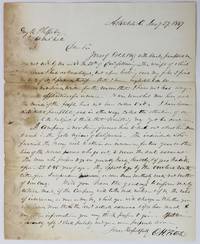
18492389Ashtabula Oh: January 29 1849. About very good. 1pp. on a bifolium. Previously folded. Light dampstaining and short closed tears along gutter somewhat affecting first few lines of text but not overall sense. An interesting letter from O.H. Field an aspirational field representative of the Connecticut Mutual Life Insurance Company in Ashtabula Ohio to the company secretary George R. Phelps inquiring about a policy for a group of men headed to the Gold Rush in California in January 1849. Connecticut Mutual was founded in Hartford three years prior to the composition of this letter in 1846. Fitch's missive begins with a report on his efforts to drum up interest in life insurance in his area with pamphlets and other materials sent to him by Phelps: <br /> <br /> "Yours of Oct 1 1849 with blanks pamphlets &c was not received by me until the 25th of Dec. following. I have not had any definitive applications for insurance. It was somewhat new here and the minds of the people had not been called to it. I have however distributed pamphlets and in other ways called the attention of our citizens to the subject. I think that something yet might be done.<br /> <br /> The letter goes on to describe a potential policy for a group soon leaving for the Gold Rush and requests a favorable rate in order to stimulate interest in policies from additional parties: <br /> <br /> "A company is now being formed to head out about ten men to work in the gold regions of California. The individuals who furnish the money wish to obtain an insurance for two years on the lives of the several persons who go out to secure the amount advanced. The men who propose to go are generally hardy healthy & of good habits & from 25 to 45 years of age. They expect to go by the overland route either from Independence Missouri or some more southerly route not south of Vera Cruz. Will you have the goodness to inform me by return mail if the company will take such risks -- & if so the rates of insurance as near as may be which you will charge -- whether you will insure more than the amt. actually advanced & if so how much & any other information you may think proper to give. If I receive a favorably sic reply I shall probably send you more proposals soon."<br /> <br /> A neat letter concerning the preparations and considerations necessary for a journey to California in the early days of the Gold Rush and the role and rise of early American insurance companies in the planning of such lengthy and dangerous overland travel. January 29 unknown
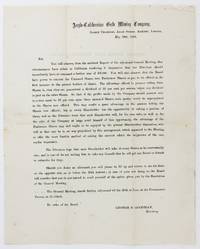
18555250London: May 19 1855. About very good. 2pp. on a bifolium. Previously folded. Light wear along top edge; short closed tear at right margin. Scattered faint foxing. With original mailing envelope. This two-page printed circular dated May 19th 1855 from the Anglo-California Gold Mining Company in London offers to convert "unissued shares" of company stock into "preference shares." The first page of the circular reads in part:<br /> <br /> "You will observe from the enclosed report not present of the adjourned General Meeting that circumstances have arisen in California rendering it imperative that the Director should immediately have at his command a further sum of £6600. You will also observe that the Board have power to convert the unissued shares into preference shares at par to be offered in the first instance to the present holders of shares. The advantage offered to persons taking those Shares is that they are guaranteed a dividend of 25 per cent per annum before any dividend is paid on the other Shares."<br /> <br /> The second leaf of the bifolium prints a blank form for recipients to purchase said preferred shares. During the first years of the California gold rush approximately 120 companies formed in Great Britain to offer mining shares in the booming goldfields to the public. Many saw these companies as an opportunity to invest in the boom without facing the expense or the danger of traveling to California. Most however ended in failure and investors collectively lost almost £2 million at the time.<br /> <br /> The Anglo-California Gold Mining Company formed by Luke Williams in March 1849 was one of the first and largest of these British ventures and it sold thousands of ten shilling shares to the public. Williams sent a former Royal Navy Captain Henry Vere Huntley to the Calaveras River in early 1850 to start the operation. When he failed Williams arranged a deal with Fremont's Quartz Rock Mariposa Gold Company to crush and refine their ore and the ore of smaller ventures. To that end the company sent two steam-powered crushing mills to California and when those proved useless to the task the company failed. May 19 unknown
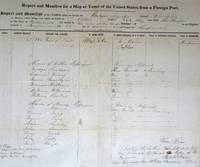
1850List2418Callao: Alsop and Company 1850. Folded ship manifest measuring 15 ¼ x 12 ½ inches. Fine condition with slight normal wear. A very scarce Gold Rush period shipping manifest for the Barque Equator captained by William Weir listing the passengers and cargo for a voyage to San Francisco in December of 1850 with notations showing the vessel’s arrival in San Francisco in May of 1851. Alsop & Co. was the work of Joseph Alsop the grandson of Continental Congress delegate John Alsop and his friend Henry Chauncey. Originally from Middletown Connecticut the pair established Alsop & Co. in New York City in 1824 and would eventually play a large role in the gold trade in California and trade extensively in South and Central America. Chauncey Alsop and others were among the partners in the trans-Panamanian railway that helped transform trans-continental trade in 1850. One of Alsop & Co.’s treasure boxes was aboard the S.S. Central America when it sank in 1857 carrying gold to the Eastern United States from Panama. <br /> <br /> The shipping manifest offered here lists the primary cargo as 195 tons of coal and also lists the names of fourteen passengers on the voyage. Imported coal - from Callao in this case - was essential to heat houses and run furnaces at factories including assay offices before the development of a local coal industry in California. We find only two instances of Gold Rush-era ship manifests - which were usually thrown away - surfacing in the trade or auction records this one and one other which sold for $3600 at PBA Galleries in 2014. Alsop and Company unknown
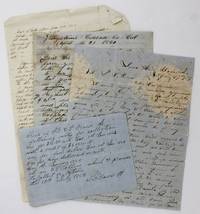
18604301Eldorado & Iowa Hill 1860. Good. Four manuscript documents including three letters totaling six pages. Old folds moderate toning minor edge wear a few tears a small hole in one letter. A neat group of four manuscript letters and documents all related to the mining activities of L.D. Davis of Georgia over a four-year period during the latter years of the California Gold Rush. Davis appears to be a lawyer living somewhere back east and may have been an investor in California mines or managing the financials for some mining concern from afar. The documents include an 1856 promissory note regarding "noted for collection" a long undated letter likely from California to Davis detailing amounts of gold taken from an unspecified mine and the mine's ownership situation and two letters overtly datelined from California -- the first from Iowa Hill in 1859 and the second from Georgetown in El Dorado County in 1860. Each document presents a unique set of concerns for Davis. Notable details of the three letters are as follows:<br /> <br /> 1 Autograph Letter Signed from A.J. Huff to Mr. L.D. Davis. Iowa Hill Ca. April 17 1859 2pp. The text reads in part "I have been very very sick for the last three weeks but am at this time improving.the disease is caused by the exposure of this last winter having worked continually in the rain and snow preparing my claim for the season. Times are very hard in this country now everyone has to work hard and is in big luck if he makes a decent living. A great many are making money very fast but in comparison not one in ten to the number than used several years back to make money or in other words the chances are about one in ten when they were one in fifty two and three in this country. If a man can get a good claim he can make more clear money out of it than he could then owing to the fact that everything is cheaper and experience has taught the People of California a great deal in respect to saving the gold and expediting the work. I think I have a very good claim which will last for a long time three or four years. It has been very expensive opening it but that is pretty well all over with now."<br /> <br /> 2 Autograph Letter Signed from J.D. Arranaut to L.D. Davis. Georgetown Eldorado County Ca. April 28 1860 2pp. Here a colleague of Davis's in California seems to be struggling and writes thanking Davis for a loan. The text reads in part with spelling normalized: "I was glad to hear from you and to.learn that you would comply with my request by letting my wife have $25 worth of corn for her use and please find enclosed a bank draft. I take it as a great favor as I am far from home. Let me know how my wife is getting along and if she stands in need of anything."<br /> <br /> 3 Autograph Letter Signed from J.H. Worley to L.D. Davis Esq. N.p. n.d. 1p. The letter concerns percentage ownership in an unspecified mine and opens with a four-line listing of the "amt. of gold taken from mine 513.51.1 while under my control." The author then writes in part: "The rent and expenses were take out of the above account and after the gold was sold one half after paying expenses. I know you are too well positioned in law to know that I dare not have settled with any other person unless I had been so instructed according to law. When Mr. Findley returned from Burke County he stated to me that one half the mine was for Mr Adams and myself and the other was for himself and his friends but did not say who they were. unknown
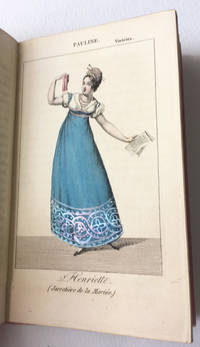
1818Flo136<p>Very rare complete set of all 8 volumes of this review of French theatre in the years 1818-1824.</p><p>All eight years of publication complete with 8 handcolored engraved title pages and over 90 finely handcolored engraved portraits of actors actresses opera singers ballet dancers and comedians in costumes of their famous roles.</p><p>"Very interesting almanac attributed to Charles Malo or Francois-Adolphe Loeve-Weimars giving a summary of Parisian and provincial theaters reviews on the plays and their performers notes on debuts repertoires etc." Grand-Carteret<em> Les almanachs français</em></p><p>Includes portraits of sopranos Mme. Gavaudan and Angelica Catalini tenors Jean-Blaise Martin and Simon Cheard ballet dancers Emilie Bigottini Genevieve Gosselin Antoine Paul and Mlle. Clotilde child actress Leontine Fay actors Francois-Joseph Talma and Charles-Gabriel Potier and many more. Odd volumes turn up occasionally but it is very rare to find the complete set of this intriguing anecdotal overview of Parisian theatre from the first quarter of the 19th century.</p><p>Condition: All volumes in their pastel card slipcases paper bindings holding some spots of foxing to a few plates but overall very good with tissue guards. Complete with all engravings and calendars at end.</p><p>Charles Malo 1790-1871 was a French author editor and translator whose books included a series of gift books for women illustrated by Pancrace Bessa almanacs city guides battlefield guides etc.</p> Louis Janet paperback
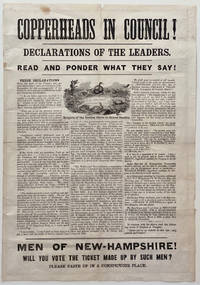
1863List1004New Hampshire: Printer Unknown 1863. First Edition. Printed broadside 16 ½ x 11 ½ inches archivally mounted and matted. A very good copy with some light toning small closed tear at upper margin light foxing at upper margin very tiny spot of loss to illustration at fold. Franklin Pierce remained politically active upon his return to New Hampshire following his presidency advocating for the Democratic cause and generally opposing the Civil War and Lincoln’s policies. This scarce pro-Union anti-slavery broadside printed for the 1863 New Hampshire elections which happened March 12 takes aim at Pierce and his fellow Democrats repeating the unfounded claim first made in 1862 by William Seward that Pierce belonged to the secret Knights of the Golden Circle the secret society formed with the goal of forming a new territory out of the CSA Mexico Central America and the Caribbean. There was never evidence that Pierce had any involvement in the KGC though the society had members in southern parts of some Union states such as Indiana Ohio Illinois and Missouri.<br /> <br /> The broadside printed for the March 12 elections quotes heavily from Pierce as well as the other Democrat candidates and party officials who were either running for office in New Hampshire or involved in politics a group which included Ira Eastman John Goerge Josiah Minot Thomas Treadwell Daniel Marcy William Burns and George Stevens. The broadside includes an engraving of coiled snakes each with these politicians named and the caption “et id omne genus.†Eastman the Democratic candidate for governor won the popular vote but lacked the constitutional majority necessary for election. Marcy was successful in his bid for the First District. “Men of New Hampshire!†the broadside asks: “Will you Vote the Ticket Made up by Such Men†with the final line imploring to “Please paste up in a Conspicuous Place.†<br /> <br /> Overall an uncommon survival from the 1863 elections. A very good copy with some light toning small closed tear at upper magin light foxing at upper margin very tiny spot of loss to illustration at fold. Quite scarce with OCLC locating two copies only at the Huntington Library and the New York Historical Society. Printer Unknown unknown
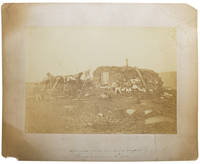
1872303445London 1872. Albumen print measuring 11-5/8 x 16-1/4 in 295 x 412 mm. Laid down on thick cream card with manuscript caption measuring 17 x 21 in. Image slightly faded card chipped with some minor soiling one tear not affecting image. Albumen print measuring 11-5/8 x 16-1/4 in 295 x 412 mm. A rare survival. This image appears in William Bradford's fabled book of photographs Arctic Regions. It was taken by either Dunmore or Critcherson the two professional photographers from Boston who accompanied Bradford on his 1869 expedition to the Arctic on the steamship Panther. It was probably taken at Upernavik a settlement on an island off Greenland's west coast or Godhavn.<br /> <br /> Arctic Regions included 141 albumen prints in addition to Bradford's account of the voyage. The title of the photograph here varies from the printed caption in the book where it reads: "Plate Number: 116 Esquimaux igloe or winter hut made of turf and stones. The entrance is to the left through a door which is about three and a half feet high. The length of the passage is about twelve or fifteen feet and at the farther end is another door through which one almost has to crawl on his hands and knees. After passing through there is then room to stand erect but one is forced to leave very soon owing to the bad air." <br /> <br /> This photograph is slightly larger than the one in the book which is 277 x 365mm. Furthermore the image in the book is cropped closer on the right and left margins. <br /> <br /> The New York Public Library has a folio of 26 images of near identicle size mounted on card. The portfolio was donated to the library in 1892 as part of the Robert Stuart Collection. According to Horch originally all of these images were captioned in manuscript though were later remounted with typed captions as "the original ink-written captions for the photographs had badly faded by 1940." It's interesting that the caption on their duplicate of this image is the same as ours and the image itself has not been cropped. Horch writes that Bradford probably not only selected these images himself but "closely directed the actual taking of the photographs." <br /> <br /> It's entirely likely that Bradford would have had extra prints made to distribute to friends repay favors and most of all to solicit subscribers to what was a very expensive book to publish. Given how it conforms to the examples in the Robert Stuart portfolio this particular image is probably one of them. Horch Frank. "Photographs and Paintings by William Bradford". American Art Journal 5.2 1973: pp 61-70; cf Parr and Badger I p31Prm/photo unknown
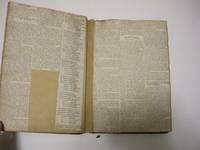
18563459n.p.: n.p. 1856. Hardcover. Fair. This quarto-sized scrapbook in green cloth over boards was manufactured c. 1850 by Eayrs & Fairbanks No. 133 Washington St. Boston. It is about half full of contemporary news clippings affixed with paste. The scrapbooker did not comment on them with the exception of one instruction to "See the loose piece."The first 40 pages are from 1856-1857. The majority of articles deal with slavery especially political events in the Kansas Territory "Bleeding Kansas" the Dred Scott Case and President James Buchanan. The first clipping is from Feb. 9 1856 and details a pro-slavery meeting in Missouri addressed by David Atchison. The last clipping in this section is from April 24 1857 and reports on Stanton's speech at Lawrence Kansas.After a break of three blank pages the scrapbook resumes with news of Reconstruction from June 30 1868. There are 6 more pages of eclectica: political news clippings interspersed with a poem by Whittier and advice on How to Keep the Feet Dry.While the scrapbook is unsigned it can be tentatively identified with the Orton family since the last page contains an 1868 20th reunion announcement from the Hamilton College class of 1848 along with 1868 clippings from southwestern Ohio newspapers including the Springfield Ohio Republic. The only surviving member of that class residing near the Dayton-Springfield area is Prof. Edward Orton Sr. Yellow Springs OH where he was president of Antioch College. The 1850s clippings come mostly from New York newspapers particularly the Tribune and the Orton family was living in Chester Orange County NY at that time.Orton went on to become the first President of the Ohio State University from 1873 to 1881.The scrapbook is in fair condition; the pages and paper have held up remarkably well. However the spine is mostly detached and the binding is weak at several signatures. 003477 n.p. hardcover
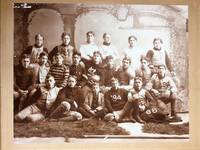
189433580np 1894. Framed photograph 10-1/2" x 13-1/2" matted behind glass within ornate gilt frame 21" x 23-1/2". Light wear to surface of photograph. Matting has some spotting. Some wear to frame and small chip to frame edge. Else Very Good. <br /> <br /> The squad is dressed in various football uniforms including laced smock vests over long sleeved shirts caped sweaters and knee length pants. Each of the two young men wearing military style uniforms has a small billed cap. unknown
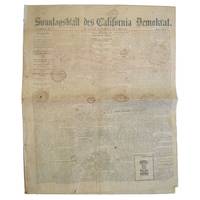
18982144San Francisco: Cal. Demokrat Publishing Co. 1898. Fair. 21-1/2 x 17-1/4 inches. 8pp. Tabloid format newspaper printed in seven columns per page. Occasional b&w illustrations. Text in German. In fair condition only with significant soiling and large light stains somewhat affecting readability; numerous small holes to first two leaves most pinhole-sized or slightly bigger a few as large as pea-sized all sporadically affecting text; several short tears to edges and last leaf; old folds. A scarce issue of this influential German-language daily which ran from 1852-1918. The front page devotes considerable space to coverage of the looming Spanish-American War which is here termed "unvermeidlich" inevitable. The increasingly ominous preparations of the two countries since the sinking of the USS Maine are described at length as well as England and various European countries beginning to choose sides. Also included in this issue is content about Japan's imperial ambitions in China viewed here as in a positive light given the potential for spreading Christianity to China news about the Klondike Gold Rush various events occuring on the Pacific Coast and more as well as advertisements in both English and German.Not located in OCLC although several institutions hold other issues of this paper and its earlier iteration the California Chronik. Cal. Demokrat Publishing Co. unknown
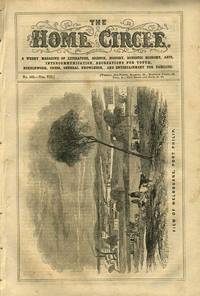
1869189011869. Paperback. Very good condition. Part of a series of articles "The Gold fields of Australia" in a 16pp 8vo weekly magazine The Home Circle magazine. Depicting countryside with cattle in the foreground city in the distance by an unidentified artist. The view corresponds with the leading article of the issue. 8vo pp 129 - 144 b&w ills. Unusual English weekly magazine No. 165 - Vol. VII. Not found on Trove. paperback
188460757New York: A.D. Clarke Rm. 26 - 61 Broadway 1884. Two pieces. 4to. 4 pp unpaginated. w/ 1 large woodcut-engraved vignette w/ fold creases and slight creasing; with Oblong 8vo. 9 x 4 in. illustrated envelope small woodcut engraving of gold placer mine in Idaho w/ recipient address in ink on recto of Mary Augusta Gray b. 1853 Olney Clatsop County OR stamped envelope w/ NY postmark minor age toning still a VG pair from the library of her older sister Caroline Augusta Gray Kamm 1840-1932 noted socialite and philanthropist in Portland built home for poor women & girls with the YWCA and was daughter of PNW pioneer William H. Gray 1810-1889 who traveled to the Lapwai Mission in Lewiston ID in 1836 where he was the Nez Perce secular agent and she subsequently later married Jacob Kamm 1823-1912 pioneering Oregon industrialist and entrepreneur. First edition of this exceedingly scarce promotional offprint for the placer gold mining concentrator for “float or flour gold†developed by A.D. Clarke in the early 1880’s at an Idaho gold mining operation. The invention required parallel bars of iron an 1/8th of an inch apart bolted in place allowing water to flow through a sluice from a hydraulic mining operation with good gentle water flow and then would be directed through a series of tanks fitted with sage brush to collect the particles of gold and then across a series of riffles to pick up still finer gold particles. There was a mini gold rush in Clatsop OR in late-1884-1885 after J.M. Weed filed a placer claim for his mine Gertrude on Rock Creek in May 1885 which claimed loose valuable material in gravel on Rock Creek followed by a plethora of gold miners staking claims in the area and by 1889 the Rock Creek Mining District was formed. Maggie Gray b. 1853 was the youngest daughter of William H. Gray and served as postmaster in Olney OR from about 1878-1884 according to government publications but sadly there are no production figures for any of the mines and no further census or government records for Maggie after 1884. No copies in Worldcat; See: The Clark Concentrator for Float or Flour Gold The Engineering and Mining Journal Vol. XXXVII No. 8 Feb. 23 1884 p. 141; Elleda Wilson In One Ear: Golden Dreams The Astorian June 6 2019. A.D. Clarke, Rm. 26 - 61 Broadway, unknown
189355608Seattle WA & Silverton WA: Stillaguamish & Sultan Mining Co. 606 Bailey Bldg. ca. 1893. Four albumen cabinet photographs sized 3.9 x 4.9 in. mounted on thick studio board stock sized 4.25 x 5.25 in. w/ all four containing manuscript annotations in ink on versos minor dustsoiling edgewear minor over-exposure to a couple images still a nice grouping with consistent contrast and definition. These scarce original albumen photos show the canyon water fall power and miners along the Hoodoo Quartz Claim Mineral Survey No. 403A and B which was filed originally in 1892 and are neatly numbered 3 6 15 & 11. The first image shows a heavily forested canyon with creek running through and annotations on verso detailing that the “Anaconda and Roman Senator lodes at the head of gulch.†The second photo shows fast running water fall and creek -- “water power that will be utilized in the development of the Stilliguamish sic and Sultan Mining Co’s property. Copper Lake Canyon.†Third photo depicts gold miners carrying and working with pick axes in “Hoodoo Canyon 500 feet higher up. . . the vein is found in the bed of the gulch at this point.†The series of mines developed by the Stillaguamish & Sultan Mining Co. had a well-defined fissure vein carrying iron and copper pyrites and pyrrhotite with bell metal all contained in a lime quartz gangue. The main tunnel was driven 420 feet on the Hoodoo ledge with about another 200 feet of tunneling ore concentrate worth about $83 a ton including gold silver and copper ores. The description on back of four describes “passageway where work was shot away for approach to Hoodoo tunnel. The snow banks in the distance and at the right are at the foot of Big Four Mountain. . . seen plainly from Monte Cristo 8 miles East.†By 1905 the company was largely dormant and later the mines would be owned by the Sykes Estate of which the Continental Illinois National Bank & Trust Co. of Chicago was the trustee. See: L.K. Hodges Mining in the Pacific Northwest: A Complete Reivew of the Mineral Resources of Washington and British Columbia 1897; The Copper Handbook: A Manual of the Copper Industry of the World 1905 Vol. V p. 655; Carithers & Guard Geology and Ore Deposits of the Sultan Basin Snohomish County Washington Bulletin No. 36 1949 pp. 49-50. Stillaguamish & Sultan Mining Co., 606 Bailey Bldg., unknown
185113408Edinburgh: The Edinburgh Evening Courant 1851. With an article on the back page column 3 entitled "Gold In Australia" measuring 13 column inches which states "The discovery of the fact by Mr. Hargraves that the country from the Mountain Ranges to an indefinite extent in the interior is an immense gold field" which has ignited "a universal rush to the diggings". The article goes on to describe the rapid rise in the cost of provisions; a description of miners returning to town with gold nuggets; the government geologist's visit to the site; and the need to appoint a "Commissioner over the gold regions. in which Mr. Hargraves being the discoverer. points him out as the most suitable and worthy person for the appointment." An article picked up by the Edinburgh Courant from the Sydney Morning Herald of May 20 which took it from The Bathurst Free Press of May 17th. Small chips at top edges a little browned. Single issue of four page newspaper disbound measuring 19" X 25" Saturday September 6 1851 Number 22168with red newspaper tax stamp at upper right hand corner and black Edinburgh Evening Courant stamp. The Edinburgh Evening Courant unknown
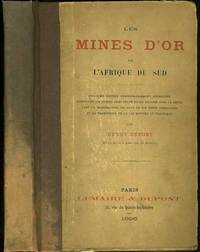
189520382Paris: Lemaire & Dupont 1895. Second revised. Hardcover. Very good condition. An important work in French on gold and gold mining in South Africa written shortly following the discovery of gold in the Witwatersrand in 1886 a profound transition for South Africa from farming to becoming the largest gold producer in the world. Part Three of the volume pertains to the various gold fields including: Lydenburg de Kaap Komati Witwatersrand Klerksforp Malmani Zoutpansberg the Murchison Range and more. 8vo xxiii 357pp 6 color folding maps. Ex library with bookplate inside front board cancellation stamps verso of title page. Quarter brown cloth with printed boards; title printed in red and black at front board no title at spine. The cover has date of 1895 printed while title page has date of 1890. Cloth at spine marked at lower half; boards a bit rubbed & marked. Internally very good condition. OCLC: 422300168. Lemaire & Dupont hardcover
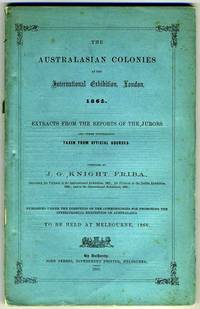
186618250Melbourne: Government Printer 1866. Second edition. Otherwise very good condition. International exposition in London held just ten years after the discovery and beginning of the Australian gold rush. The introduction nicely summarizes the increased presence of the Australian colonies: "In 1851 the Australasian colonies were but poorly represented although a few made some efforts to put in an appearance. . in 1862 the Australian colonies exhibit one of the most extensive and finest collections of the whole group. . New South Wales has a beautifully arranged collection of its gold products from all the principal fields in the several shapes of nuggets quartz grain gold washing stuff coin from the Sydney mint &c. . Victoria has gone to great expense . one of the most striking objects is a gilded obelisk representing the actual amount of gold found in the colony since 1851 about 800 tons or L103000000 sterling.:" Also information on wine with wine coming from South Australia; 4 exhibitors from Western Australia; Mr. Thomas Little of Dardanup won a medal for his light red Frontignac; Victoria 19 exhibitors with no wines older than 1858 shown putting them at a "taste disadvantage". Each district is represented with a short history of their products and resources. In Western Australia there are lead and copper mines iron ore mines Albany and Bunbury. <br /> <br /> Printed paper pamphlet. 8vo 101pp. Blue printed paper wrappers title in black at front cover no title at spine. Small unobtrusive Iibrary stamp at title page deaccession stamp at back cover. Lower corner back cover chipped. F11229. Otherwise very good condition. Government Printer unknown
181719934New York: W.B. Gilley 1817. First American Edition. Hardcover. Good. 13 cm 180 pp. Contemporary marbled boards; spine recovered in black cloth tape. Some peeling to marbled paper one crack at center of binding where signature is partly sprung otherwise sound and clean. On oft-reprinted moral tale for children the "ornaments" are good manners and a well-regulated mind first published in London in 1815 by William Darnton Jr. This edition is scarce. Shaw & Shoemaker; 41095. W.B. Gilley hardcover
186932728Virginia City California 1869. Paper. Very good. Approx. 8" x 3" check with printed green borders information and 2 stamps. Check is drawn on the account and signed by Isaac L. Requa. The information printed on the check is "Gould & Curry Silver Mining Company W. C. Ralston Treasurer. Agency of the Bank of California Virginia City. The written date is Aug 3 1869. <br /> <br /> Requa was a mining engineer early Oakland pioneer and later President of Oakland Bank and Savings. unknown