4 résultats
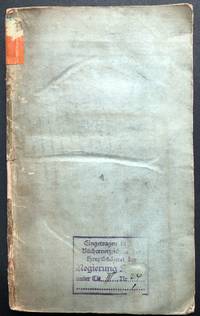
1811H22492Berlin: Amelang 1811. First printing. Paperback. Good. 8vo older possibly original pale green wraps good with some wear to wraps ink stamp on front cover and on title page text very good. 130 1 pp two folding plates at rear. Amelang paperback
189749394Philadelphia: Textile Publishing Co. 1897. Tall 8vo. 324 pp. Over 1500 text illustrations diagrams weaving diagrams numerous illustrated ads. Black pebbled cloth gilt lettering on front cover & spine minor shelfwear slight rubbing w/ notes clippings & postcard laid-in from the library of Elisa Serin b. 1887 silk weaver married to Maurice Serin foreman of the Allentown PA plant of Broad Silk Mills. Early printing of this scarce and important guide intended to provide reference for 19th-century weaving students and textile manufacturers. Posselt 1858-1921 emigrated from Austria after managing his father’s textile mills and was a designer in mills all over New England and Pennsylvania. He became the first director in 1884 of the first successful textile school in the U.S. and later became editor of the Textile Record of North America the foremost journal on textile design and manufacturing at the end of the 19th-Century. Although his many works on textile machinery and manufacturing are now primarily of historical interest this well-illustrated work on weaving and loom design is still relevant and considered some of the most important books on textile design ever published. See: Ralph Griswold Emanuel Anthony Posselt 2004. Textile Publishing Co., hardcover
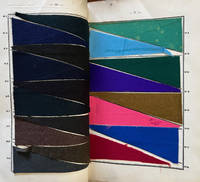
188262704Elbeuf Paris Berlin London & Chicago IL: L. Bertin Printing Office Levasseur March 1882 - Aug. 1882. Ten parts in one vol. Thick tall 8vo. With 96 of 98 tipped-in fabric swatch samples with the text a couple partially clipped by previous owner 3 thread samples and 169 pennant-shaped samples out of 181 1 additional woven-in to No. 654 series 12 removed divided amongst 30 different plates each installment featuring 3 numerous woodcut engraved diagrams weaving diagrams illustrations plates extra-illustrated with 5 additional engraved plates of Jacquard Loom & Power Loom weaving equipment. Half-calf over burgundy-coloured cloth gilt lettering on spine marbled endpapers rebacked preserving original spine edgewear creasing still VG exemplar. First editions in English of this series of periodical installments issued for weavers designers and fashion houses in the 19th-Century featuring the latest patterns instructions new and original designs shadings and dye-lots for woolen textiles. Originally published either weekly or bi-weekly these very ephemeral textile sample installments and weaving instructions were issued by subscription and heavily used and often most of the fabric samples removed along with the plates in order to offer specific hands-off patterns for workers setting up looms and weaving. In addition samples provided the latest dye lots of fashionable fabrics for women and men’s clothing with emphasis in the first few issues present here on use and settings for the Jacquard Loom. No. 646 for the April 30 1882 issue includes brilliantly dyed samples encompassing such vivid jewel colours in red pink green blue and browns. These fabrics also provide an essential tactile and visual reference for the latest textiles in production during the Gilded Age in both Europe and America. Worldcat locates only runs and partial runs of the 45 vols. originally issued in French German English & Italian in the Bibliotheque Nationale Issues at BN in English for Summer Season 1876-1877. L. Bertin, [Printing Office Levasseur], hardcover
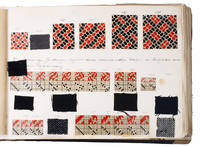
190019623Vaals-Aachen on the Dutch-German border 1900. Oblong folio 24 x 32 cm. Höhere technische Schule für Tuchfabrikation Contemporary beige half cloth sewn on 2 cloth tapes with a hollow back black cloth sides title in gold on the front board tissue interleaving tipped in between the leaves. Manuscript in German written in black ink in a neat and legible Latin hand on paperboard leaves comprising short instructional texts and about 2000 colour-coded weaving patterns and small samples of woven cloth mounted on both sides of the leaves. 2 blank 117 1 blank pp. Unique course in cloth weaving as taught in a German-language technical school probably carefully noted down by one of the pupils and beautifully illustrated with nearly 2000 weaving patterns drawn on grid paper with the various threads colour-coded and accompanied by hundreds of samples of woven cloth both the patterns and the cloth samples mounted on the leaves. Most pages contain primarily patterns and samples with only brief captions but the occasional longer text sometimes run over a few pages. This German text provides an explanation of the patterns and their colour-coding the various kinds of cloth and the weaving process. Many of the patterns are shown in red black and white but some add yellow and/or blue a few use brown and a few use only red and white or only black and white. The weaving patterns and cloth samples are numbered as 1214 figures but many numbers include two patterns or samples and some as many as five and occasionally a number has been accidentally repeated. There are also at least 80 unnumbered patterns and samples.The title's reference to the school in "Vaals-Aachen" probably means it was situated in Vaals but served German speakers in both communities. The area around Aachen had produced cloth for centuries but after an economic depression in the mid-19th century it emerged and became known for its textile manufacturing by the 1880s. The present manuscript course forms a rich and splendid example of the thorough education its young people received in technical schools for a career in the cloth industry around 1900.A piece has been cut out of three leaves and some have come loose from the pages but at least most of them are still present. The binding is slightly loose. The manuscript is generally in good condition. A remarkable and important source for any study of weaving and weaving education also graphically fascinating and colourful. ABE CAT Art History hardcover