(WJ McCahan Sugar Refining Co) W JBiblio.com
5 résultats
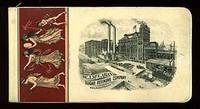
190083787Philadelphia: W.J. McCahan Sugar Refining Co 1900. Hardcover. Very Good. Small approximately 4.75" x 2.5" staple-bound day calendar with celluloid covers advertising the W.J. McCahan Sugar Refining Company and picturing their Philadelphia buildings on the rear cover. Neat owner name on the first page a couple of light penciled notes in the calendar and a couple of smudges on the cover else very good plus. W.J. McCahan Sugar Refining Co hardcover
182418594London: Hatchard and Sons 1824. Disbound 41pp. First and last leaves lightly dusted and worn else Very Good. <br /> <br /> The author argues that "notwithstanding the preferential duty rate of 10s. per hundredweight enjoyed by West Indian sugar as against East Indian the latter could be entered for internal consumption so as to afford a large profit to importers. It would be a most advantageous speculation for young men of good character and with small capital native or European to embark in the manufacture of sugar in Bengal." Ragatz. <br /> FIRST EDITION. Ragatz 249. Hatchard and Sons unknown
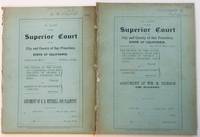
188930671San Francisco: Commercial Publishing Company 31 California St. 1889. 73 1 blank pp. Original printed front wrapper with wrapper title as issued disbound. A clean text signed in ink on the last text page and on the front wrapper by Mitchell. Except as noted Very Good<br /> offered with . ARGUMENT OF WM. M. PIERSON FOR PLAINTIFF. San Francisco: Commercial Publishing Co. 1889. 154pp original printed front wrapper with wrapper title as issued. Disbound. Else Very Good.<br /> <br /> Two arguments for the State of California claim that this large refinery company "had surrendered the management of its concern and the control of its business to a body of men known as 'The Sugar Refineries Company' an unincorporated association of non-resident individuals formed and operated for the purpose of limiting the supply and thus advancing the price of sugar and therefore an unlawful combination and monopoly acting in restraint of trade." Over the next thirty years the Company would be charged with many antitrust violations.<br /> We do not locate records of these items in Cowan Harv. Law Cat. or on OCLC as of December 2024. Commercial Publishing Company, 31 California St. unknown
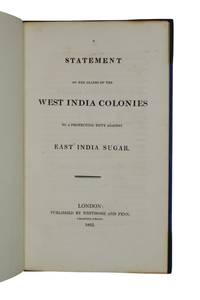
1823AQ32361London: Published by Whitmore and Fenn 1823. 4 120pp. Recent dark green half-morocco tooled in gilt and blind blue cloth boards. Very minor shelf-wear. Title page a trifle marked. The sole edition of an anonymous survey of the political economy of the West Indian sugar trade - with particular regard paid to proposals for the equalisation of duties on the produce of the East and West Indies - dedicated to a planter and slave owner in St Kitts and Santa Cruz William Manning 1763-1835 a leading figure in the London Society of West India Planters and Merchants who represented the claims of the West India sugar planters for fiscal measures to alleviate their growing economic difficulties in the early years of the nineteenth century. . First edition. 8vo. Published by Whitmore and Fenn hardcover
185756060New York: C.M. Saxton & Co. Agricultural Book Publishers No. 140 Fulton St. 1857. 8vo. 106 pp. plus 11 1 pp. publisher’s catalogue. Woodcut-engraved frontisp. 1 text engraving. Original printed softcovers minor chipping head & foot of spine slight chipping couple lower corners dustsoiling still a VG bright copy. First edition of one of the earliest American studies on Chinese Sugarcane Sorghum and the possibilities that this was the sorghum plant that American farmers hoped would grow in the Northern United States and definitive work on growing harvesting and distilling sorghum. A variety of “Chinese Sugarcane†was imported by Father Du Halde from Sichuan China in 1851 where it was quickly adopted also under the name of “Northern Chinese or Shanghai Sugarcane†as a crop to provide sugars for alcoholic products filling the void left by the grape crop failure in the 1850s. Chinese Sugarcane seeds were first brought into United States by Jay Browne Esq. in 1854 and a few intrepid American nurseries began planting and determining if it could be planted and harvested profitably in the North. Hyde writes that in his test crop he was able to secure a dark sugar from the cane molasses and notes that it will be of tremendous value in producing alcohol and confectionaries and that the Sorghum remnants could be fed to livestock. Hyde 1825-1898 worked with his father James Hyde in developing the very successful nursery emphasizing fruit trees ornamental trees and cash crops. He was a pioneering environmentalist who founded the first improvement society in the United States the Newton Centre Tree Club whose purpose was to emphasize beautifying the roads and commons in Massachusetts. He was Newton MA first mayor after the city was incorporated in 1873 and was also successful in persuading the Boston & Albany RR to acquire the existing single-track line of the Charles River Railroad to aid his nursery business. Original editions of this work have become quite scarce in the trade. See: Deborah Jean Warner Sweet Stuff: An American History of Sweeteners from Sugar to Sucralose pp. 252-253; Watts Dictionary of Chemistry and the Allied Branches 1869 Vol. V p. 354; Newton’s First Mayor: A Hard Act to Follow Historic Newton 2019; Walnut Grove Nursery The New England FarmerVol. IV 1852 p. 538 C.M. Saxton & Co., Agricultural Book Publishers, No. 140 Fulton St., paperback