6 résultats
1731WRCAM46722London 1731. 31pp. Folio. Vertical fold reinforced with tissue. Very light foxing and wear. Very good. A protest against a bill to restrain the northern colonies from trading with the French and Dutch sugar islands. One of two editions published. Only four copies located by ESTC: British Library Bibliothèque National John Carter Brown Library and University of Minnesota. ESTC T20672. HANSON 4222. EUROPEAN AMERICANA 731/39. unknown books
1731WRCAM46721London 1731. 31pp. Folio. Vertical fold reinforced with tissue. Minor soiling. Very good. A protest against a Bill to restrain the northern colonies from trading with the French and Dutch sugar islands. One of five editions published all rather scarce. Only four copies of this edition noted by ESTC - at the National Archives New-York Historical Society University of Michigan and the University of Minnesota. European Americana also notes Yale and JCB. ESTC N15514. EUROPEAN AMERICANA 731/37. unknown books
1748WRCAM27927London: M. Cooper 1748. 21pp. Dbd. Internally clean and fresh. Very good. From the establishment of the sugar colonies in the 17th century taxation on exports and imports to and from the colonies was a matter of continuous debate in Parliament. Enter less expensive French sugar particularly for distillation purposes in New England and questions of appropriate duties reach a fervor in the 1730s in part resulting in the Molasses Act of 1733. Colonial merchants ignored the Molasses Act almost universally perpetuating the discussion of how to best garner revenue from the colonies made more timely by the depleted funds of Britain's exchequer at the close of King George's War in 1748. Preceding the infamous Sugar Act by seventeen years this pamphlet represents yet another voice in the crescendoing sugar tax discourse. SABIN 68280. KRESS S3804. HANSON 6182. GOLDSMITHS 8353. M. Cooper unknown books
17810000533Paris: Chez Clousier 1781. First edition. Binding rubbed & scuffed shallow losses at spine extremities joints cracking free endpapers excised text lightly toned & occasionally foxed lacking the folding plate about Good & still quite serviceable. 8vo 8" x 5" viii 1 & 4-512 with tables occasional woodcut illustrations and woodcut headpieces throughout. LACKING THE FOLDING PLATE. Publisher's full calf the spine decorated in gilt with a gilt-lettered maroon morocco spine label. Text in French. <br/><br/>In the Preface Casaux describes his credentials on the subject of growing sugarcane: born in France in 1727 he migrated to the then-French island of Grenada in 1757; he remained there and took English citizenship after the Treaty of Paris ceded the island to the British in 1763 serving George III as Deputy for the French population of the colony until his return to Europe in 1777. He joined the Royal Society there in 1780 and was also a member of the Academy of Agriculture in Florence. During his years in the Caribbean he interested himself in the cultivation of sugarcane; he became especially concerned with methods for producing the same amount of sugar with many fewer “Negres†and “treating them more gently.†Casaux additionally writes of methods to produce quality sugar from inferior grades of cane and maintaining equal quantity and quality of sugar from “exhausted†plots of land. Casaux leaves no aspect of growing cane and extracting the sugar untouched; much can be learned about colonial plantation practices regarding not only sugar but agriculture in general. He includes a history of sugar and discusses “new†species of cane hybrids formed from crossbreeding; he also includes a table of rainfall for Grenada for the year 1773 and advises the use of such tables “to be kept by public appointment for the improvement of agriculture†elsewhere. Casaux was an influential thinker on subjects other than agriculture including politics economics and social issues and was a member of the Jacobin Club; after Mirabeau’s death in 1792 he moved from France to London and died there in 1796. Chez Clousier, unknown books
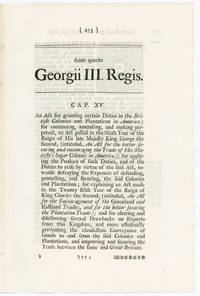
1764WRCAM54454ALondon: Printed by Mark Baskett.and by the Assigns of Robert Baskett 1764. 2275-299pp. Folio. Loose gatherings stab holes at gutter margins. Near fine. An outstanding copy of the rare official Parliamentary printing for the "Grenville Budget" of 1764 accompanied by three later acts amending regulations set forth. This budget act contains the so-called "Sugar Act" which was the first deliberate and direct attempt to tax the American colonies in order to pay for the British military presence in North America. <br> <br> The Sugar Act levied a tax of three pence per gallon on the importation of foreign molasses molasses from the British West Indies would be exempt from the tax. But the proposed legislation did far more than tax sugar products. It also detailed more foreign goods to be taxed including certain wines coffee pimiento cambric and printed calico and further regulated the export of lumber and iron. The enforced tax on molasses caused the almost immediate decline in the rum industry in the colonies. <br> <br> The final part of the title of the Act was Grenville's response to the British Customs Board's estimate that the annual revenue from American customs was a paltry £1800. Grenville whose guiding principles were strict adherence to legality and financial solvency found this state of affairs to be intolerable. Existing trade regulations designed to raise greater revenue would be more rigidly enforced with incentives offered to naval officers and customs officials. <br> <br> This Budget Act of 1764 set the tone for many of the British policies and measures that followed. A chain of events was set in motion which would lead step by step to the American Revolution. Reaction in the colonies was not long in coming. In Massachusetts James Otis and Samuel Adams fired pamphlets at it; the merchants of Boston banded together to protest; other colonial writers from Newport to Williamsburg added their voices; in England Thomas Pownall and others defended the step. All understood that a new era had dawned with the so-called Sugar Act. <br> <br> The present copy is accompanied by three further scarce acts of Parliament related to the statutes set forth by the Sugar Act. The first from 1765 alters the duties imposed on sugar imports. The other two from 1777 and 1779 made amendments to address penalties for smuggling sugar from America into Great Britain during the Revolution. They are as follows: <br> <br> 1 AN ACT FOR MORE EFFECTUALLY SECURING AND ENCOURAGING THE TRADE OF HIS MAJESTY'S AMERICAN DOMINIONS.FOR ALTERING THE BOUNTIES AND DRAWBACKS UPON SUGAR EXPORTED. caption title. London 1765. 2799-818pp. ESTC N56877. <br> <br> 2 AN ACT TO EXPLAIN AND AMEND SO MUCH OF AN ACT MADE IN THE FOURTH YEAR OF THE REIGN OF HIS PRESENT MAJESTY AS RELATES TO THE PREVENTING OF CLANDESTINE CONVEYANCE OF SUGAR AND PANELS FROM THE BRITISH COLONIES AND PLANTATIONS IN AMERICA TO GREAT BRITAIN. London 1778. 21027-1030pp. ESTC N57924. <br> <br> 3 AN ACT TO AMEND AN ACT MADE IN THE EIGHTEENTH YEAR OF HIS PRESENT MAJESTY INTITULED AN ACT TO EXPLAIN AND AMEND SO MUCH OF AN ACT MADE IN THE FOURTH YEAR OF THE REIGN OF HIS PRESENT MAJESTY AS RELATES TO THE PREVENTING OF CLANDESTINE CONVEYANCE OF SUGAR AND PANELS FROM THE BRITISH COLONIES AND PLANTATIONS IN AMERICA TO GREAT BRITAIN. London 1780. 2175-178pp. ESTC N57924. <br> <br> An excellent set of Parliamentary acts comprising the first attempt to tax the American colonies the Sugar Act and several additional acts revising its statutes up through the Revolution. ESTC N56801. REESE REVOLUTIONARY HUNDRED 4 ref. Printed by Mark Baskett,...and by the Assigns of Robert Baskett unknown books
17384782London: Printed by John Baskett Printer to the King's most Excellent Majesty 1738. Octavo-sized title plus one leaf. Removed from larger collection of acts. Near fine. Printed by John Baskett, Printer to the King's most Excellent Majesty unknown books