(Pliny the Elder) C Plinio SecondoBiblio.com

76 résultats
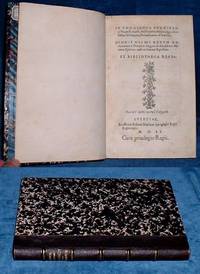
1548227758Venice: Alessandro Brucioli & i Frategli 1548. First Antonio Brucioli translation. Full vellum skiver leather title and date spine labels. Deaccession library stamps title page; marginalia p. 544; .5" chip lower corner p. 768 no loss; period ink mark affecting text p.980; pps. 950-1068 faint water stain lower corners & corners curled chipped frayed with some loss to margins and one part of marginal annotation. Octavo. xvi; 24; 1-1068 numbered in roman numerals. Gathering "O" misbound out of order but complete pp. 490-490 mispaginated as 494-495. The succession of translations of Pliny's Historia Naturale from the earliest printed incunables to Cinquecento Italian editions is a complex study of the collaborative process among humanist intellectual peers. Renaissance translators of early Greek thought worked with previously published translations offering emendations and alterations to improve or correct an earlier text. Antonio Brucioli edited Cristoforo Landino's well-received translation in 1543 which he then sought to improve upon with his own edition in 1548 making corrections to the table of contents offering an extended preface and including a “Life of Pliny.†Ultimately Landino's translation was the preferred text supplanting this Brucioli edition making it the only edition of this version of Pliny's Historia Naturale. Alessandro Brucioli & i Frategli unknown
1562376729Frankfurt am Main: David Zöpfel 1562. Woodcut title vignette 43 woodcut illustrations some repeated. Title page in red and black. 8 300 leaves. Small 4to 7-3/4 x 5-7/8 inches. Late nineteenth century brown crushed morocco gilt by Frances Bedford marbled endpapers gilt edges. Provenance: William Title inscription dated 1856 on front free endpaper; C. S. Ascherson bookplate and inscription to; Edward Ascherson bookplate. Woodcut title vignette 43 woodcut illustrations some repeated. Title page in red and black. 8 300 leaves. Small 4to 7-3/4 x 5-7/8 inches. The first of two Frankfurt printings by David Zöpfel that year using the same woodcuts. The text is descended from the Low German version Reynke de Vos first printed at Lübeck in 1498. <br /> <br /> Among the most widely adapted of the beast fables the tales of Reynard the Fox originated in the 12th and 13th centuries with early versions in French Dutch Latin and German being notable. One of the most important secular literary traditions of the Middle Ages Reynard the Fox is at its essence biting satire and parody. The character of Reynard an anthropomorphic fox and trickster has since become almost an archetype in the literatures of many languages. "The supreme 'anti-hero' of medieval fiction" Cambridge Guide to Children's Books in English.<br /> <br /> This copy from the renowned library of the eminent British architect and book collector Sir William Tite 1798-1873 whose sale at Sotheby's in May-June 1874 took sixteen days certainly one of the greatest collections of the time. [David Zöpfel] unknown
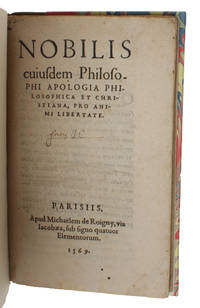
156941451Paris Apud Michaëlum de Roigny 1569. Small 8vo. Very nice recent half calf with five raised bands and gilt title to spine. Old owner's name to title-page discreet. A nice and clean copy with only minor very light soiling. Nice woodcut initials. 51 ff. <br/><br/><em>Very rare first edition of this work on the freedom and immortality of the soul by the father of the famous physicist and anatomist Jean Riolan the Younger. Jean Riolan the Elder 1539-1605 was also himself a noted French anatomist and a leading member of the medical faculty of Paris. He fought against the novelties that entered the faculty due to Paracelsus and authored a number of works attacking the most famous of the scientists who were in favour of chemical means. Works by him are of great scarcity.The work which is divided into three parts attacks the theories on the soul of Pomponazzi Portius Sepulveda and Cardano and as such it is an important document in the seminal controversy about the immortality odf the soul which dominated most philosohical thought of the Renaissance.We have been unable to find the work in any bibliographies. </em> hardcover
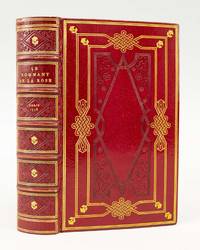
1538ST14933<p>Paris: Jehan Masse Jean Macé 1538. Fourth Edition. 182 x 91 mm. 6 3/8 x 3 3/4". 8 p.l. ccciii 1 blank leaves.Edited by Clément Marot. <br />ELEGANT SCARLET MOROCCO BY LORTIC stamp-signed on front turn-in covers tooled in gilt and blind in a Grolieresque strapwork design raised bands spine compartments with central gilt rose surrounded by blind tooling gilt titling turn-ins richly gilt marbled endpapers all edges gilt. With title page vignette and 49 impressions of 26 CHARMING WOODCUTS in the text. Front pastedown with engraved bookplate of P. Grandsire. Brunet III 1175; Bourdillon "Early Editions of the Roman de la Rose" the "S" version pp. 62-63. ◆Leaves lightly washed and pressed following the bibliophilic fashion at the time of binding occasional mild browning or small marginal stains but still A LOVELY COPY clean and still crisp IN A SPARKLING BINDING.<br /><br />Beautifully bound this is a most attractive copy of the last early edition of this classic of courtly love perhaps the most influential work in Medieval French literature. An allegorical love poem that unfolds as a dream vision the "Romance of the Rose" is the work of two authors Guillaume de Lorris who composed the first 4000 or so lines around 1230 and Jean de Meun who contributed an additional 18000 lines 40 years later. Our version was edited by the poet Clément Marot 1496-1544 to make the language more accessible to 16th century French readers and his efforts contributed to a renewed popularity for the tale. Marot did four recensions of the text; this is the final one. After our printing no other edition appeared until 1735. According to Bourdillon the woodcuts here are copied from the "very pretty" series in the 1529 edition. The scenes are impressive in the level of detail especially considering their diminutive size. Pierre Marcellin Lortic 1822-92 was one of the great binders of 19th century Paris known for his superb interpretations of traditional styles as in the present binding. According to Flety "at once artisan and artiste intelligent and conscientious an expert and a lover of his metier he knew how to give his work the finish the brilliance that very few practitioners of his time could attain." Our copy comes from the library of French bibliophile Paul Grandsire of Nogenten-Bassigny Haute-Marne whose notable collection of French imprints from the 15th to the 18th centuries was sold in 1930. All early versions of the "Romance of the Rose" are sought after and this is especially true of well-preserved copies of those editions with charming illustrations and in fine bindings favored by discriminating bibliophiles.</p> Jehan Masse [Jean Macé]
158326929Paris 1583. Engraved portrait oval with surrounding legend and text beneath on laid paper 6 7/8 x 4 1/4 inches. Cut to just within platemark and inlaid into later wove paper sheet. Later ink inscription on verso reading "from Holland / 1809." Minor wear and soiling. Very good. A very early engraved portrait of Sir Francis Drake.<br/> <br/> A clean impression of the second state of this famous portrait of Sir Francis Drake at age forty-three shortly after he returned from circumnavigating the globe the basis for most of the later images of him. The image is taken from a portrait purportedly painted from life by Jean Rabel the Elder and is said to be a credible likeness of the famed navigator. The legend beneath the portrait indicates the dates of Drake's circumnavigation listing Rabel as the painter and Thomas de Leu as the engraver. Thomas de Leu 1560-1612 a pupil of Rabel's moved to Paris around 1576 and became one of the most noted portrait engravers of his time. This engraving of Drake was the basis for many later images of him including the well-known engravings by Jodocus Hondius and Crispin van de Passe. The earliest graphic image of one of the greatest figures in maritime history.<br/> <br/> Marianne Grivel "Au Sieur Rabel Parangon du la 'pourtraicture'." in H. Zerner and M. Bayard's RENAISSANCE EN FRANCE Paris 2009 pp. 227-92 2d state. unknown
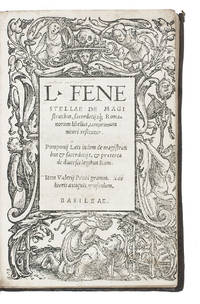
15236849Basel: colophon: Valentino Curio 1523. Contemporary panel-stamped calf sewn on 4 supports each board with the same 3 panel stamps: 2 virtually identical panels 76 x 52 mm with the foot of the panels toward the spine with 6 animals in 2 grape vines the animals from head to foot in the left vine: a monkey dog and wyvern 2-legged dragon; and in the right vine: a squirrel hare and lion in a border of a diaper of quatrefoils in lozenges the two separated by a small panel stamp 12 x 75 mm with a peacock right side up with its head toward the right but turned back and pecking at the ground paste-downs made from a leaf from an Aristotle manuscript on vellum with a fragment of another manuscript in a bastarda script under it. 8vo 16 x 10.5 cm. Ad 1: With the general title in a woodcut border with a woman mounting a man as if he were a horse a head on a stake and other grotesque or satirical figures Curios large architectural woodcut device on the otherwise blank final page with a shield held by 4 putti bearing a hand emerging from a cloud painting or writing on a tablet with what appears to be a brush 4 woodcut decorated initials 2 series: roman inscriptional capitals with pictorial backgrounds and a vine-leaf ornament Vervliet 7. Ad 2: With 2 woodcut decorated initials. Ad 3: With 3 woodcut decorated initials 2 series and 2 different vine-leaf ornaments Vervliet 7 & 8. All three editions set in italic type with upright capitals ad 2 with equally extensive passages in roman. 3 works in 1 volume. Including with a drop-title: POMPONIO LETO Giulio. De Romanorum. magistratibus .With:2 LUCIANUS OF SAMOSATA. Complures . dialogi à Desiderio Erasmo Roterodamo . in Latinum conversi & à Nicolao Buscoducensi illustrati additis Fabularum & difficilium vocabulorum explanationibus.Colophon: Antwerp Michael Hillen van Hoochstraten 1524.3 MOSELLANUS Petrus Peter SCHADE. Paedologia . in puerorum usum conscripta & aucta. Dialogi XXXVII. Dialogi pueriles Christophori Hegendorphini. XII. .Including with a drop-title: HEGENDORF Christoph. Dialogi pueriles . XII. .Colophon: Antwerp Michael Hillen van Hoochstraten 1523. Three rare editions of humanist works in a contemporary panel-stamped binding all well produced and the panel stamps finely rendered. Fogelmark p. 33 calls panel-stamps with gothic animals in foliage "the Flemish panel stamp par préférence". We have not found an exact match in the literature. The impressions of the panels are very crisp and clear especially that on the lower half of the front board.Ad 1: First Basel edition of an account of the sacerdotium priesthood and administration in ancient Rome written by the Florentine humanist Andrea Domenico Fiocco d. 1452 assuming the name of a first century Roman writer Lucius Fenestella. It is followed by a work on the same subject by the Italian humanist Giulio Pomponio Leto 1428-1498 and a list of abbreviations by Valerius Probus. While these works by Fiocco and Leto had been published together since 1510 the present edition introduces a new form that seems to have become the standard followed by others.Ad 2: Rare Antwerp edition of satirical dialogues by the 2nd-century rhetorician Lucianus of Samosata now in Turkey near the Syrian border often simply called Lucian in English. They come from his Dialogues of the gods and Dialogues of the dead. The present translation from the Greek by Erasmus first appeared at Louvain in 1512. Only one other copy of the present edition is known.Ad 3: Rare early Antwerp edition of a very popular pedagogical work by the German humanist and professor at Leipzig Peter Schade better known as Petrus Mosellanus 1493-1524. The present edition includes as usual the dialogues for children by the German Hellenist Christoph Hegendorf 1500-1540. Only one other copy of the present edition is known.With several early owners' and other inscriptions and an occasional manuscript note or underlining in the text. The title page of ad 1 with an owner's inscription removed and about a millimetre shaved from the fore-edge of the woodcut border a small worm hole in the first 5 leaves and some mostly marginal water stains not significant outside the last 8 leaves: still in good condition. Recased with the four corners of each board and the head and foot of the spine restored and a few small wormholes and cracks in the calfskin of the boards slightly affecting the panel stamps but nearly all of each of the 6 panel impressions survives in very good condition. Three humanist works in Latin two in extremely rare Antwerp editions with finely executed contemporary panel stamps.l Ad 1: Adams F597; BMC STC German p. 300; Hieronymus Oberrhein. Buchillustr. 377c; USTC 671401; VD16 F1641; ad 2: Netherlandish books 19680 1 copy; Nijhoff & Kronenberg 1401 same copy; USTC 437231 same copy; not in Adams; BMC STC Dutch; UniCat; ad 3: Netherlandish books 21706 1 copy; USTC 404733 same copy; not in Adams; BMC STC Dutch; Buisson; EOL www.erasmus.org; Nijhoff & Kronenberg; UniCat; the main panel stamps not in Fogelmark; Goldschmidt; Indestege "De boekband in de Zuidelijke Nederlanden ." in De Gulden Passer XXXIV 1956 or the addendum in XXXV 1957; Oldham; Weale. (colophon:) Valentino Curio, hardcover
151969853Princeton:: Princeton Tiger 1915-1916. framed to an overall size of 15-1/4 x 18-1/4 inches. Very slightest of silvering to the outside areas of the image; otherwise very fine. . Image size 9-3/4 x 13 inches . The sitters are named by last name only on the verso in ms. Signed in the image by the photographer: initial illegible White N.Y." Princeton Tiger, unknown
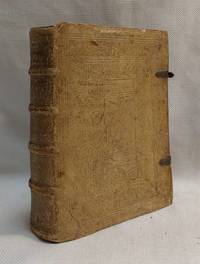
1544321627Wittenberg Germany: Veit Kreutzer 1544. Hardcover. Very Good. Wittenberg: Veit Kreutzer 1544 German edition of Melanchthon's Loci Communes first published in Latin in 1521 as "Loci communes or Loci communes rerum theologicarum seu hypotyposes theologicae" Latin for Common Places in Theology or Fundamental Doctrinal Themes. Very good. Pages of the text are numbered entirely in roman numerals to page CCCLIII. With an unnumbered register index of 23 pages. Beautiful contemporary stamped ivory vellum veneer boards with a set of elegant silver clips. No front endpaper. The copy bears an early bookplate "Ex bibliotheca Gust. Ad. Hauseri theol et philos. stud. Cl nr" inside the front board. Light pencil signatures from the 19th century trace the stewardship of Ole Lokensgaard 1854-1931 Granite Falls Minnesota who came to the US in 1857. The family was associated through his son Gerhard W. Lokensgard with St. Olaf College in Northfield. It has been held by the family through 3 generations. The Loci Communes evolved with the reform movement. This 1544 edition is translated by Justus Jonas into German based on Melanchthon's 1542 revision. Title in English: "The Heubtartike Christian Literature/ drawn together/ By Philippum Melanthon/ called in Latin/ Loci Communes Theologici. Germanized by Justum Jonam/Doctor/ and in the 1542nd year/ By Philip. Melanth. checked again and improved." The Loci Communes evolved with the movement. Philipp Melanchthon 1497 – 1560 was a German reformer a collaborator with Martin Luther and part of the Wittenberg team that established the foundation of the Protestant Reformation. Melanchthon was its first systematic theologian and an intellectual leader of the Lutheran Reformation who with Luther was a primary founder of Lutheranism. Loci Communes was Melanchthon's Magnum Opus. "Melanchthon points out that he wrote the Loci Communes to encourage people to bypass extra-biblical sources and go straight to scripture. He does not believe it makes sense to try to integrate philosophy with the interpretation of the Holy Scriptures. Melanchthon berates the scholastic methodology of dialectic. He discusses the skewing of scripture that those who employ such methodology foisted upon the interpretation of scripture". The colleagues that Luther assembled in Wittenberg’s theological faculty formed the nucleus of his team. This included Justus Jonas 1493 –1555 who served in addition to roles as advisor and legal expert as translator of the works of Luther and Melanchthon from Latin into German or German into Latin. In the 16th century intellectuals across Europe spoke Latin. To spread the Wittenberg message this process of translation and revision was essential to the maturing of the movement. The later editions were published from 1543-1559 with the final edition being published just one year before Melanchthon’s death in 1560. The 1560 edition is four times the size of the original 1521 edition. "The German text of the third generation remains close to the second generation of the Latin Loci; the text is a revision by Melanchthon of the translation of Jonas.He once confessed that he found the final revision of this German translation better than the Latin Loci CR 22 31/32." We believe that this 1544 Jonas translation may be the one to which Melanchthon refers. But that is a matter for further scholarly investigation. The simple beauty of the copy with its silver clasps is exceptional. Veit Kreutzer hardcover
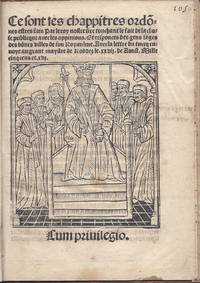
15161704S.l.: s.n. 1516. First edition. Title page with large woodcut illustration showing the King on his throne surrounded by the delegates. In Bastarda type with two floral woodcut initials. In later hard paper. Gilt title vignette on spine damaged. Concise marginal notes and page-numbers in ink by a contemporary hand throughout. Trimming of the leaves slightly affects the glosses with no effect to legibility otherwise the margins are wide. Title page crinkled at the upper right corner with a small tear that only affects the margin. Narrow inkblot to the lower margin throughout. B4 with two light brown stains C1 crinkled at lower corner. Bookplates on the inner front panel G. J. Arvanitidi; Antoine Mouradian. Overall in very good condition. First edition. Title page with large woodcut illustration showing the King on his throne surrounded by the delegates. In Bastarda type with two floral woodcut initials. In later hard paper. Gilt title vignette on spine damaged. 20 p. <p><br /> A bibliographically unrecorded early sixteenth-century French book about royal ordinances regarding the commonwealth along with the French translation of Sultan Selim I's letter of conquest fethname addressed to the Grand Master of Rhodes. <br /> <p><p><br /> The first and major part of the book presents nine concepts of orders of Francis I 1494-1547 King of France from 1515 until his death regarding the commonwealth chose publique. The drafts concern such topics as the commerce of spices and drugs wool cloth and other goods chapter 1-4 the weights and equivalents of coins and the recognized foreign currencies chapter 5 the recognized units of measures chapter 6 the regulation of the extravagance of clothing chapter 7 the inn trade chapter 8 and the money that goes to Rome for obtaining Bulls chapter 9. <br /> <p><p><br /> The second section comprises the responses to the aforementioned concepts of the representatives of the Good Cities Bonnes Villes Provence and Dauphiné who had been previously assembled in Paris by the order of the King in March 1516. In most cases they requested a delay of reply to discuss the matters with those who they were representing.<br /> <p><p><br /> The third section presents the grievances and requests delivered to the King by the delegates regarding the provincial councils conciles provinciaux the prolixity of the trials the tariffs the public officers the superior courts cours souveraines the land taxes tailles and the abuse and plunder by the soldiers crossing the kingdom. <br /> <p><p><br /> These sections were recorded and written down by the court clerk Jean Hesselin Seigneur of Girodon. Hesselin mentions himself twice p. 14 and 17 once by name p. 14 within the text.<br /> <p><p><br /> The final part is the French translation of the Ottoman Sultan Selim I's fethname letter of conquest sent on 27 August 1516 from Aleppo to Fabrizio del Carretto 1455-1521 Grand Master Magnus Magister of the Knights Hospitaller in Rhodes between 1513 and 1521. The fethname accordingly to its genre details Selim's expedition and the conquest and emphasizes the power and grandeur of the Sultan and his army. <br /> <p><p><br /> Selim I 1470-1520 ascended the throne as the Sultan of the Ottoman Empire in 1512. He is remembered for the enormous expansion of the Empire during his reign thus raise the Ottomans to the leaders of the Muslim world. Selim's most notable deed was the conquer of the Mamluk Sultanate which included Levant Hejaz and Egypt in 1516 and 1517 at the Battles of Marj Dabiq and Ridaniya.<br /> <p><p><br /> The Battle of Marj Dabiq near Aleppo took place on August 24 1516 where Selim defeated the Mamluk Sultan Al-Ashraf Qansuh al-Ghuri. This was a decisive victory of the war between the Ottoman Empire and the Mamluk Sultanate which ended in the conquest of much of the Middle East. Such an expansion of the Ottoman territory was a clear threat to Rhodes which was the nearest Christian possession to the coast of Asia halfway between Constantinople and Egypt. At the time the Grand Master in Rhodes was the Italian admiral Fabrizio del Carretto 1455-1521; Grand Master from 1513 to 1521 for a short interlude of a course of fifty-five years of Frenchmen serving as the supreme heads of the Order. Selim announced his victory and forecasted his threat to del Carretto in a fethname presented here in French translation however eventually he did not have the time to conduct the campaign against Rhodes. It was his successor Suleiman I who conquered the island in 1522 thus gained control over the eastern Mediterranean for the next centuries. By the time of the siege the commander of the Order was again a Frenchman Grand Master Philippe Villiers de L'Isle-Adam 1464-1534. Suleiman allowed him and the surviving knights to leave unmolested and eventually the Hospitallers were quartered permanently on Malta in 1530.<br /> <p><p><br /> To the best of our knowledge the original fethname has not survived and we could not trance any other printed version or edition of the French translation. We could find one surviving copy of a Spanish translation of Selim's letter which was addressed to Pope Leo X titled Carta de nuevas grandes buenas y ciertas embiada a nuestro s. padre Leon X de las cosas que han passado en Levante entre el gran turcho y el gran solda Valencia Juan Viñao 1517; Norton 1256 IB 11215 USTC 344377 kept at Cambridge University Library F151.d.8.12.<br /> <p><p><br /> Provenance: Bookplate of Georgios Arvanitidis 1876-1953 a noted Constantinopolitan collector of books on Turkish and Greek history. Bookplate with the motto "On abuse du vrai" of Antoine Mouradian.<br /> <p><p><br /> Ref.: Bibliographically unrecorded.<br /> <p><p><br /> Bibl.: Setton K. M. Hazard H. W. ed.: A History of the Crusades. Vol. 3. Wisconsin: The University of Wisconsin Press 1975. pp. 332-335. Pedani-Fabris M. P.: Ottoman Fetihnames. The Imperial letters announcing a Victory. In: Tarih İncelemeleri Dergisi 13 1998. 181-192. <br /> <p>. [s.n.] unknown
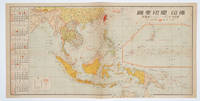
1572160545No place of publication.: 朝日新聞社. The Asahi Shimbun. 昭和十五1940. Published by 朝日新聞社 The Asahi Shimbun Japanese folding coloured WWII map with a calendar from January to June Shōwa 15 at the left scale 1:300000. Map includes French Indochina Dutch East Indies and parts of the territory of Papua China and British India. Some light browning and foxing otherwise very good. Text in Japanese. 25.3 x 51cm. Legend at lower left lists the boundaries between continents countries and provincials or regions railways airline routes capitals and Japanese embassies and consulates. <br> <br>The natural resources are indicated across the map. The map also shows parts of the territory of Papua under Australia's administration " 濠洲委任統治領 Gōshū inin tōchiryō". . 朝日新聞社. [The Asahi Shimbun]. unknown
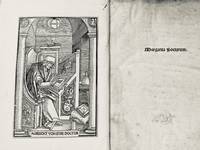
1503723<p>Post incunable: publisher not identified or Venezia: Albertino da Lessona 1502. 1503. It is bound in full seventeenth century vellum with spine label. . The first printing of the Margarita Poetica was printed by Johannes Sensenschmidt in1472 between 1472 and 1503 there appeared at least a dozen editions In this edition the marginal index letters correspond to those of 1493 Venice edition. <br />¶ Eyb went to Italy and devoted himself to humanistic study at the Universities of Pavia and Bologna. He returned to Germany in 1451 having been appointed Canon at Eichstätt and Bamberg. From 1452 to 1459 he was again a student at Bologna gaining the degree of doctor in 1459. The Margarita is named after Eyb's mother and was written in 1459.<br /><br />Fabriccius observed the "Eyb stressed two things throughout the Margarita: to be able to write well and to be disposed to live properly."<br /><br />¶ In a contrast to "Ars Dictaminis" perhaps the Middle Ages version of TEXTING von Eyb uses this work to re-Introduce Cicero's Vetera Rhetorica. While certainly there are many late medieval texts on letter writing Eyb as can be seen in the structure of this book<br /><br />The Content are in three parts the first Epistola five Prologus is a revised and augmented version OF M.T.C. CICERO with excerpts taken from classical authors and Italian humanists and formulas for letter-writing. The first part offers style samples of Roman rhetoric poetry and epistolography. <br />¶The second part the AUCTORITATES consists of an a Florilegium Roman writer and with its third part extracts from Petrarca Terence Plautus and SenecaCicero Lactantius Macrobuius Plutarchus etc finally 30 speeches as models of humanistic eloquence.<br />¶ The third part ORATIONES: contains selections from Petrarch dramatic poets Terence <br />Seneca Plautus and a variety of humanist speeches by Renaissance copyists letter-writers and philosophers including Johannes Lamola Poggius Florentinus Galeatius Sforza and the author himself. Folio a8 B-X8 Y8 this copy is lacking the final gathering signed with numbers 1-4 only comprising a Materiarum-tabula which is not present. Gatherings a-I have printed decorated intitials; K-X have blanks some with printed guides for manuscript initials not filled in.<br /><br /><br />Panzer IX 107 4; Rare: Not in Adams VD 16 BM Geman or Italian.</p> [publisher not identified] or [Venezia: Albertino da Lessona, 1502]. Â hardcover
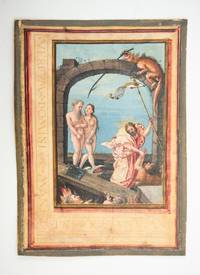
1540ST20622Germany ca. 1540. 183 x 133 mm. 7 1/8 x 5 1/4". <br/> WITH A FULL-PAGE MINIATURE DEPICTING THE HARROWING OF HELL featuring a naked Adam and Eve on the left and on the right Christ bending down to rescue John the Baptist the figures framed by a stone archway supporting a hairy creature who aims the point of a spear directly at Adam and Eve the miniature in a thin brown frame with gilt lines surrounded on two sides by the words "VERBUM DOMINI MANET IN ETERNUM" in gilt all framed in gray and red washes with double rules of black and gilt. Light soiling to frame a little flaking to the gray border and a couple of small scuffs and smudges elsewhere verso with spotting but the miniature vibrant and well preserved with only very trivial imperfections.<br/> <br/> A close copy of an early 16th century engraving by Albrecht Dürer this powerful miniature depicting the Harrowing of Hell is an intriguing artifact that ties together manuscript art print culture and the Reformation. The image depicts an apocryphal tale in the Gospel of Nicodemus in which Christ following his death but before his Resurrection descends into Limbo in order to save righteous souls who had passed away before him particularly figures from the Old Testament. Christ appears here in pale pink robes carrying a long staff with a cross and banner adorning the top. Having just brought down the gates of Hell he stoops to rescue John the Baptist here dressed in furs from its depths. A naked Adam and Eve covering their loins stand at the left of the composition--Adam now a gray-bearded old man as a reflection of sin and mortality but Eve still as she was at the Expulsion in keeping with the period's inclination to retain the classically idealized youthful feminine form. Above them is a stone arch upon which a dog-like demon perches stealthily aiming a spear directly at the oblivious couple. Another demon snaps its jaws at the feet of Christ and we can see a lick of flames below the broken gate as more captive souls clamor to escape. The painting is skillfully done showing the artist's facility with anatomy proportion and foreshortening. The bodies of Adam and Eve are particularly excellent with lovely skin tones and convincing molding. The composition is clearly based on an engraving by Dürer published in 1513 as part of a major series of 16 images known as the "Engraved Passion." In translating a black & white print into a full-color painting the artist here dispensed with a few details seen in Dürer's work such as the shadowy figure behind Adam and Eve and the stigmata on Christ's hand; however the overall composition deviates little from the original suggesting that the artist may have been working from an actual engraving. Although this leaf contains just a few words in the form of a border inscription--"Verbum Domini manet eternum" "the Word of the Lord endures forever"--they are monumentally important. This line from Isaiah 40:8 and 1 Peter 1:25 became the motto of the Lutheran Reformation appearing on art clothing coins and even armor of the 16th century. The Schmalkaldic League an influential group of allied Lutheran principalities in the Holy Roman Empire at the time also adopted it as their motto. Given the dominance of print materials during the Reformation period our hand-painted miniature--possibly produced as a frontispiece--must have been a very special commission. It is also an object that is prime for further study touching on aspects of book production religious art and the transmission of images and ideas in the early modern period. unknown
15541506230049Venice: Apud Hieronymum Scotum 1554-01-01. Hardcover. Good. Folio. Original vellum. Minor soiling to cover. Good binding and cover. Later leather binding straps. Later end pages. Printer's device on title page. Text generally clean a few lines of early marginal notation and underlining. Collated: A-L8 M-M6 N-N4 in 8's with the title as leaf A1. Faint stain on first few leaves. Edito princeps 1535. Refs: British Museum p. 44. STC Italy Vol I. p. 99; Not in Brunet. <br><br> Johannes Philoponus John the Grammarian or John of Alexandria was an important Aristotelian commentator and Christian theologian. John's commentaries on Aristotle were influential on medieval and early modern thinkers in Europe such as Gianfrancesco Pico della Mirandola and Galileo. Philoponus has been seen as an important precursor to the establishment of empirical philosophy. <BR> In this book Philoponus comments on Aristotle's De Anima On the Soul and substantially modifies Aristotle's ideas. His commentary deals specifically with Aristotle's theory of light "Philoponus contends that Aristotle' view fails to account both for the laws of optics. Philoponus modifies the theory so as to save the phenomena he proceeds to re-interpret the term Energeia not as a state of actuality but rather as an 'incorporeal activity' which besides constituting the transparency of the medium is also capable of warming bodies.Due to this novel interpretation of Aristotle's terminology light is now understood not statically but as something dynamical." - Stanford Philosophical Encyclopedia. <BR>It should also be noted that since Michael Hayduck's edition Berlin 1897 it is generally assumed by scholars that the third book of the commentary that had been ascribed to John Philoponus wasoriginally written by Stephanus of Alexandria as is attested in the manuscript Parisinus gr. 1914 11th/12th cent. An important early work in physics and natural philosophy. Venice: Apud Hieronymum Scotum hardcover
1502M250727114Crypt Records 2015-02-17. audioCD. Very Good. 5x0x4. Gently used includes case cover art inserts and CD. Ships Next Business Day. Crypt Records unknown
1552V48030Basel: H. Froben 1501-1563 1552. Hardcover. Very Good. Large Froben printer's device on titlepage historiated woodcut initials throughout. . Four Volumes in One large folio bound in blind-stamped pigskin dated 1564 with initials I.D.F.H. on bevelled wooden boards with metal clasps lacking one clasp each board has 16 small marginal panels of biblical scenes and four larger central stamps of Justice Fortitude etc with legends under each spine on four raised double bands with MS title and shelf mark "Basilius 39" some small worm holes tips worn. Title page catalogue 6 787pp with colophon "Basiliae apud Hier. Frobenium et Nic. Episcopium anno M.D.LI" 1551 21pp index 3pp blank with large Froben device on last page. Bookplate with coronet initials dated 1913 inscription "Ex bibliotheca Johannis Mathon Lugd. Bat." with MS devices on free endpaper & another inscription on titlepage. Collated complete &4 a-z A-M6 N8 O-Z Aa-Ss6 Tt8 Vv-Xx6 with pagination continuous each of 4 vols has divisional titlepage see Adams B340. Crisp and clean throughout but with quite extensive worming of pages near front and back of book. NB large heavy book so extra shipping/postage costs. H. Froben (1501-1563) hardcover
159135316Ingolstatt David Sartor 1591. Folio. Contemporary full blindstamped pigskin over wood. With one of 2 clasps preserved. Stamps on top of title. Engraved ornamental title Dominic Custodis sc. 6120015 pp. Tiny wormholed in covers and on the first ca. 20 leaves and last ca. 10 leaves. Internally fine and clean. <br/><br/><em>First German edition of Basil the Great's works. In 370 he became the successor of Eusebius as bishop of Caesarea and he is well known for organizing the monastic communities in Asia Minor and his composing of monastic rules his improvements of liturgy still in use in the Eastern Church the liturgy of St. Basil. His letters and sermons belongs to the best of his times. </em> unknown
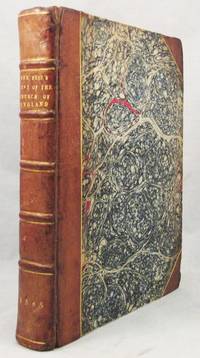
156532099Antwerp: John Laet 1565. Five books in one volume. A VERY RARE COMPLETE COPY the First Edition of Historia ecclesiastica gentis Anglorum translated into English. Provenance: Montanus 1602 -- Sir Roger Twysden 1648 and Sir John Saunders Sebright armorial bookplate. With woodcut device on titlepage woodcut armorial dedication to Queen Elizabeth woodcut plate of St. Augustin with Elbert King of Kent in anno 596 woodcut plate of King Oswald uniting the Umbrian kingdoms halfpage woodcut of Elbert building St. Paul's and with many large and handsome woodcut initials all throughout. The woodcuts are possibly by Arnaud Nicolai. Small 4to 188 x 140 mm in antique three-quarter russia over marbled boards the spine with raised bands ruled in gilt one compartment gilt lettered gilt dating at the tail gilt lined back and cornerpieces. 1-6 >1-4 #1-4 192 9 pp. A truly excellent survival of a book rarely found complete. The text-block is especially fresh and well preserved crisp and very clean. The blanks date from the time of the binding but the text is otherwise wholly complete and original the binding is handsome though its age is evident and there was restoration some time ago to the hinges the front of which is also strengthened from within. VERY RARE FIRST EDITION IN ENGLISH OF THE FIRST AND GREATEST WORK OF ENGLISH HISTORY BY THE FATHER OF ENGLISH HISTORY. RARE IN COMPLETE STATE when one reads the catalogue entries of copies in even some of the worlds most prestigious institutions one finds descriptions of missing signatures facsimile titles or entire sections excised to be quite the norm. This copy but for its probable early 19th century blank flies and endpapers is wholly intact and in a truly exceptional state of preservation.<br> The Venerable Bede's title of "The Father of English History" is well deserved. He was England’s greatest historian in the Middle Ages. His greatest work is the Historia Ecclesiastica here in its first English edition. It is an ecclesiastical history of the English people. Bede begins with Caesar’s invasion in 55 BCE and St. Alban’s martyrdom in Roman Britain tracks the spread of Christianity following St. Augustine’s mission to England in 597 and provides an account of critical events such as the Council of Whitby which decided that Roman rather than Celtic Christian customs would be followed in Britain.<br> Bede drew on the many manuscripts in the Jarrow monastery’s outstanding library and correspondents provided him materials. He was a diligent scholar and properly credited his sources. To the benefit of historical scholarship Historia Ecclesiastica spread widely throughout Europe in the Middle Ages with some 160 manuscripts still surviving. Not long after his death he became known as the Venerable Bede. His was one of the first printed history books published in Latin in Strasbourg about 1475. Highly popular on the Continent and in Britain it was reprinted in 1500 1506 and 1514.<br> Due to its strong association with Catholicism this first translation into the English tongue was published in Antwerp as the book was then prohibited in England as traitorous. Stapleton was educated in Oxford where he became a fellow in 1553. On Queen Elizabeth’s accession he left England to study theology in Louvain and Paris. His translation of Bede was his first of many fine works. Stapleton used Bede’s history to remind the reader that “we Englishmen also these many hundred of years kept and preserved sound and whole the precious perle of right faith and belefe†and he admonished that “after we forsooke the first paterne off the Christen faith delievered to us we have fallen in to plenty of heresies.†He added that the Venerable Bede a most reliable source describes many miracles that occurred in Britain under the true faith. Stapleton's translation has been called an "enduring contribution to this sparkling collection of recusant prose" -DNB <br> This is also a copy of fine and established provenience. It was formerly owned by the renown historian and antiquary Roger Twysden whose ownership signature is dated 1648. Having been caught up in civil war strife Twysden retired to his seat Roydon Hall and devoted himself to his study and writings particularly on early English histories and monasticism. His collection passed to Sir John Sebright who sold the main portion at auction in 1807. Much of Twysden's collection later passed to Sir John Sebright whose fine engraved armorial plate is afixed to the front paste-down. The present binding was likely made while the book was in Sebright's possession. <br> Contrary to the implications of Stapleton's edition of Bede Twysden's Historical vindication of the Church of England 1657 argued that it was the Church of England rather than Rome which had held fast to the true faith and that the pope's powers over England gained gradually over the centuries had been submitted to voluntarily out of love not duty for the archbishop of Canterbury had no mediate superior but only Christ and God see Jessup Sir Roger Twysden pp. 192-5. Completed in 731 Bede's Historia ecclesiastica gentis Anglorum is 'probably one of the most popular history books in any language and has certainly retained it popularity longer than any rival. The enthusiasm shown for his writings in the eighth century by English missionaries on the Continent such as Boniface Lul and others led to the spread of knowledge of his works not only in England but also in western Europe . . . . From then on as the spread of his manuscripts shows the History became popular all over western Europe and 160 of them survive today in spite of all the wars and other dangers to which manuscripts are always subject' Colgrave & Mynors p. xvii. It was first printed c. 1475 at Strasbourg PMM 16. 'Bede provided for over a thousand years and to a large extent still provides nearly all the knowledge available of the early history of England. His Historia is the only work other than parts of the Bible which has been read by every English generation from his own day to the present. It has the power to move and to convey something of the personality of its author to a degree which has called forth not only admiration but a kind of affection' Oxford DNB. John Laet hardcover
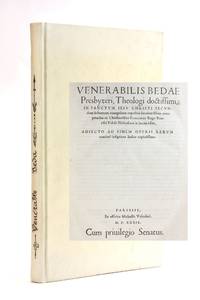
1539505317Michaelis Vascosani Michel Vascosan 1539. Leather. NEAR FINE. 4 218pp. 9 Index. Folio in 6's collation complete: 2 A3-T6 2. Vulgate text printed in larger font with woodcut drop caps marginal references. Nicely bound in recent vellum with hand-written spine title in a convincing antiquarian hand. Some light staining to the edges small wormhole to top margin toward the gutter not affecting text; else FINE internally; a nice fresh copy. Bede the Venerable was one of the greatest minds of the Middle Ages and his immense learning is on full display in this commentary on the Fourth Gospel drawing on the church fathers as well as interlocating Old Testament and intertextual references. Bede had a particular devotion to the Johnannine gospel; his translation of the Vulgate into Old English is held as the first vernacular translation. The value of this particular edition is due to its significance in the history of printing. Vascosan set up his press 1530 under the banner of his father in law the famed printer Badius and adorned his title pages with the Badius printer's device through the decade. For reasons unclear possibly a dispute with relatives sharing an interest in the firm in 1539 Vascosan stopped using the Badius device. Rather than cut his own device Vascosan simply printed his title pages without one remarkably becoming the first printer to forego this branding tool that was so essential to printer differentiation in an age when books were sold without bindings. While his motivations at the outset are unclear it may have been simply needing to sell some books before a proper device could be cut he took a liking to it and maintained this style throughout his career. Today he is remembered as a pioneer of this 'unadorned elegance of his editions' Oxford Companion to the Book p. 1238. His text-only title pages were 'a harbinger of a new approach to title pages. Vascosan’s decision flew in the face of the Parisian and more generally European book-trade where printers’ devices had played a vital role in the identification and marketing of printers’ and booksellers’ output. He was trail-blazing a new method of promoting his works – a minimalist style which would challenge the use of ornate devices so popular among the first generation of Parisian printers and booksellers. Coupled with his rejection of a printer’s device was what one might call his ‘purification’ of the title page for his title pages are incredibly simple in style the whiteness of the paper dominating. Henri-Jean Martin wittily calls this ‘the graphic mode’ of ‘solemnization of the title page’ as opposed to the second ‘monumental mode’ which by the end of the sixteenth century became saturated with symbols and architectural motifs.' Exhibition Catalog 'Printing in Sixteenth-Century France at the Edward Worth Library.' While we cannot speculate on the priority of printings within the year 1539 we can say that no other copies of a 1539 Vascosan imprint are available in trade at this time and only one appears in auction records. OCLC 60698411 listes 8 copies. Michaelis Vascosani [Michel Vascosan] unknown
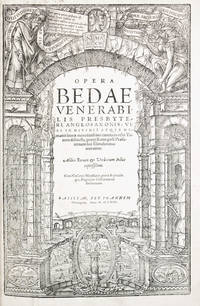
1563254015Basileae i.e. Basle: Per Joannem Hervagium 1563. First collected edition. Title within architectural border with device of Johann Herwagen. Profusely illustrated with iwoodcut maps music tables diagrams. Text in two columns; with Index. 4 vols. Folio. Contemporary calf rebacked new leather spine labels labels misnumbered later endpapers; covers worn but sound one joint starting but firm. Text show various degrees of slight worming and scattered light foxing but overall a very good sound set of this massive collected edition complete except for the final blank leaf of Volume VI. First collected edition. Title within architectural border with device of Johann Herwagen. Profusely illustrated with iwoodcut maps music tables diagrams. Text in two columns; with Index. 4 vols. Folio. This is the first of three continental editions of the works of Bede the others being from Cologne in 1612 and 1688. Johann Herwage a printer originally from Strassburg married the widow of the great Basel printer Johann Froben and for a while collaborated with his stepson Hieronymus Froben. From 1532 however he again started printing under his own name.<br /> <br /> RARE ON THE MARKET. Adams B-477 Per Joannem Hervagium unknown
154421323Paris: Petrum Regnault 1544. First Edition. . Hardcover. Good. Folio. Vignette title not in British library 261pp Vellum <br/> <br/> Petrum Regnault hardcover
158857770Kiøbenhaffn Matz Vingaard 1588-89. Folio. 39 x 27 cm. Samtidigt hellæderbind i brunt kalveskind over svært træ og med kanter i smig. Lettere ophøjede bind på ryg. Håndsyede kapitælbånd. Lille hak i skindet på nederste rygfelt. Med de 4 originale hængselsbeslag i støbt messing bevarede men den ene strop fornyet og den anden mangler. Permerne har begge blindtrykte arabesker i midterfeltet en stor arabesk og i hjørner og kanter 6 pyramideformede arabesker som alle er med en blindtrykt krone i pyramidens top. Permerne har mindre messingstifter med store hoveder til beskyttelse af bindet ved opslag. Marmoreret snit. Bindet er ganske velbevaret med kun lidt kantslid og let slid på de ophøjede rygbind. 22353i.e.354226159 blade. Komplet men uden de 3 blanke blade. Træskåret titelblad med tekst trykt i rødt i midterfeltet. Titelbladsvarianten med kongens kobberstukne portræt af Goltzius opklæbet på bagsiden en del eksemplarer udkom uden portrættet. Blad 2 med rigsvåbnet bladet er kantrepareret. 2 træskårne deltitelblade. Registerbladene med svag skjold i ydre marginer. De sidste 35 blade delvist omkantede for det meste i ydre marginer. Ganske få spredte brunpletter. Iøvrigt ganske lette brugsspor. Et udmærket velbevaret og komplet eksemplar bortset fra de 3 blanke.På forreste friblad er anført lidt af eksemplarets ejerhistorie fra 1819 - erhvervet af Mikkel Johannesson Fladebøe som her delvist klausulerer dens ejerskab til fremtidige ejere af gården Fladebøe . Senere synes den overgået til andre i slægten bosat i U.S.A. Olaf Albertsen Axel Albertsen Stanley Albertsen Sidney Albertsen. Folio. 39 x 27 cm. Contemporary brown full calf over heavy wooden boards with oblique edges. Sloghtly raised bands to spine. Hand-stitched capital bands. A small notch to the leather of bottom compartment of spine. With the four original brass clasps preserved but one strap has been renewed and the other is missing. Boards with large blindstamped centre-arabesque and six pyramid shaped arabesques to corners and edges all with a blindstamped crown on top. Large-headed bras spins to boards to protect the boards when open. Marbled edges. A bit of wear to edges and light wear to the raised bands. 22 353i.e.354 226 159 ff. Complete save for the three blank leaves. Woodcut title-page with centre-text printed in red. The title-page variant with the engraved portrait of the king by Goltzius mounted on verso. Several copies were issued without portrait and some were issued as here with the title-page mounted on verso. F. 2 with the royal arms restored at edges. Two woodcut helf-titles. The index-leaves with a vague damp stain to the outer margins. The last 35 leaves have been partly re-edged mostly at the very outer margins. A bit of light scattered brownspotting. Light signs of wear. An overall well preserved copy in- as well as externally. Front free end-paper with handwritten notes on provenance from 1819 onward – bought by Mikkel Johannesson Fladebøe who partly clauses the ownership of the copy to the future owners of the estate Fladebøe. It seems to have then passed to other generations of the same lineage located in The United States Olaf Albertsen Axel Albertsen Stanley Albertsen Sidney Albertsen. <br/><br/><em>The magnificent first printing of the second Danish-Norwegian Bible in folio. This the second Danish Bible in folio is also the first to be printed by a Dane. The scarce and famous "Frederik II-Bible" constitutes the magnum opus of the famed book printer Mads Vingaard "and the most extensive work of printing undertaken in Denmark during the sixteenth century. The book is profusely illustrated with woodcuts copied from a german Bible issued by Sigmund Feyerabend in Frankfurt a. M. 1560. The original woodcuts were made by the artist and craftsman Virgil Solis. Wide woodcut borders together with pictures using themes from the Scriptures surround the title pages and the illustrations. On the reverse of the first title page many copies have pasted in a portrait of Frederich II engraved by the Dutch artist Hendrick Goltzius. However this portrait may also be found on a separate leaf." Thesaurus I.Lauritz Nielsen 405. - Thesaurus I 129. - Birkelund 34. </em> hardcover
1512241017074Demon/Edsel 2015-12-04. audioCD. New. 5x5x0. brand new in original shrinkwrap; because we care that your order arrives in the condition stated we have additionally sealed the case in bubblewrap for added protection during shipment Demon/Edsel unknown
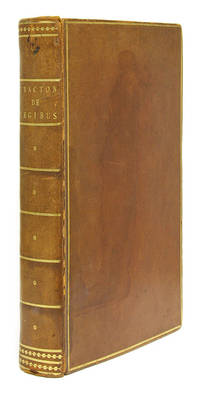
1569673671569. London 1569. First edition. Folio. London 1569. First edition. Folio. PMM 89: "The Crown and Flower of English Medieval Jurisprudence" Bracton Henry de d. 1268. De Legibus & Consuetudinibus Angliae Libri Quinq; In Varios Tractatus Distincti ad Diversorum et Vetustissimorum Codicum Collationem Ingenti Cura Nunc Primum Typis Vulgati; Quorum Quid Cuiq; Insit Proxima Pagina Demonstrabit. London: Apud Richardum Tottellum An. do. 1569. With imprimatur "Cum priuilegio" at foot of title. xvi 172 175-444 ff. Complete. Folio 11-1/4" x 7-3/4"; 28.6 x 19.7 cm. Nineteenth-century diced calf gilt rules to boards gilt fillets ornaments and title to spine gilt rules to board edges gilt inside rules marbled endpapers ribbon marker. Light rubbing to boards faint dampstain to front board moderate rubbing to extremities front joint starting at head rear joint cracked corners bumped and somewhat worn armorial bookplate "Ex Libris Munden" to front pastedown. Attractive large woodcut decorated initials. Light toning to text somewhat heavier in places light foxing and finger smudges to some leaves some fading to text of ff. 1 and 2. A handsome copy of a landmark work with an interesting provenance perserved in a navy blue clamshell box. $13000. First edition. Written between 1250 and 1256 De Legibus et Consuetudinibus Angliae The Laws and Customs of England is the first treatise on English law. A systematic work it emphasizes the separation of procedural and substantive matters and also cites cases as sources of at least intellectual if not formal authority. Both the principles formulated in this work and its use of precedents determined the development of English law and established the method adopted by Littleton and Coke. In Maitland's words it is "the crown and flower of English medieval jurisprudence" and "by far the greatest of our medieval law books." This copy belonged to Arthur Henry Holland-Hibbert 3rd Viscount Knutsford 1855-1935 of Munden House Hertfordshire. He served as both a justice of the peace and High Sheriff of Hertfordshire. His bookplate was engraved by Sir Henry Badeley who designed bookplates for a number of important clients including the House of Lords Library. Maitland Collected Papers II:43. Dauchy et al. Eds. The Formation and Transmission of Western Legal Culture: 150 Book. unknown
15880026748London & Oxford: Oxford University Press Humphrey Milford Horace Hart 1588. First Edition Thus . Soft cover. Very Good. 8vo. FIRST EDITION. OXFORD : 1907 written in 1588 . Grey printed paper covers as issued. Untrimmed edges as issued. Sewn book. With the Editor's compliments' in neat hand to head of title-page. Text tight and clean Covers have edge-wear and are a little dusty. One or two minor marks. VERY GOOD. Full title; The ' Retractation' of Robert Browne . Being 'A reproofe of certeine schismatical persons-i.e. Henry Barrowe John Greenwood and their congregation-and their doctrine touching the hearing and preaching of the Word of God.' Written probably early in the year 1588 since lost and now first published with a brief account of its discovery by Champlin Burrage. VERY GOOD. viii 65 pages. SCARCE. Will be well-packed for posting/shipping. 8vo. Rosley Books for Antiquarian books CHS Cumberland Everyman GKC Inklings Keswick Literature MacDonald Rarities Theology and History. . SCARCE. <br/> <br/> Oxford University Press (Humphrey Milford) Horace Hart paperback
1551V73009Paris Lutetiae: Robertus Stephanus Cum privilegio Regis 1551. Hardcover. Very Good. Nice Estienne printer's device on titlepage of basilisk wound round vine and floral headpiece and initial on first page of life of Pompey the Great. Small quarto 23.5x14mm half 19th century morocco on 5 bands gilt ruled with Greek title and brown marbled boards marbled endpapers with neat Greek Athens bookseller's label 357pp 3pp Variae Lectiones & Errata. Beautifully clean and crisp handsome Greek typography. Editio princeps of the epitome of Dio's Roman history abridged in the 11th century by Joannes Xiphilinus the only source for Dio's lost books 61-80 dealing with events from 47 B.C. to 235 A.D. Robert Estienne issued this epitome to compliment his folio edition of Dio Cassius of 1548. Printed in the gros-romain font of the "grecs du roi" cut by Claude Garamond. Robertus Stephanus Cum privilegio Regis hardcover