24 résultats
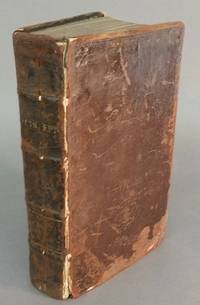
1633156London: Robert Barker.by the Assignes of John Bill 1633. Very Early Elizabethan Printing. Tooled leather. Very Good /Custom Case. 12mo original tooled leather 17th century binding engraved frontispiece very closely cut borders all edges gilded original green silk page divider viii blank ~ 524 vi blank pages. THE NEW TES_/ TAMENT / Of our Lord and / S A V I O V R / - Jesus Christ Newly translated out of the / Originall Grrek : and / with the former transla- / tions diligently compared / and revised by his Maie- / sties special commande- / ment. ---------------------------- Imprinted at London / By Robert Barker Printer / to the Kings most Excel- / lent Majesty and by / the Assignes of John Bill 1633. Cum privilegia. A GEM! In an original tooled leather binding no less. Beautiful clear type. Minimal wear. Some pages so closely cropped by the printer that the chapter headings at the top have been partially excised though not the text. In order to ensure its proper long-term preservation we commissioned Scott Kellar distinguished Chicago bookbinder and restorer to make minor professional repairs and to construct a protective box for this already Exceptional and Rare tiny edition of the Authorized King James version of the New Testament. Finely bound in contemporary tan embossed calf over wooden boards richly gilt to spine. four hubs and boards. Marbled pastedowns & endpaper. a.e.g. and gauffered. Spine very slightly rubbed with partial loss of caps at head and foot restored and almost invisible. Edges of engraved title page reinforced; overall a fine copy. Ink inscriptions on two front free endpapers naming "Edmund James Gore" & his London addresses. The continental binding on this small format Authorized version MAY suggest that it might be a pirated edition of the English Bible pirated in Amsterdam. For example the Stam printing family were printing small format Bibles in 1673-- after our publication see Cambridge History of the Book in Britain IV p.467. Herbert 713-14 Wing B2511A. Robert Barker...by the Assignes of John Bill hardcover books
1633306616Paris: Societatis Typographic Librorum Officii Ecclesiastici . 1633. Engraved title numerous small and large engraved vignettes head-and tail-pieces one full-page engraving; text printed in black running headlines and chapter headings in red numerous large decorated initial capitals. 1 vols. Folio. Full red crushed morocco covers decorated with single black and gilt fillets including a central diamond in black and gilt with a gilt-rolled frame spine in six compartments with raised bands gilt lettered in two others with simple frame of black and gilt fillets wide gilt turn-ins with large gilt cornerpieces a.e.g. gilt-stamped on the turn-in of the inside front cover "French Binders Garden City NY" and on that of the rear cover "H. Hardy Relieur 1934 G. Pilon Doreur." Very slight rubbing to extremities still near fine with some toning to text. In a quarter morocco slipcase with chemise. Engraved title numerous small and large engraved vignettes head-and tail-pieces one full-page engraving; text printed in black running headlines and chapter headings in red numerous large decorated initial capitals. 1 vols. Folio. Bound by The French Binders 1934. Beautifully bound in full red morocco by The French Binders successors to The Club Bindery and signed on the rear turn in by two of the firm's most distinguished binders Henry Hardy and Gaston Pilon. <br/>The French Binders traces its lineage back to The Club Bindery founded in 1895 by members of the Grolier Club to provide exceptionally fine bindings for American collectors. The Club Bindery moved to Cleveland where it was successively renamed the Rowfant Bindery 1909-1913 the Booklover's Shop 1914-1917 and finally The French Binders 1918-1920s as in-house bindery to Doubelday in Garden City New York. Henry Hardy worked for all incarnations of the bindery starting with The Club Bindery; his brother-in-law Gaston Pilon worked with Chambolle-Duru in Paris and came over to America to join the Rowfant Bindery. Both Hardy and Pilon were named Officers of the French Academy in 1933 the highest recognition given by the French government to naturalized Americans see Martin Antonetti's essay in Bound to Be the Best: The Club Bindery. Provenance: Estelle Doheny red morocco booklabel; Carl C. Kalbfleisch brown morocco booklabel Societatis Typographic Librorum Officii Ecclesiastici .. unknown books
164929369London: Printed for Matthew Simmons dwelling in Aldersgate-street 1649. 1st edition issue with 'Parlament' Wing E-1498 noting "Part of E1505". Disbound with leather remnants to spine. Age toning to text block edges. A VG copy. 2 12 - 28 = 18 pp. P. 13 misnumbered as p. 12. Printed glosses to pp 19-20. Headpieces. Decorative initial capital letters. 4to: 2 C-D3 -D4 a blank. 6-7/8" x 5-1/8" <br/><br/> Printed for Matthew Simmons dwelling in Aldersgate-street hardcover books
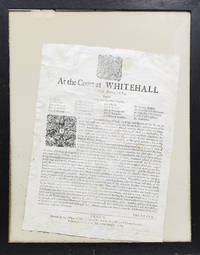
1683264178London: printed by the assigns of John Bill deceas'd; and by Henry Hills and Thomas Newcomb printers to the Kings most excellen t Majesty 1683. Printed broadside. Woodcut royal arms at head large decorative initial capital. 1 vols. 14-1/2 x 11-1/4 inches. Backed with tissue some old dampstaining some loss at margins but printed area complete except for a very small area of the royal arms. Old folds rust marks along with marginal wear suggest that this may at one time have been "affixt to some conspicuous place" as the text instructs. Printed broadside. Woodcut royal arms at head large decorative initial capital. 1 vols. 14-1/2 x 11-1/4 inches. King's Evil and the Royal Touch. From the Middle Ages in England and France it was believed that scrofula or "the King's Evil" could be cured by the touch of royalty; ceremonies were held in which the King would touch and "heal" hundreds of afflicted subjects. <br/>By the late 1400s it was believed that one could also be cured by touching a type of coin called an angel which had been touched by the monarch. After angels ceased to be minted in the 1620s the same effect was said to be achieved by touching a gold medallion embossed much like the old coin.<br/>Some monarchs touched many people. King Henry IV of France touched up to 1500 at one time. The last English monarch to carry out this practice was Queen Anne who died in 1714 but it continued in France. Louis XV touched more than 2000 scrofula sufferers and the last French monarch to do this was Charles X in 1825 Science Museum London. Cf. F Barlow "The King's Evil"Â The English Historical Review 95/374 January 1980 pp 3-27; M BlochThe Royal Touch: Sacred Monarchy and Scrofula in England and France London: Routledge & Kegan Paul 1973.<br/>The present broadside setting the dates for such ceremonies is rare on the market: no copies are listed for sale and none have appeared at auction. It also is signed in type by Lord Chief Justice George Jeffryes sic "The Hanging Judge" amongst others.<br/>An interesting manuscript note in a contemporary hand at the lower margin with significant loss calls the attention of "All Parsons Vicars and Curates" to the regulations set forth in the broadside. ESTC R34884 11 copies in UK 6 in US; OCLC 15328355 2 copies; Wing E-831 printed by the assigns of John Bill deceas'd; and by Henry Hills, and Thomas Newcomb, printers to the Kings most excellen t Maje unknown books
16154007Ávila and La Horcajada 1615. Manuscript on parchment 380 x 270 mm. 18. Complete. Contents: ff. 1r-4v: Regla in Spanish in 30 numbered sections inconsistent numbering on ff. 3v-4v in a rounded script in brown ink the first page slightly larger up to 27 lines. F. 1r: incipit first four lines in large lettering with very large calligraphic initial: En el nombre de dios todo poderoso padre y hijo y espiritu sancto tres personas y una esencia. Section 30 f. 4v added in a slightly later hand. The word Cruz symbolized by a red Maltese cross. Text on ff. 2r-2v underlined in red. Calligraphic initials some with marginal extensions in brown purple or red. Marginal drawings of prickly foliage some in the shapes of fantastic animals. Later marginal notes opposite many sections. Ff. 5r-5v: Heading: Este es traslado de un testimonio followed by two notarial subscriptions on f. 5v one partially in cursive signed and dated Ávila 11 May 1527 the other in italic partly faded including the date 1615. F. 6r: A cerca de la procession de la Resurrection. After an introductory portion in a small round early 16th-century hand in brown ink the text continues from f. 4v with sections 32-37 of the Regla of which sections 33-37 are in a later sixteenth-century hand; these sections ruled through with light diagonal lines. Signatures or notes in lower margin. F. 6v: blank except for five lines heavily cancelled in red. Ff. 7r-7v: five paragraphs in a fine upright italic hand the first and third with headings in red La orden que han de tener en la procession de la Resurxection sic en la faded and illegible.; La orden que sea de tener en la procession de la Resurretion sic en el domingo de pascua es la siguente. Followed on f. 7v by a note in a different hand dated from La Horcajada 21 May 1550. Ff. 7v-8v and back inner cover: later additions some quite faded. A few later marginal annotations throughout.Rubrication and decoration: headings and line fillers in red a few ornamented line fillers or borders some passages underlined in red or light purple else ruled in dry point numerous calligraphic initials in red or brown ink opening initial with purple filigree extension filling left margin numerous foliate vegetable and zoomorphic ornamental designs in the margins in red purple and brown ink.Binding: stitched into the original parchment cover with title "Regla de la Pasion" in large letters the R with decorative extensions above a large cross in green ink entwined with the snake and in the margins apparently the instruments of the Passion.Condition: rubbing and staining vertical crease from folding causing occasional erasure of text outer edge of first page somewhat rubbed affecting legibility of text some words at line ends helpfully written over in a later hand the inks used in the last two leaves quite faded; wrapper worn and darkened with tears at top and 3 small holes in lower cover.Provenance: Confraternity of the Holy Cross of Horcajada; purchased in France with export license. An early Spanish confraternity manuscript containing the rules and statutes that governed the Confraternity of the Holy Cross referred to as the Cofradía or Hermandad de la Cruz the word Cruz being supplied by a Maltese cross in red of La Horcajada a town located in Castile y León in the province of Ávila. As in other Roman Catholic countries confraternities or lay brotherhoods played a vital role in community life in Spain functioning as mutual aid societies and venues for laypeople to express their piety and perform charitable acts. Vernacular manuscript confraternity statutes from the Iberian peninsula surface much more rarely than for example their Italian counterparts although it appears that Spain had a larger number of confraternities proportional to the population especially in Castile y Leon than the other Catholic lands. Virtually every community including small villages had at least one confraternity. While exact numbers of confraternities in sixteenth-century Spain are unknown "studies carried out for a number of cities suggest that the number of confraternities and brotherhoods in the Hispanic kingdoms was larger than elsewhere in Catholic Europe. The reasons behind the extraordinary popularity of confraternities and brotherhoods in the Hispanic kingdoms cannot yet be established however in view of the current state of research on the topic. There has been a tendency for scholars to emphasize the confraternity as a primarily urban phenomenon a reflection perhaps of their early development in Italy where they formed an essential part of civic and urban life. In the Hispanic kingdoms however these institutions were equally important in the religious and social life of the small village. Pastoral visitations carried out by the bishops of Cuenca during the sixteenth century found that `nearly every community had at least one brotherhood' even small villages of 500 inhabitants. A similar pattern prevailed in villages around Toledo during the late sixteenth century" Callahan pp. 18-19.In his article on Spanish confraternities William Callahan further points out their popular nature which "arose from the initiative of the laity rather than the clergy prime examples of the lay piety that began to flourish in late medieval Europe. This piety developed largely on its own uncontrolled by either local bishops or the pope both of whom regarded its manifestations with some suspicion. The resiliency of traditional confraternities and brotherhoods developed from their connection to local religious cultures. It also reflected a fact noted by scholars who have studied specific cities and regions the strongly popular character of membership. There were of course some associations that limited membership to the nobility or clergy but in most cases members were recruited from the popular classes. This was obviously true in the case of peasant villages where only one or two confraternities existed." pp. 22-23. In spite of the centrality of confraternities to early modern religious life in Spain there is comparatively little modern scholarly literature especially on the rural confraternities. Note the absence for example of any articles on Spain or Portugal in Brill's recently published Companion to Medieval and Early Modern Confraternities edited by Konrad Eisenbichler.This working manuscript bears witness to this central but understudied aspect of Spanish popular religious culture before the restrictions placed on confraternities by the Council of Trent and succeeding Popes. Consulted frequently and contributed to by members of the confraternity the manuscript includes abundant interlinear and marginal additions and corrections and half- or full-page later additions. The town of La Horcajada is identified in the opening page. Ff. 1r to 5v contain the introduction the first 30 statutes and a notarized testimony with heading "Este es traslado de un testimonio" which relates to the apparently recent establishment of the confraternity. The statutes cover admission of new members general rules of comportment requirements of prayer and confession for feast days and for the canonical hours charity for poorer members of the confraternity chants etc. Several paragraphs relate to processions including required habits and admission of non-members into the processions. On f. 6r a paragraph on the procession de la Resurrection is followed by six entries numbered 32 to 37 of which paragraphs 33 to 37 are in a later 16th-century hand. Several light diagonal lines through these five paragraphs may indicate that they were cancelled. The verso f.6v contains only five lines heavily cancelled in red ink and f. 7r continues discussion of the procession of the Resurrection on a feast day the name of the saint is smudged and on Easter Sunday in a different 16th-century upright cursive. This second section of which portions are difficult to read because of fading ends on f. 7v and is followed by a note in a larger hand dated from La Horcajada 21 May 1550. The final leaf and inner back cover contain later additions some quite faded. One late addition in the lower margin of f. 5v is dated 1615.The manuscript is decorated in a popular style. Some of the leafy plant designs have a thorny look that may reflect local vegetation. Animals and grotesques include a scorpion-like creature birds and possibly imaginary mammals. A witness to the central role played by religious confraternities in early modern Spain bearing the marks of its use and in original condition it is a rare survival and would repay further study.Cf. William Callahan "Confraternities and Brotherhoods in Spain 1500-1800" Confraternitas: The Newsletter of the Society for Confraternity Studies 12:1 2001 17-25. See also William A. Christian Local Religion in Sixteenth Century Spain Princeton 1981; Maureen Flynn Sacred Charity: Confraternities and Social Welfare in Spain 1400-1800 Basingstoke 1989. unknown books
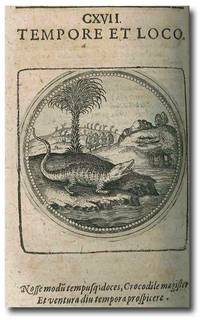
1668WRCLIT67650Mogvntiæ i.e. Mainz: Sumpt. Ludovici Bovrgeat . Typ. Christophori Kuchleri 1668. 820112044blanks2044blanks201 1pp. Small octavo. Four parts in one volume. Later limp vellum. Engraved title illustrated with four hundred circular engraved emblems within 7x7cm frames. Loss from lower margin of engraved title and first four prelims due to worming with no loss of letterpress and some repairs to foremargins the same worm track recedes to nothing by A8 part of one line of text marked through in early ink on 2M6 short tear in corner of one leaf mended at an early date; main portion of the text block apart from some tanning characteristic of the paper very good. A collective edition of this popular series of emblem books uniting the four sequences: I. Stirpium; II. Animalium quadrupedium; III Volatilium & insectium; and IV: Aquatilium & reptilium. Camerarius 1534-1598 the son of the German humanist was a practicing physician and botanist and served as dean of the medical college at Nuremburg until his death. This work originally published in sequence in Nuremburg 1590-1604 prints each emblem accompanied by a Latin distich along with an essay in Latin. It proved a model for further works in the genre including a continuation by Jacob Bornitz. The fourth century devoted to aquatic animals and reptiles was published posthumously under the supervision of his son Ludwig Camerarius. The original editions feature large in Nissen and Hunt where the engravings are ascribed to Hans Sibmacher. The engravings were reworked for the Frankfurt editions of 1654-61. BRUNET I:1513. OCLC: 17421505. Sumpt. Ludovici Bovrgeat ... Typ. Christophori Kuchleri hardcover books
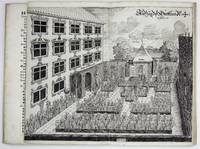
1641401738Augsburg: Johann Schultes and Mathias Rembold 1641. From the Collection of Arthur & Charlotte Vershbow. Folio 300 x 203 mm. Letterpress title printed in red and black torn and repaired 15 double-page or folding engraved plates or plans by Matthäus Rembold 1629-1657 on guards. Contemporary vellum. Some plates trimmed closely. Provenance: purchased from Ars Libri 1990. FIRST EDITION of this work on civil architecture by the eminent Ulm architect Joseph Furttenbach the Elder. The Architectura privata describes his own dwelling-house and grounds and the fine copperplates show the basics and elevations of the house windows portals grotto and gardens among other things. With its small grotto richly decorated with rare flowers arranged in compartments Furttenbach's garden courtyard epitomizes the intimate "secret garden" owned by the wealthy bourgeoisie in early seventeenth-century Germany and the Netherlands. The grotto in his garden is described as being filled with artifice and exotica including shell-encrusted sculptures and waterworks painted cosmological imagery and mirrors. The flowers depicted are identifiable as the most sought after and costly bulbs of the period the narcissus tulip fritillary and crown imperial demonstrating Furttenbach's knowledge of current botanical research. Following his studies in architecture and engineering in Italy Furttenbach returned to Ulm where he designed buildings and gardens and published a number of treatises on architecture and fortification. His construction of the Ulm city fortifications were among the strongest of their time remaining impregnable during the Thirty Years' War. Berlin Kat. 1958. <br/><br/> Johann Schultes and Mathias Rembold hardcover books
1635JC14671Amsterdam: Broer Jansz 1635. First Edition. Hardcover. Very Good. 4to 218 x 162 mm. Pagination: 38 1-400 pp. Signatures: -4; A-Z4; Aa-Zz4; Aaa-Ddd4. Engraved pictorial title of Heraclitus and Democritus and 2 illustrations and 19 circular emblematic engravings partly by Crispijn van de Passe the Younger. Contemporary stamped vellum with central arabesque ornament; some light browning some margins sliced in final quire but present few corners chipped. Rear pastedown with inscription from the library of Van Isaac le Long and dated 1744. Modern armorial bookplate of Bibliotheque I.G. Schorsch on the front pastedown. Dawsons Bookshop label also affixed on rear pastedown. <br/><br/>First edition and scarce variant copy of this classic Dutch poetry and emblem work by Zierikzee native Adriaan Hoffer which Benesch described as .adorned with etchings which in themselves are perfect little works of art although only slightly connected with the text Benesch Rubens to Daumier p. 39. Hoffers work contains poems comprising the authors self-commentary Biblical quotes and notably mentioned the victory of the Spanish silverfleet by Pieter Heyn in 1628 all in verse. Largely written in the vernacular Hoffer supplemented Latin notes to his poetry through ample marginal references. Hoffer was a wealthy man and book collector with many connections in the Zierikzee community. The Nederduytsche Poëmata was his most important work which sought to restrict the interest of natural inquiry to its edifying potential. This edition is notable for its engravings by Crispijn van de Passe the Younger a talented engraver who inherited his fathers style and repertoire and who remains inextricably linked to seventeenth-century Dutch printmaking. Not much else is known about the influence of Hoffers Nederduytsche Poëmata or Dutch Poems but an earlier work of the same title was written by Daniel Heinsius 1580-1655 and published in Amsterdam by Willem Jansson in 1618. Landwehr Dutch Emblem Books 92; Landwehr Low Countries 217; De Vries 161; Praz p. 370 Broer Jansz hardcover books
16351316802Amsterdam: Broer Jansz 1635. First Edition. Hardcover. Small Quarto 40 382 pages; G; bound in contemporary worn calf rebacked with brown calf black label with gilt lettering; lacking pages 383-400; with 18 out of 19 emblems and 2 other plates of symbolic character; with engraved title page; first 6 pages with repair to gutter; names written to front pastedown; scarce; shelved case 0. Follows the work itself consisting of a collection of poems containing emblemata on pages 47 52 65 85 97 104 110 114 116 140 179 185 189 200 283 328 333 337. Lacking plate on page 389. Those on pages 116 283 and 337 are from Cr. de Passe Jr. They are bordered in squares. Moreover the work also contains 2 plates on pages 17 and 19 also from Cr. de Passe Jr. The rest of the preliminary work contains praise from: Abr. van der Meer J. Cats and Ludov. à Kinschoot Lat. Num Zelus init damna I.V. D.M. D. Herm. the Hubert &c <br /> <br><br /> <br><br /> Volgt het werk zelf bestaande uit een bundel gedichten waarin emblemata voorkomen op blz. 47 52 65 85 97 104 110 114 116 140 179 185 189 200 283 328 333 337 389. Die op blz. 116 283 en 337 zijn van Cr. de Passe Jr. Ze zijn rond in vierkanten geärceerden rand. Bovendien bevat het werk nog 2 platen op blz. 17 en 19 eveneens van Cr. de Passe Jr.<br /> Anne Gerard Christiaan de Vries 1899. 1316802. Shelved Dupont Bookstore. Broer Jansz hardcover books
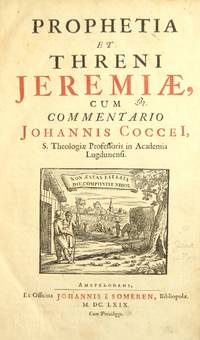
16699577Amstelodami: Johannis a Someren 1669. Folio pp. 6 319 7; bound with Prophetia Ezechielis cum commentario Johannis Coccei. Amsterdam 1669; engraved title page pp. 8 415 9; woodcut vignette on both titles titles printed in red and black 19 copper-engraved architectural plates on 16 folding or double-page sheets; old leather encrustations on front and back covers otherwise a good sound copy in full contemporary vellum. With an inscription on the flyleaf: "Library of Kenyon College Ohio. Presented by Rev. E. B. Pusey - Regis Professor of Hebrew Oxford 1835." Edward Bouverie Pusey 1800-1882 was a canon of Christ Church an esteemed orientalist and champion of orthodoxy. He counted among his intimate frinds Cardinal Newman and Gladstone. See DNB for a nine-page account of his life. <br/><br/> Johannis a Someren hardcover books
1640001354London: None listed 1640. Full Morocco. Very Good. 64 pp. 4to 12 by 8 inches 30 by 20 cm. Typos on title page include possibly "Johnson" although spelling was a more fluid matter in the 17th century and the year of printing is given as 1440 instead of 1640. Pages have expected levels of age toning but generally clean otherwise. Leaf with pp 33/4 has tiny hole by the continuation word "The" in lower right of 33 with trivial loss of part of the lettering of "the". Modern morocco and marbled endpapers bright and fresh. <br/><br/> None listed unknown books
1642EPL71London 1642. Paperback. Good. Published between 1628-1642. Based on the Common Debates of 1628. Including An act to prevent Extortions in Sheriffes Under-Sheriffes and Bayliffes of Franchises and Liberties in cases of Execution and An act for the better suppressing of unlicensed alehouse keepers. Upon question passed. Some contemporary inscriptions in English. Some pages remargined intermittent browning or chipping but a rare piece. Size: 260 x 180mm. <br/><br/> paperback books
165849004Amstelodami: ex officina Elseviriana 1658. 12mo pp. 24 643 1; engraved title page printer's woodcut device on printed title several woodcut initials and ornaments; contemporary full calf gilt-decorated spine in 5 compartments gilt-lettered direct in 1; spine worn but generally good and sound. This is the third Elzevier edition. Copinger 2552; Willems 1231. <br/><br/> ex officina Elseviriana unknown books
1679D11030Lyon: Chez Pierre Guillimin 1679. Hardcover. Very Good. Lyon: Chez Pierre Guillimin M.DC.LXXIX 1679. 8vo 150 x 80mm. 428pp. 43. Full page engraved frontispiece depicting a worshipper at the foot of the cross laden with Passion instruments crown of thorns sponge on reed withes ladder spear pillar with caption Les souffrances & la mort Dun DIEV pour nous Nôtre Continuelle. Meditation. The suffering and death of God for us is our continual meditation. Woodcut device of heraldic shield and cardinals hat with tassels on title. Woodcut chapter head vignettes and tailpieces one repeating of Evangelist John on isle of Patmos and another of Veronicas veil and woodcut historiated initials mostly birds throughout. Dedicated to LÂme Chrétienne. The Christian Soul. Italic and Roman type. Contemporary speckled calf spine gilt in compartments; joints splitting light edgewear; margins trimmed close affecting few engravings. Front pastedown with book label of Justin Godart 1871-1956 a French politician and bibliophile of Lyon. Godarts personal library stamp is also on title with the Lyonnais lion. Internet records show that the library of Justin Godart was sold at auction in Paris by Hôtel Drouot in 1957. Importantly this book remained part of the local fabric of the French city from its publication to over 275 years. Stated seventh edition of this devotional text on the Passion of Christ printed by a public brotherhood of Catholics although no other editions located. It is a highly uncommon pocket prayer book with little traceable history save the fact that this same 1679 edition appeared in an auction by Techener in 1861. Another Meditations publication by the same society appears 39 years later as the Nouvelle édition Chez Barthelemy Martin 1718 now held in the Public Library of Lyon. This elusive and largely anonymous French Catholic confraternity probably a local chapter of Lyon likely had various periods of flourishing and disbands or did not make large print-runs of their books possibly explaining the scarcity. <br/><br/>The aim of this brotherhoods untitled publication was to disseminate widely the prayers and reflections to be offered daily first day of the month second day etc. for the suffering of Christ. By publishing a text like this the brothers would in effect be gathering lower orders to participate in penitential exercises which is in itself an act of devotion and which would win them indulgences. In total there are 41 copperplate engravings attributed to François Houat who came from a family of printers and engravers in Northern France. These engravings are exceptional for their dramatic shadows and perspectives. As well the Guillimin publishers were known for their Catholic devotional imprints. For 31 days a full-page copperplate engraved scene of Christs Passion with captions precedes each daily reflection. The daily meditations build up chronologically ending with Christs death on the cross. Full-page engravings are also for Litany of the Passion Litany to the Infant Christ Nativity Lent repeating frontispiece Resurrection Ascension Pentecost the Blessed Sacrament and the emblemata of the brotherhood skull instruments of Passion candle and hourglass. French penitent confraternities survived during the early modern centuries as they underwent several transformations which made them more reflective of French as opposed to Italian devotional sensibilities. They enjoyed prestige and spiritual currency in Catholic society right up the Revolution. Chez Pierre Guillimin hardcover books
168619026London: Printed for and sold by Stephen Bateman 1686. Second edition. Frontispiece & Illustrated with 44 sculptures. 1 vols. Folio. Contemporary quarter calf and boards rebacked later endpapers; corner of title page torn away first three leaves waterstained at lower edge. A good sound copy. Second edition. Frontispiece & Illustrated with 44 sculptures. 1 vols. Folio. Pettus was deputy governor of the royal mines for over thirty-five years. The first part is translated from the German of Erckern but the second part is Pettus' own contribution to the lexicography of metals - and wonderfully anecdotal and original it is as this from his entry on "DUNG":<br/>".among the Indians it was usual that when they intended Homage to their Superiors or welcome too their Friends they did evacuate their Dung into their Hand and so daub it on the Face of whom they intended to honour or pleasure and was ever accepted by them as the first and best of the Welcoming Ceremonies: for Agricola tells us of Mans-Dung made as sweet as Civit. But to return nearer home when I remained in London during the great Plague in 1666 Dr. Glisson famous in his time being my old Friend and Acquaintance perswaded me to take a piece of his constant Antidote which was only the Dung of one that had dyed of the Plague dryed and so kept in a foraminous Box for the best Antidotical Perfume; but I thank God I escaped without it."<br/>Engaging too are the delightful engravings which embellish the work. Wing P-1907 Printed for and sold by Stephen Bateman unknown books
16013078London:: Impensis G. Bishop 1601. FIRST EDITION second issue with cancel title page. Folio:. 33 x 22 cm. Ï€6 par.4 a-b6 A8 B-3I6 3K4; A-3G6 3H4 3I-3O6 3P8 lacking blank leaves Ï€1 and 3P8 Complete in two parts; with a divisional title page to the second tome and the errata/colophon on leaf 3P7 Bound in contemporary English calfskin ruled in blind rebacked and recornered in morocco. An excellent crisp bright copy with very minor faults: repaired clean tear with no loss leaf P4. A few signatures with very light marginal dampstains. Occasional rust spots marginal tears or marginal natural paper flaws no loss whatsoever. Title pages to both volumes. The first with an elaborate architectural border with Solomonic columns. The second with a large woodcut device. An impressive book. “The ‘Natural History’ of Pliny the Elder is more than a natural history: it is an encyclopaedia of all the knowledge of the ancient world… It comprises 37 books with mathematics and physics geography and astronomy medicine and zoology anthropology and physiology philosophy and history agriculture and mineralogy the arts and letters… The ‘Historia’ soon became a standard book of reference; abstracts and abridgements appeared by the third century. Bede owned a copy Alcuin sent the early books to Charlemagne and Dicuil the Irish geographer quotes him in the ninth century. It was the basis of Isidore's Etymologiae and such medieval encyclopedias as the Speculum Majus of Vincent of Beauvais and the Catholicon of Balbus. One of the earliest books to be printed at Venice the centre from which so much of classical literature was first dispensed it was later translated into English by Philemon Holland in 1601 and twice reprinted a notable achievement for so vast a text… Over and over again it will be found that the source of some ancient piece of knowledge is Pliny.†PMM 5 “Holland's first book the first complete rendering of Livy into English was published in 1600 when he was nearly fifty. It was a work of great importance presented in a grand folio volume of 1458 pages and dedicated to the queen. … “The Livy was followed in the next year by an equally huge translation of the elder Pliny: The Historie of the World Commonly called the Naturall Historie. This encyclopaedia of ancient knowledge about the natural world had already had a great indirect influence in England as elsewhere in Europe but had not been translated into English before and would not be again for 250 years.â€ODNB Pforzheimer 496; STC 2nd ed. 20029 Impensis G. Bishop, unknown books
1652310102Trajecti ad Rhenum Typis Gisberti à Zijll & Theodori ab Akersdijck 1652. 263pp. 16mo 5 x 2-3/4 inches. Bound in near contemporary speckled calf. Fine. 263pp. 16mo 5 x 2-3/4 inches. Trajecti ad Rhenum Typis Gisberti à Zijll, & Theodori ab Akersdijck unknown books
1659310832Amsterdam: Elzevir 1659. 24 404 28 pp. 12mo. Contemporary vellum. Very good. 24 404 28 pp. 12mo. Provenance: royal stamp on title; various early ownership signatures; Siebold ownership signature dated 1825 stamp on verso of title; Kirby Flower Smith bookplate Elzevir unknown books
16437451baX3no place: Petrum and Jacobum Chouer 1643. Book. Very good- condition. Hardcover. 646 pages of text followed by 24 pages of index and additional sections with 168 pages and 151 pages each. Hardcover binding in full vellum stained and darkened; author name and title word on top edge of pages; Title page slightly defective; missing corner not affecting text; bookplate; owner marks on clipped flyleaf. Roman history philosophy. Petrum and Jacobum Chouer Hardcover books
16696728baX3Leyden Netherlands: Hackiana 1669. Book. Very good- condition. Hardcover. Roman history; philosophy; 818p.; 19.7cm; full old leather worn; front hinge cracked; engraved t. p. added; index; author Roman consul; one of earliest references to Christians in letter to emperor Trajan; Kasper von Barth 1587-1658; Francois Baudouin 1520-73; August Buchner 1591-1661; Isaac Casaubon 1559-1614; Joan Maria Catanaeo d.1529; Henri Estienne 1531-98; Joannes Fredericus Gronovius 1611-71; Janus Gruterus 1560-1627; Konrad Rittershausen 1560-1613; Joannes Veenhusen 17th century; Gerardus Joannes Vossius 1577-1659; bookplate. Hackiana Hardcover books
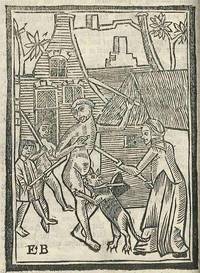
1684WRCLIT66732London: Printed by T.J. for Edward Brewster . and Thomas Passenger . 1684. Three parts bound in one volume. 80 leaves A-U4; 56 leaves A-O4; and 8160pp. Quarto. Modern blind paneled calf raised bands gilt label. First two parts illustrated with spirited woodcuts. Occasional foxing and mild spotting marginal smudges to first title usual tanning lower forecorners of E2-3 in first part torn away and replaced with a few letters and a few words in the sidenote in ms a few upper margins dust-soiled last three gatherings in third part supplied from another copy and trimmed slightly shorter at lower margin; a good sound copy neatly bound. First edition of the third part. An omnibus gathering of these three separately printed editions each with independent register and with the title of the first part taking into account the presence of the latter two. The terminal advert leaf to the first part is present. Wing attributes the text of the first part to John Shirley and that for the third is occasionally attributed to the publisher Edward Brewster. The first part is illustrated with 62 woodcut illustrations signed 'E.B.' of which 23 are repeats; the second part includes 15 woodcuts all of which appear as well in the first part. The first part was first printed in this form in 1667 and the second in 1672; the first part was reprinted again in 1701. Among the most widely adapted of the beast fables the tales of Reynard the Fox originated in the 12th and 13th centuries with early versions in French Dutch Latin and German being notable. Caxton printed a translation based on a Flemish text in 1481. The character of Reynard an anthropomorphic fox and trickster has since become almost an archetype in the literatures of several languages. ESTC R24532 & R218371 & R40614. WING S3513 & M2912 & S3436. BRUNET IV:1228. LOWNDES VII:2076. Printed by T.J. for Edward Brewster ... and Thomas Passenger ... hardcover books
166729593Oxford London: printed by William Hall for John Adams and Edward Forrest and various 1667; 1667; 1668. Hardcover. Very good-/No jacket issued. with; MOSES & AARON; with ROMANAE HISTORIAE 3 VOLUMES BOUND AS ONE. Oxford London: printed by William Hall for John Adams and Edward Forrest and various 1667; 1667; 1668. Three volumes bound as one vols. 376 8 264 10 270 20 pp. Hardcover. 16mo. Modern period-style 3/4 pressed morocco over marbled paper covered boards. 4 raised bands double ruled in gilt leather label lettered in gilt to spine. ATTICAE title-page is unevenly browned and stained and badly tattered about edges with up to 1/2Ó loss in some places. The text is relatively clean in the first two titles but is unevenly browned through out the final title. Withal a nice collection of scarce titles and in a handsome if simple binding. Very good-/No jacket issued. Multiple volumes - extra shipping charges apply Insurance required to ship this item. printed by William Hall for John Adams and Edward Forrest, and various hardcover books
1612WRCLIT35327Frankfurt: Cura ac sumtibus Zachariae Palthenii 1612. 4 471 i.e. 487 due to many errors in numbering in the late portion of the text1 blankpp. Small quarto. Slightly later plain full calf visible waste sheets from an English astronomical gazette used in the binding are for the year 1635. Alchemical device on title two marginal woodcuts several tables leaf M1 folded at fore-edge to accommodate the over extension of the table on that leaf. Crown of spine has shallow loss bookplate scar on front pastedown front inner hinge cracking and binder's free endsheet detached text block considerably browned as usual for this title 3N4 has a short clean tear in from the margin some occasional marginal discoloration occasional spotting; still a good copy. First edition of this very substantial lexicon compiled by the physician to Emperor Rudolph II and lecturer at the gymnasium at Lauingen in Swabia. "He was in favor of Parcelsus' reforms but he dealt greatly in secret remedies especially in emetics." - Ferguson. "This lexicon is very full less mystical and more practical than some later ones. Useful in explaining early terminology" - Bolton. DUVEEN p. 520. FERGUSON II:302. BOLTON I:1041. Cura ac sumtibus Zachariae Palthenii unknown books
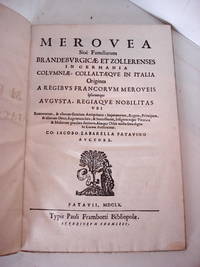
16607272Padua: Typis Pauli Frambotti Bibliopolae 1660. First edition. Boards. Very Good . Folio. 8124pp. Woodcut printer's device on title. Illustrated with 2 armorial woodcuts and numerous letterpress genealogical tables. 20th c. marbled boards. Rare. Typis Pauli Frambotti Bibliopolae hardcover books