226 résultats
1677181987London: In the Savoy: Printed by T.N. for Henry Herringman at the Anchor in the Lower Walk of the New Exchange 1677. 1st Edition . Hardcover. Very Good/No Jacket. Folio - over 12 - 15" tall. Original leather boards tips worn a newer but antiquarian spine added with gilt title on a red leather panel; 5 raised bands with vertical black stripes bordered by triple black stripes. Eleven-page dedication to the King; 206pp 6 folding plates an engraving of Charles II mounted with military formations deployed for battle and a fleet in the background as frontis. A detailed description on the constitution and operation of an army from a commander's viewpoint based on the author's considerable ECW experience. Includes a number of references to the ancients and also considerable discussion of the actual operations of the army in the field. A very nice example. <br/> <br/> In the Savoy: Printed by T.N. for Henry Herringman at the Anchor in the Lower Walk of the New Exchange hardcover
1631BTETM0002700Germany: Johann Krebs Cologne Koln 1631. Hardcover. Good/No Jacket. Super octavo 8vo 7 × 11 in 178 × 279 mm . Please email for Photographs or further information. Good - Present: engraved title 128 plates single-sided; versos blank. One plate is duplicated the Sacrifice of Isaac scene appears twice. Accordingly one subject from the standard 128-plate suite is absenta not-uncommon issue in surviving plate suites where plates may have been gathered or replaced at some point in the books history. The missing subject can be identified definitively by matching the plates to a reference suite such as VD17. Later patterned-paper boards with printed/handwritten label; rubbing and edgewear with bumps/scuffs consistent with age and handling. Internally generally clean and well-contrasted for the period with scattered toning/foxing and occasional light handling marks. Margins with minor wear. Prior-owner pencil numbering and a bibliographic note on the front pastedown/blank. Collation: pp. 129 Please see Photos as part of condition report. 1631 Köln: Johann von Kreps Oblong ICONES BIBLICAE PRAECIPUAS SACRAE SCRIPTURAE Historias eleganter et graphicae repraesentantes = Biblische Figuren; darinnen die furnembsten Historien in Heiliger Gottliger Schrifft begriffen Biblical Icons Elegantly and Graphically Representing the Main Stories of the Holy Scriptures By after Matthäus Merian the Elder Author Bio: Matthäus Merian der Ältere or "Matthew" "the Elder" or "Sr."; 22 September 1593 19 June 1650 was a Swiss-born engraver who worked in Frankfurt Germany for most of his career where he also ran a publishing house. He was a member of the patrician Basel Merian family. Synopsis: Cologne Köln / Johann Krebs issue 1631 first Kreps issue. A compact image-led Bible in copper: 128 finely etched scenes spanning the principal narratives of Scripture issued here as an oblong picture-book with an engraved title. A Cologne imprint closely related to the widely-collected Icones Biblicae suites associated with the Merian tradition the series also appears in later expanded and reordered states. A striking early 17th-century suite of biblical imagerysmall dramatic stage-sets of sacred history rendered with the lively line and atmospheric hatching typical of German Baroque book-illustration. The plates function as a visual concordance: creation and patriarchal scenes prophetic and royal narratives the life of Christ and emblematic moments of judgement and revelation each designed to be read quickly as a devotional prompt or teaching aid. This kind of compact iconographic core set is notably desirable to collectors because it sits at the intersection of: print-history a portable coherent suite of copperplates devotional culture pictures meant to be read without text collector appeal the plates also circulate independently in museum and printroom collections. Format: Hardcover Super octavo 8vo 7 × 11 in 178 × 279 mm Note: Binding/size selection follows standard bibliographic conventions and is approximate; exact measurements may vary. Language: German/Latin Published By: Johann Krebs Cologne Koln Germany Condition Report: Dust Jacket: No Jacket Dust Jacket Condition: No Jacket Good - Present: engraved title 128 plates single-sided; versos blank. One plate is duplicated the Sacrifice of Isaac scene appears twice. Accordingly one subject from the standard 128-plate suite is absenta not-uncommon issue in surviving plate suites where plates may have been gathered or replaced at some point in the books history. The missing subject can be identified definitively by matching the plates to a reference suite such as VD17. Later patterned-paper boards with printed/handwritten label; rubbing and edgewear with bumps/scuffs consistent with age and handling. Internally generally clean and well-contrasted for the period with scattered toning/foxing and occasional light handling marks. Margins with minor wear. Prior-owner pencil numbering and a bibliographic note on the front pastedown/blank. Collation: pp. 129 Please see Photos as part of condition report. SKU: BTETM0002700 Shipping Info: Approximate Package Dimensions H: 12.5 L: 30 W: 25 Units: cm W: 2Kg Tracked Shipping Insurance Coverage as per Customer Request Johann Krebs, Cologne (Koln) hardcover
1633156London: Robert Barker.by the Assignes of John Bill 1633. Very Early Jacobean Printing. Tooled leather. Very Good /Custom Case. 12mo original full leather 17th century tooled and inlaid binding engraved frontispiece closely cut borders all edges gilded green silk page divider decorative marbled endpapers viii blank ~ 524 vi blank pages.<br /> <br /> THE NEW TES_/ <br /> TAMENT /<br /> Of our Lord and /<br /> S A V I O V R /<br /> - Jesus Christ<br /> <br /> Newly translated out of the / <br /> Originall Grrek : and / <br /> with the former transla- /<br /> tions diligently compared /<br /> and revised by his Maie- /<br /> sties special commande- /<br /> ment.<br /> ----------------------------<br /> Imprinted at London / <br /> By Robert Barker Printer / <br /> to the Kings most Excel- /<br /> lent Majesty and by / <br /> the Assignes of John Bill <br /> 1633. <br /> Cum privilegia. A GEM! In an original tooled leather binding in remarkably well preserved condition . Beautiful clear and crisp type. Moderate and quite uniform age-toning to paper with the occasional smudge. Pages closely cropped by the printer so some chapter headings at the top have been partially excised though not the text. Endpapers renewed. Generally minimal wear.<br /> <br /> Finely bound in contemporary tan gilt-embossed calf over wooden boards richly gilt to spine and covers. four hubs and boards. Marbled pastedowns & endpapers renewed a.e.g. and gauffered. Spine very slightly rubbed with partial loss of caps at head and foot restored and slightly visible. Edges of engraved title page reinforced with Japan paper. Previous owner's ink inscriptions on two front free endpapers naming "Edmund James Gore" & his London addresses. <br /> <br /> Housed in a protective clam-shell box custom made for this Rare and Precious 1633 edition of the Authorized King James version of the New Testament. Overall a VG copy.<br /> <br /> The continental binding on this small format Authorized version MAY be a pirated edition of the English Bible from Amsterdam. For example the Stam printing family were printing small format Bibles in 1673-- after our publication see Cambridge History of the Book in Britain IV p.467. <br /> <br /> Herbert 713-14 Wing B2511A. Robert Barker...by the Assignes of John Bill hardcover
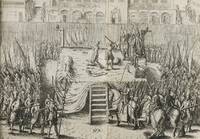
161549135Leiden and Breda: H. L. van Haestens and Isaac Schilders 1615. First editions. Hardcover. Fine. Sammelband of two works quarto published in 1615 and 1616. Contemporary vellum yapp edges manuscript lettering at spine. A few faint marginal stains; some worming in the upper blank margin of a few leaves else fine.<br /> <br /> I. J. Gysius Oorsprong Leiden: H. L. van Haestens 1616. Signed: rev. parens4 A-3D4 3E6 2H1 signed 2G1; 2N3 signed 2M3; = 210 leaves; 8 411 1 blankpp. Title in red and black with double-ruled border and engraved title vignette; 17 text engravings 15 full-page oval portraits; a smaller medallion portrait; a statue of Alva 2 engraved folding plates graphically depicting public executions; roman and gothic letter. Lacks bottom corner D4 no loss.<br /> <br /> Rare first edition of this illustrated account of the Spanish campaigns in the Netherlands. Johannes Gysius d. 1652 has compiled this history from many sources including Bor van Meteren Meursius’ Rerum Belgicarum and Baudartius’ Morghenwecker along with his own analyses. A second edition appeared in Delft in 1626. A finely-printed work partly in Gothic type. Notably the half-page medallion portrait pair p. 260 depicts only Dierick van Batenburch on the right; while his martyred brother Gisbert’s medallion is left blank. Haitsma Mulier/v.d. Lem 197a. De Wind 1835 571-76. For substantial notes on the publication history see Bibl. Belgica G 63 G64 ed. 1626; G65 ed. Latin 1619.<br /> <br /> II. J. Baselius Historisch-verhael Breda: Schilders 1615. Signed: pi1 A4 A-S4 T3 = 80 leaves; 10 149 1 blankpp. Engraved title; main text in gothic letter. <br /> <br /> First and only edition of this companion work by Jacobus Baselius the Elder 1563-1604 a minister at Bergen op Zoom who was born in Flanders. Posthumously published the work was edited and continued by the author’s children. Dedication signed “De Kinderen Jacobi Baseliiâ€. Haitsma Mulier/v.d. Lem 30b. De Wind 374 noting one other work by Baselius. Not in Bibl. Belgica. OCLC locates only 6 copies in the Netherlands and the UK. NNBW 3:67-68. Full titles: 1 Oorsprong en voortgang der Neder-Landtscher beroerten ende ellendicheden. Waerin vertoont worden de voornaemste tyrannijen moorderijen ende andere onmenschelijcke wreetheden die onder het ghebiedt van Philips de II coninck van Spaengien door zijne stad-houders in ‘twerck ghestelt zijn gheduyrende dese nederlantsche troublen ende oorlogen. Hier zijn mede bygeboecht de voornaemste placcaten brieven ende remonstrantien van beyde zijden: mitsgaders de afbeeldingen der princen die aen d’een zijde getyranniseert hebben ende aen d’ander zijde tyranniger wijse omghebracht zijn. 2 Historisch-verhael inhoudende sekere notable explooten van oorloge in de Nederlanden. Sedert het oprechten van de companien der heeren gouverneurs ende ritmeesteren van Paulus ende Marcelis Bax. H. L. van Haestens [?] and Isaac Schilders hardcover
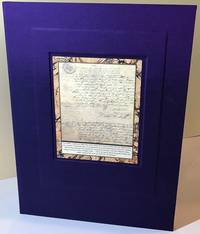
1691CA0706<p><br />8 sheets written on recto and verso. Folio 12 1/2" x 8 3/4" unbound leaves. 1 page written in Nahuatl currently housed in a custom made enclosure by Octavaye Studios. <br /><br />The Cabildo Justice and Aldermen of the Village of Tehuacán testify that Don Gabriel Santiago cacique of Tehuacán has in his possession documents that belong to the City starting with the Royal Decree that ordered the founding of Tehuacán over the village of Calcahualco in times of Viceroy Peralta 1566 – 1567 as well as deeds for grants of land and water made by the Viceroys to the City of Tehuacán. He has this papers that he inherited from his father Agustin de Santiago deceased. He also has other documents: deeds formalities sales and possessions. They ask all these papers be returned to the City to be stored by the Royal Notary in a box with 5 keys. They deem these papers necessary to the city to be able to solve land disputes and land invasions and to be able to give deeds to the landowners. The case is presented to a judge who orders all papers belonging to the city be turned over to the Notary in possession of Don Gabriel Santiago or any other cacique. He complies but requests papers of a water dispute in the village of Santa Maria be included in this box.<br /><br />Don Gabriel Santiago testifies he needs those papers in order to collect tributes from the Indians and to solve problems that arise in the community. On the back of his testimony there is one page in Nahuatl signed by the members of the Cabildo.<br /><br /><strong>Condition:</strong><br /><br />Edge wear with tears and chips heal corner damaged else very good in a fine enclosure.</p> Manuscript
169632611Nürnberg 1696. The large engraving of the procession through Stockholm being composed of 13 engraved plates joined together measuring 30x450 cm. Plates numb. 1-13. Some mostly marginal dampstains some marginal tears some brownspots mainly marginal. Upper margin of plate 3 partly gone. Margins strenghtened at verso with brown paper. Some variation to paperquality but in general in good strong impressions. <br/><br/><em>The procession gives a panoramic view through Stockholm with the Swedish battleships salute-firing in the harbour. The engraving was published together with Pufendorf's work De rebus a Carolo Gustavi gestis.Nürenberg 1696. The procession was drawn by Erik Dahlberg who was an eyewitness and engraved by different engravers. </em> unknown
165349198Leiden Joannis Maire 1653 - Amsterdam Ioannes Blaeu 1650. 4to. One contemp. full vellum. Contemp. handwritten titles weak to spine. First title in red/black with large engraved titlevignette. 81541 pp. Ars Historica 1653 - 169414 pp. Grammatistice etc. 1650 - 88315 pp. De Philologia 1650 - 1646733 pp. De Universae Mathesios. 1650. Fine and clean. <br/><br/><em>First edition of "De Qvattuor Artibus." which includes "De Universae Mathesios" with separate titlepage and second edition of "Ars Historica"The mathematical work: Poggendorff II 1235. "de Mathesios.": "According to prof. Cantor it is the first history of mathematics in its widest sense". Honeyman Coll. 3081. </em> hardcover
16810001028EDINBURGH SCOTLAND. Very Good. 1681. Unbound. On offer is an excellent skin charter being a land grant from Charles II to well-noted jurist James Dalrymple 1st Viscount of Stair Scotland with mentions the Dukes of Rothes and Lauderdale who were also prominent Scotsmen. Dalrymple was famed not only for his legal judgments but also he was a prominent character in Scotland's history having been involved in the negotiations between Charles and the Scottish Parliament. This grant was given at Edinburgh on the 10th of December 1680 absent of seals. There is another note on the back of the parchment to say that the charter was written at Edinburgh on the second of March 1681 suggesting the deal was struck in December but that the charter was not actually drawn up until the next March. Historically the Charters falls squarely between the Restoration period and when he was prominent until his sympathy with the Covenanters at the time of the Scottish Test Act caused him to lose 1681 his appointment as judge. The note giving March as the date for the writing of the charter appears to be in the same hand as the charter itself. Dalyrymple was a fascinating Scotsman who found himself on one side or the other of the Scottish-English political scene but was well considered. Sir Walter Scott observe that the Viscount of Stair was fortunate in his descendants. "The family of Dalrymple produced within two centuries as many men of talent civil and military of literary political and professional eminence as any house in Scotland." Folded to a small 12mo. Save for some general soiling this ancient document is VG.; Latin; Elephant Folio - over 15" - 23" tall; ENGLAND GREAT BRITAIN CHARLES II HANDWRITTEN MANUSCRIPT DOCUMENT LETTER AUTOGRAPH WRITER HAND WRITTEN DOCUMENTS SIGNED LETTERS MANUSCRIPTS HISTORICAL HOLOGRAPH WRITERS AUTOGRAPHS PERSONAL PERSONAL HISTORY DIARIES JOURNALS LOGS MEMOIR MEMORIAL antiquité contrat vélin document manuscrit papier Antike Brief Pergament Dokument Manuskript Papier oggetto d'antiquariato atto velina documento manoscritto carta antigüedad hecho vitela documento Manuscrito . unknown
1691D14221La Haye: Barent Beek 1691. Hardcover. Very Good. Early 18th century calf gilt-stamped lettering in red leather spine label gilt-stamped ornament in spine compartments 5 raised bands; 16mo 146x93mm; pp. 20 98 plus engraved frontispiece and 62 engraved plates 4 folding. Some light chipping along joints; light scuffing at spine tips and along edges of boards; front joint tender. Frontispiece and one folding plate with discreetly repaired tears; otherwise internally nice and clean. An excellent copy with an interesting provenance -- Bibliothèque Deprins bookplate; Hippolyte Destailleur 1822-1893 French architect bookplate and mss note tipped-in. <br/><br/>William III of Orange 1650-1702 King of England Scotland and Ireland entered The Hague on 5 February 1691 to spectacular celebration decoration and pomp. Numerous triumphal arches and pyramids were erected throughout the city illuminations of the city's public buildings were designed and a fireworks display was arranged for the evening of the King's arrival. The plates illustrate the arches pyramids emblems and the the fireworks show and several represent scenes of victory from the King's life including sea battles sieges and treaties. Although the plates are unsigned some have been attributed by Vinet to Adriaan Schoonebeck and Romeyn de Hooghe but 16 plates are by Jan Luyken; an English edition was published in London in 1692. Watanabe attributes the text to Bidloo but all other bibliographers leave it anonymous. It is most likely that these descriptions of the plates were supplied by the print publisher Barent Beek himself. Berlin 2954 Dutch edition; Landwehr Splendid Ceremonies 156; Vinet 750; Watanabe 2736. Barent Beek hardcover
168619026London: Printed for and sold by Stephen Bateman 1686. Second edition. Frontispiece & Illustrated with 44 sculptures. 1 vols. Folio. Contemporary quarter calf and boards rebacked later endpapers; corner of title page torn away first three leaves waterstained at lower edge. A good sound copy. Second edition. Frontispiece & Illustrated with 44 sculptures. 1 vols. Folio. Pettus was deputy governor of the royal mines for over thirty-five years. The first part is translated from the German of Erckern but the second part is Pettus' own contribution to the lexicography of metals - and wonderfully anecdotal and original it is as this from his entry on "DUNG":<br /> ".among the Indians it was usual that when they intended Homage to their Superiors or welcome too their Friends they did evacuate their Dung into their Hand and so daub it on the Face of whom they intended to honour or pleasure and was ever accepted by them as the first and best of the Welcoming Ceremonies: for Agricola tells us of Mans-Dung made as sweet as Civit. But to return nearer home when I remained in London during the great Plague in 1666 Dr. Glisson famous in his time being my old Friend and Acquaintance perswaded me to take a piece of his constant Antidote which was only the Dung of one that had dyed of the Plague dryed and so kept in a foraminous Box for the best Antidotical Perfume; but I thank God I escaped without it."<br /> Engaging too are the delightful engravings which embellish the work. Wing P-1907 Printed for and sold by Stephen Bateman unknown
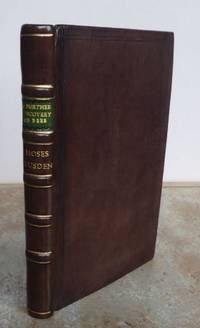
167952434<p>London printed for the author and are to be sold at his house next the sign of the Kings Arms in the Bowling-Alley near the Abby in Westminster: and by Henry Million bookseller at the Bible in the Old-Bayley 1679. TITLE CONTINUED: Also proper directions to all such as keep bees as well to prevent their robbing in straw-hives as their killing in the colonies. By Moses Rusden an apothecary; bee-master to the Kings most excellent Majesty. Published by His Majesties especial command and approved by the Royal Society at Gresham Coll. FIRST EDITION 1679. Small 8vo approximately 170 x 95 mm 6½ x 4 inches engraved frontispiece by Henry Million 3 folding plates pages: 24 1-144 last page blank rebound in full modern calf gilt lettered green label author's gilt name and gilt rules to spine between raised bands new brown endpapers. Neat vertical repair to inner margin on blank side of frontispiece with pale browning to foot title page and frontispiece lightly dusty old ink name to top of title page 2 outer margins neatly replaced 1 outer margin slightly trimmed varying pale brown staining some with tide mark to lower part of pages 81-100 all text legible see attached images 1 corner neatly repaired pale age-browning to margins a few margins lightly soiled not affecting text old ink stain to first pastedown and small ink splash to last free endpaper 2 leaves lightly dusty. A good copy with some minor repairs and staining. Moses Rusden was appointed Beemaster to the King at the instigation of John Evelyn who had a copy of this title in his library. Rusden firmly believed that a hive was led by a King and not a Queen. In 1679 Rusden improved Geddie's hive and put a frame in it for the bees to fasten their combs upon. See: British Bee Books A Bibliography 1500-1976 page 61 No. 55; Walker Catalogue of Bee Books page 61; Geoffrey Keynes John Evelyn A Study in Bibliophily page 300 No. 83; ESTC R11920. MORE IMAGES ATTACHED TO THIS LISTING ALL ZOOMABLE FURTHER IMAGES ON REQUEST. POSTAGE AT COST.</p> London, printed for the author, and are to be sold at his house next the sign of the Kings Arms in the Bowling-Alley, near the hardcover
1672907London: Thomas Collins 1672. First Edition in English First Issue. Near fine. Small 8vo; 6 1/2 x 4 1/8 inches 165 x 104 mm; 40 237 1 pp. with the errata at the beginning of the table of contents table misbound after dedication C1 with tear to lower margin not affecting text some light marginal browning. Etched garland and cornucopia arms of Lord Arlington on both title and dedicatory page. Later brown calf binding decorative blind stamp on covers title in gilt on spine; trimmed marbled edges. Internally clean and bright with consistent toning on the edges; spine a little faded and light rubbing to spine ends and corners; firmly bound.<br /> Provenance: Herbert Maynard Smith 1869-1949 and J. Outram Smith 1871-1954 with their library stamp to the front free endpaper. The Smiths both Anglican clergymen amassed a substantial collection of theology history philosophy and literature. Also a previous owner's ink inscription dated 1770 is at head of dedication page: Tho. Boston Alnwick 1770.<br /> <br /> Keynes 181; ESTC 006089128. John Evelyn the Younger's first book RARE FIRST ISSUE with title date 1672. We can trace no example of this issue for sale and only 6 copies listed on ESTC. Keynes states seeing the TABLE with errata relating to page numbering in only the ULC copy. Keynes Geoffrey. John Evelyn: a study in bibliophily with a bibliography of his writings. Oxford; London: Clarendon Press 1968<br /> <br /> René Rapin 1621 - 1687 was an erudite French Jesuit who taught rhetoric and was knows as the "Second Theocritus". He wrote extensively on the classical Greek and Latin authors as well as on theological issues linked to Jansenism a controversial movement within Catholicism primarily active in France. <br /> John Evelyn the Younger 1655 - 1699 was the third son of John Evelyn the famed writer diarist bibliophile and horticulturalist. Through his father's influence he moved in the influential court circles of the Restoration period and held some posts at the treasury. He was also a poet and a translator from both Latin and French. Thomas Collins unknown
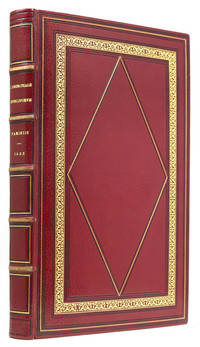
1633306616Paris: Societatis Typographic Librorum Officii Ecclesiastici . 1633. Engraved title numerous small and large engraved vignettes head-and tail-pieces one full-page engraving; text printed in black running headlines and chapter headings in red numerous large decorated initial capitals. 1 vols. Folio. Full red crushed morocco covers decorated with single black and gilt fillets including a central diamond in black and gilt with a gilt-rolled frame spine in six compartments with raised bands gilt lettered in two others with simple frame of black and gilt fillets wide gilt turn-ins with large gilt cornerpieces a.e.g. gilt-stamped on the turn-in of the inside front cover "French Binders Garden City NY" and on that of the rear cover "H. Hardy Relieur 1934 G. Pilon Doreur." Very slight rubbing to extremities still near fine with some toning to text. In a quarter morocco slipcase with chemise. Engraved title numerous small and large engraved vignettes head-and tail-pieces one full-page engraving; text printed in black running headlines and chapter headings in red numerous large decorated initial capitals. 1 vols. Folio. Beautifully bound in full red morocco by The French Binders successors to The Club Bindery and signed on the rear turn in by two of the firm's most distinguished binders Henry Hardy and Gaston Pilon. <br /> The French Binders traces its lineage back to The Club Bindery founded in 1895 by members of the Grolier Club to provide exceptionally fine bindings for American collectors. The Club Bindery moved to Cleveland where it was successively renamed the Rowfant Bindery 1909-1913 the Booklover's Shop 1914-1917 and finally The French Binders 1918-1920s as in-house bindery to Doubelday in Garden City New York. Henry Hardy worked for all incarnations of the bindery starting with The Club Bindery; his brother-in-law Gaston Pilon worked with Chambolle-Duru in Paris and came over to America to join the Rowfant Bindery. Both Hardy and Pilon were named Officers of the French Academy in 1933 the highest recognition given by the French government to naturalized Americans see Martin Antonetti's essay in Bound to Be the Best: The Club Bindery. Provenance: Estelle Doheny red morocco booklabel; Carl C. Kalbfleisch brown morocco booklabel Societatis Typographic Librorum Officii Ecclesiastici .. unknown
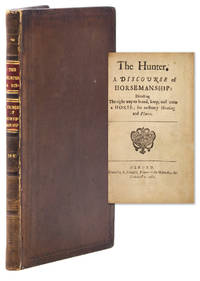
1685321988Oxford: Printed by L. Lichfield Printer to the University for Nicholas Cox 1685. First edition. 2 98 pp. A-F8G2. Printer's device on the title-page. 1 vols. 8vo 175 x 97mm. Later calf red spine labels boards with borders in blind. Slightly rubbed at joints. Nice clean copy. First edition. 2 98 pp. A-F8G2. Printer's device on the title-page. 1 vols. 8vo 175 x 97mm. A rare copy of the first edition of Langbaine's treatise which not only treats horse breeding horsemanship and farriery but it also horse-racing and training for matches "plates". ESTC R1219; Wing L-374; Podeschi 33; Loder 4391 with inaccurate collation and the inaccurate statement that Langbaine's book was included in the 1674 first edition of Cox's Gentleman's Recreation; Smith p. 344 Printed by L. Lichfield, Printer to the University, for Nicholas Cox unknown
1677ZB666713Moguntiae: Sumpt. Ludovici Bourgeat Academiae Bibliopolae 1677. Rariores proprietates historias et sententias memorabiles non paucas breviter exponit. Ultima editio leaves slightly taller than 13.5 cm. 4 parts in one as issued 8 201 3 204 204 201 1 pp. each part has a special half title and each contains 100 circular engravings by Hans Sibmacher; contemporary vellum very worn with only a fragment of the spine covering remaining and the front cover bowed and almost detached armorial book plate of Wm. Strong and his name written in block letters on the now detached front free endpaper general light age toning with occasional age spotting the first twenty emblems hand colored good; edited by the author's son Ludwig Camerarius. - If you are reading this this item is actually physically in our stock and ready for shipment once ordered. We are not bookjackers. Buyer is responsible for any additional duties taxes or fees required by recipient's country. Photos available upon request. Moguntiae: Sumpt. Ludovici Bourgeat, Academiae Bibliopolae, hardcover
168649367Venezia 1686. 8vo. 165x11 cm. Contemp. full vellum. Halftitle-page. Engraved Title-page the Lion of St. Mark. 82371 blank2- Indice pp. and 41 of 42 double-page folded engraved maps and plans bird's-eye views or plans of fortified towns and places etc. Internally fine and clean. Printed on good paper. A fine copy. <br/><br/><em>Second edition the first 8vo-edition issued the same year as the first in folio describing the Venetian campaign for the reconquest of the Peloponnese or Morea from which Venice had been almost completely excluded since the Turkish conquest of the Greek island in 1458."As is often the case with Coronelli's work the contents may vary with each example as plates were added subtracted or changed as the editor saw fit" Rodney Shirley "Maps in the Atlases of the british Library" T.Coro-1a - listing only 39 maps and views for this copy.Coronelli Vincenzo Maria an Italian geographer and draughtsman was born at Venice about 1650. From 1681-1683 he worked in Paris on a pair of 3.85 meter diameter globes for Louis XIV which are now in the National Library in Paris. On his return to Venice he was made cosmographer of the Republic and founded the Academy of Argonauts the first Geographical Society. In 1702 he became general of his order. </em> hardcover
1651CA1001<p>1651 Mexico City Imprenta de Juan Ruyz. From the library of Luis Garcia Pimentel<br /><br />2 of 7136 leaves of 141. Octavo 8 1/2" x 6" bound in original period vellum with title hand written to spine. Last 36 leaves are headed "Lib. II" Libros 3 and 4 were issued separately the following year. From the library of Luis Garcia Pimentel. Medina Mexico 724; Palau 72254 First edition.<br /><br />Juan DÃaz de Arce born in Mexico towards the end of the 16th century he graduated as a bachelor from the Royal and Pontifical University on October 23 1603 he entered the College of Santa MarÃa de Todos Santos where he obtained the chair of theology which he taught for 30 years. Among other positions he was an archdeacon in charge of administering a diocese or part of it under the orders of the bishop he was appointed vicar general; He was also appointed as the schoolmaster which means that he was in charge of teaching the ecclesiastical scenes as well as archbishop of Santo Domingo but whether or not he took office is unknown. the pope appointed him delegate of the Augustinian cause over the alternative he died on June 1 1653.<br /><br />Bernardino Alvarez 1514–1584 promoted the formation of a congregation to take care of the ill founding the hospital in 1569. This congregation was given all the privileges of which the Brothers Hospitallers of St. John of God enjoyed. The Brothers remained as a congregation until 1700 when the petition of Hipolitos and Pope Innocence XII gave them the possibility of making chastity votes poorness obedience and hospitality under the rule of San AgustÃn. The San Hipólito Brothers' order was important for New Spain because seven hospitals were under their charge six of which were founded by money obtained from alms. One of those was San Hipólito hospital also founded by Bernardino Ãvarez. He was a priest born on Rosales León Spain. He studied humanities and Latin on a preceptorship located on Vegarienza León. He did his training prior making his vows before being a member of the religious institute on El Escorial Monastery where he finalized his novitiate in September 22 1531. He worked in Rome in the Real Monastery in the Ucles Monastery and in Santiago Monastery. He became a priest in 1538. He went back to Spain where he worked as a teacher in El Escorial Monastery. Bernardino Ãlvarez was imprisoned on August 6 1547. When he was released he went to Mexico after the fall of Tenochtitlan. When he arrived he started the religious order of the Hipólitos. He founded San Hipolito Hospital and "Santa Cruz" hospital in Oaxtepec Morelos Mexico. This hospital was also dedicated for patients with mental diseases. During the next years he opened other hospitals one in Puebla that was named "San Roque" which was for female psychiatric patients another one in Jalapa Veracruz called "La Concepción" and one in Acapulco Guerrero. Ãlvarez decided the foundation of five hospitals in Mexico was not enough so he traveled to Mesoamerica and founded more hospitals than he expected all the way from La Habana Cuba to Mexico. The information about his death is nonexistent but it is known that today there is a tribute to the priest on the Hospital de Jesús.<br /><br />Luis GarcÃa Pimentel 1835-1930 He was the son of and the also bibliographer and historian JoaquÃn GarcÃa Icazbalceta. He continued the compilation that his father started and carried out photolithographic essays on the work <em>Bibliography of the 16th century</em>.<br /><br /><strong>Condition:</strong><br /><br />Ownership tag of Luis Garcia Pimente to front vellum verso. .Moderate wear with stains to vellum lacking frontispiece plate lacking 5 preliminary leaves lacking the 6 final leaves table of contents lacking rear pastedown minor worming to inner margin; early ownership inscription on title page unidentified Carmelite marca de fuego on top edge. Spine lettering faded defective but only 7 in OCLC.</p> Imprenta de Juan Ruyz
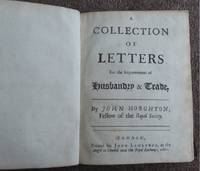
168152963<p>London printed for JOHN LAWRENCE at the Angel in Cornhill near the Royal Exchange 1681. VOLUME 1 ONLY The first trade & agriculture periodical in England 1681 complete with all 15 parts VOLUME 2 which is missing had six parts no more published. Although the title page is dated 1681 each issue has a separate imprint the last number 15 is dated 1683. Small 4to approximately 190 x 140 mm 7½ x 5½ inches pages: title page 1-184 bound in contemporary sheep rebacked with paler leather 2 black leather gilt lettered labels and gilt pattern dots to spine 2 bookplates of previous owners. Binding rubbed and lightly scuffed corners slightly worn 1 with small repair occasional pale age-browning strip of browning to edges of pastedowns and endpapers "Winchilsea" in old ink to top of first page free endpapers slightly chipped at edges otherwise a very good copy. Part 12 has a chapter by JOHN EVELYN pages 127-136: An Account of bread from the Learned John Evelyn Esquire; Entituled Panificium or the several manners of making Bread in France. Where by universal consent the best Bread in the World is eaten: Benit O Brioche Household-Bread Mountrau D'Esprit D'Citroville D'Cousin. Pages 35- 38 mention the Plantations in America. Part 14 pages 163-167 "An Experiment of the Ingenious Mr. John Worlidge for improving and Fyning of Syder" fining of cider; No.15 consists of lists of imports exports and ship movements in and out of London from Feb. 1683-March 1684; Other chapters History of Malting and the Method of making Malt; Improving Land by Marle; Some Account of the Plague 1665; The Manner and Advantage of Planting Liquorice; A Catalogue of the Books in the Library of the Royal Society relating to Agriculture; articles on trade agriculture the poor Ireland and all kinds of grain etc. See: Geoffrey Keynes John Evelyn A Bibliography of his Writings pages 261-62 No. 127; Mary Aslin Catalogue of the Printed Books on Agriculture 1471-1840 page 64; Forum Auctions lot 373 11th July 2018; Fussell 1523-1730 pages 81-82; Donald McDonald Agricultural Writers 1200-1800 pages 122-124; Catalogue of the Goldsmiths Library of Economic Literature Volume 1 page 140; The Kress Library of Business and Economics page 86 No. 1538; ESTC P2335. MORE IMAGES ATTACHED TO THIS LISTING ALL ZOOMABLE FURTHER IMAGES ON REQUEST. POSTAGE AT COST AND ALL PARCELS SENT FULLY TRACKED AND FULLY INSURED.</p> London, printed for JOHN LAWRENCE, at the Angel in Cornhill near the Royal Exchange, 1681. hardcover
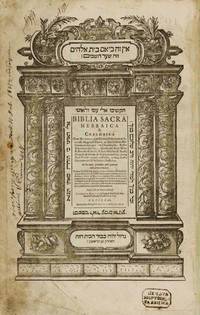
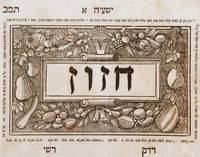
161948847Basel: Ludwig König 1619. First editions. Hardcover. Good. Seven parts in two volumes folio biblical texts and commentary in four parts continuously foliated; two supplemental sections each with separate foliation; Tiberias 1620 with separate pagination here bound after the second part - Vol. 1: 6 title and prelims 1-228 1 sect. title 234-441 1 blankff.; 6 sect. title and prelims 2 blank 114 2 blankpp. Vol. 2: 442-946; 8 Targum Yerushalmi; last leaf unfoliated; 67 Masora 1 blankff. Largely arranged in two columns of biblical texts in square font surrounded by commentaries in rabbinic Rashi font; text reads from right to left. This copy with collective Latin title surrounded by biblical quotations in Hebrew set within elaborate woodcut architectural borders. Hebrew sectional titles set within the same woodcut borders for the second and fourth parts with a plain letterpress half-title for the Five Megillot. The third sectional title for the Latter Prophets is lacking as are the Ashkenazi Haftarot readings not found in all copies. Apart from these lacks the Rabbinic Bible collates complete despite numerous errors in foliation throughout as per the detailed notes in Prijs Die Basler hebräischen Drucke. Opening word of each biblical book set in large one-third to one-half page cartouche vignettes with elaborate woodcut borders and surrounding letterpress Hebrew text. Main Latin title dated 1619 with the editor's Latin preface to the reader appearing at the verso. Jewish date chronogram for the second section Former Prophets dated 5378 1618/1619. Early twentieth-century black cloth boards worn at extremities gilt-lettered spine. Title moderately soiled re-inforced at gutter; neat old repairs to corners and fore-edge of title and next three leaves; old Russian stamp at bottom margin title manuscript entry in Russian along fore-edge dated 1837; intermittent mild to moderate marginal dampstains largely confined to corners and embrowning throughout both volumes somewhat more heavily in the first especially throughout Tiberias; top right corner of the opening leaf in vol. 2 repaired with loss of about 12 words surrounding title cartouche recto and some text in 9 lines of the commentary at the verso. Overall a good set with a notable chain of provenance. <br /> <br /> Sixth Rabbinic Bible in Hebrew: Mikra'ot Gedolot edited by Johann Buxtorf I 1565-1629 professor of Hebrew at the University of Basel and the foremost Christian Hebraist of his era with the assistance of the Jewish scholars Abraham Braunschweig who served as the principal corrector and Mordechai Gumplin of Posen. This was "a truly audacious undertaking for his time" Burnett From Christian Hebraism to Jewish Studies as no Christian scholar had yet attempted to edit the entire biblical corpus including the Aramaic versions Targumim and masoretic notes. Based mainly on the third Rabbinic Bible published by Daniel Bomberg at Venice in 1546-1548 the editor has carefully incorporated elements from two other Venetian editions. At the verso of the Latin title Buxtorf provides a detailed bibliographical excursus on the earlier Venetian editions and offers a tribute to Bomberg's industry by reprinting the colophon of the second Venetian Rabbinic Bible 1524-1525 at the conclusion of the masoretic appendix with text by the Hebrew grammarian and lexicographer Elijah Levita 1468 or 1469-1549 and a new introduction by Abraham Braunschweig. The design of the sectional titles and separate book title vignettes closely model those of the Venetian editions. "Buxtorf did not plan simply to reprint one of the existing Venice editions but rather to assemble the best features of them all into one work" and "to provide theologians with what he considered the most important tools for interpreting the Old Testament" Burnett. Buxtorf served in an official capacity as Basel's Hebrew censor charged with the oversight of all Jewish printing in the city and insuring that "no 'blasphemies' or slurs against Christians or Christianity appear in any book printed in Basel" Burnett. He carefully edited the Jewish commentaries in the Rabbinic Bible in accordance with this mandate "and removed many words and phrases which had escaped the attention of earlier censors" Burnett. <br /> <br /> The Rabbinic Bible contains the vocalized Masoretic text of the Hebrew Scriptures with accents and a vocalized Targum an Aramaic paraphrase of the biblical text: Onkelos for the Pentateuch; Jonathan b. Uzziel for the Prophets; and Targum Hagiographa for the Writings. The Hebrew and Aramaic versions are printed in square characters and presented in facing columns at the center of each page. The Jerusalem Targum of the Pentateuch appears as an appendix. In addition to the Aramaic paraphrases the Rabbinic Bible includes a massive scholarly apparatus of biblical commentaries by Rashi Ibn Ezra Baal ha-Turim Jacob b. Asher R. David Kimchi Radak R. Levi b. Gershon Ralbag Saadia Gaon and R. Isaiah along with the Masora a corpus of critical notes on the external form of the Biblical text compiled by Jewish scholars from late antiquity through the medieval era. As frequently occurs a copy of Buxtorf's work on the textual history of the Hebrew Bible Tiberias the 1620 first edition is bound-in. This work was made possible by the publication in 1538 of Elijah Levita's Masoret ha-Masoret a commentary on the Masora which Buxtorf translated into Latin for his own private use in 1593. "Buxtorf was concerned with the integrity of the consonantal text and the origin and integrity of the vowel points and accents of the Hebrew Bible from the very beginning of his scholarly career" and while he had earlier published a long excursus on the age of the vowel points and accents in his 1609 Thesaurus Grammaticus "Tiberias is Buxtorf's fullest and most impressive work on the history of the biblical text" Burnett. Intended as a reference work for Christian students and scholars interested in studying the Masora Buxtorf was also keen to refute the view advanced by Levita that the Hebrew vowel points were early medieval innovations. Our folio version of Tiberias was intended to accompany the Rabbinic Bible and has the same architectural borders at the title. König also published a quarto edition in the same year but only the folio version includes a critical commentary on the Masora in which Buxtorf proposes various corrections to the Masoretic notes. <br /> <br /> As noted at the title Buxtorf's faithful study and tireless labor studio fido et labore indefesso yielded notably long-lasting results: "The Basel rabbinical Bible became a standard tool for research among Christian scholars and would remain so. until the end of the nineteenth century" Burnett. A vast array of early modern scholars including Protestants like Johannes Drusius and John Selden as well as Roman Catholics like Robert Bellarmine and Andreas Masius owned a copy or two of the Rabbinic Bible. "Johannes Buxtorf's thoroughly censored "Christian" version of the Rabbinic Bible Basel 1618-19 only made it easier for Hebraists to own copies of their own" Burnett Christian Hebraism in the Reformation Era p.163.<br /> <br /> A note on the date of publication: "The actual printing began between the mid-August and mid-September of 1618. According to the colophon production ended on the 24 of Ab 5379 = August 4 1619 but since this date also appeared on the colophon of the Bomberg Biblia rabbinica edition of 1524-25 reprinted unchanged in the 1546-48 and 1568 editions it is suspect. Prijs suggested that the probable completion date was sometime during Ab of 5379 between July 12 and August 10 of 1619" Burnett. <br /> <br /> Provenance: from the library of acclaimed theologian and biblical scholar Brevard Childs with his entry at the free endpaper in the second volume. The earlier bookplate of judge Samuel Heller with his motto in Hebrew: Mi-kol melamdai hiskalti from all my teachers I have learned appears at the front paste-down. An old blue ink-stamp in Hebrew characters makes occasional appearances the text: Bet ha-Midrash ha-Gadol Minsk The Great Synagogue of Minsk. A Russian entry dated 1837 appears at the fore-margin of the main title along with an old ink stamp in Russian at the bottom margin the last word of which reads "Rabbina" References: Biblia Sacra: Burnett 7. Cowley 87. Darlow & Moule 5120 bound with the 1665 second edition of Tiberias cf. 5093. Davidson Otsar ha-shirah vol.1 p.406 no.8954. Prijs 219. Steinschneider 423 423b. VD17 23:675325G. S. Burnett Christian Hebraism in the Reformation Era Leiden: Brill 2012 p.163. Tiberias: Burnett 111. Prijs 222a. For detailed analyses of both works see: S. Burnett From Christian Hebraism to Jewish Studies Leiden: Brill 1996 pp.169-239 chaps. 6 & 7.<br /> <br /> Full Latin title: Biblia Sacra Hebraica & Chaldaica cum Masora quae critica Hebraeorum sacra est Magna & Parva ac selectissimis Hebraeorum interpretum commentariis Rabbi Salomonis Jarchi R. Abrahami Aben Esrae R. Davidis Kimchi R. Levi Gerson R. Saadie Gaon R. Jeschajae & Notis ex authore quem Baal Turim vocant collectis quibus textus grammaticè & historicè illustratur. In his nunc primum post quatuor editiones Venetas textus Chaldaicus qui Targum dicitur à deformitate punctationis & pravitate vocum innumeratum vindicatus; loca in Masora transposita deficientia pugnantia numeris depravata subsidio diversorum exemplarium & Concordantiarum Hebraicarum quantum fieri potuit reposita restituta & conciliata sunt ut in praefatione amplius declarabitur. Studio fido & labore indefesso Johannis BuxtofI linguae sanctae in Academia Basileensi Professoris Ord. Basileae: Sumptibus & typis Ludovici König 1619.<br /> <br /> Collation vol. 1 Rabbinic Bible: ital.a6 a-z8 A-E8 F4 G-Z8 Aa-Hh8 Ii9 Ii10 blank; 1 blank :3 1 blank A-N4 O5.<br /> <br /> Collation vol. 2 Rabbinic Bible: Kk-Rr8 Kk1 lacks Ss6 Tt10 Vv-Zz8 AA-PP8 QQ-TT6 VV9 VV10 blank XX-ZZ8 Aaa-Nnn8 Ooo3 Ooo4 blank PppTtt8 Vuu3 Vuu4 blank Xxx-Zzz8 AAaa-EEee8 8 A-G8 H6 I5 I6 blank. Ludwig König hardcover
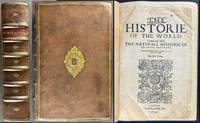
16341634SSLondon: Printed by Adam Islip 1634. 2nd edition in english. Leather-bound Hardcover. Very Good /no dj as issued. 2nd edition in English Very Good<br /> --- --- --- <br /> London printed by Adam Islip 1634 second English edition two Volumes bound in One 13.5" x 9"'<br /> Vol I 58 614 pages plus 42 pages Index for Tombe I; Vol II 632 pages plus 82 pages Index for Tombe II 2.<br /> Two volumes in one bound in modern full calf decorated papered boards six raised bands to spine gilt lettering and decorations on spine and front and back board.<br /> Elaborate woodcut printers device on title page woodcut initials head and tailpieces copious indexes of both volumes small piece of paper on final sheet saying that the previous issue had a lengthy Errata sheet which is no longer required as the errors have been corrected for this edition.<br /> Faint ownership inscription on top of the title page dated 1647.<br /> <br /> The Historie of the World was first translated into English by Philemon Holland in 1604. The original work of Pliny was published two years before he perished at Pompeii during the eruption of Mount Vesuvius in 79 CE.<br /> <br /> Gaius Plinius Secundus or Pliny the Elder was a Roman author naturalist scientist and naval and army commander of the early Roman Empire. He wrote several works and was dedicated to study in his life. <br /> <br /> The work is in good to very good condition overall. There is some marginal toning. There are some restored marginal losses to prelims and concluding leaves. There is very light intermittent spotting. There may be a few minor imperfections or faint marks to be expected with age. ---- ---- ---- <br /> The Historie of the World was first translated into English by Philemon Holland in 1604. The original work of Pliny was published two years before he perished at Pompeii during the eruption of Mount Vesuvius in 79 CE.<br /> <br /> Gaius Plinius Secundus or Pliny the Elder was a Roman author naturalist scientist and naval and army commander of the early Roman Empire. He wrote several works and was dedicated to study in his life. <br /> <br /> The work is in good to very good condition overall. There is some marginal toning. There are some restored marginal losses to prelims and concluding leaves. There is very light intermittent spotting. There may be a few minor imperfections or faint marks to be expected with age. Printed by Adam Islip hardcover
16191903070006Lutetiae Parisiorum: Typis Regiis 1619. First Edition. Hardcover. Good. 1st edition of Du Val's collected works of Aristotle. 2 volumes bound in 4. Folio 40 x 26 cm. Bound in contemporary Cambridge-style paneled calf. Rebacked and restored bindings. 6 raised bands. Title pages in red and black with engraved portrait of Aristotle. Text in Greek and Latin in parallel columns. Institutional blind stamps. Dampstaining along bottom scattered marginal staining. First title has its margins trimmed and conserved. Collated: Tome 1 part 1: 16 430 p.; T.1 p.2: 431-1251 p. 19; T.2 p.1: 3 469 p. 1; T. 2 p.2: 470-1104 p. 16. <br> According to John Lempriere's Classical Dictionary Aristotle's "treatises have been published separately; but the best edition of the works collectively is that of Duval." p. 96. Refs: Brunet I. 459. <br> Subtitle: "Veterum ac recentiorum interpretum ut Adriani Turnebi Isaaci Casauboni Julii Pacil studio emendatissima. Cum Kyriaci Strozae Patritii Florentini libris duobus Graecolatinis de Republica in supplementum politicorum Aristotelis. Sed nouissimae huic editioni omnium quae hactenus prodierunt ornatissimae accessit breuis ac perpetuus in omnes Aristotelis libros commentarius siue Synopsis Analytica Doctrinae Peripateticae non antehac visa; in qua ut in expeditiore tabella Aristotelis philosophia omnis provt ea suo ordine descripta est perspicue breuiterque indicatur & pro rerum dignitate exponitur. ; Authore Guillelmo Du-Val Pontesiano Philosophiae Graecae & Latinae in Parisiensi Acade" <br> This is an oversized or heavy book which requires additional postage for international delivery outside the US. Lutetiae Parisiorum: Typis Regiis hardcover
167944323Paris Thomas Jolly 1679. Small8vo. 15x9 cm. Contemp. full sprinckled calf. raisedbands richly gilt spine. Top of spine a bit worn. Edges of covers gilt. 12861 pp. Last page "Extrait du Privilege du Roy". 34 fine full-page engravings 25 copper-engraved a. 9 in woodcut. A paperflw at foot of titlepage neathly repaired no loss of paper or letters. Internally clean and fine printed on thick good paper. <br/><br/><em>Extremely scarce first edition of Leclerc's important work on binocular vision in which he finds that one of the eyes has a dominant status thus announcing the discovery of the "Master-eye" - a discovery of outmost importance in the theory of shooting and elsewhere. With use of diagrams he shows that "things that can be seen clearly are seen with but one single eye.". He records and depicts a large series of experiments with binocular vision and shows geometrically the relation to the science of perspective and points out the importance of understanding the physiology of binocular vision for perspective painting in general.Sebastien Leclerc was originally an engraver who studied physics and geometry in relation to perspective theory a field of which he became famous. In 1672 he was appointed to "l'Academie de Peinture" as professor in perspective. He was also engraver to Louis XIV and was appointed professor at "l'Ecole des Gobelins". </em> unknown
169141859Leipzig Grosse & Gleditsch 1691. 4to. Contemp. full vellum. Faint handwritten title on spine. a small stamp on titlepage. In: "Acta Eruditorum Anno MDCLXXXXI". 85906 pp. and 13 of 15 folded engraved plates. The 2 first plates lacks but they do not belong to the papers listed.Leibniz' papers: pp.277-281 a. 1 plate pp. 435-439. Johann Bernoulli: pp. 274-276 a. 1 plate. Huygens: pp. 281-282. - Jacob Bernoulli: pp. 282-290 a. 1 plate. <br/><br/><em>All papers first apperance. All 5 of extreme importence in the development of the Calculus. Leibniz' 2 papers on the catenary curve paper 1-2 offered here was written at the instigation of Jacques Bernoulli. Following the example of Blaise Pascal who had initiated in 1658 a contest for the construction of the cycloid Leibniz also provoked the geometers of his time by challenging them to submit at the fixed date of mid-1691 their geometric method for the construction of the catenary curve. Leibniz later provided the answer followed by Johann Bernoulli and Huygens.'These two papers are a historical account of the origin of the study of this transcendental curve and at the same time the first physical-geometric construction showing the species-relationship between the catenary and the logarithmic curves as two companion curves; one arithmetic the other geometric. All of the differentials of the catenary curve are arithmetic means of corresponding differentials of the logarithmic curve; and all of the differentials of the logarithmic curve are geometric means of the catenary.'"The Catenary is the form of a hanging fully flexible rope or chain the name comes from "catena" which means 'chain' suspended on two points. The interest in this curve originated with Galileo who thought that is was a parabola. Young Christiaan Huygens proved in 1646 that this cannot be the case. What the actual form was remained an open question till 1691 when Leibniz Johann Bernoulli and the then much older Huygens sent solutions to the problem to the "Acta" Jakob Bernoulli 1690 Johann Bernoulli 1691 Huygens 1691 and Leibniz 1691 - these 4 1691-papers offered here - in which the previous year Jakob Bernoulli had challenged mathematicians to solve it. As published the solutions did not reveal the methods but through later publications of manuscripts these methods have been known. Huygens applied with great paper 4 virtuosity the by then classical methods of 17th century infinitesimal mathematics and he needed all his ingenuity to reach a satisfactory solution. Leibniz the papers 1-2 and Bernoulli paper 3 applying the new Calculus found the solutions in a much direct way. In fact the catenary was a test-case between the old and the new style in the study of curves and only because the champion of the old style was a giant like Huygens the test-case can formally be considered as ending in a draw." Grattan-Guiness in "From the Calculus to Set Theory 1630-1910.".The paper by JACOB BERNOULLI no. 5 offered here is a milestone papers as it marks the invention of the "SYSTEM OF POLAR COORDINATES" with points located by reference to a fixed point and a line through that point. Although newton had earlier also devised such a coordinate system in 1671 his work was not known so that the credit for the discovery generally goes to Bernoulli. Parkinson Breakthroughs 1691.Further papers contained in this volume of Acta Eruditorum:DENYS PAPIN: Mecanicorum de Viribus Motricibus sententia asserta a D. Papino adversius C.G.G. L. Leibniz objectiones. pp. 6-13. The plate lacks. - and Dion. Papini Observationes quaedam circa materias ad Hydraulicam spectantes. Pp. 208-213 a. 1 plate. This importent paper is part of the LEIBNIZ-PAPIN-CONTROVERSY.JACOB BERNOULLI: Specimen Calculi Differentialis in dimensione Parabolæ helicoidis ubi de flexuris curvarum in genere carundem evolutionibus. Pp. 13-22. The plate lacks. - and J.B. Demonstratio Centri Oscillationis ex Natura Vectis reperta occassione eorum quæ super hac materia in Historia Literaria Roterodamensi recensentur articulo.Pp.317-321.LEIBNIZ: O.V.E. Additio ad Schediasma de Medii Resistentia publicatum in Actis mensis Febr. 1889. Pp. 177-178. and O.V.E. Quadratura Arithmetica Communis Sectionum Conicarum quæ centrum babent.Pp. 178-182 a. 1 plate.TSCHIRNHAUS: Singularia Effecta Vitri Caustici bipedalis quod omnia magno sumtu hactenus constructa specula ustoria virtute superat per D.T. Pp. 517-520 </em> hardcover
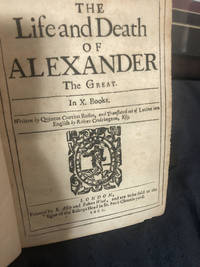
1661Bv1103<p>"NONE BUT ALEXANDER COULD PERFORM WHAT ALEXANDER HATH DONE": SCARCE 1661 EDITION IN ENGLISH OF QUINTUS CURTIUS RUFUS' LIFE AND DEATH OF ALEXANDER THE GREAT CODRINGTON Robert translator. The Life and Death of Alexander the Great. In X. Books. London: E. Alsop and Robert Wood 1661. Small quarto 6 x 7-1/2 modern full brown calf elaborately gilt-decorated spine raised bands black morocco spine label. Housed in a custom black linen slipcase. 1661 edition the scarce second edition of Robert Codrington's esteemed translation into English of this life of Alexander the Great a splendid volume attractively bound in full calf. Curtius Rufus flourished in the first century C.E.; particulars of his life are unknown. His Historiarum Alexandri Magni "introduces a number of picturesque details which are grouped effectively; and the career of the great Macedonian is regarded as a series of brilliant and romantic adventures. There are a number of carefully finished speeches worked into the narrative and much sententious reflection. The style is evidently formed on that of Livy" Peck 449. Preceded by John Brende's 1553 first translation into English which ran through a number of printings in the intervening century before Codrington undertook his new translation "exactly conferred with the Original and purged from many gross errors and absurdities with which it before abounded." Codrington's translation first appeared in 1652 under a slightly different title see Wing C7699. Title page with wood-cut engraved vignette engraved headpieces and ornamental initials. Occasional mispagination toward the end as issued without loss of text. A superlative example handsomely bound. Book Bv1103. $4000. We specialize in rare Ayn Rand as well as other legends and landmarks.</p> E. Alsop and Robert Wood hardcover
161952679Basel: Ludwig König 1619. First edition in part. Hardcover. Good. Eight parts in three volumes folio biblical texts and commentary in four parts continuously foliated; three supplemental sections each with separate foliation; Tiberias 1655 with separate pagination here bound after the Haftarot - Vol. 1: 6 title and prelims 1-228 1 sect. title 234-441 1 blank ff. Vol. 2: 1 sect. title 442-705 3 blank 707 sect. title-837 1 blank ff. Vol. 3: 839 half-title-881 1 blank 883-946; 8 Targum Yerushalmi; last leaf unfoliated; 67 Masorah 1 blank; 1 title 2-36 Haftarot ff.; 8 title and prelims 108pp. Despite the gap in foliation between the first and second parts and numerous errors in foliation throughout the Rabbinic Bible collates complete with all blanks noted in Prijs Die Basler hebräischen Drucke and the Haftarot bound at the end. Largely arranged in two columns of biblical texts in square font surrounded by commentaries in rabbinic Rashi font; biblical texts read from right to left. This copy with collective Hebrew title surrounded by biblical quotations in Hebrew set within elaborate woodcut architectural borders; brief preface in Hebrew by Abraham Braunschweig at the verso. Hebrew sectional titles set within the same woodcut borders for the three other biblical sections and the Haftarot with a plain letterpress half-title for the Five Megillot. Opening word of each biblical book set in large one-third to one-half page cartouche vignettes with elaborate woodcut borders and surrounding letterpress Hebrew text. Main title Jewish date chronogram = 5378 1618-1619. Near-contemporary half calf over speckled boards worn and rubbed; spines with raised bands gilt morocco lettering pieces and old paper labels heavily faded. About two-thirds of the text embrowned ranging from minimal to moderately heavy; worm tracing in a 1- by 2-inch section at leaves 541-553 affecting text. A good complete set notably containing the Ashkenazi Haftarot readings not found in all copies.<br /> <br /> Sixth Rabbinic Bible in Hebrew: Mikra'ot Gedolot edited by Johann Buxtorf I 1565-1629 professor of Hebrew at the University of Basel and the foremost Christian Hebraist of his era with the assistance of the Jewish scholars Abraham Braunschweig who served as the principal corrector and Mordechai Gumplin of Posen. This was "a truly audacious undertaking for his time" Burnett as no Christian scholar had yet attempted to edit the entire biblical corpus including the Aramaic versions Targumim and masoretic notes. Based mainly on the third Rabbinic Bible published by Daniel Bomberg at Venice in 1546-1548 the editor has carefully incorporated elements from two other Venetian editions. At the verso of the Latin title Buxtorf provides a detailed bibliographical excursus on the earlier Venetian editions and offers a tribute to Bomberg's industry by reprinting the colophon of the second Venetian Rabbinic Bible 1524-1525 at the conclusion of the masoretic appendix with text by the Hebrew grammarian and lexicographer Elijah Levita 1468 or 1469-1549 and a new introduction by Abraham Braunschweig. The design of the sectional titles and separate book title vignettes closely model those of the Venetian editions. "Buxtorf did not plan simply to reprint one of the existing Venice editions but rather to assemble the best features of them all into one work" and "to provide theologians with what he considered the most important tools for interpreting the Old Testament" Burnett. Buxtorf served in an official capacity as Basel's Hebrew censor charged with the oversight of all Jewish printing in the city and insuring that "no 'blasphemies' or slurs against Christians or Christianity appear in any book printed in Basel" Burnett. He carefully edited the Jewish commentaries in the Rabbinic Bible in accordance with this mandate "and removed many words and phrases which had escaped the attention of earlier censors" Burnett. <br /> <br /> The Rabbinic Bible contains the vocalized Masoretic text of the Hebrew Scriptures with accents and a vocalized Targum an Aramaic paraphrase of the biblical text: Onkelos for the Pentateuch; Jonathan b. Uzziel for the Prophets; and Targum Hagiographa for the Writings. The Hebrew and Aramaic versions are printed in square characters and presented in facing columns at the center of each page. The Jerusalem Targum of the Pentateuch appears as an appendix. In addition to the Aramaic paraphrases the Rabbinic Bible includes a massive scholarly apparatus of biblical commentaries by Rashi Ibn Ezra Baal ha-Turim Jacob b. Asher R. David Kimchi Radak R. Levi b. Gershon Ralbag Saadia Gaon and R. Isaiah along with the Masora a corpus of critical notes on the external form of the Biblical text compiled by Jewish scholars from late antiquity through the medieval era. As frequently occurs a copy of Buxtorf's work on the textual history of the Hebrew Bible Tiberias the 1655 revised edition is bound-in. This work was made possible by the publication in 1538 of Elijah Levita's Masoret ha-Masoret a commentary on the Masora which Buxtorf translated into Latin for his own private use in 1593. While "Buxtorf was concerned with the integrity of the consonantal text and the origin and integrity of the vowel points and accents of the Hebrew Bible from the very beginning of his scholarly career." While he had earlier published a long excursus on the age of the vowel points and accents in his 1609 Thesaurus Grammaticus "Tiberias is Buxtorf's fullest and most impressive work on the history of the biblical text" Burnett. Intended as a reference work for Christian students and scholars interested in studying the Masora Buxtorf was also keen to refute the view advanced by Levita that the Hebrew vowel points were early medieval innovations. Our folio version of Tiberias was intended to accompany the Rabbinic Bible and has the same architectural borders at the title. König also published a quarto edition in the same year but only the folio version includes a critical commentary on the Masora in which Buxtorf proposes various corrections to the Masoretic notes. <br /> <br /> As noted at the title Buxtorf's faithful study and tireless labor studio fido et labore indefesso yielded notably long-lasting results: "The Basel rabbinical Bible became a standard tool for research among Christian scholars and would remain so. until the end of the nineteenth century" Burnett. A vast array of early modern scholars including Protestants like Johannes Drusius and John Selden as well as Roman Catholics like Robert Bellarmine and Andreas Masius owned a copy or two of the Rabbinic Bible. "Johannes Buxtorf's thoroughly censored "Christian" version of the Rabbinic Bible Basel 1618-19 only made it easier for Hebraists to own copies of their own" Burnett Christian Hebraism in the Reformation Era p.163.<br /> <br /> A note on the date of publication: "The actual printing began between the mid-August and mid-September of 1618. According to the colophon production ended on the 24 of Ab 379 = August 4 1619 but since this date also appeared on the colophon of the Bomberg Biblia rabbinica edition of 1524-25 reprinted unchanged in the 1546-48 and 1568 editions it is suspect. Prijs suggested that the probable completion date was sometime during Ab of 379 between July 12 and August 10 of 1619" Burnett. References: Biblia Sacra: Burnett 7. Cowley 87. Darlow & Moule 5120 like our copy bound with the 1665 second edition of Tiberias cf. 5093. Davidson Otsar ha-shirah vol.1 p.406 no.8954. Prijs 219. Steinschneider 423 423b. VD17 23:675325G. S. Burnett Christian Hebraism in the Reformation Era Leiden: Brill 2012 p.163. Tiberias: Burnett 114. Prijs 272a. For detailed analyses of both works see: S. Burnett From Christian Hebraism to Jewish Studies Leiden: Brill 1996 pp.169-239 chaps. 6 & 7. Ludwig König hardcover