76 résultats
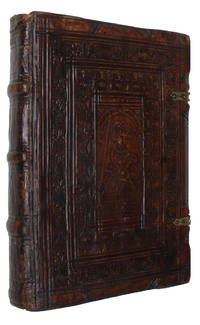
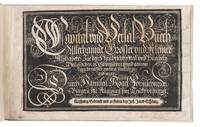
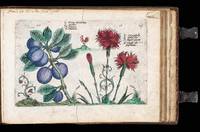
159416352Amsterdam 1594-1635. Oblong quarto 260 by 170mm 176 engraved plates numbered in an early hand 1-46 48-54 57-69 80-189 including 8 title-pages all with fine contemporary hand-colour in full occasionally heightened in silver two plates torn with slight loss to image and with early repairs six plates with slight worming to margins and three plates trimmed to neatline and laid down on old paper front free endpaper with later ownership inscription; mid-seventeenth century English red morocco elaborately gilt silver clasps and catches. A magnificent album of natural history engravings collected and bound for an English patron containing two complete suites of plates: Hoefnagel's 'Diversæ insectarum volatilium'; and Woutneel's 'Cognoscite lilia agri quomodo crescent' often bound as the fifth part 'Altera Pars' to the Crispin de Passes' 'Hortus Floridus' - the "most ambitions if not the first early effort to employ Continental resources to produce a set of botanical engravings designed for the English market" Gerard; and nine near complete or partial suites including an early issue of tulip plates from the 'Hortus Floridus'. All plates have been numbered consecutively in manuscript at the time of binding to a rudimentary scientific rubric: insects first then aquatic animals quadrupeds birds and botanicals last but not least. As a result some plates are bound with like subject rather than with their original publications. The album represents the work of some of the most famous natural history artists of the late sixteenth and early seventeenth centuries. The majority are published by Claes Jansz Visscher 1587-1652 the most important publisher of prints and maps in Amsterdam of his day. Recorded as an engraver in Amsterdam as early as 1608 he built a distinctive inventory of prints after the designs of Flemish artists which proved extremely popular and formed the basis of Visscher's early success as a publisher. INSECTS HOEFNAGEL Jacob. Diversæ insectarum volatilium: icones ad vivum accuratissmè depictæ per celeberrimum pictorem D.I. Hoefnagel typisq. Mandatae a Nicolao Ioannis Visscher anno 1630 Engraved title-page complete with 15 numbered plates of insects misbound including some upside-down bound with plates 11 and 12 from 'Volatilium varii generis effigies' after Nicolaes de Bruyn all with contemporary hand-colour heightened in silver consecutively numbered in an early hand 1-18. North German insects with the exception of the tarantula and scorpion. Engraved by Visscher after those by Jacob Hoefnagel 1573-1632 court painter for Emperor Rudolph from 1607 son of Joris Hoefnagel whose drawings of animals flowers and insects he engraved and published as the 'Archetypa Studiaque Patris Georgii Hoefnagelii' 1592. He also engraved plates for Braun and Hogenburg's 'Civitates Orbis Terrarum' 1512 - 1617. Ebert 798; Hagen I 371f; Hollstein IX 46 1-16; Nissen 1955; Horn-Schenkl. 10473. AQUATIC ANIMALS BRUYN Nicolaes de. Libelius sic varia genera piscium compectens pictoribus sculptoribus etc mire utilis et necessaries Nicolaes de Bruyn inventor Claes Ianss. Visscher excudit. interspersed with: COLLAERT Adrian. Piscium vivae icones inventae ab Adrian Collardo et excusae a Nicolao Ioannis Visscher anno 1634 Engraved allegorical title-page for 'Libillus' 11 of 12 without the sea-horse plates of aquatic animals and sea-monsters; 19 of 20 engraved plates of aquatic animals numbered in an early hand 19-44 followed by the allegorical title-page for 'Piscium' numbered 45 all with contemporary hand-colour all annotated in an early hand with common names in English. An early state of the title-page for de Bruyn's 'Libellus' before correction. Nicolaes de Bruyn 1571-1656 is best known for his large engraved landscapes "after designs by artists such as Gillis van Coninxloo and David Vinckboons from around 1600 his pupil and brother-in-law was Jan van Londerseel" Hollstein online A near complete suite of plates from a later edition of Collaert's famous work on fish first published in about 1598 in which the original engravings included elaborate landscape backgrounds. For his version Claes Visscher has incorporated his harpoon monogram into the dramatic title-page. Collaert 1560-1618 married engraver and publisher Philippe Galle. WEYER Gabriel. Monstra marina dat is verscheydon zee-monsters ge inventeert door Gabriel Weyer gedrucht by Claes Ianss. Visscher a.o 1634 Engraved allegorical title-page 7 of 12 plates of mermaids and mermen all with contemporary hand-colour numbered in an early hand 46 48-54. Berliner 'Ornamentstichkatalog' 4292 I; Nagler XXIV S. 220 I QUADRUPEDS BOLSWERT Boetius Adams after Adrien BLOEMAERT. Natus Dei solius ad servitium cinctis homo per hund creates imperat. Volentibus promisq.e; ut huic puessulo blande Leo Jouisq.e ales submittitur. ABloemaert invent: BA. Bolsuerd: sculp C Visscher excudebat 1632 G. Ryckius interspersed with: BRUYN Nicolaes de. Animalium quadrupedum varii generis effigies Allerley viervuessiger thier eigentliche abbildung den goltschmieden dienlich 1594. 8 of 14 without plates 1 5 and 11 plates 12 13 14 bound below with 'Volatilium' engraved plates of pastoral scenes from 'Natus'; 11 of 12 bound without the title-page engraved plates of animals from 'Animalium' all with contemporary hand-colour numbered in an early hand 57-69 and 80-85 allegorical title-page for 'Natus' numbered 86 annotated with the common names in English. The artistic Bolswert and Bloemaert families of Utrecht seem to have been very close frequently working together. Bloemaert met a grisly death at the hands of one of his students in 1666. 'Animalium' cf Hollstein 303-310; 'Natus' cf Hollstein 406-419 BIRDS BRUYN Nicolaes de. Volatilium varii generis effigies in tyronum praecipue vero aurisabrorum gratiam aeri incisa Claes Ianss. Visscher exu. NB. interspersed with: COLLAERT Adrian. Avium vivae icones Adriano Collardo inventore et excusum apud C Visscher anno 1625. 9 of 13 without plate 13 and plates 11 and 12 bound with 'Diversæ insectarum volatilium' above engraved plates of birds from 'Volatilium'; 12 of 18 without plates 4 9 14 15 18 plate 1 title-page bound separately below engraved plates of birds from 'Avium'; plates 12 13 and 14 from 'Natus' see above all with contemporary hand-colour numbered in an early hand 87-110 allegorical title-page for 'Volatilium' numbered "1" in the plate in manuscript "iii" ie 111 and with "Thretti" in the lower margin. BOTANICAL PASSE Crispin van de the elder and younger. Hortus Floridus Utrecht 1614 12 engraved plates of tulips numbered 32 43-53 all with early hand-colour numbered in an early hand 112-123 one ascribed to Willem de Pass in the plate. An early issue with no text on verso and captions only in Latin of a selection of tulip plates from "the most popular florilegium ever published" 'An Oak Spring Flora'. The work was first issued in a number of states between 1614 and 1617 and is often hailed as "the most important of early examples of botanical illustration" Gerard. It was issued in four sections on for each season with text in Latin and subsequently a selection of vernacular languages. 'An Oak Spring Flora' 12 WOUTNEEL Hans; and possibly Crispin van de PASSE the elder. Cognoscite lilia agri quomodo crescent non laborant neque nent: attamen dico vobis ne salomonem quidem in universa Gloria sua sic amic tum fuisse.ut unum ex his. Matthe: 6 Cap. Formulis Crispiam Passaei et Joannis Waldnelij 1603-1608 Allegorical title-page 61 engraved plates captions in Latin French English and Dutch all with early hand-colour numbered in manuscript 124-185 annotated throughout in two early hands with the months in which they flower and their medicinal properties in the "first" "second" and "third degree" misbound. The "most ambitions if not the first early effort to employ Continental resources to produce a set of botanical engravings designed for the English market" Gerard. Complete a suite of 61 plates depicting 120 plants published as a separate work in its own right but often issued as the fifth part of the de Passe's 'Hortus Floridus' when it appears with an additional letterpress title-page as the 'Altera Pars'. An early issue with no text on verso. "Traditionally the 'Alera Pars' has been considered as an aesthetically inferior appendage to the 'Hortus Floridus' and has received little attention from historians of prints or botanical illustration. However the presence on the title-page of the imprint of Hands Woutneel "Joannis Waldelij" an Antwerp native who was a bookseller and publisher in London from 1576 until his death sometime between 1603 and 1608 implies that the 'Altera pars' had a significant English component. As such it stands as an early example of Anglo-Continental print publishing collaboration. Prior to publication of the 'Altera Pars' the demand in England for botanical illustrations had been met primarily by relatively crude highly schematic collections of woodcuts such as those in Jacques LeMoyne de Morgue's 'La Clef des Champs' 1586 and John Norton's publication of Gerard's 'Herball' 1597. The 'Altera Pars' with its more naturalistic depictions of 120 plants set a new standard and served as the primary source of botanical images for English engravers and publishers from the late years of the reign of James I through the Restoration' Gerard. Hans Woutneel first appears in London on being admitted to the Stationers Company in 1579-80. Cartographer Abraham Ortelius mentions him frequently in his correspondence with his nephew Jacob Cole Gerard and Woutneel appears to have worked as Christopher Plantin's London agent. de Belder 272; Gerard 'Woutneel de Passe and the Anglo-Netherlandish Print Trade' 1996; Hunt 199; Nissen BBI 1494 Avium vivae icons Adriano Collardo inventore et excusum apud C Visscher anno 1625 Engraved allegorical title-page numbered 186 see above for plates. Untitled composite natural history. Claes Janss Visscher excudibat A.o 1625 A suite of 12 numbered engraved plates of composite natural history subjects all with early hand-colour numbered in manuscript 187-198 11 with the joint imprint of Assuerus van Londerseel and Claes Visscher. In the style of Hoefnagel's 'Archetypa Studiaque ' 1592 this is a very scarce suite of plates with only one uncoloured set known in the British Library.
158041650Antwerp 1580. Print. 3 1/2 x 2 2/3 inches. Engraved portrait on laid paper. Latin text around oval vignette with caption below. Stamp on verso of Frederic R. Halsey. Image: 3 2/5 x 2 3/4 inches. Matted: 18 x 14 inches. Provenance: Frederic R. Halsey collection.<br/> <br/> One of the earliest portaits of one of the greatest figures in maritime history Sir Francis Drake.<br/> <br/> Sir Francis Drake c.1540-1596 was an English explorer pirate and politician best known for his circumnavigation of the world in a single expedition in his galleon the Golden Hind. Drake left England with five ships in December of 1577 as is noted in the present print. He returned three years later having challenged Spain's hegemony over the Atlantic Ocean and the New World. Drake would go on to help defeat the Spanish Armada in 1588. Drake is pictured half-length in an oval vignette which is lettered in Latin text meaning: "Most Noble English Knight Very Experienced in All Things Nautical and Military." Wierix captures Drake around the age of 43 with signs of age. He engraved this image after a portrait purportedly painted from life by Jean Rabel the Elder; it is said to be a credible likeness of the famed navigator. Drake is in a three-quarter view looking to his right wearing etched armor with a sash a lace collar over his gorget and holding a shield on his right arm which is decorated with two ships. The legend beneath the portrait indicates the date of Drake's circumnavigation and reads: "Hic est qui toto terrarum Orbe duorum annor. Spatio et mensium to circumducto Angliam patriam revisit 1577 id Dece." This is the one known throughout the world. He circumnavigated England and returned 1577 December. "Drake's voyage of 1577-80 had two purposes - to discover trading bases in the legendary "Terra Australis" and the Moluccas and to raid the west coast of South America. Sailing up the coasts of Chile Peru and Mexico Drake sacked towns and plundered shipping. He reached California which he named New Albion and claimed for England in the name of Queen Elizabeth. Returning to England via the Pacific and Indian Oceans Drake was the first Englishman to circumnavigate the world." Hill The printmaker Hieronymus Wierix was one of three brothers who were all engravers. Hieronymus was a child prodigy who went to work for the legendary printer Christophe Plantin in 1570. There he learned to engrave copper engraving his first plate for Plantin at the age of seventeen. Wierix made over 120 engravings for Plantin from 1569 to 1576. He became a master printer known for his "very delicate religious prints on a very small scale" and lived in Antwerp the remainder of his life. It is unclear if Plantin had a hand in the publication of the present print but he did live in Antwerp until 1589 and he was a close associate of Wierix's. Wierix's portrait of Drake is the basis for later derivative images by other printmakers including Jodocus Hondius and Crispin van de Passe. In those other prints of Drake the image and his face are in reverse orientation and most are inaccurate copies of copies presenting a Drake far afield from his actual appearance. This print from the esteemed Frederic R. Halsey print collection with Halsey's stamp on its verso has impeccable provenance to match its quality. Halsey was a notable book and print collector attorney member of the council of the Grolier Club and trustee of the New York Public Library. His collection of prints was estimated to hold about ten thousand items the scale and scope of which would be near to impossible to replicate. Halsey collected Americana and prints of sporting Napoleonia and etchings by old and modern masters. His collection was sold through Anderson Galleries in New York November-December 1916 and its catalog remains an essential reference.<br/> <br/> Graesse V: 154. Grivel "Au Sieur Rabel Parangon du la 'Pourtraicture'" in Renaissance en France pp. 227-92. Hill p.86. Hollstein Dutch and Flemish Etchings XV.709. Kraus Drake 59. O'Donoghue Catalog of Engraved British Portraits O8.88. Sabin 58995. unknown
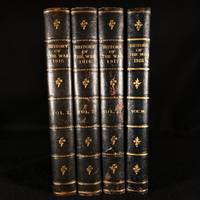
1519731L8London: The Times 1915-1918. Fine Binding. Very Good Indeed. 12" by 8". Various. A finely bound set of four volumes from The Times' popular periodical regarding the First World War. With a folding map frontispiece to volume II. With black and white in-text illustrations throughout. Comprising volumes II VII XI and XIV issued from 1915 to 1918. Battles discussed include the Battle of Jadar The Fall of Antwerp and the The Aisne Battles. In uniform full morocco bindings. Externally very smart. Repair to the rear board of volume XIV. Light rubbing . Rear joint to volume II strained but firm. Patches of rubbing to the front board of volume VII. Very Good Indeed The Times unknown
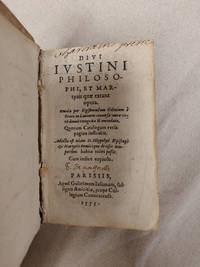
157541312Paris at William Julian's in the Garden of Friendship near the College of Cameracenfe 1575. Vellum. Very Good. 32 mo aged vellum boards with what appears to be the title stamped on the spine though very faded. Rough translation - All the extant works of the great philosopher and martyr of Ivstin Justin passed down translated into Latin by Sigismund Celenius. Includes an addition/addendum trans from D. Hippolyi Epifcopi. The condition of the book is Very Good for it's age binding of the text block intact; general aging to the vellum; fading on the spine as noted prior; text block separating some from the boards but the exposed bands on the spine are intact. 440pgs roughly100pg index. <br/> <br/> hardcover
1512250826035Real Gone Music 2015-12-04. audioCD. Very Good. 5x4x0. 40th Anniversary Remastered & Expanded Edition RGM-0411; bonus tracks & outtakes; tiny ding to booklet; otherwise jewel case and rear cover art are in excellent condition; disc is mint/near mint; because we care that your order arrives in the condition stated we have additionally sealed the case in bubblewrap for added protection during shipment Real Gone Music unknown
150106400The Bristol Courier 1915-01-01. Hardcover. Very Good. Green ribbed cloth boards with red text on the front are worn at the corners to threads spine also worn at the head/tail. bleached spot on rear about 1.5x.5". Hinge breaking at inside front cover pen mark on paper edge. In addition to the b&w illustrations there are four inserted color illustrations and 100 pages of ads many graphic. All orders packed with care most dust jackets protected by Brodart sleeve independent bookseller since 2011 The Bristol Courier hardcover
1519702L19Kobe: Kobe Herald 1915-1924. Cloth. Good. 9" by 6.5". None. A very scarce collection of recollections regarding the mountains of Rokko-san. Compiled by 'The Bell Goat' a member of the Japan Alpine Club. Comprising of volumes I-XIII and XV-XVIII of this very scarce set. It is extremely scarce to have so many volumes together. An important account of mountaineering during the Golden Age of this sport and at a time where mountaineering in Japan was becoming a popular activity. A charming work written in English which provides a detailed description of journeys on Mount Rokko in the Hyogo Prefecture in Japan. Volumes IV to X are signed by the author with an association to one of their fellow 'mountain goats'. There is no volume XIV to this set. Volume IV is signed by the author with an inscription to the recto of front endpaper. 'J G S Gausden The flying Goat with the author's best compliments Kobe July 8th 1916'. Volume V is also signed by the author with the inscription 'To the flying goat with the Bell Goat's best compliments Kobe Xmas 1916'. Author's inscription to volume VI reads 'With the author's compliments'. Inscription to volume VII reads 'J G S Gausden The flying goat with the Bell Goats' Compliments Kobe Xmas 1916'. Inscription to volume VIII reads 'To the flying goat with the Bell Goats' best Compliments Kobe Japan May 1918'. Author's inscription to volume IX reads 'J G S Gausden from . Kobe New Years Day 1919'. Inscription to volume X reads 'With the Editors' best compliments and Thanks Kobe June 30th 1919'. Inscription to the recto of front endpaper to volume XV 'With love from Jim'. To the start of volume I there is a dedication to Arthur Groom who had a home at Mount Rokko and opened the first golf course in Japan Kobe Golf Club. Rokko-san was also the first place that rock climbing was introduced in Japan. Forty-four illustrations to volume I thirty-four illustrations to volume II fifty illustrations to volume III fifty illustrations to volume IV fifty-five illustrations to volume V fifty illustrations to volume VI VII thirty-five illustrations to volume VIII with thirty seven illustrations to volume IX forty-one plates to volume X thirty plates to volume XI twenty-five plates to volume XII twenty-five illustrations to volume XIII twenty-five illustrations to volume XV twenty-five illustrations to volume XVI twelve illustrations to volume XVII with thirteen plates to volume XVIII. With the colophon in Japanese. With poems and diary entries anecdotes and transcripts this work is a thorough account of many mountaineering expeditions over the course of several years. A delightful examination of Rokko-san. In the publisher's original cloth bindings. Externally generally smart. Loss to the spine of volume I and II. Bumping to the head and tail of all spines. Damp staining to the bottom of boards to all volumes. Gilt to the front board of volume X is fading. Author's inscription to the recto of front endpaper to volumes IV to X inclusive. Further inscription to the recto of front endpaper to volumes XII and XV. Internally most volumes are firmly bound. Volume XIII has a tender binding. Pages 75-78 of volume XIII are detached but present. 'The Bessan Ridge' plate is detached but present to volume X. 'The sword peak' plate to volume VIII is detached but present. Pages are bright with occasional scattered spots. Good Kobe Herald hardcover
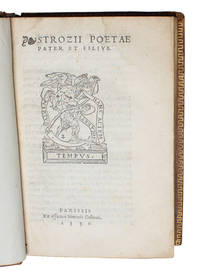
153045363Parisiis Ex officina Simonis Colinaei 1530. 8vo. Bound in a very fine later full calf around 1700 profusely gilt spine titlelabel in leather with gilt lettering broad gilt borders on covers edges of covers gilt edges of leaves gilt. A very small nick to top of spine. 8 lvs. 1-2563 lvs. 1 blank. A small and very faint dampstain to upper inner margins of the first 8 lvs. Otherwise very clean throughout. A beautifull printed and wide-margined copy 17x115 cm. <br/><br/><em>Scarce second edition of the "opera" of the poetical works of both father and son. Their collected opere were first published by Aldus Manutius in 1513 together with works of his son under the title Strozii poëtae pater et filius. The offered edition is copied from this Aldus-edition. They were both members of the famous Strozzi-family exiled from Florence.Adams S 1957. - Graesse VI: 512. </em> hardcover
157656695Colophon: Kiøbenhaffn Copenhagen Matz Wingaardt 1576. 4to. Pragtfuldt samtidigt hellæderbind af kalveskind over træ med skråtskårne kanter og 2 lukkestroppe med messingbeslag det ene hængsel løst antageligt udført af en dansk bogbinder. 3 ophøjede ægte bind på ryggen og med blindtrykte stregbordurer. Permer med dobbelte stregrammer og 2 brede rammer udført med ruller og stempler. Midtfelterne med stort pladetrykt billede af Justitia på bagpermen et billede af Justinian . Kapitæler med mindre reparationer. Titelbladet med en træsnit illustration af den danske konge med rigsvåbnet. Kolofon med Gotfred af Ghemens trykkermærke i træsnit. 111 unummerede blade. Indersiden af forpermen har notater i gl. hænder vedrørende bogens indhold. Fra Oscar Wandels bogsamling med hans exlibris. Da bogen ikke er ombundet foreligger den her i dens opsrindelige størrelse med pænt brede marginer. Få spredte brunpletter. Nogle blade med en svag skjold nederst på siderne. De første 6 blade incl. titelbladet er noget restaurerede med senere omkantning. Titelbladet har en smule tab af stregrammen omkring kongen blad 2 recto har tab af et ord i nederste linie tagher. Trykt på svært papir. <br/><br/><em>Extremely rare first printing of what is arguably the world's first facsimile namely Mads Vingaard's 1576 reproduction of the first printing of the Law of Sealand originally printed by Ghemen in 1505 and here re-issued in exact reproduction. This wonderful print is not merely a "line to line word to word"-reproduction but a facsimile making use of the same types and exact reproductions of the woodcuts. It is generally believed that "the first facsimile in the history of the book was a manuscript of Austrian provenance - the Goldene Bulle - reproduced in 1697 by the Frankfurt law historian Heinrich Günther Thülemeyer and Johann Friedrich Fleischer" from "Imagination Almanach" 1986-1993 Sammelheft. 1993; 2006. The present reproduction predates that work otherwise hailed as the first "facsimile" in the history of the book by more than a century!Some credit Plantin in the 17th century with being the first to produce a facsimile. This is also about a century after Mats Vingaard's facsimile of the Law of Sealand. Like the laws of Sealand and The Law of Scania The Law of Jutland" constitutes a law book "Rechtsbuch" in German in the sense of a private collection of those common laws pertaining to inheritance ownership marriage measurement of land murder theft vandalism etc. that were commonly applicable in the region.The medieval Danish regional laws possess an immense importance both linguistically and legally and the influence is evident even today both in the development of our legal system and of our written language. At the time of their foundation the Danish kingdom was divided into jurisdictional areas lands that in turn were divided into townships. Each land had a county council which also served as a judicial court. It quite quickly became standard for the township court to be able to refer verdicts and rulings to the county/land council. In the 13th century there were three main lands namely Jutland Sealand and Skåne. With time these three lands came to rule over all townships and thus we find three ruling legal books from the 13th century namely the three earliest Danish law books - Jyske Lov the Sealandic Laws and Skånske Lov. They were all printed for the first time in 1505 and 1505 respectively. It is not until 1683 with "Danske Lov" that Denmark gets a law that covers the entire kingdom. The 1576 facsimile is scarce and Thesaurus estimates that only ab. 10 copies still exist on private hands. </em> unknown
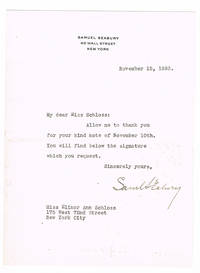
151925338New York: November 15 1933. November 15 1933. Very good. - sc Small quarto 8-1/2 inches high by 12-1/2 inches wide folded to form 4 sides. 21 words typed on the first side of a sheet of his personalized cream letterhead with his Wall Street address printed at the top. Signed "Samuel Seabury". The letter is lightly soiled & slightly darkened along the left side. There are 4 small pieces of tape on the 4th side where the letter was once mounted in an album. Folded once for mailing. Very good. New York: November 15, 1933. unknown
152629791Venetiis: Per Joan. Antoniu et fratres de Sabio 1526. First Edition. Hardcover. 4 64 numbered leaves. Later half vellum over marbled boards. Engraved title page initials woodcut printer's device of Lorenzo Lorio and Battista Putelletto at end featuring Saint Catherine of Alexandria a breaking wheel and the palm of martyrdom. Text block is faintly stained throughout. Old inscription on title a couple of old annotations on the margins tiny hole and mend to title page old mends to the last two leaves two small tears to printer's device. A very good copy. Uncommon. There are no auction records for the first edition and only a handful for later editions. ; Small octavo. Per Joan. Antoniu et fratres de Sabio hardcover
156821281Augsburg: Johann Jacob Schönig 1568. Vellum ca. 1985 with each leaf attached to a stub and the stubs side stitched in a cloth slipcase. Oblong folio 21 x 34 cm. With a richly calligraphic woodcut title-page 18 x 28 cm with text in white fraktur lettering on black with a white panel at the foot with the letterpress imprint in a fraktur type; and 9 of 10 full-page woodcuts about 17 x 25.5 cm showing alphabets in white on black one dated 1568: 8 with decorated gothic capitals versals: 22-150 mm and 1 with textura capitals textura lowercase and roman capitals all versos blank. Lacking 1 leaf. With a small and perhaps fragmentary manuscript on parchment 2 ll. 11.5 x 13.5 cm written on both sides: a Protestant copybook written soon after 1557 probably in Basle or vicinity with 7 writing samples including alphabets of capitals and minuscules the first two pages in fraktur gothic styles and the last two in humanistic styles. Sixth known copy of Johann Jacob Schönig's edition of a stunningly decorative Augsburg writing master's woodcut copybook devoted primarily to decorated gothic capitals versals printed in the period 1680-1694 from the original woodblocks of the first edition of 1568. Hans Rogel the elder 1532-1592 writing master school teacher poet wood-block cutter engraver printer and publisher at Augsburg cut the woodblocks and probably executed the lettering himself. All the lettering examples and the title-page are printed from large richly calligraphic woodcuts with their lettering in white on black. Nine of the ten examples display versals the missing leaf supplied in reproduction including complete alphabets in three sizes. The final leaf displays alphabets of textura capitals textura minuscules and roman capitals. As early as 1779 Paul von Stetten described Rogel's Capital und Versal Buech as "besonders fein geschnitten" and said that if Rogel executed the lettering himself he "ist er billig den zierlichsten Schreibmeistern beyzuzählen". He thought it good enough to be the work of Caspar Brinner 1565-1610 the greatest Augsburg writing master of the second half of the century apparently not knowing Brinner was only about three years old in 1568.All editions should apparently contain 11 leaves but many contain only 10 and some fewer. Some have also been bound with additional leaves that do not belong to the edition. There appear to be only 3 complete copies of the present edition.An early owner skilfully wrote out alphabets in the fore-edge margins of 2 leaves and phrases at the foot of one. It seems likely to be the copy owned by Jan Willem Six van Vromade 1872-1936. Lacking leaf "2" as noted professionally and unobtrusively restored in 1984 and probably rebound soon after: the tattered fore-edge margins of several leaves were restored and a couple gaps in the right border of the title-page filled in with black ink. A small brown smudge in the unnumbered first page of versals 22 mm slightly affects small bits of 4 letters but in general the woodcuts remain in good condition.l Berlin Kat. 4799; Bonacini 1548 Berlin copy; Doede 21 note; Hollstein German 34 KVK & WorldCat 4 copies: 2 lacking 1 leaf; Van Stockum Cat. bibl. J.W. Six de Vromade part 1 16-21 November 1925 lot 407 the present copy; cf. Paul von Stetten Kunstgewerbe und Handwerksgeschichte . Augsburg 1779 vol. 1 p. 23 1655/68 ed. Johann Jacob Schönig, hardcover
159260391Rostock Stephan Mölleman 1592 4to. In contemporary limp vellum. Extremities with light soiling and miscolouring. Front free end-paper annotated in contemporary hand. Three leaves T-Tiii with repairs with loss of text and woodcut. Title-page and colophone supplied in facsimilie. Internally with light occassional browning but in general good condition. 272 ff f. 272 erroneously printed as f. 273 with 44 woodcut illustrations in text. <br/><br/><em>Later Rostock edition of the famous epic. Circulating from the 12th-century and derived in part from Aesop Reynard the Fox is one of the most popular and enduring beast-epics. Reynard the Fox is a collection of fables that originated in medieval Europe and the exact authorship is unknown. The stories were likely passed down orally before being written down in various versions over the centuries. The fables with the wily fox as a central character lent themselves to satire and it became a vehicle used by the Protestant reformers and others. The Low-German version first appeared at Lubeck in 1498 and the Rostock editions which followed from 1517 facilitated the spread of the epic towards the east. The woodcuts had previously illustrated the 1539 Rostock edition of which 36 are attributed to Erhard Altdorfer. Stylistically they depend on the first Lubeck and Rostock editions. </em> hardcover
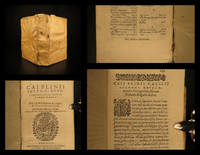
154719486Lugduni: Apud Seb. Gryphium Sébastien Gryphius 1547. EARLY GRYPHIUS EDITION. Printer’s device on title historiated capitals. Contemporary vellum speckled edges; a few wormholes on the final leaves and back board otherwise an excellent copy with ownership signatures on the title page. Early edition of the works of Pliny the Younger. This edition is a reprint of a 1508 Aldine edition by the notable Lyon-based printer Sébastien Gryphius who published editions in 1531 1539 and 1542. Pliny the Younger was one of the best-known first century historians and his written works were very popular. This series of personal letters to Roman figures provide a detailed view of everyday life within the Roman empire especially Pliny’s views on Christianity. Indeed the tenth letter treats situations in which people are accused of being Christians and how to deal with their interrogation. Also included is Pliny’s panegyric on Trajan and short treatises by Suetonius and Julius Obsequens. This edition includes an introductory note by Gryphius and a preface by Aldus Manutius.<br /> <br /> Caius Plinius Caecilius Secundus nephew and son of the elder Pliny was born at Novum Comum in 62 CE. After studying rhetoric under Quintilian he began his career as advocate at the age of nineteen. He subsequently served in Syria as a military tribune was a quaestor under Domitian and consul under the emperor Trajan. About the year 112 he governed Bithynia as imperial legate his death occurring shortly after in the year 114. He was more or less of a dilettante painstaking very desirous of making a literary reputation and amiable but lacking in force of character and original thought. His panegyric on Trajan delivered to express his gratitude to the emperor who had recently appointed him consul is his only speech which really possessed vitality and his letters which exhibit his self-complacency form entertaining reading. <br /> <br /> German-born Gryphius 1493-1556 was one of the most successful printers in sixteenth-century Lyon. He specialized in popular small-format editions of classical texts and actively competed with Italian printers like Aldus Manutius. <br /> <br /> See Baudrier Bibliographie lyonnaise 8 pp. 211; on the 1508 Aldine Press edition see Renuoard pp. 53-54. Apud Seb. Gryphium [Sébastien Gryphius] unknown
15889875<p>1588 1st ed Pliny the Younger Epistles Panegyricus Vesuvius ROME Early Church<br />Pliny the Younger one of the most notable 1st-century historians is best remembered for his written works and orations. His best-known and still widely popular work is his 'Epistles' which was a series of personal letters to other Roman figures. They give an important view of Roman everyday life as well as an interesting perspective on Pliny's views against Christianity. <br />However the most important epistles concern Pliny's account of the Mount Vesuvius eruption. Tacitus a friend of Pliny wanted to know more about the death of his uncle Pliny the Elder and the eruption itself.<br />This 1588 first edition was published by Jean Richer and includes a dedicatory epistle from Claude Mignault<br />Item number: #9875Price: $599<br />PLINY the Younger<br />Cai Plinii Secundi Novocomensis Epistolarum libri decem. Notæ & observationes auctore Claudio Minoe jurisc. Cum indicibus amplißimis & certißimis.<br />Parisiis apud Joannem Richerium via D. Joannis Lateranensis sub Arbore virescente. 1588. First edition.<br />Details: • Collation: Complete with all pageso 10 287 19• References: USTC 170912• Language: Latin • Binding: Vellum; secure• Size: ~6in X 3.75in 15cm x 9.5cm<br />Our Guarantee:Very Fast. Very Safe. Free Shipping Worldwide.Customer satisfaction is our priority! Notify us with 7 days of receiving and we will offer a full refund without reservation!<br /><br />9875<br />Photos available upon request.</p> Joannem Richerium, via D. Joannis Lateranensis, sub Arbore virescente hardcover
1518elala713Colophon on kk7r: Venice: In Aedib. Aldi Et Andreae Asulani Soceri June 1518. 1518. 8vo. pp. 26 p.l. 525 1 leaf. Aldine anchor device on title & at end. 19th century red morocco Aldine anchor device in gilt on covers all edges gilt rubbed title lightly toned & with small paper repair in lower margin x in colophon date erased with tiny hole. probably from the Syston Park Library of Sir John Thorold. Second Aldine Edition. The letters of the consul and Governor of Biyhinia friend of Tacitus and Suetonius provide an interesting view of the varied interests of a cultivated Roman gentleman. "The etiquette of the imperial circle scenes from the law-courts and the recitation-room the reunions of dilettanti and philosophers the busy life of the capital or of the municipal town the recreations of the seaside and of the country all these he brings vividly before our eyes". Encyc. Britan. 11th Edn. Topics range from his Tuscan villa happy memories of Lake Como love for his wife Calpurnia dreams ghost-stories the beauties of the Clitumnus and the floating islands of the Vadimonian lake the eruption of Vesuvius in connection with the last days and death of Pliny the Elder the deaths of Silius Italicus and Martial the principles that should guide a Roman governor in Greece the government of Bithynia and the relations between the governor and the Emperor. "The Letters are models of graceful thought and refined expression each of them dealing with a single topic and generally ending with an epigrammatic point." Ibid. The whole of Book 8 was first published in its proper place by Aldus Manutius in 1508. Adams P1538. BM STC Italian p. 525. Renouard I 195.4. Dibdin 4th Edn. II p. 330. Moss II pp. 493-94. Hardcover. Very Good. [Colophon on kk7r:] Venice: In Aedib. Aldi, Et Andreae Asulani Soceri, June 1518. Hardcover
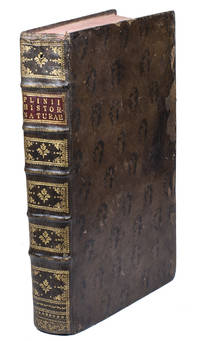
1532K7GAXLMCHM25Paris 1532. Folio. Jean Parvum index: Jean Petit 18th-century cat's paw calf richly gold-tooled spine with red title-label red edges. With a woodcut printer's device on the individual title-page for the index. 36 671 188 pp. Praised 1532 edition of Pliny's Naturalis historia: "Cette édition citée avec éloge par Ernesti et par Rezzonico." Brunet. Pliny's Natural history is one of the largest single works to have survived from the Roman Empire and purports to cover the entire field of ancient knowledge based on the best authorities available at the time. It encompasses the fields of botany zoology astronomy geology and mineralogy as well as the exploitation of those resources. It remains a standard work for the Roman period and the advances in technology and understanding of natural phenomena at the time. ''We know from Pliny that there were important pearl fisheries in the Gulf Pliny identifies Tylos Bahrain as a place famous for its pearls He attests that pearls were the most highly rated valuable in Roman society and that those from the Gulf were specially praised The pearl related finds at the site of El-Dur indicate the site was integrated into the maritime trade routes linking the Roman Empire the Persian Empire India and South Arabia'' Carter.With bookplate on paste-down some ink notes on the title-page the first page and occasionally in the margins; title-page a bit soiled; some wormholes near the end of the book mostly in the margins. Binding slightly worn along the extremities. Overall in good condition.l Brunet IV col. 715; Carter ''The history and prehistory of pearling in the Persian Gulf'' in: Journal of the economic and social history of the orient 48 2005 pp.139-209; Graesse V p. 339 "Excellente édition"; for Pliny: DSB XI pp. 38-40. unknown
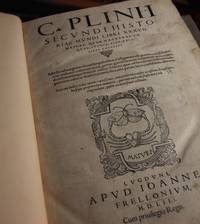
155328<p>C. Plinii Secundi Historiae mundi libri XXXVII majore quam hactenus unquam studio fide religione emedati adjectis ad marginem succinctis . . . una cum indice totius operis copiosissimo.<em> Lugduni Apvd Ioannem Frellonivm. M.D.L.III.</em></p><p>Pliny's <em>Natural History</em> is Shakespeare's source for the famous description in <em>Othello</em> of "men whose heads grow beneath their shoulders." See Kenneth Muir <em>Shakespeare's Sources </em>London 1957 p. 127.</p><p>Although there were translations of Pliny into French and English some scholars have argued that Shakespeare read Pliny in Latin. See T. W. Baldwin "A Note upon William Shakespeare's Use of Pliny" in <em>Essays in Dramatic Literature </em>London 1935 pp. 157-82.</p><p>Folio. 3 parts in one vols. A2-A4 B-C4 a-z5 A-Z5 AA-ZZ4 Con2 m4; l.; 34 679 236 p. Title-page vignette. Medium brown calf blindtooled border on both boards.</p><p>Provenance: Inverchapel bookplate.</p><p>The <em>National Union Catalog of Pre-1956 Imprints</em> lists only two known copies not including the present one.</p><p>References: NUC: 461 671-90 NP 0424260. Not in USTC.</p> John Frellonium
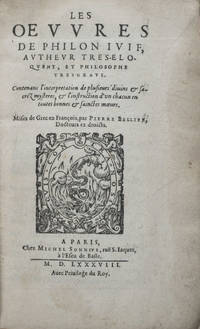
158843973Paris: Michel Sonnius 1588. Early edition. Hardcover. f to vg. 12mo 7 x 4 3/4". 8 528 32 leaves. Contemporary full vellum with handwritten title to spine. Publisher's title vignette. Decorative headpieces and initials. <br /> <br /> Originally published in 1575 this first French language edition of the works of Philo a first-century Alexandrian philosopher known for his mostly allegorical interpretations of the Torah known in the Hellenic world as the Pentateuch. His works also include histories and comments on philosophy. <br /> <br /> Many of the titles by which texts and text groups are known as modern conventions and not inventions of Philo.<br /> <br /> This book contains no less than 24 titles including the following:<br /> <br /> - De la Création du Monde On The Creation of the World<br /> - Allégories des Saintes Lois Allegorical Expositions of the Holy Laws<br /> - Du Plantement On Planting<br /> - De la Vie de Moïse On the Life of Moses<br /> - De la Charité et de l'Amour de son Prochain On Charity and Love for Others<br /> - De l'État et Devoir du Juge On a Judge's Duty<br /> - De l'Érection et Création du Prince The creation and elevation of the Prince<br /> - De la Force et Grandeur de Courage On the Power and Grandeur of Courage<br /> - Les Dix Commandements The Ten Commandments<br /> - Des Lois Particulières On the Specific Laws<br /> - De la Circoncision On Circumcision<br /> - De la Monarchie On Monarchy<br /> - Quels doiuent estre les loyers & honneurs des Sacrificateurs Rents & Honors of Priests<br /> - Des animaux qui sont propres aux Sacroifices: & quelles sont les elpeces des Sacrifices Elements of Animal Sacrifices<br /> - De ceux qui offrent les hosties au Sacrifice Hosts of Sacrifices<br /> - Qu'il ne faut point receuoir au temple le loyer & gain de la paillarde Rent and Profit of the Merchants<br /> - Que tout homme de bien est libre Every Good Man is Free<br /> - De la vie contemplariue ou des vertus des personnes deuotes Contemplative Life and Virtues<br /> - De la Noblesse On Nobility<br /> - Des loyers & peines Rents and Penalties<br /> - Des maledictions Curses<br /> - Que le monde n'est perissable That the World isnot Perishable<br /> - Contre Flaccus: ou de la prouidence Against Flaccus: or the Providence<br /> - Des vertus & ambassade fait à Caius Virtues & Embassy to Caius<br /> <br /> Binding age-toned. Book block separating from binding but still holding. Fore-edge of front free endpaper and fly leaf creased and torn. Clear and sporadic water-staining along upper margin of pages throughout. Text in old French. Binding in overall fair to good interior in good to very good condition. Michel Sonnius hardcover
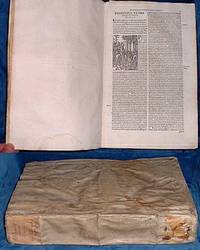
1557V68774Koln Cologne: apud Maternum Cholinum 1557. Hardcover. Good. Small woodcuts 40 with a few repeats mostly of biblical scenes a few historiated initials. . Folio flexible vellum with stubs of ties some wrinkles /paper spine label & large old shelfmark B Titlepage 25pp=dedication indices to reader & errata. 1pblank 5-704pp As listed on a4 the book collates !6 #4 a6 b4 c-z6 A-Z6 Aa-Mm6 Nn7 lacks Nn8=the final blank Title has stamp of the library of P.P.Capuci & early "sum ex libris Leodegarj a Meggen Can. Beron." Another "Capucinorum in Sursee" also "loci Capu. in Schyfen". Three small pin sized worm holes to TP soon diminishing to one and then none after the first few pages of text. There are two corners torn away without loss 4 marginal tears only one into text and that without loss. And p 634 has a marginal paper fault again not affecting text.Page 479/480 is bound before 477/478. There are a few gatherings that are browner and a few creases. A few ink splatters to about 6 pages and the lower edge has some faint damp marking mainly marginal but the overall condition is very good with a tight text block and clean pages. This collection was made by order of Charles the Great and until the present is still the basis of breviary readings. Although assigned to Paul the Deacon it has also been ascribed to Alcuin by Adams but as a suppositious work cf. H-819. apud Maternum Cholinum hardcover
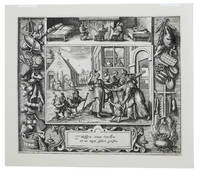
1590ABC_46070Antwerp 1590. Folio 7 of 8 plates trimmed. Adriaen Collaert 7 plates with the Acts of Mercy & Johannes Galle the Last Judgement Loose prints. 8 engravings ca. 17.5 x 20.5 cm on laid paper by Crispijn de Passe I the elder after Maarten de Vos with the central scene framed by an exquisite ornamental border showing crafts tools and scenes relating to the subject. All engravings captioned with engraved Latin text in a cartouche below the images. Complete series of the Acts of Mercy including the plate of the Last Judgement engraved by the engraver illustrator and publisher Crispijn de Passe I ca. 1564-1637 after Maarten de Vos 1532-1603 one of the most prolific and influential print designers of his generation. They were first published by the engraver Crispijn de Passe the elder I and subsequently by Adriaen Collaert Theodoor Galle and Johannes Galle. Our set shows the 7 prints of the Acts of Mercy in their second state of 4 by Collaert with his monogram "AC" in the plates. The eighth print showing the Last Judgement is in its third state published by Johannes Galle. The acts of mercy depicts feeding the hungry giving drink to the thirsty clothing the naked in a dress shop housing the homeless tending the sick visiting prisoners and burying the dead.One print feeding the hungry untrimmed. The 7 trimmed prints are reinforced with two small white paper slips in the head margin the Last Judgement very slightly toned and with a few spots. Otherwise in good condition with very sharp and dark impressions of the plates. The complete series of the Acts of Mercy including the Last Judgement.l Hollstein XV 471-477; New Hollstein Maarten de Vos 613.3; 614-620.2. ABE CAT Art History ABE CAT Bibles Sermons & Psalmbooks hardcover
1541357266Basileae.: No publisher. 1541. 1st Edition. 8vo. Ancient brown leather boards with an old leather replacement spine edges stained red. Good. Moderate dampstains throughout scattered ink notes boards bowed. 14.3x10x2.5 cm. Latin text. Four short works in one volume â€On the best Emperor and his office a work no less learned than pleasant†“On the office of princes dukes and the ancient militia Book One very learned and useful†“On the office of the king to Justinian Caesar a small work filled with very salutary aphorisms†and “On the doctrine of princes Book Iâ€. Scarce. Woodcut headpieces historiated initials. weight: 0.4 lb. Nicolas of Saguntum; Alban of Turin; Erasmus of Rotterdam translators No publisher. hardcover
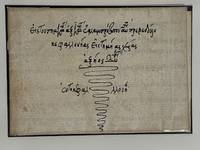
1591BOSTONVB11<br />MOREA OTTOMAN GREEK TURKISH PRISONERS Entire Letter writen from Chlonmontsi to "Lord David di Bembo Lord of Cephelonia" acknowledging receipt of nine Turkish Prisoners who are listed sent by the Lord of Cephalonia to "our Lord Bairakbasha Governor of the Morea". A very interesting and early letter during the period that Morea was under Ottoman rule expressing gratitude for the lenient treatment of Turkish prisoners. Surviving Ottoman letters in Greek are extremely rare. in commerce. A full translation and transcription is included.
1519ZB393224Macmillan Co. 1915-1937. Volumes 15-39 lacking vol. 26#6; partly bound minor ownership markings else texts clean and bindings tight. - If you are reading this this item is actually physically in our stock and ready for shipment once ordered. We are not bookjackers. Buyer is responsible for any additional duties taxes or fees required by recipient's country. Photos available upon request. Macmillan Co. unknown
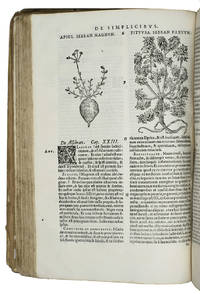
1581ABC_46255Venice: Lucantonio Giunta 1581. Near-contemporary vellum black morocco spine label with title in gold. Folio 23 x 34 cm. With 39 woodcut illustrations in the text. 2 parts in 1 volume. Second illustrated edition the first with the commentary of Costaeus of the collected works of the Arabic physician Mesue the younger also known as Masawaih al-Mardini in Latin with commentaries by Mondino de Liuzzi Christoph de Honestis Jacobus Sylvius Giovanni Mardi and Johannes Costaeus. It includes the "Canones universalis" dealing with treatment regimens; the second part "De simplicibus" about the properties of various pharmaceutical drugs; and the Grabadin "the most popular compendium of drugs in medieval Europe and . used everywhere in their preparation" Garrison. "The esteem in which these works were held is shown by the fact that a Latin translation of both was one of the first medical works to be printed Venice 1471" ibid.With the bookplate of the American botanist Edward Sandford Burgess 1855-1928 on the front paste-down. Also with the bookplate of the Horticultural Society of New York on the first free endpaper identifying this volume as part of the bequest of the American attorney and plant collector Kenneth Kent MacKenzie 1877-1934. Binding stained rubbed and chipped at the extremities. Interior shows occasional brown stains modern endpapers a little browned and brittle but overall in good condition.l Adams Y10; BM STC Italian p. 739; Durling 3131; EDIT 16 CNCE 27626. Lucantonio Giunta, hardcover