MASAWAIH AL-MARDINI (MESUE the younger).Biblio.com
76 résultats
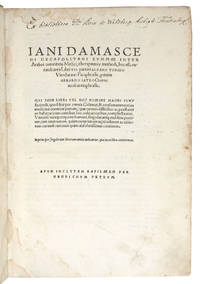
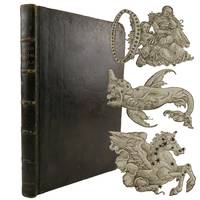
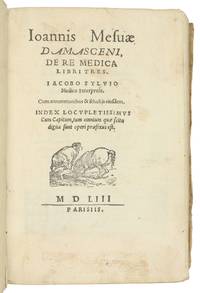
1553L7NA2E7L5WJBParis = Venice: Girolamo Scotto 1553. Contemporary vellum traces of ties. 8vo. With Scottos woodcut device on the title page showing what are probably two of the wild mares of King Abderus being devoured by the mares of King Diomedes of Thrace devouring either Abderos or Diomedes himself and about 22 woodcut decorated nearly all pictorial initials 7 series plus a few repeats. Rare Venetian edition with a false Paris imprint of Mesues three seminal pharmacological works including his great pharmacological handbook the principal model for the European pharmacopoeias translated into Latin by Jacques Dubois/Jacobus Sylvius 1478-1555 who taught anatomy at Paris his students including Vesalius and Gesner. Dubois first published it in a Paris folio edition in 1542. As far as we know the present edition has not previously been recognised as a false imprint but Girolamo Scotto in Venice used the woodcut device on the title-page in 1543 Bernstein Music printing p. 88 & fig. 3.16: much more artistic than most publishers devices so perhaps made to illustrate an unidentified book and the woodcut pictorial initial on r8r also appears in Lippomano Espositioni volgare Venice Girolamo Scotto 1554 A4r where some of the types match as well. Moreover the 2 initials in the largest series A on l2v and H on e2v show respectively: another Scotto device anchor with S O S and the motto in tenebris fulget: see Scottos 1554 Lippomano 1555 Aquinas and his heirs 1585 Monte Madrigali and the coat of arms of the Medici Grand Dukes of Tuscany dexter impaled with a tree atop six mounts sinister.De Vos calls Mesues present works a conduit for the Arabic contributions to that epistemology and its subsequent development and impact describing them as the most dominant source of pharmaceutical writings and by far the most influential in the subsequent development of European pharmacy with Duboiss new Latin translation of particular note pp. 668 670 673. Though these Mesue works had been printed already in 1471 Duboiss translation became the standard De Vos counting 17 editions in less than a century. The preliminaries include the title-page Duboiss 7-page dedicatory epistle addressed to Etienne de Poncher 1446-1529 Bishop of Bayonne and chancellor of the University of Paris and an 8-page contents covering all three works. The three Mesue works follow: Methodus medicamenta purgantia simplicissima deligendi & castigandi theorematis quatuor absolutus = Canones universales ll. 1r-33v 13 chapters; De singulis medicamentis purgantibus deligendis & castigandis = De simplicibus ll. 34r-82v 30 chapters; and De antidotis = Antidotarium or Grabadin ll. 82v-239r 12 sections; followed by definitions of the technical words ll. 239v-248r and a 9-page table of contents for all three works. Duboiss version of the first work differs considerably from earlier editions where it bore the title Canones universales. It describes general techniques in the preparation of medicines and was originally closely associated with the simples in the following work but it was given a much broader application. The De simplicibus originally gave information on 49 simples mostly purgatives here expanded to 53. Although it includes many known since classical antiquity more than a fourth are additions made by the mediaeval Arabic physicians. The bulk of the book is devoted to the Antidotarium also called Garbadin after the Arabic for dispensary. It is by far the most detailed and extensive mediaeval book of pharmacological recipes far surpassing the 12th-century Antidotarium Nicolai which had been the standard work in Europe. Not only does it include 432 recipes for compound medications compared with Nicolais 85 it arranges them by the kind of medicine rather than alphabetically and unlike Nicolai it gives detailed instructions for their preparation. It largely superseded Nicolai in Europe in the late 1300s and early 1400s. Although Mesue and his present works have fallen into undeserved obscurity in the general public they went through more editions than Ibn Sina Avicenna Galen or Discorides.If the attribution to Joannis Mesuae Damasceni is correct the author must be Yahya = Yuhanna ibn Masawaih al-Mardini ca. 925-1015 known in the West as Mesue the younger. He is said to have been a Syrian Jacobite/Nestorian Christian physician from Mardin in upper Mesopotamia now on the Turkish-Syrian border who worked in Damascas may have headed the Baghdad hospital served as personal physician to caliphs in Cairo and wrote in Arabic. His present principal works are now known however from Latin translations the earliest from 1281 and De Vos even suggests they may have been compiled in Bologna after 1260 adapting several unidentified Arabic medical works of the 10th and 11th centuries to 13th-century European needs. She notes that Dubois published a new Latin translation in 1542 and emphasises its importance but she does not discuss his sources he was well-versed in Greek and Hebrew but apparently not in Arabic. In any case the writings attributed to Mesue the younger clearly derive from the mediaeval Islamic world and contain many innovations that provided the basis for the theory and practice of pharmacology for centuries and perfectly met the demands of the developing medical marketplace of mediaeval Europe. The early Paris folio editions of Duboiss translation would have been out of reach of most students and country or small town physicians or apothecaries so Lyon printers introduced 8vo editions in 1548. The present 8vo edition appears to be the first outside Lyon and Scotto may have thought a false Paris imprint would make it seem more authentic than the Lyon competitors.With faint brown stains some marginal worming near the end of the text and the corner of Aa3 lost not affecting the text.l Durling 3145; ICCU NAPE 006561 8 copies; USTC 151259 2 copies; WorldCat 9 copies in 7 entries; cf. Brockelmann GAL I 232; Hirsch I 171f; not in Adams; BM STC French; EDIT 16; Wellcome; for Mesue and the present works: Paula De Vos The Prince of Medicine: Yuhanna ibn Masawayh and the foundations of the Western pharmaceutical tradition in: Isis 104 2013 pp. 667-712; Prioreschi History of medicine IV Byzantine and Islamic pp. 290-291. [Girolamo Scotto], hardcover
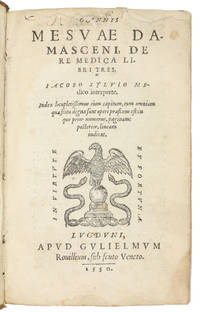
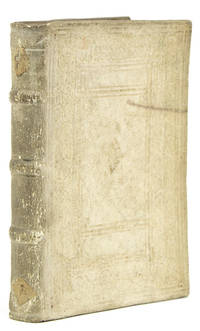
1550L7NAYKM7EWW1Lyon: Guillaume Rouillé colophon: printed by Philibert Rollet 1550. 19th-century marbled boards manuscript spine label. 8vo. With Rouillés woodcut device on the title-page eagle on a globe flanked by 2 snakes numerous woodcut decorated initials and an arabesque decoration below the colophon. Well-made but popularly priced Lyon 8vo edition of Mesues three seminal pharmacological works including his great pharmacological handbook the principal model for the European pharmacopoeias translated into Latin by Jacques Dubois/Jacobus Sylvius 1478-1555 who taught anatomy at Paris his students including Vesalius and Gesner. Dubois first published it in a Paris folio edition in 1542. Speaking of the artisanal epistemology crucial to the European scientific revolution De Vos calls Mesues present works a conduit for the Arabic contributions to that epistemology and its subsequent development and impact describing them as the most dominant source of pharmaceutical writings and by far the most influential in the subsequent development of European pharmacy with Duboiss new Latin translation of particular note pp. 668 670 673. It is by far the most detailed and extensive mediaeval book of pharmacological recipes far surpassing the 12th-century Antidotarium Nicolai which had been the standard work in Europe. Not only does it include 432 recipes for compound medications compared with Nicolais 85 it arranges them by the kind of medicine rather than alphabetically and unlike Nicolai it gives detailed instructions for their preparation. It largely superseded Nicolai in Europe in the late 1300s and early 1400s. Although Mesue and his present works have fallen into undeserved obscurity in the general public they went through more editions than Ibn Sina Avicenna Galen or Discorides.If the attribution to Joannis Mesuae Damasceni is correct the author must be Yahya = Yuhanna ibn Masawaih al-Mardini ca. 925-1015 known in the West as Mesue the younger.Provenance: 1 owners inscription in ink dated 1636 struck through and difficult to decipher on front paste-down; 2 another dated 21 August 1818 on back paste-down also difficult to read; 3 19th-century ink owners inscription of Arthur Rénaux on front paste-down. Occasional browning; an owners inscription erased on the title-page with slight loss to authors name. Binding rubbed; hinges cracked and minor chips in the spine.l Baudrier IX 176; Durling 3144; USTC 150499; Wellcome 4280; cf. Hirsch I 171f; not in BMC STC French; for Mesue and the present works: Paula De Vos The Prince of Medicine: Yuhanna ibn Masawayh and the foundations of the Western pharmaceutical tradition in: Isis 104 2013 pp. 667-712; Prioreschi History of medicine IV Byzantine and Islamic pp. 290-291. Guillaume Rouillé (colophon: printed by Philibert Rollet), hardcover
15821906030028Venetiis apud Aldum colophon: ex typographia Georgii Angelerii sumptibus Mag. D. Aldi Mannuccii M.D. LXXXI 1582. Hardcover. Acceptable. Aldine edition of the Works of Cicero 7 volume set bound in 3. The first 7 of 10 books. Originally issued separately 1578-83. Folios 33 cm. Rebound in 17th century calf. Binding worn boards detached. Institutional stamps and book plates renewed end pages. All edges red. Engraved title page with Aldine device. Woodcut titles for vols. III & VI. An important edition: "Ces volumes . sont toujours consideres comme une des plus importants editions de Cicero . Un exmeplaire d'une parfaite conservation est un livre fort rare et toujours digne de toute l'attention des amateurs." - Renouard. Renouard 232. Adams C 1660. Brunet II p. 8. Venetiis, apud Aldum [colophon: ex typographia Georgii Angelerii sumptibus Mag. D. Aldi Mannuccii M.D. LXXXI hardcover
1576304748Venice: Aldus Manutius 1576. First edition. viii 125 3 blank; 106 6 blank; 103 pp. 8vo. 17th-century German blind-stamped pigskin red edges. First edition. viii 125 3 blank; 106 6 blank; 103 pp. 8vo. This work on questions of antiquity written by Aldus the Younger son of Paulus Manutius esteemed Cicero scholar and grandson and namesake of the famous Venetian printer Aldus Manutius covers astronomy the Ptolemies and questions of the liberal arts. <br /> <br /> Aldus the Younger was the last member of the Manutius family to be active with the family's renowned press in Venice. Ahmanson-Murphy 898; Renouard 223:13. Provenance: early canceled ownership inscription at base of title "Paulus Johanne Patavii MDLXXVII"; Earls of Maccelsfield North Library bookplate embossed stamp to title and following leaf [Aldus Manutius] unknown
1566292430Venetiis: Aldus 1566. Hardcover. Very Good. Early vellum over boards red and blue morocco spine labels gilt. 800 167 7 30pp. A small horizontal tear and a small shelf label on the spine bookplate removed a tiny nick at the corner of the first several leaves very good. Contains commentary and letters from Aldus the Younger to Francsco Morandi and Aurelio Porcellaga Portulaca. The Catalogue of the Ahmanson-Murphy Collection at UCLA cites a copy and references Renouard 201:12 Adams M453; BMSTCI 412; HRHRC 458. Aldus hardcover
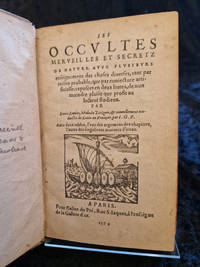
1574001927<p>Paris: pour Galliot du Pre 1574. 3rd Edition . Hardcover. Very Good. French translation from the 1st edition in Latin Occulta Naturae Miracula published 1559. 12mo collated as Title page with woodcut of viking ship pp2 pp213 plus 30 pages of alphabetical index to rear. Hardcover issued without dust jacket. Slightly later rebind of full leather with 5 raised bands and leather title label to spine and half of the "Gen de Paris" stamp to front cover. Binding in good condition with some rubbing to all edges and boards and a little chipping to top of back board. Inside except for the very odd mark all pages with all edges dyed red in excellent clean and bright condition with no foxing waterstains fingermarks etc. . For added interest the bookplate of Baron Hyacinthi Theodori dean of the Faculté de médecine de Paris circa 1720s is pasted to front pastedown. Levinus Lemnius was a celebrated Dutch physician whose medical writings were much translated. He studied under the famous Swiss botanist and bibliographer Konrad Gesner at the University of Louvain and under the famous Flemish anatomist Andreas Vesalius at the University of Padua. This Renaissance treatise on natural philosophy and medicine draws on classical sources particularly Aristotle with Lemnius being influenced by the "airs waters places" doctrine from the Hippocratic Corpus. This important work includes explanations of demonology somnambulism and the physical causes of mental illness the properties and healing virtues of herbs and gemstones alongside oddities like hermaphrodites. An superb copy of a very scarce early work with an interesting provenance. <br /><br /></p> pour Galliot du Pre hardcover
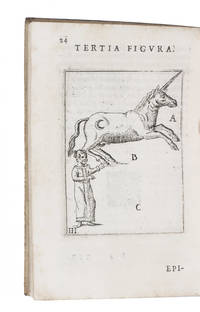
1596F75BBB01U79OBrescia 1596. Small 8vo 14.5 x 10 cm. Pietro Maria Marchetti Contemporary limp sheepskin parchment sewn on 3 alum-tawed thongs with manuscript title on smooth spine. With Marchetti's woodcut anchor and dolphin device imitating Aldus's on the title-page 16 numbered engraved emblematic illustrations plate size 8.5 x 6.5 cm woodcut headpieces tailpieces and decorated initials 3 series and decorations built up from cast fleurons. With the Latin text set in italic and the Italian translation in roman. 106 6 blank pp. First edition of the so-called Oracles of Leo the Wise with a bilingual Latin an Italian text and 16 lovely and rather surreal engravings: an emblematic book of prophecies traditionally attributed to Leo VI 866-911/12 Emperor of Byzantium from 866 to his death and at least here also to Antonius Severus 188-217 sole Emperor of Rome from his murder of his brother in December 211 to his death the book does not indicate which Severus is intended but the preface notes that he reigned from 212. The Latin text was circulated already attributed to Leo the Wise in the 12th century but Christians revived it in the 16th century and interpreted it as a prophecy that the Ottoman Empire would fall in 1622. These oracles remained popular in the 17th century when they were presented as having predicted the setbacks that the Ottomans suffered in Europe in that period.Owner's inscriptions on the title-page further with a bookplate. With a water stain in the first quire but otherwise in very good condition with only very minor foxing. The sewing supports have broken at the back hinge the thong ties are lost and the vellum is slightly wrinkled but the binding is still in good condition.l BMC STC Italian p. 622; Caillet 11042; Edit16/ICCU CNCE 28586; Mortimer Italian 254. hardcover
15695032541569. Book. A lengthy series of royal edicts / decrees / writs produced by the court under Philippe's close scrutiny in 1569 regarding financial and other obligations on the part of the persons in the area of Castro del Rio and elsewhere. 49 vellum leaves 98pp of manuscript 4 blank pages. The last page of which bears the date 18 November 1569 and the elaborate signatures and marks of the King and a number of his courtiers. Each page of the text bears 2 flourishes ie initials likely by the King and by the person responsible for the production of the document. In the original leather covers much rubbing and wear with remnants of the binding ribbons but the document still well-bound and with we think the original tri-coloured spine-cord binding the text to the cover. The first page with ornate decoration and illustrations in ink embellished with gold detailing and flourishes. Exquisite calligraphy throughout on well-preserved vellum. No seals present. 14" x 10". hardcover
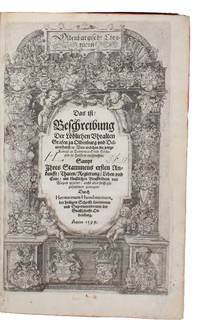
159355259Slesvig Nicolai Wegener 1593. 4to. Helpergamentsbind fra 1600-taller. Ved ombindingen er bagerst indsat ca. 100 blanke blade. Forgyldt titeletiket i skind på ryg. Etiketten med lidt tab. Gl. ejernavn Bille Brahe Hvedholm. 129 blade. På titelbladet er 2 linier som var trykt med rødt overskrevet med sort. Blad 1b med stort træsnit af Danmarks våben. Blad 2a med helsides træsnit Christian IV's portræt. Gl. ejernavn på titelbladet. Rent eksemplar trykt på kraftigt skrivepapir og med talrige samtidige tilskrifter i en net hånd. <br/><br/><em>Yderst sjældent forekommende anden udgave den første trykt af Brandis 1486 af den plattyske oversættelse af Jyske Lov ved Blasius Eckenberger. Der eksisterer kun en lille håndfuld bevarede eksemplarer i privat ejerskab. Det foreliggende eksemplar er en af varianteksemplarerne som er beskrevet af Lauritz Nielsen Dansk Bibliografi p.348 no.1072 og som gør sig bemærket ved flere udeladelser. Således er udeladt oversætterens eneretsprivilegium dedikationen fra oversætteren Chr. IV's autorisation m.v. = læg 2 og 3. I dette eksemplar starter teksten med "Vörrede" som har arksignatur D og slutter med blad 139 b som er et helsides træsnit af oversætterens bomærke. Repertoriet som Eckenberger udgav 1594 sammen med loven er heller ikke tilstede.Lauritz Nielsen 1072. - Thesaurus I 167. </em> unknown
1501mon0000081633Baldwin Cradock & Joy 1815-01-01. Hardcover. Good. in x in x in. pocket edition printed by scott webster 7 geary a new edition in one volume with 195 wood cuts on green rather worn cloth some looseness Baldwin Cradock & Joy hardcover
1600957544 Vols. 1979. Near Fine. 1600. First Edition. Softcover. Glossy pictorial softcovers. First editions. Books are in near fine condition crisp and clean with tight binding and sharp corners. Historic photos color illustrations and crew info as well as technical specs throughout. 4tos . paperback
1543IB7BGV3WR8OIBasel: Heinrich Petri 1543. 17th century black vellum made from an earlier liturgical music manuscript. Folio 20.5 x 29 cm. Important Latin edition of an Arabic medical compendium first printed also in Latin in 1479 with additions by Gerard de Cremona. It provides a collection of opinions voiced by Greek and Arabic physicians on pathology and therapeutics. "No Arabic printed edition exists so far" Choulant. The ninth-century Christian physician perhaps in or near Damascus Yahya ibn Sarabiyun son of a Bagarma physician wrote his great medical work Al-Kunnas in Syriac but it was soon translated into Arabic by scholars such as Musa Ibrahim al-Haditi and ibn Bahlul. Manuscripts survive in twelve and in seven books. "The seven-book edition was frequently printed in Latin translations as 'Breviarium' and 'Practica therapeuticae methodus' or here Therapeutice methodi. Albanus Torinus the editor of the Basel 1543 edition called the author Janus Damascenus for which reason he has been confused with the well-known theologian of that name. He is also often mistaken for his younger namesake Serapio junior" GAL. Some catalogues even ascribe this work to the Baghdad physician Abu-Zakariya Yuanna Ibn-Masawaih.Minor water stains; some unobtrusive worming to front board and flyleaves. Binding rubbed; extremities bumped with chipping to spine-ends. A wide-margined copy. With a 1677 owners inscription of the pharmacist and medical student Joseph Franz König on front paste-down; later owners inscription on the title-page of Bonifacius Brix von Wahlberg 1726-1776 court physician to the Princes of Fürstenberg.l Adams I14; BM STC German p. 932; Choulant Handb. p. 347; Durling 4778; GAL I 233 & S 417; USTC 606427; VD16 Y11; not in Waller. Heinrich Petri, hardcover
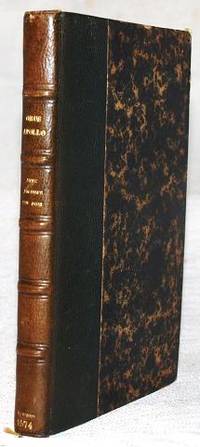
15741412080047Parisiis : Apud Galeotum a Prato & Ioannem Ruellium 1574-01-01. Hardcover. Very Good. 12mo. 8 107 frontis 196 ill. Parallel Latin and French. Quarter bound in fine early 20th century quarter green Moroccan. Gilt spine. 5 raised bands. Speckled boards. Marbled end pages. Silk ribbon. Printers device on final blank. Clean unmarked pages with minimal tanning. Inlaid auctions slips from 1936 and 1940 of this book at auction and the 1551 edition. Harvard Mortimer French 316; Brunet III 343; Adams H852. <br><br> Hieroglyphica is a text extant from the early medieval period ascribed to Horapollo Horus Apollo but it may be a pseudepigraph. The text of the Hieroglyphica consists of two books containing a total of 189 explanations of Egyptian hieroglyphs. The books profess to be a translation from an Egyptian original into Greek by a certain Philippus of whom nothing is known. The text was discovered in 1419 on the island of Andros and by the end of the 15th century the text became immensely popular among humanists. <Br>The Greek text is not in this edition which reproduces the engravings from the 1551 edition with some additions and a nice frontispiece Brunet. The frontispiece is attributed by Didot in his essay on the woodcut gives it as the most elegant woodcut that surrounds the title page and attributes the work to Jean Cousin. Papillion adds further that all the figures of this book are from the same artist. from auction slip. Parisiis : Apud Galeotum a Prato, & Ioannem Ruellium hardcover
1570801Basel: Eusebius Episcopius 1570. Hardcover. Poor. Heinrich Vogtherr the Elder. Rich provenance adorns this wonderful renaissance work capturing the myths geometry and observational data of the ancient world's heavens adorned with 48 beautiful illustrations of the constellations. Although the illustrator wasn't named scholars generally attribute the 48 woodcuts of constellations to Heinrich Vogtherr the Elder who was active in Basel at the time and shared a similar style. These blocks reflect a more modern 16th century approach to the constellations in comparison the 15th century Ratdolt illustrations of the same work. Provenance - A Latin scholar likely circa 16-17th century wrote witty Latin phrases at the front and rear. The title page has an inscription warning that roughly translated ""a fat belly does not produce subtle thoughts"". At the colophon is a lengthy indictment of the Roman Church drawing from phrases found in Graecimus by Eberhard of Bethune 13th century and Albertus de Rosate 14th century. Adding more context this book was printed in Basel at the height of the reformation. The large front ex libris plate is of Sir William Stirling-Maxwell. The book is listed in his 1860 library catalogue and he wrote page 197 "".useful collection of ancient mythologists. Included here for the curious fragments of ancient lore and table-talk ana preserved in the Fabulae and the astrological traditions."" At the rear pastedown is a ticket from Stirling-Maxwell's library assigning it to the ""Ana"" section. The ex libris on the FEP is that of the noted Harvard astronomer historian bibliophile and author Owen Gingerich. Bibliographic Details - Universal Short Title Catalogue USTC number 617529 41 copies recorded in the world's finest libraries. Physical Attributes - Measures approx. 30.5 x 20.5 x 2.5 cm. Old repair to even older leather binding. Boards with faint blind fillets forming double borders with corner florets. Spine with five raised bands author/title/date/Basel in gilt in compartments/at base. Edges mostly red but along fore-edge also in green sections. USTC calls it a folio but it might be a large quarto but regardless gatherings of 6. Printer's device on title page. Some initials. 48 in-text illustrations. Pages - viii 251 1 - blank 26 - Index Collation - a4 a-y6 z7. The z7 is odd but the 13 leaves of y6 and z7 index equal the 26 pages of the USTC catalogue entry so it appears complete and not missing a blank z8. Condition - See pictures. Old repair of even older leather binding with a new spine and corners but the corners are worn through exposing and wearing on pasteboard. Original leather dried and crazed little cracks newer repairs worn through and worn also. Some rubs to binding and spine bands also and a light bump on the front board. Large ex libris applied to pastedown small ex libris ticked applied to FEP. Gutter cracked. A moisture mark occasionally from edge throughout possibly from the application of text block edge coloring. Text block with toning occasional thumbing dog-eared or chipped corner page edge chip fox mark candle ember mark errant annotation/ink mark/doodle etc. throughout. Title page with a handful of inscriptions ink and graphite; trimmed slightly different from following page. 4th leaf Index trimmed tight at top edge. Several ink smudges on b6. Moisture mark bottom corner g and h gathering. Ink drop btm margin l3. No blank z8 if ever. Writing on colophon. More ex libris marks/tickets on rear binder's endpaper. Eusebius Episcopius
159950394Oldenburg Warner Berendts Erben 1599. Folio. Contemp. full calf. Richly gilt spine. Titlelabel gone. Engraved ornamental title-page. 8649418 incl. 2 blank. Profusely textillustrated with engravings and woodcuts among them the full-page portrait of the author a full-page view of Oldenburg 3 folded genealogical tables and the double-page engraved elevated plan of Oldenburg. Internally clean and fine. <br/><br/><em>First edition. Hamelmann's Chronicon is the first book to be printed in Oldenburg Brunet and it is the historical source work for the "House of Oldenburg" whose descendents became kings of Denmark and emperors of Russia. -Adams H 30. </em> unknown
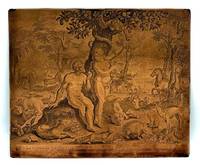
16001745Original printing plate: Johannes Galle. c.1600-1650. Engraved copper printing plate depicting Adam and Eve in the Garden of Eden surrounded by all manner of creatures with Adam sitting at the foot of the tree of knowledge about to take a bite from an apple whilst Eve takes another from the hand of a serpentine creature coiling around the branches above. 22.7 x 19.1cm. The plate incorporating text to the foot from Genesis 3. Signed at the foot "M. de Vos invenit / Corn. Galle Sculp. / Io. Galle excudit". The plate with some old fine scratches is otherwise in very good order. WITH: A later mid nineteeth-century and somewhat weak impression of the plate on paper. This laid down to board with manuscript French labels dated 1851 to the reverse apparently gifting the item from Mademoiselle C. Thyes of Brussels to "Monsieur Delpy"; the print with two pin holes to the blank lower margin and a few spots of faint foxing. A beautifully-executed original engraved copper printing plate by the Flemish engraver Cornelis Galle the Elder 1576-1650 forming a typically busy depiction of the Garden of Eden with Adam and Eve sealing their fate amidst a varied menagerie of peaceable beasts including an elephant camel bear porcupine ostrich and rearing unicorn amongst others.</p><p>Cornelis Galle was first taught engraving by his father the engraver and publisher Philip Galle 1537-1612. He subsequently resided in Rome for several years where he acquired an accuracy of design and freedom of style which marked him out as a master of his art form. Following his return to Antwerp he continued to engrave numerous plates after the works of his countrymen as well as his own designs becoming a master of the Antwerp Guild of St Luke in 1610.</p><p>The present engraving was made after an original painting by the prominent Flemish artist Maerten de Vos 1532-1603. A prolific draughtsman de Vos produced numerous designs for the engravers of Antwerp the resulting prints of which circulated widely in Europe and the Spanish colonies significantly contributing to his international reputation and influence.</p><p>Hollstein XLIV.61.243. [Original printing plate]: Johannes Galle. unknown
1600046524Geneva: Paulus Stephanus Paul Estienne 1600. Early Edition. Hardcover Full Leather. Very Good Condition. Early paneled calf rebacked ca. 19th c. endpapers refreshed hinges worn and cracked held by cords corners bumped wear at edges title foxed scattered mostly light foxing and browning - generally quite clean internally and an attractively printed Estienne edition of Pliny's letters. 28 646 blank 28 8 168 151 pp. Size: Quarto 4to. Quantity Available: 1. Shipped Weight: Under 1 kilo. Category: History; Antiquarian & Rare. Inventory No: 046524. Paulus Stephanus (Paul Estienne) hardcover
1562045392Venice: Domenico Guerra & Gio Battista 1562. Early Edition. Hardcover rebound in leather. Good Condition. Rebound in modern sheep front endpapers replaced minor worming and modest staining throughout but still an attractive copy of this early Italian edition of Pliny the Younger and others. With historiated initials - separate section titles but continuously paginated. 16 375pp with a printers mark on the verso of page 375. Size: Octavo 8vo. Quantity Available: 1. Shipped Weight: Under 1 kilo. Category: History; Antiquarian & Rare. Inventory No: 045392. Domenico Guerra & Gio Battista hardcover
157963961Frankfort & Wechelus: Francofurti Ad Moenum Apud and Wechelum 1579. Around 1961 a previous owner writes "According to the recent national archives survey this is the second oldest book in the State of Florida." Ask for scanned images of this rare volume and the laid-in notes of early researcher. "THIS CONSISTS OF ORATIONS AND COMMENTS OF FAZELLUS or FAZELUS WHO WAS PROFESSOR OF THE CUSTOMS OF THE SICILIAR AND SACRED HERITAGE OF THE PREACHER.". First Edition 1st Edition. Hardback LEATHERBOUND. Good Used Antique Condition. 13 3/4 Inches X 8 1/5 Inches X 2 1/4 Inches. Francofurti Ad Moenum Apud and Wechelum Paperback
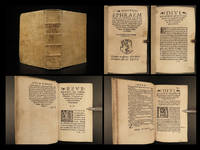
154720350<p><b>1547 1ed Saint Ephrem of Syria Aramaic Hymns Syriac Persian Greek Cologne RARE</b></p><p>Saint Ephrem the Syrian was a 4th-century early church Syriac Christian theologian. He wrote hundreds of hymn texts many of which engage with Greek philosophy and the traditions of Persian symbolism. Each of his writings were originally written in the Syriac language. </p><p>This 1547 edition of the works of Saint Ephrem is incredibly rare with only one known copy in any institution in America! </p><p>Item number: #20350</p><p>Price: $950</p><p>EPHREM Saint the Syrian </p><p><b><i>Sanctiss. Ephraem Syri eremitae archidiaconi & presbyteri ecclesiæ Edissenæ opuscula omnia quæ apud Latinos reperiri potuerunt operosius & auctius multo quam hactenus vnquam suæ integritati restituta & in hanc Enchiridij formam Christiano lectori exhibita.</i></b></p><p>Coloniæ : ex officina Melchioris Nouesiani 1547. First edition.</p><p><br /></p><p><u>Details</u>:</p><p>· Collation: Complete with all pages</p><p>o 40 232 leaves 112</p><p>o Signatures: -2⸠3â´ A-2Nâ¸</p><p>· References: USTC 692042; </p><p>· Language: Latin </p><p>· Binding: Vellum; tight and secure</p><p>· Size: ~6.25in X 4in 16cm x 10cm</p><p>· Very rare and desirable</p><p>Our Guarantee:</p><p>Very Fast. Very Safe. Free Shipping Worldwide.</p><p>Customer satisfaction is our priority! Notify us with 7 days of receiving and we will offer a full refund without reservation!</p><p>20350</p><p>Photos available upon request. </p> Melchioris Nouesiani hardcover
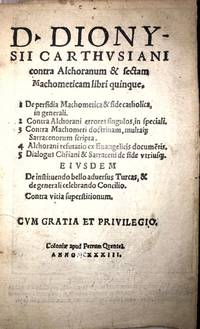
15331027Coloniae Köln: apud Peter Quentel 1533. First edition. In later gilt burgundy maroquin. Gilt floral ornaments and title on spine. Marbled endpapers. Gilt edges. Green silk bookmark. Two leaves misbound: Oov–vi after Qqiiii. Pages trimmed that occasionally effects the printed marginals and page headers. Two wormholes effects the upper part of the last four signatures slightly the text as well partly restored with old paper. Otherwise clean. Engraved bookplate and printed bibliographic reference on inner front panel. Collection vignette on front and rear endpapers. Collection inscription and stamp on additional endpaper. Overall in fine condition. With two large woodcut illustrations the Virgin and Child on verso of title and woodcut of the author at end. Woodcut initials. With two large woodcut illustrations the Virgin and Child on verso of title and woodcut of the author at end. Woodcut initials. First edition. In later gilt burgundy maroquin. Gilt floral ornaments and title on spine. Marbled endpapers. Gilt edges. Green silk bookmark. 16 628 i.e. 626 2 p. Pages 113 and 178 omitted in pagination. Signatures: AA8 A-Z8 Aa-Nn8 Oo10 Pp-Qq8. <p><br /> First edition of Denis the Carthusian’s treatise against Islam with numerous quotations from the Qurʼan. Preceded the earliest complete Latin edition of the Qurʼan by ten years. <br /> <p><p><br /> “Contra Alchoranum†the anti-Islamic work of the Carthusian monk Dionysius 1402–1471 was written around 1454 but only printed some eighty years later in this edition. It was edited by Petrus Blomeuenna whose dedicatory epistle is addressed to Emperor Ferdinand I. The laudatory poem about Dionysius Carthusianus that closes the book was written by Nicolas van Essche 1507–1578.<br /> <p><p><br /> Dionysius cites passages of the Qur’an in the Latin translation of Robert of Ketton and counters them by biblical quotations he places these Qur’anic theses and biblical antitheses in the mouths of a Christian and a Saracen as a fictitious dialogue. He also encourages crusades against the Ottoman Turks who shortly before he wrote this treatise had conquered Constantinople. <br /> <p><p><br /> “Contra Alchoranum†is considered to be the first printed source in Latin of the legend of Bahira or Sergius the Nestorian Monk who according to the story together with three Jews conveyed the text of the Qur'an to Mohammed with massive falsification of the Biblical traditions.<br /> <p><p><br /> The book has been published ten years earlier than the first printed version of the entire text of the Qurʼan in Latin translation Machumetis Saracenorum principis; Basel 1543 and uses the same translation by the English scholar Robert of Ketton Robertus Ketenensis; 1110–1160. In 1540 a paraphrased abridged German translation of “Contra Alchoranum†was published in Strasbourg under the title “Alchoran. Das ist des Mahometischen Gesatzbuchs …†whose translator was probably Heinrich von Eppendorff.<br /> <p><p><br /> Bibl.: Francisco A.: Martin Luther and Islam. A Study in Sixteenth-Century Polemics and Apologetics. Leiden; Boston: Brill 2007. pp. 16–17.<br /> <p><p><br /> VD 16 D 1863.; USTC 626366.; Adams D 539.<br /> <p>. apud Peter Quentel unknown
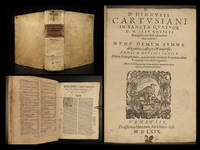
156920468<p><b>1569 1ed Denis the Carthusian BIBLE & Commentary New Testament Gospels Catholic</b></p><p>The works of Denis the Carthusian were important contributions to Roman Catholic doctrine. He published some 900 sermons and began commenting on scripture in 1434 which became immensely popular after Pope Eugene IV promoted his works. In fact he was so highly regarded that he was considered an oracle and prophet by bishops and common men alike.</p><p><i>'In Sancta Quatuor'</i> one of Denis the Carthusian's many books is a commentary on the four Gospel books of the New Testament complete with narratives of the stories of Jesus.</p><p>Item number: #20468</p><p>Price: $795</p><p>DENIS the Carthusian</p><p><b><i>In sancta quatuor D.N. Iesu Christi Euangelia praeclarae admodum enarrationes</i></b></p><p>Venetiis: Ex officina Hæredum Melchioris Sessæ 1569. First edition.</p><p><br /></p><p><u>Details</u>:</p><p>· Collation: Complete with all pages</p><p>o 28 1018 6</p><p>o Signatures: 8 26 A-Z8 2A-2Z8 3A-3S8</p><p>· References: USTC 826546</p><p>· Language: Latin</p><p>· Binding: Vellum; tight and secure</p><p>· Size: ~8.25in X 6.25in 21cm x 15.5cm</p><p>Our Guarantee:</p><p>Very Fast. Very Safe. Free Shipping Worldwide.</p><p>Customer satisfaction is our priority! Notify us with 7 days of receiving and we will offer a full refund without reservation!</p><p>20468</p><p>Photos available upon request. </p> Hæredum Melchioris Sessæ hardcover
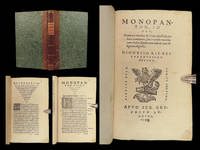
154924302<p><strong>1549 RARE Denis Carthusian Monopanton New Testament BIBLE Commentary Epistles </strong></p><p>The works of Denis the Carthusian were important contributions to Roman Catholic doctrine. He wrote some 900 sermons and began commenting on scripture in 1434 which became immensely popular after Pope Eugene IV promoted his works. In fact <strong>he was so highly regarded that he was considered an oracle and prophet by bishops and common men alike. </strong></p><p>As a supplement to his biblical commentary Denis wrote "<em>Monopanton</em>" – a short treatise on the Paulian Epistles organized by subject matter. </p><p>Item number: #24302</p><p>Price: $750</p><p>DENIS the Carthusian</p><p><strong><em>Monopanton id est unum ex omnibus D. Pauli epistolis per locos communes : seu certarum materiarum titulos summo tum indicio tum diligentia digestis</em></strong></p><p>Lugduni: Apud Seb. Gryphium 1549.</p><p><u>Details</u>: </p><p><!-- if !supportLists-->· <!--endif-->Collation: Complete with all pages</p><p><!-- if !supportLists-->o <!--endif-->220 4</p><p><!-- if !supportLists-->· <!--endif-->References: Lewis du Pin<em> New Ecclesiastical History</em> 1699 p. 92; Andrea Fiamma<em> Nicholas of Cusa</em>;</p><p><!-- if !supportLists-->· <!--endif-->Language: Latin </p><p><!-- if !supportLists-->· <!--endif-->Binding: Leather; tight and secure</p><p><!-- if !supportLists-->· <!--endif-->Quite rare!</p><p>Our Guarantee:</p><p>Very Fast. Very Safe. Free Shipping Worldwide.</p><p>Customer satisfaction is our priority! Notify us with 7 days of receiving and we will offer a full refund without reservation!</p><p>24302</p><p>Photos available upon request. </p> Seb. Gryphium hardcover
1576EE5120Apud Hieronymum Wellæum bybliop. Iurat. 1576. ~The seven works are: Liber de arcta via salutis & contemptu mundi / Speculum amatorum mundi / Liber de gravitate & enormitate peccati / Liber de conversione peccatoris / Liber de fonte lucis & semitis vitae / Liber devotum praecordiale praenotatus / Dialogus patroni ad Canonicum. ~Original full vellum yapped fore-edges folded in. Low raised bands to spine. Some loss to fore-edges. 12mo 7.5 x 11.5cm. Numbered by leaf not page. All edges speckled darkened. Hinges sound. Two owners' signatures in old hands to front endpapers. Loss to top of rear free endpaper. Printer's device to title page and final page. Decorated initials and elaborate tail-pieces throughout. Numbered as leaves but printed as pages. Rare: only one volume on WorldCat. Denis the Carthusian 1402-1471 theologian and mystic. ~Robust packaging. All UK orders trackable others on request. Used books are exempt from USA tariffs. 1st edn. Hardback. Hardback. Good. 8 330 2ff. Apud Hieronymum Wellæum bybliop. Iurat. Hardcover
1572EE4911Haeredum Iohannis Quentel / Viduam Mauricii a Porta / et al 1572. ~DATE RANGE: 1547-1572 ~FULL TITLES: D. Dionysii Carthusiani Enarrationes piae ac eruditae in quatuor prophetas quos vocant maiores. Imprint: Coloniae : Ex Officina Haeredum Iohannis Quentel. M.D. LVII. BOUND WITH: D. Dionysii Carthusiani Enarrationes piae ac eruditae in duodecim prophetas quos vocant minores. IMPRINT: Coloniae Apud Geruuinum Calenium & haeredes Iohannis Quentel. M. D. LXVIII. 2 VOLS IN 1. / D. Dionysii Carthusiani Insigne commentariorum opus in Psalmos omnes Davidicos. Imprint: Parisiis Apud Dionysiam & Hieronymum de Marnes viduam spectabilis viri Ambrosii Girault. M.D. XLVII. BOUND WITH: D. Dionysii Carthusiani Enarrationes piae ac eruditae in quinque libros Sapientiales. IMPRINT: Coloniae ex officina Haeredum Ioannis Quentel. M. D. LV. 2 VOLS IN 1. / D. Dionysii Carthusiani Enarrationes piæ ac eruditæ in quinque Mosaicæ legis libros. Imprint: Coloniae : Apud haeredes Joannis Quentel et Geruuinum Calenium M.D. LXVI. / D. Dionysii Carthusiani enarrationes piae ac eruditae in libros Iosue Iudicum Ruth Regum Primum secundum tertium & quartum item Paralipomenon primum & secundum . Coloniae Ex Officina Haeredum Ioannis Quentel. M.D.LII. BOUND WITH: D. Dionysii Carthusiani eruditae ac piae enarrationes in Librum Iob Tobiae Iudith Hester Nehemiae Machabaeorum primum & II. IMPRINT: Coloniae. Impensis Geruini Calenii & haeredum Iohannis Quentel. Anno M. D. LXXII. 2 VOLS IN 1. / D. Dionysii Carthusiani in quatuor Evangelistas enarrationes. Paris. Apud Viduam Mauricii a Porta. M.D.LII. BOUND WITH: D. Dionysii Carthusiani in omnes B. Pauli epistolas commentaria. IMPRINT: Parisiis Apud spectabilem viduam Maruicii a Porta. 1548. BOUND WITH: D. Dionysii Carthusiani in Catholicas septem epistolas piae ac eruditae admodum enarrationes. Eiusdem Commentarii doctissimi in Acta Apostolorum Apocalypsim ac Hymnos ecclesiasticos. IMPRINT: Parisiis. Apud Viduam Maruitii a Porta. 1548. 3 VOLS IN 1. ~PAGINATION: 16 814 2 12 358pp. 12 327ff. 28 593 2pp. 12 1015pp. 12 611 4 501pp. 10 348 4 130 5 170ff. ~Full uniform 18th-century mottled calf bindings raised bands to spines. Spines decorated in gilt with small tools. Blind triple fillets to boards. Gilt decor to board edges much rubbed. Two brown gilt labels per spine intact only on 'libros Iosue .'. Other vols have single label remaining or none 'Prophetas'. All edges red. Endpapers marbled in Placard pattern. Folios 21 x 31.5cm. Library markings to prelims including Pusey Library markings to all vols. Owner's signature of E. B. Pusey to vols I & II. Loss to spines of 'Prophetas' & 'Pentateuch'. Headbands loose. Splitting over all outer hinges but all hinges holding. Decorated initials throughout to all vols. Publisher's devices to all title pages. Dedicatory epistle to Henry VIII dated 1532 to 'in quatuor Evangelistas enarrationes'. A little sidelining and annotation in old hand especially to final vol. with some more recent pencil sidelining throughout. Text printed in double columns. Some age-browning and foxing mostly to vol. I & 'enarrationes in Librum Iob .'. Tiny amount of worm damage to inside front board of 'Psalmi'. Tear 7cm to p. 1015 of 'Pentateuch' minor effect to text. With tickets from 2005 Christie's sale. 19th-century bookmarks to vols I & II one with Pusey's name on part of ironmonger's bill. 5 striking identical woodcuts 12.5 x 16.2cm of Denis with the Virgin and Child to verso of some tps in vols I-IV. Woodcut of Denis triumphing over devil 12.7 x 17cm to final page of vol. I. All woodcuts signed with monogram 'A W' i.e. Anton Woensam c.1493/1496 - c.1541 a frequent collaborator with the Quentel publishing house. Denis the Carthusian 1402-1471 theologian and mystic. Collection of 16th century editions of his influential Biblical commentaries with close association with E. B. Pusey 1800-1882 leading figure in Oxford Movement. ~Robust packaging. All UK orders trackable others on request. Used books are exempt from USA tariffs. Hardback. Hardback. Good/Fine. c. 500pp. per vol. Haeredum Iohannis Quentel / Viduam Mauricii a Porta / et al Hardcover