10 résultats
1800D8852France likely the late 1800s. Ephemera. Near Fine. Group of 5 full-color illustrated cards captioned in French showing children tasked with wine-making tending the vineyards guarding the vineyards harvesting the grapes getting sloshed. Each is about 3x4.25 inches with a thin white border. Some pencilled markings on the verso; one with some scuffing on the verso and a small closed tear at the edge likely removed from an album; otherwise fine. <br/><br/> unknown
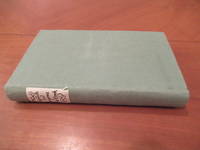
1770031817London: S. Crowder And J. Coote; W. Griffin; And W. Nicoll 1770. 3rd Edition . Hardcover. Poor. Iii-Xi 226I.E.2291Xxii Pp. Defective Lacking Title Page Begins With P. Iii "A Table Of Diet". 6 1/2" X 3 7/8". Rebound In Green Cloth With Handwritten Calligraphic Title On Paper Spine Label. Edition Identified From Worldcat Entries Which Show This 1770 Edition With 229 Pages P. 229 Mis-Numbered As 226 And With The Index At End The Only Edition Appearing As Paginated Thus. Worn But Complete With No Loss Of Text On Pages. 1" Brown Stain In Upper Fore Edge Corner Of Pages At Front Diminishing Away At End Of Book. Loose Clipping From Baltimore Sun About New Remedy For Small Pox. <br/> <br/> S. Crowder, And J. Coote; W. Griffin; And W. Nicoll hardcover
1790AQ10903London: Printed by Charles Eyre and Andrew Strahan Printers to the King's most Excellent Majesty 1790. 2. pp-711-730pp. Twentieth-century red morocco gilt titled in gilt to upper board. Slight wear to extremities. Reinforcement to gutter margins of text. A parliamentary Act to update the details prices and outlines of fines applicable for the licensing of the sale of alcohol in Great Britain during the final decade of the eighteenth-century including notice of the £50 fine to be imposed on 'any Person or Persons who shall retail any Foreign Wine or any British-made Wines or Sweets or any distilled Spiritous Liquors or Strong Waters without first taking out a License'. Not in ESTC. Folio. Printed by Charles Eyre and Andrew Strahan, Printers to the King's most Excellent Majesty unknown
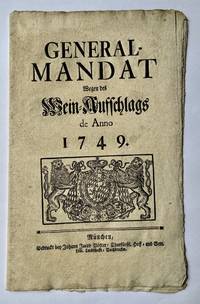
17493885<p><em>Wine Consumption Tax</em></p><p>WINE. Maximilian III Kurfürst Bavaria. General-Mandat wegen des Wein-Aufschlags de Anno 1749. Munich Johann Jacob Vötter 1749.</p><p>Folio pp. 19 1 blank; with large armorial woodcut to title; uncut folded unbound; title lightly dust-soiled else clean and crisp.</p><p>First edition of this rare regulation for the imposition of a special consumption tax on wine in Bavaria superseding all earlier legislation governing import duties etc. This tax of 2 Gulden 30 Kreuzer is due irrespective of the type of wine. It is interesting to note that foreign wines such as Champagne Frontiniac and 'Monte Pulciano' which are imported in casks or bottles are also subject to this tax which is due on import.</p><p>KVK lists a copy in Munich only a later edition was published in 1760.</p> Voetter
171521224London 1715. Broadsheet 12 1/2 x 7 3/4 inches. 1p. plus printed docket title on verso. Disbound. Early folds and early stab holes in left margin. Upper margin trimmed close with slight loss to first line of text. Two-inch closed tear in body of text. Small portion of inner margin excised with no loss to text. Minor foxing. A early political leaflet petitioning on behalf of tobacco and wine merchants for relief from interest on duties owed during the War of the Spanish Succession. The document is among the earliest examples of commercial lobbying literature which first began proliferating during the major changes in British government in the mid-1710s. ESTC records only two copies at the British Library and Harvard.<br/> <br/> Hanson 2065. unknown
175045405London John and Paul Knapton 1750. Small 8vo. Contemp. full calf. Spine worn and frontcover detached. Corners of binding worn. 12420 pp. textdiagrams and textfigs. 12420 pp. Browning to titlepage and repairs to verso of. A bit of inner lower corner of titlepage gone loosing 3 letters in "Printed for" Some brownspots to outer margins. Some traces of use. Internally generally clean and printed on good paper. <br/><br/><em>The first edition was published 1707 and it was regularly printed throughout the eighteenth century. All issues are scarce. Dougharty 1677-1755 was an Irisman who ran a writing and arithmetic school in Worchester Macclesfield No 657 1707. </em> unknown
1733026428London: Charles Rivington 1733. Fourth Edition Revised . Full Paneled Calf. Very Good. 8" Tall. Engraved Frontispiece By J Pine. Fourth Edition "Much Improved". Unpaginated But Complete A1-Q6 With One Page Ad Printed On Verso Of Last Leaf. Contains: Two Page Leaf "Domestic Brewing - Cheap Beer" A Two Page Recipe Printed By Maurice & Co.; Frontispiece; Title; Four Page Dedication 'To All Good Housewives";"Some Divertissements In Cookery" 2 Pp; Text Unpaginated 560 Pp. With Unfortunate Section "To Fry Maids" Corrected In Pencil To "Meats" I Think It's A Typo But Alphabetically It Is Under The Correct Place For "Maids" Rather Than For "Meats" And "Maids" Is Repeated In The Recipe So Perhaps A Joke Recipes; Miscellaneous Sections At Rear Including Index 31 Pp. There Are A Few Pencil Words On The First Page Of The "Menus" Section Immediately Following The Main Text. Original Paneled Calf With "T. Pitt" Stamped At Center Probably The Grandson Of Thomas "Diamond" Pitt And With Ownership Information "Thomas Pitt 1817 The Gift Of Miss Foljambe" On Front Pastedown And Another Similar Note "Thomas Pitt The Gift Of Miss Foljambe 1810" At Top Of Title Page. Recently Re-Backed To Style Five Bands Original Morocco Label Laid Down On Spine Gilt Rules And Decorations In Each Compartment. Pages Clean And Square Somewhat Crisp Apparently Unread Or Lightly Read. Most Recently The Copy Of Robert Balzer Los Angeles Food And Wine Expert From His Library With A Half-Page Of Stationary From His Tirol Restaurant In Idyllwild Which Had Been Used As A Bookmark. <br/> <br/> Charles Rivington unknown
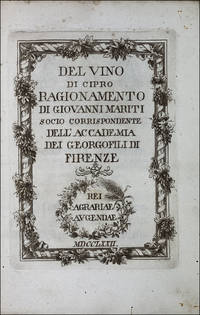
1772117<p>Extraordinary rare first edition of the famous treatise on Cyprus wine by Giovanni Mariti</p><p>A complete analysis on wines grapes vines and production technique</p><p>Mariti Giovanni. <em>Del vino di Cipro ragionamento di Giovanni Mariti socio corrispondente dell'Accademia dei georgofili di Firenze: Rei agrariae avgendae</em>. Firenze : G. Cambiagi MDCCLXXII 1772.</p><p>8vo 220 x 155 mm original printer cardboard pp. 2 XVI 127 1 illustrations along the text engraved title page before the dedicatory letter at leaf a1r a chalcographic vignette with coat of arms of the dedicatee Lord Nassau Clavering signature a⸠πa1 A-Hâ¸.</p><p>xylographic illustrations along the text one full page plate depicting tool for wine production</p><p>In his treatise <em>Del vino di Cipro</em> About the Cyprus Wine published in Florence in 1772 by Cambiagi Mariti dedicates an ample analysis to the wine of Cyprus discussing a lot about the types and varieties of the vines and wines produced in the different regions of the island and reporting its own "observations" made in the countryside around Larnaca where it draws indications and procedures to follow in Italy too to reach the maximus possible efficiency of the crops as Mariti himself well describe in the Preface to the volume:</p><p>"In questo mio Ragionamento ho avuto il riflesso di appagare non solo la curiosità di qualche dilettante de i grati e generosi Vini di Cipro e di dar la norma per qui allignarli ma ancora di poter giovare alla Coltivazione alla Manifattura e alla Conservazione de i nostri Vini Toscani e particolarmente per migliorare alcuna sorta di quegli che oggigiorno sogliono qui farli in scelta maniera il che mi lusingo possa ottenersi dal genio de i nostri Agricoltori Mariti 1772 p. 3. In this reasoning I had the will to satisfy not only the curiosity of some amateur of the grateful and generous Wines of Cyprus giving the rules to list them but also to be able to improve the Cultivation the Manufacture and the Conservation of our Tuscan Wines and particularly to improve the quality of the wines produced there using the support from the genius of our Farmers"</p><p>More in details he starts addressing the issue of the poor resistance of Tuscan wines to navigation deepening the observations already published in the first volume of his "Travels in Cyprus". Mariti studying grapes and winemaking processes in use in Cyprus gives an account of the island's wines distinguishing them by types based on the quality of the grapes the length of the aging process and their conservation and also giving data and figures relating to the sale of the product both in the East and in the West.</p><p>Mariti dedicated this essay on the wines of Cyprus to Lord Clavering whose arms are engraved at the top of the first leaf of the dedication. The preliminary leaves also include an account of the <em>Accademia dei Georgofili</em> devoted to the study of agriculture which was founded in Florence in 1753 and is still active today.</p><p>Giovanni Filippo Mariti 1736 –1806 he was an Italian antiquarian scientist and historian. Intellectual with multiple interests he became famous in Europe mainly for his travels in the East.</p><p>Mariti became interested since his youth in natural sciences cultivating botany and especially agronomy studies and in 1772 he became a corresponding member of the <em>Accademia dei Georgofili</em> founded in Florence on July 4 1753 by Ubaldo Montelatici under the impulse of that renewal of agriculture that the Habsburgs-Lorraine hoped for and promoted to remedy the problems that arose in their lands starting from the first decade of the second half of the century regarding crops and food supplies.</p><p>Mariti lived for seven years at Larnaca in Cyprus becoming honorary British vice-consul and became increasingly familiar with the wine-making process of the island. A shortened version of this treatise was included in the French translation of his "Travels in the Levant".</p><p>Beside <em>Del Vino di Cipro</em> he is remembered for the treatise titled <em>Della Robbia sua coltivazione suoi usi</em> Florence 1776 dedicated by Mariti to the Grand Duke of Tuscany Pietro Leopoldo concerning a plant the <em>Robbia</em> Madder cultivated in the East and used for the colouring of clothes which Mariti hoped to introduce in Europe and for <em>Odeporico o sia itinerario per le colline pisane</em> which was published in Florence in two volumes between 1797 and 1799.</p><p>The first volume of this work which remained partly unpublished deals with the agricultural history of the Tuscan hills the second is dedicated to the history of the water bath today Casciana Terme. The two volumes are divided into chapters that take the form of letters written to an imaginary friend.</p><p>George Clavering-Cowper 3rd Earl Cowper 1739 - 1789 was an English nobleman and politician. In 1780 he purchased Villa Palmieri in Fiesole with a splendid view of Florence. Skilled diplomat and politician he decided to obtain prestige by turning a blind eye on the relationship that his wife had established with the Grand Duke Pietro Leopoldo from which he managed to obtain the title of Prince of Nassau d'Auverquerque.</p><p>The art collection that Count Cowper built during his years in Florence was a great investment of time and money for him. Among the most important works that were part of his collection we mention two paintings by Raphael the first known with the name of <em>Piccola Madonna Cowper</em> and the other as <em>Madonna Niccolini-Cowper</em>.</p><p>Conditions: fine copy untrimmed in its original printer paper board small restoration at spine.</p><p>Provenance: I. Ownership signature dated 1868 at rear inside board. II. Handwritten title at front board and spine.</p><p>References: Lastri p.82; Sormanni p.79; <em>Bibl. </em><em>Vinaria</em> p. 139; Andre Simon Bibliotheca Gastronomica page 97 No 1002</p> G. Cambiagi hardcover
17500001563Good. 1750. On offer is an absolutely sensational ancient original 1750s manuscript sailor's vade mecum or reference manual handwritten by and or for a mariner over 260 years ago. The name William Wine appears on the rear inside cover dated March 4th 1788. The handwriting is similar throughout to the signature but it is inconclusive if Mr. Wine is the author original owner or a later owner. The first page detached but present is dated November 1750. There are many many tables of information illustrations charts drawings etc. that are indexed and with over 420 pages written in a small meticulous hand there are within these pages everything that a mid-18th Century senior officer or mate would require being filled with geographical mathematical financial navigational and geometric information and there are also sections detailing carpenter's work joiners painters glaziers lavers masons plus foreign exchange and monetary info and conversions in foreign countries. There are sections for algebra calculus trigonometry all manners of measurement whether liquid or dry and even how to calculate the contents of a globe with many of the mathematical sections deal with measuring heights and distance from afar measuring and surveying dealing with casks all information that a Lieutenant 1st mate or Ship's Master or even a Captain would need. We conclude that the information and the quality of the manuscript book vellum which double folds and creates an envelope that would protect the pages from the elements plus a metal clasp broken give further credence that this book was owned by a senior officer and most certainly of English origin as evidenced by the section regarding Oxford and Cambridge terms plus a chart that helps one establish the dates of the Easter season leap years tides . The volume begins with a few pages of indices and in the first section one finds pages of geographical place names and distances from one to another: "the coast of Carolina Virginia etc. to Newfoundland" and the "Bohema Islands" and another "The Coast of y.e main Continent in y.e West Indies" and the degrees of longitude and latitude are listed alongside each listed place. The standard depth and sheer volume of information also leads us to conclude that the seaman was likely an officer of a merchantman as opposed to a casual traveler. This is an absolutely unique manuscript relic of ancient seafaring and the age of sail. The 7 x 4.5 x 1.5 inch book is generally soiled on the covers but the interiors are good save for the loose page and the odd stains to the inner pages. The cover is stiff somewhat fragile and has some cracks/tears but overall the book is G. ; 12mo - over 6¾" - 7¾" tall; KEYWORDS: HISTORY OF GREAT BRITAIN ENGLAND BRITANNIA RULES THE WAVES NELSON HORNBLOWER AUBREY RAMAGE REFERENCE MANUAL HANDBOOK NAVIGATION MARINE NAUTICAL NAVAL TIDES VADE MECUM SAILOR SAILING AGE OF SAIL SEVEN YEARS WAR TRAVEL ASEA SURVEYING LONGITUDE LATITUDE MATHEMATICS GEOMETRY GEOGRAPHY PORT OF CALL HARBORS SEAFARING SEAFARERS HANDWRITTEN MANUSCRIPT DOCUMENT LETTER AUTOGRAPH DIARY JOURNAL LOG KEEPSAKE WRITER HAND WRITTEN DOCUMENTS SIGNED LETTERS MANUSCRIPTS HISTORICAL HOLOGRAPH WRITERS DIARIES JOURNALS LOGS AUTOGRAPHS PERSONAL MEMOIR MEMORIAL PERSONAL HISTORYantiquité contrat vélin document manuscrit papier Antike Brief Pergament Dokument Manuskript Papier oggetto d'antiquariato atto velina documento manoscritto carta antigüedad hecho vitela documento manuscrito papel. . hardcover
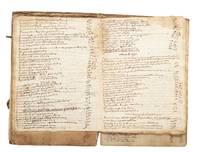
179265431792. 59 leaves enumerating the names of grapes cereal crops and oils and their prices for nearly two centuries. Small folio 273 x 178 mm. 18th-cent. vellum over boards tail of spine defective two of four ties lacking. Burgundy: 1622-1792.<br/> <br/> A fascinating and rare survival which details the precipitous rise in the prices of Burgundian wine and the emergence of a hierarchy among regions and vintages over a 170-year period. This document consisting of three gatherings 28; 28; 3 leaves bound together and written in several legible hands provides a wealth of information on grain harvests in the region which varied greatly from year to year and indicates years with disastrous harvests. The present manuscript constitutes a unique history of agriculture in Burgundy especially pertaining to the evolving market for Côte de Nuits wine.<br/> <br/> “Burgundy had no experience like the boomtime of 18th-century Bordeaux. No new wines were invented no new districts planted. The Bordeaux picture is all expansion and creation; the Burgundy one of evolving tastes and techniques of new market forces and overall of slowly progressing definition: a more precise notion of the character style and value of the wine from each corner of the Côte…In the Côte de Nuits the notion of the ‘cru’ was further advanced…The vineyards were generally less overcrowded and by now planted with cuttings rather than layers; hence more deep-rooting. Increasingly in the 18th century owners of the most prestigious crus selected their best grapes to make separate cuvées the best vat being called the ‘tête de cuvée’.â€â€“Hugh Johnson Vintage 1989 pp. 267 & 272.<br/> <br/> The motivation for compiling this record-book may have come from the introduction of a law in 1622 that outlawed the sale of Lyonnais and Beaujolais wines as Burgundian. The records of the first three decades consist mostly of grains and oil from the region but in the early 1670s wines begin to predominate and the lists for each year become increasingly long. It is very likely that at this point landowners would have shifted to using any arable land for vastly more lucrative grapes. By the 1690s dozens of grape varietals are noted from communes such as Auvilliers Les Cailles Chambolle Chorey Comblanchien Corgoloin Côte de Beaune Gilly Magny Saint Georges Saint Julien Les Cailles Vaucrains Pouilly Prissey etc. Prices for wine rose enormously from the 1690s and experienced peaks in 1701 1733 and 1770. Wines are increasingly categorized by the mid-18th century according to vineyard and in some cases cru.<br/> <br/> The name “de Bays†appears several times in the manuscript and the signature of “de Bays†is found at the end of the year 1771.<br/> <br/> Very few comparable documents survive and the present manuscript provides a vast amount of data on the prices for wine grapes and grains in the 17th and 18th centuries. A couple leaves browned. unknown