20 résultats
1782038401London: John Boydell 1782. First Edition . No Binding. Very Good . An Engraving 35.8 X 26.7 Cm. One Of A Large Collection Of Original Antique Engravings Formed By A Southern California Artist In The Early To Middle Twentieth Century. Each Plate Has Small Glue Marks On Reverse Where They Were Tipped In To An Album. Victor Marie Picot Publisher/Printer; Printmaker; 1744 - 1802 Was Born At Monthières In The Somme Presumably Trained In Paris And Was In England By 1766 When He Married Angelique Daughter Of Simon François Ravenet. He Was A Partner With Jean Marie Delattre In A Print-Selling Business In St Martin's Lane London. He Returned To France C.1790 And Lived In Abbeville; He Died In Amiens. <br/> <br/> John Boydell unknown
1800038037Paris Circa 1800 1800. 1st Edition 1st Printing. No Binding. Very Good. Original Engraving. Part Of A Large Collection Of Original Antique Engravings Formed By A Southern California Artist In The Early To Middle Twentieth Century. Each Plate Has Small Glue Marks On Reverse Where They Were Tipped In To An Album. Antoine Arnauld 1612 - 1694 - Le Grand As Contemporaries Called Him To Distinguish Him From His Father - Was A French Roman Catholic Theologian Philosopher And Mathematician. He Was One Of The Leading Intellectuals Of The Jansenist Group Of Port-Royal And Had A Very Thorough Knowledge Of Patristics. He Was One Of The First To Adopt The Philosophy Of René Descartes Though With Certain Orthodox Reservations Relating To Meditations On First Philosophy; And Between 1683 And 1685 He Had A Long Battle With Nicolas Malebranche On The Relation Of Theology To Metaphysics. On The Whole Public Opinion Leant To Arnauld's Side. When Malebranche Complained That His Adversary Had Misunderstood Him Boileau Silenced Him With The Question: "My Dear Sir Whom Do You Expect To Understand You If M. Arnauld Does Not" Later Arnauld Was Engaged In An Extensive Correspondence With Gottfried Wilhelm Leibniz Regarding The Latter's Views Detailed In His "Discourse On Metaphysics" 1686. Popular Regard For Arnauld's Penetration Was Much Increased In His L'art De Penser Commonly Known As The Port-Royal Logic Which Kept Its Place As An Elementary Text-Book Until The 20Th Century And Is Considered A Paradigmatical Work Of Term Logic. Arnauld Came To Be Regarded As Important Among The Mathematicians Of His Time; One Critic Described Him As The Euclid Of The 17Th Century. After His Death His Reputation Began To Wane. Contemporaries Admired Him As A Master Of Intricate Reasoning; On This Jacques-Bénigne Bossuet The Greatest Theologian Of The Age Agreed With Henri François D'aguesseau The Greatest Lawyer. However His Eagerness To Win Every Argument Endeared Him To No One. "In Spite Of Myself" Arnauld Once Said Regretfully "My Books Are Seldom Very Short."Citation Needed. Despite Arnauld's Achievements In Various Fields His Name Is Mostly Known Because Of Pascal's Acclaimed Writings Which Were More Fit For The General Public Than Arnauld's Technical Essays. Wikipedia <br/> <br/> unknown
1719038056Paris 1719. 1st Edition 1st Printing. No Binding. Very Good. Original Engraving. Trimmed To Margins All Around. One Of A Large Collection Of Original Antique Engravings Formed By A Southern California Artist In The Early To Middle Twentieth Century. Each Plate Has Small Glue Marks On Reverse Where They Were Tipped In To An Album. Antoine Houdar Or Houdart Of La Motte Born On January 17 1672 In Paris Where He Died On December 26 1731 Is A French Writer And Playwright . He Held An Important Place In The Literary Life Of His Time By His Writings And His Conceptions. In The Salon Of The Marquise De Lambert Whose La Motte Was One Of The Pillars With His Friend Fontenelle With Whom He Shared An Absence Of Prejudice And A Spirit Of Investigation The Question Was Considered Of Whether Versification Was Indispensable To Poetry. It Was Ultimately Thought That The Verse Rendered The Poet Slave With Superfluous Complicated And Harmful Rules Which Favored The Ankles And Periphrases And Hindered The True Expression Of Poetry. It Was Advocated To Return To The Sharpness And Firmness Of Prose Especially In The Theater For Reasons Of Naturalness. Houdar De La Motte Wanted To Demonstrate That Prose Could Very Well Serve Poetry. He Gave Fenelon's The Adventures Of Telemachus As An Example In This Sense And Put In Prose A Scene Of Mithridates Of Racine.His Reputation Today Rests On The Excellent Prose In Which He Expressed His Views Much Better Than His Verses Hard And Colorless. We Also Remember That He Refrained From Answering A Letter From Jean-Philippe Rameau Who Would Have Liked To Put One Of His Librettos To Music: Probably A Great Opportunity Missed By Houdar De La Motte. But More Than By His Productions It Is By His Role In The Movement Of Ideas And By The Important Place He Occupied In The Literary Life Of His Time That The Name Of Houdar De La Motte Has Reached Us. "He Proved According To Voltaire That In The Art Of Writing One Can Still Be Something In The Second Rank. "French Wikipedia. Gérard Edelinck 20 October 1640 Baptized - 2 April 1707 Was A Copper-Plate Engraver And Print Publisher Of Flemish Origin Who Worked In Paris From 1666 And Became A Naturalized French Citizen In 1675; His Son Nicolas-Etienne Edelinck Did This Engraving. <br/> <br/> unknown
17642111902160200912Hanaya Kyujiro 1764. Soft Cover. Fine. Size: 22.7cmx15.5cm Number of books: 2 Hanaya Kyujiro paperback
17932110502150900667Souzanbozo 1793. Soft Cover. Fine. Number of books: 5 Souzanbozo paperback
1770161411770. Etching and engraving. Unfinished working proof. In fair condition with the exception of being trimmed within the platemark. Laid onto contemporary backing card. Tear along middle of image which has been expertly repaired. Some creases in image. A rare working proof by John Browne the celebrated English landscape engraver.<br/> <br/> One of the most esteemed English landscape engravers John Browne was born in Finchfield Essex in 1741. In 1756 he was apprenticed to the engraver John Tinney but then went to work for the influential landscape engraver William Woollett. It is believed that many of Woollett's most admired plates were in fact engraved by Browne. He devoted himself entirely to engraving landscape and genre scenes in particular after works by the French and Dutch masters. In 1770 he was elected an associate engraver of the Royal Academy exhibiting thirteen plates between 1767 and 1801. This stunning genre scene is a wonderful example of his skilled hand and a rare working proof. This intriguing print shows a unique step in the printmaking process before an image is ready for publication. Before the image is completed the engraver has printed a trial impression to view this stage of the engraved plate. It is incredibly rare to find prints in this unfinished experimental stage; impressions which were pulled as working proofs are unique and were almost never duplicated.<br/> <br/> Dictionary of National Biography. unknown
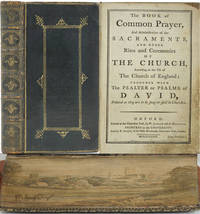
178126467Oxford: Printed at the Clarendon Press by W. Jackson and A. Hamilton Printers to the University: Sold by W. Dawson at the Bible Warehouse Paternoster Row London 1781. Hardcover. Otherwise very good condition. A handsome Book of Common Prayer in full black gilt calf with an early foredge painting of St. Albans Abbey and recording the births and deaths of an English family from 1787 to 1830. The end paper has a note in an early hand stating the foredge is of "St. Albans Abbey" with the surrounding district. The original owners name has been crossed out but the last pages of the book include record the births and deaths of the Osmond Family of Hungerford. <br /> <br /> 8vo 568pp. Printed in a large and attractive type on laid paper marbled endpapers. A little light soiling thumbing on the first few pages on the lower right corner but the whole in very clean without foxing. Period full black calf gilt tooled binding marbled end papers gilt inner and outer dentelles all edges gilt. Housed in a later cloth slip case. Spine a touch dry the binding is tight yet opens comfortably. <br /> <br /> ESTC T166750 - No pagination provided ; 8° the final leaf = Ll4. 8vo 21 cm 568p. Signatures: a-b8A-2K82L4; OCLC: 19077869. <br /> <br /> Full title - The Book of Common Prayer And Administration of the Sacraments and other Rites and Ceremonies of the Church According to the Use of the Church of England: Together with The Psalter or Psalms of David Pointed as they are to be Sung or Said in Churches.<br /> <br /> The family genealogy on the last two leaves are for John Osmond baptised 1 Apr 1787 in Hungerford Berkshire England whose parents were Joseph & Mary Osmond. FHL Film Number: 88273 from Ancestry. John Osmond married Sarah Coxhead in Hungerford on 27 Jul 1809. As is sadly the case in those times there are many more births and deaths of children recorded than there are surviving children recorded on the family tree on Ancestry. Printed at the Clarendon Press, by W. Jackson and A. Hamilton, Printers to the University: Sold by W. Dawson, at the Bible Wareh hardcover
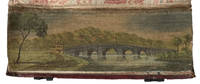
1784FF2537London:: Printed for J. F. and C. Rivington . . . 1784. 1784. 16mo. 80 x 140 mm. viii 317 23 pp. Original full crimson turkey morocco with massed gilt stamping on both covers and spine all edges gilt two clasps black leather spine label; head of spine a bit chipped at corner clasps missing the movable element pages trimmed closely with occasional loss but a very good copy with a lovely period binding. Bookplate of Oscar Ehrhardt Lancaster. Good. With a fore-edge painting of Richmond Bridge Surrey. Painted circa 1948-60 by Samuel E. Stevens. PROVENANCE: Pre-fore-edge: Mary Strand 1790 – Mary S. Partridge 1792; After fore-edge: Oscar Ehrhardt Lancaster 1887- Lancaster collected fore-edge paintings. Printed for J. F. and C. Rivington . . ., 1784. hardcover
1794FF159London:: Printed for C. Dilly in the Poultry 1794. 1794. 8vo. x 402 pp. Engraved frontispiece by Singleton. Modern full crushed chocolate brown Oasis morocco raised bands gilt spine title all edges gilt bound by David Weinstein. Two former ownership signatures. With a fine fore-edge painting hand painted by Martin Frost in 2006 depicting an eighteenth century scene of "St. Mary's Abbey York." Signed by the artist and with a presentation label describing the scene. See: Weber Jeff Annotated Dictionary pp. 151-3 Frost fl. 1973-2018. Printed for C. Dilly, in the Poultry, 1794. hardcover
17972090202122800695Naniwa Shorin Shinsaibashi Street Otsukaya / Sobei 1797. Soft Cover. Fine. Size: 26x18 Naniwa Shorin Shinsaibashi Street Otsukaya / Sobei paperback
1800ABC_495071800. In a contemporary wooden frame ca. 28.5 x 34 cm. Oil on canvas ca. 20.5 x 26.5 cm unsigned. A finely observed 19th-century oil study of a skate shown resting on a neutral background. The artist captures the texture and colour of the fish with careful attention to light and detail giving the work a quiet natural presence. Paintings like this were often made as studies from life reflecting the 19th-century interest in nature and everyday subjects. The restrained composition and subtle tones lend the piece a sense of calm realism. An appealing work that would suit both collectors of 19th-century painting and those interested in natural history or maritime subjects.A minor barely detectable dent near the bottom of the painting several cracks on the edges which are mostly hidden by the frame laid down on modern canvas. The frame shows traces of use. Otherwise in good condition. unknown
17892110502150908283Not Available 1789. Soft Cover. Fine. Number of books: 1 Not Available paperback
17882110502150901615Tsuta-ya-ban 1788. Soft Cover. Fine. Volume: 1 Tsuta-ya-ban paperback
1800227046Edinburgh: Printed by Sir J.H. Blair and J. Bruce 1800. 1 vols. 18mo. Near contemporary blue cloth with floral gilt tooled border rose silk endsheets with gilt tooled braid borders title page with ornamental gilt tooled border a.e.g. wih a vertical fore-edge painting of a flower. Provenance: Ownership signature of "Mary Lister May 18 1804" on first blank. 1 vols. 18mo. An early cloth binding with the unusual addition of gilt tooling on the endleaves and title page. Printed by Sir J.H. Blair and J. Bruce unknown
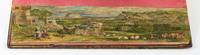
1788ST19954London: Printed for the Author and sold by Edwards in Pall Mall; Also by Edwards's in Halifax 1788. FIRST EDITION quarto issue with the etchings printed directly above the text. 257 x 205 mm. 10 1/8 x 8 1/8". iv 27 1 pp. 25 leaves; 11 1 pp. 25 leaves. Two parts bound in one volume. <br/> HANDSOME ORIGINAL ESTRUSCAN CALF BY EDWARDS OF HALIFAX covers with central panel of tree calf enclosed by a gilt Greek key border and a frame of stenciled dark brown palmettes on light tan calf this surrounded by graceful gilt ivy roll on dun-colored calf all within a gilt pentaglyph-and-metoped border smooth spine divided into panels by strips of inlaid black morocco tooled with gilt Greek key roll panels with inlaid central oval medal featuring an Etruscan vase calligraphic gilt flourishes at corners black morocco label bright pink endpapers all edges gilt expertly rebacked preserving original spine. WITH A FINE BRIGHTLY COLORED FORE-EDGE PAINTING OF THE CRAIGMILLAR CASTLE RUINS WITH EDINBURGH IN THE DISTANCE. WITH 50 ENGRAVED VIGNETTES 60 x 85 mm. of the ruins of Scottish castles and abbeys. A Large Paper Copy. Front pastedown with engraved armorial bookplate of Christopher Turnor Stoke Rochford Library. Lowndes 370; ESTC T153718 but with a variant title page. Front cover with a couple small areas of lost patina from insect activity rear cover just slightly marked upper corners a bit bumped faint freckled foxing in the margins more noticeable on the first two leaves slight offsetting of engravings on facing blank versos. A few condition issues but still a very attractive book the lovely binding retaining virtually all of its antique appeal and the contents with nothing approaching a significant problem.<br/> <br/> This is an excellent atypically large example of an Edwards of Halifax binding enhanced with a most appealing early fore-edge painting depicting one of the castles pictured in this attractive quarto edition. Scottish surgeon and antiquary Adam de Cardonnel 1746/7 - 1820 wrote and illustrated the present work "to preserve from oblivion the ancient remains of Caledonian splendour." Originally intended as a supplement to the popular "Pennant's Tour" of Scotland it appeared in four parts the first two in 1788 in a few different forms including an octavo edition and the second two published in 1793. The fore-edge painting features Craigmillar castle a Medieval fortress located a few miles from Edinburgh whose most famous guest was Mary Queen of Scots. One of her stays resulted in the so-called "Craigmillar bond" which set in motion plans to dispatch Mary's husband Henry Stuart. By the late 18th century the castle had fallen into disrepair and it appears in the present painting as an idyllic ruin with sheep and cows grazing in the fore-ground and the city with Edinburgh Castle rising in the distance. The Edwards of Halifax bindery was founded by William Edwards 1723-1808 and continued by several of his brothers half-brothers and sons by far the most important of the sons being Thomas who lived from 1762-1834. This famous firm produced a number of important innovations in binding design the most significant being the idea of concealing a painting under the gilt of the fore edge. This hidden treasure could be revealed once the edge was fanned out as a special surprise element of the volumes the Edwards firm bound--typically in Etruscan calf as here or in their patented transparent vellum. Although bindings produced by the Edwards workshop are almost never signed the present item is surely Edwards' work as indicated by the characteristic binding style and by the fact that our volume was actually sold by the Edwards firm. As usual there is no clear way to assign a precise date to the painting; while it is not done in the soft grays that can be firmly associated with the earliest Edwards examples it clearly is a painting done before 1850. While fore-edge paintings likely produced at the Edwards bindery and especially produced by their imitators appear in the marketplace with some regularity most offered are octavo or duodecimo in size. Of the fore-edge paintings attributed to Edwards of Halifax that have appeared in RBH over the past 65 years fewer than one in 10 were on quarto volumes. This copy was previously owned by the MP Christopher Turnor 1809-86 a member of the House of Commons and owner of more than 20000 acres in Linconshire where he built the grand Stoke Rochford Hall. Printed for the Author, and sold by Edwards, in Pall Mall; Also by Edwards's, in Halifax unknown
17922110502150906716Not Available 1792. Soft Cover. Fine. Number of books: 1 width Not Available paperback
17926999London: Printed by T. Davidson for L. Wayland 1792. First thus. Near Fine. Handsomely bound in contemporary full dark blue straight-grained morocco. Small quarto 250 x 155 mm. collating complete with thirteen fine engraved plates including frontispiece. Geometric gilt design to boards gilt spine with five raised bands and turn-ins with gilt floral roll. With a very fine double fore-edge painting by Martin Frost. The painting which fans open to 4 in. 100 mm. captures two views: the first is of the Cantebury and Salisbury Cathedrals and the second of Westminster Abbey and Chester Cathedral. A Near Fine copy clean and bright throughout with just a bit of edgewear and some foxing to versos of plates. In a custom silk-lined dark blue linen clamshell case with gilt-lettered leather spine label.<br /> <br /> Martin Frost is a master craftsman who was awarded the MBE in the New Years Honours list in 2019 for his work to preserve the art of fore-edge painting. This lovely colorful double-view example demonstrates the height of his skill as an artist presented here on an attractively printed and elegantly bound volume. Near Fine. Printed by T. Davidson for L. Wayland unknown
179471006hLondon: T. Cadell Junior and W. Davies 1794. Book. Fine. Hardcover. 12mo - over 6¾ - 7¾" tall. Contemporary full gilt crimson straight-grain morocco with gilt edges and marbled endpapers. With a hidden fore-edge painting of a marine scene of the Cromer seashore. Mild scuffing and toning to covers. Contemporary and early owners' names to front fly-leaf. Otherwise clean tight and unmarked. Very neat -- a sound and handsome copy. With custom crimson quarter-morocco slip-case and chemise. T. Cadell, Junior, and W. Davies Hardcover
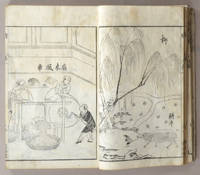
1735911581735. ZUE TOKAI åœ–æœƒå®—å½ SOU-I 7 vols in one. Edo Suharaya Shimbei Kyouho 20 1735. Oohon 27.0 x 17.5 cm. Originally published as a series of artists's guides in a set in China in 1607 it was redone in Japan in 1702 then reprinted as here in 1735. Like the HASSHU GAFU å…«ç¨®ç”»èœ it had a large influence in Japan particularly on Nanga style artists. Everything human animal and vegetable is rendered in beautiful sumi-e woodblock prints. There are extracts from classic Chinese texts on painting technique going back centuries. A vade mecum for the Edo artist interested in the techniques and theory of Chinese painting. The seven volumes of the original are here rebound into a single volume with the original worn cover and title label. This gappon volume is complete and has been cleaned internally to neutralize staining. There are some pages that remain stained but the book is still a remarkable work which is quite scarce. Most copies referenced online are incomplete or microfilmed. See Mitchell 566 for his information on the original Chinese edition. It should be noted that the copy he saw of the Genroku 1702 edition was incomplete. Not a common set. Mitchell misreads ZUE as ZUKAI in the title. unknown
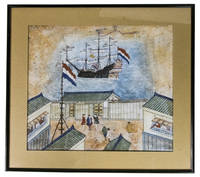
1800ABC_48559Japan 1800. In a passepartout and framed. Drawing size ca. 34 x 39.5 cm; frame size ca. 46 x 51 cm. Oil painting on leather. Late 18th-century painting on leather depicting everyday life on the island of Deshima in Japan created by an anonymous artist who seems to be of Japanese origin possibly originating from the Nagasaki school of painting: the faces of most human figures show remarkable Japanese features despite their reddish-brown hair and Dutch clothing.Judging by a woodcut map of Deshima published in 1780 by Toshimaya Bunjiemon the south-eastern part of the island is shown in the present illustration. On the left the warehouse masters residence next to a tall flagpole with the Dutch flag at top; in the centre the important watergate through which cargo was brought in via ship with four Dutch merchants one seen from behind and two Javanese servants in front of the gate; on the right the warehouse "De Lelie" The Lily. In the background lying in the bay of Nagasaki a Dutch three-master has been depicted with fourteen hoisted Dutch flags and several sailors on deck and in the rigging. This ship closely resembles a transom return ship in Dutch: "spiegelretourschip" which was used by the Dutch East India Company VOC during its whole existence.Based on the depicted style of clothing of the Dutch merchants we assume that this painting could have been made during the second half of the 18th century.The artificial island of Deshima was a small fan-shaped island used as trading post initially by the Portuguese until 1639 and subsequently by the Dutch from 1641 until 1858. During the Tokugawa Shogunate the military government of Japan in the Edo period of 1603-1868 foreigners were not allowed to enter the Japanese territory and the island of Deshima was the only place where initially only the Portuguese and later only the Dutch were admitted.With some flaking of the paint off the leather slightly affecting the image but mainly affecting the upper outer corners. Otherwise in good condition.l H. Paul Nederlanders in Japan 1600-1854. De VOC op Desjima pp. 106-107. unknown