163 résultats
199868943Museum. New. 1998. Paperback. FREE UPGRADE to Courier/Priority Shipping Upon Request - IN STOCK AND IMMEDIATELY AVAILABLE FOR SHIPMENT - Flawless copy brand new pristine never opened -- Text in French. 240 pp. With 285 ills. 23 col. . 28 x 22 cm. -- with a bonus offer-- . Museum paperback
199884778Prestel. New. 1998. Hardcover. 3791319841 . FREE UPGRADE to Courier/Priority Shipping Upon Request - IN STOCK AND IMMEDIATELY AVAILABLE FOR SHIPMENT - Flawless copy brand new pristine never opened -- 108 pages 89 illustrations many in color; 8vo. -- with a bonus offer-- . Prestel hardcover
199184780David R Godine. New. 1991. Hardcover. 0879238976 . FREE UPGRADE to Courier/Priority Shipping Upon Request - IN STOCK AND IMMEDIATELY AVAILABLE FOR SHIPMENT - Flawless copy brand new pristine never opened -- 109 pages 97 illustrations; small oblong 4to. -- with a bonus offer-- . David R Godine hardcover
199184779Museum; Et Al. New. 1991. Paperback. 0879239255 . FREE UPGRADE to Courier/Priority Shipping Upon Request - IN STOCK AND IMMEDIATELY AVAILABLE FOR SHIPMENT - Flawless copy brand new pristine never opened -- Corresponds to ISBN: 0879239255. 109 pages 97 illustrations; small oblong 4to. -- with a bonus offer-- . Museum; Et Al paperback
196984378Collectors Editions Dacapo. As New. 1969. Hardcover. FREE UPGRADE to Courier/Priority Shipping Upon Request - IN STOCK AND IMMEDIATELY AVAILABLE FOR SHIPMENT - AS NEW THE TEXT BLOCK IS PRISTINE CLEAN UNMARKED AND IN EXCELLENT CONDITION - - Volumes 14 & 15. Text in French. Unpaginated; large 4to. Reprint of 1922 publication. -- with a bonus offer-- . Collectors Editions, Dacapo hardcover
1965C84782Tudor Pub Co. As New. 1965. Hardcover. FREE UPGRADE to Courier/Priority Shipping Upon Request - IN STOCK AND IMMEDIATELY AVAILABLE FOR SHIPMENT - AS NEW THE TEXT BLOCK IS PRISTINE CLEAN UNMARKED AND IN EXCELLENT CONDITION - - 278 pages 120 illustrations 49 in color ; 8vo. -- with a bonus offer-- - May be EITHER: out of print OOP and extremely rare in this pristine condition; signed by author or contributor; or a first or special edition; inquire for details . Tudor Pub Co hardcover
1962C27349New York: Harry Abrams. As New. 1962. Hardcover. FREE UPGRADE to Courier/Priority Shipping Upon Request - IN STOCK AND IMMEDIATELY AVAILABLE FOR SHIPMENT - AS NEW THE TEXT BLOCK IS PRISTINE CLEAN UNMARKED AND IN EXCELLENT CONDITION - - Catalogue Raisonne Catalog Raisonné Complete Works Life and Work Raisonnee -- with a bonus offer-- - May be EITHER: out of print OOP and extremely rare in this pristine condition; signed by author or contributor; or a first or special edition; inquire for details . Harry Abrams hardcover
196584782Tudor Pub Co. As New. 1965. Hardcover. FREE UPGRADE to Courier/Priority Shipping Upon Request - IN STOCK AND IMMEDIATELY AVAILABLE FOR SHIPMENT - AS NEW THE TEXT BLOCK IS PRISTINE CLEAN UNMARKED AND IN EXCELLENT CONDITION - - 278 pages 120 illustrations 49 in color ; 8vo. Tudor Pub Co hardcover
196227349New York: Harry Abrams. As New. 1962. Hardcover. FREE UPGRADE to Courier/Priority Shipping Upon Request - IN STOCK AND IMMEDIATELY AVAILABLE FOR SHIPMENT - AS NEW THE TEXT BLOCK IS PRISTINE CLEAN UNMARKED AND IN EXCELLENT CONDITION - - Catalogue Raisonne Catalog Raisonné Complete Works Life and Work Raisonnee -- with a bonus offer . Harry Abrams hardcover
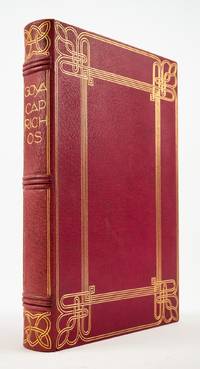
1922ST20816Munich: Hugo Schmidt 1922. No. 423 OF 500 COPIES of the "Engraved Edition. 305 x 205 mm. 12 x 8". 6 leaves followed by plates.With a foreword by Valerian von Loga. <br/> HANDSOME CRIMSON MOROCCO GILT BY OTTO DORFNER stamp-signed on rear turn-in covers with a strapwork frame in an Art Deco design raised bands strapwork ornaments at head and foot of spine gilt lettering in one panel turn-ins with thick and thin gilt rule marbled endpapers top edge gilt other edges untrimmed. WITH 83 COPPERPLATE ENGRAVINGS all with tissue guards. Spine gently faded to a soft rose a scattering of small faint spots to leather but A FINE COPY--entirely clean fresh and bright internally and the binding with almost no signs of wear.<br/> <br/> The sumptuous Hugo Schmidt edition of Goya's striking satirical "Caprices" is presented here in a lovely Dorfner binding. Francisco de Goya y Lucientes 1746-1828 conceived of this series of 80 prints as a critique of the ills he saw plaguing late 18th century Spanish society. The suite focuses on the nobility the Church and the Inquisition but also addresses more general societal concerns such as child abuse superstition and poor education. Its general message is in keeping with the Enlightenment philosophy of the day; philosopher Alexander Nehamas writes that in these artworks Goya advocates for a society in which "freedom in place of custom knowledge instead of ignorance and morality where custom held sway will remove the 'lies and prejudices' that stand in the way of human happiness." However the "Caprices" represent more than just a period critique: art historian Carl O. Schniewind writes that "in a way it may be said that modern art was born in these compositions which break away once and for all from the domination of eighteenth century tradition." Originally executed in etching and aquatint this suite of prints demonstrates Goya's ability in the medium with wonderful depth and subtlety of shading skillfully reproduced in copper engraving in the current edition. Publisher Hugo Schmidt who released high quality art books and facsimiles in the first two decades of the 20th century had published a reproduction of "Los Caprichos" in photogravure in 1918. The publisher's note here dated December 1922 tells us that the present edition with Goya's works expertly reproduced in copperplate by the art printers J. B. Obernetter was prompted by a lively scholarly interest in the 1918 edition. Both Schmidt editions begin with an introduction by art historian Valerian von Loga 1861-1918 who taught at the University of Berlin and is best known for his monograph on Goya. Our copy is distinguished by its binding executed by one of the leading artisans of the period. Otto Dorfner 1885-1955 taught at the School of Applied Arts in Weimar and at the Bauhaus workshop before founding his own school to teach binding. He was awarded a number of international prizes and is particularly noted for his work with the Cranach Press. His bindings tend to be elegantly understated but executed with exemplary craftsmanship and using the best materials. Our binding which falls squarely into the Art Deco mode is almost radically decorative by comparison. Hugo Schmidt unknown
1964C84781BRUNO CASSIRER. As New. 1964. Hardcover. FREE UPGRADE to Courier/Priority Shipping Upon Request - IN STOCK AND IMMEDIATELY AVAILABLE FOR SHIPMENT - AS NEW THE TEXT BLOCK IS PRISTINE CLEAN UNMARKED AND IN EXCELLENT CONDITION - - TWO 2 VOLUME SET. Vol. I: Text and Illustrations - 234 pages 190 plates; Vol. II: Catalogue Raisonne 458 pages 292 figures; folio. Catalogue Raisonné Catalogue Raisonne Catalog Raisonnee Complete Works -- with a bonus offer-- - May be EITHER: out of print OOP and extremely rare in this pristine condition; signed by author or contributor; or a first or special edition; inquire for details . BRUNO CASSIRER hardcover
196484781BRUNO CASSIRER. As New. 1964. Hardcover. FREE UPGRADE to Courier/Priority Shipping Upon Request - IN STOCK AND IMMEDIATELY AVAILABLE FOR SHIPMENT - AS NEW THE TEXT BLOCK IS PRISTINE CLEAN UNMARKED AND IN EXCELLENT CONDITION - - TWO 2 VOLUME SET. Vol. I: Text and Illustrations - 234 pages 190 plates; Vol. II: Catalogue Raisonne 458 pages 292 figures; folio. Catalogue Raisonné Catalogue Raisonne Catalog Raisonnee Complete Works -- with a bonus offer . BRUNO CASSIRER hardcover
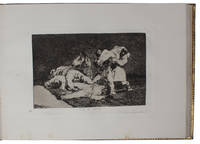
190660282Madrid 1906. Folio oblong. Bound in a splendid recent full longgrained burgundy morocco binding in pastiche style with four raised bands to beautifully gilt spine. Boards with gilt ornamental borders and gilt centre-piece. Gilt line to edges of boards and inner gilt dentelles. Marbled end-papers. All leaves re-hinged. Occasional light brownspotting but overall very nice. Title-page the version with the second line beginning "Colección de Ochenta. in lower case 2 pp. of text dated 1863 80 engraved plates on fine laid paper measuring 234x32 cm. Plates 17 and 77 have been misbound the numbers 1 and 7 look almost the same - Harris II:201: "In some sets this plate has been bound out of order where the number hs been read as 77"; II:288: "In some sets this plate has been bound out of order where the number has been read as 17. <br/><br/><em>A beautiful copy of the splendid fourth edition of Goya's magnificent "Disasters of War" - one of the most significant anti-war works of art ever produced - consisting in all 80 plates that were issued. "The Disasters of War" constitutes Goya’s political masterpiece directly inspired by and documenting the horrors he witnessed during the Peninsular War of 1808-14 between Spain and France under Napoleon Bonaparte the terrible famine in Madrid in 1811-12 and the disappointment at the restoration of the Bourbon monarchy. As such it is one of the earliest and most important examples of war documentation and remains to this day one of the boldest anti-war statements ever made. This however is also the reason why these groundbreaking etchings were not published during Goya’s life-time. It was both too dangerous and too gruesome. As Alastair Sooke puts it "even today it is difficult to look at the Disasters because Goya catalogues the brutality and fatal consequences of war in such a stark confrontational and unflinching manner." See his article for BBC Culture 2014. In this seminal series of etchings Goya not only uses art to comment on politics and the atrocities connected with war he also pioneers a number of artistic tools. Breaking from painterly traditions he deviates from the heroics of most previous war art to show us how war can bring out the worst in humanity. He abandons colour in order to show us a more direct truth conveyed by the use of shadow and shade. Also the fact that he presents the 80 works of art as a collection together with the harsh realistic nature of the etchings themselves connect the images more closely to the art of photography that we are now so familiar with causing the work as a whole to be viewed as one of the earliest examples of actual first-hand war reportage. The work has been extremely influential perhaps most famously inspiring Pablo Picasso and Ernest Hemingway For Whom the Bells Toll. "There are many contenders for the most powerful example of war art from the past two centuries: Picasso’s Guernica 1937 painted in response to the bombing of a Basque village during the Spanish Civil War would be an obvious choice. For me though nothing quite matches the originality and truth-telling ferocity of the Disasters of War a series of 80 aquatint etchings complete with caustic captions by the Spanish artist Francisco de Goya 1746-1828." Sooke. The execution of the engravings has been dated to a period between 1810 and 1820 but no contemporary edition was made of this spectacular series. "Possibly by the time they were finished the war and famine scenes were not of great appeal and Goya was probably unwilling to risk another financial failure such as he had experienced with the "Caprichos". It was a time of stern repression and the publication of the satirican and violently anti-clerical subjects of some of the "caprichos enfánticos" would certainly have been dangerous. These facts would account for a postponement of publication. Also Goya himself tells us that he fell seriously ill in the winter of 1819. and on his recovery he was planning to leave Spain and settle permanently in France. That Goya did not attempt to make an edition of "Desastres" in Madrid before leaving for France is borne out by the investigations of Catharina Boelcke-Astor who showed that the copperplates were stored away in safes by Goya's son Javier where they remained until the latter's death in 1854. Eventually in November 1862 they were acquired by the Academia de San Fernando from D. Jaimé Machén for 28000 reales." Harris I:141. In 1863 the first edition of Goya's seminal work was issued under the famous title "Los desastres de la guerra". In all 500 copies were issued. A second edition followed in 1892 and a third in 1903. Both of these editions were issued in merely 100 copies. In 1906 the fourth edition appeared in a number of 275 copies. "This edition is excellently printed on very suitable papers" Harris II: 175 and is considered much superior to the third. A further three editions appeared in 1923 1930 and 1937 respectively. "When Goya had engraved all the plates of the "Desastres" he gave his friend Céan Bermúdez an album containing a proof set of eighty-five plates including the eighty plates eventually published as "Los Desastres de la Guerra" two plates numbered 81 and 82 which were prepared for the series but not published with it and the three little engravings of "prisoners" which were never intended by Goya for inclusion in a published edition of the series." Harris I:140. The first plate prepares the spectator for the contents of the series and can be seen as a sort of frontispiece plates 2-47 deal mainly with the horrors of the war plates 48-64 record the terrible famine in Madrid and the final plates 65-80 constitute the "Caprichos enfánticos". " "The impact of the scenes is incredible" says the independent art historian Juliet Wilson-Bareau one of the world’s leading Goya experts. "Each one is a powerful original work of art in its own right yet linked to the others with a common theme including the way their titles - terse comments questions or cries of outrage - connect them and read on from one to another. The grouping of the series into three ‘chapters’ gives the whole a sense of rhythm and purpose." Goya must have hoped that he would live to see the publication of his Disasters but the despotic rule of Ferdinand VII made this impossible. "Under his repressive and reactionary regime" Wilson-Bareau explains "there was no way that Goya could have published his set of prints that so clearly denounced all violence and all abuse of power." Still following their posthumous publication the Disasters proved enormously influential inspiring artists including the German Otto Dix as well as Dalí and Picasso - and more recently the British brothers Jake and Dinos Chapman who bought a complete edition of the prints and ‘defaced’ them by adding grotesque cartoonish faces. Even the war photographer Don McCullin acknowledges a debt: "When I took pictures in war I couldn’t help thinking of Goya" he has said. The genius of the Disasters is that they transcend particularities of the Peninsular War and its aftermath to feel universal - and modern. Perhaps this is because as the British writer Aldous Huxley put it in 1947 "All Goya shows us is war’s disasters and squalors without any of the glory or even picturesqueness." So should we consider the series as the greatest war art ever created Wilson-Bareau certainly thinks so. "For me yes" she tells me. "I have lived with these prints which many people consider too shocking absolutely unbearable and I find in them - besides the heartbreak and outrage at the unspeakable violence and damage - a great well of compassion for all victims of the suffering and abuses they depict which goes to the very heart of our humanity." From Alastair Sooke's BBC-article. Harris II: 175. </em> hardcover