Baralt, Rafael MariaBiblio.com
267 résultats
18552101357Madrid.: Imprenta Nacional. 1855. Hardcover. Pequeños roces en la cubierta. Cubierta deslucida. Good. 19 cm. XXIII 709 p. Encuadernación en tapa dura artesanal con lomo en piel. Baralt Rafael María 1810-1860. Diccionario de galicismos. Con un prólogo de Juan Eugenio Hartzenbuch. Imprenta Nacional. Lengua española. Diccionarios. Hartzenbusch Juan Eugenio. 1806-1880 . Pequeños roces en la cubierta. Cubierta deslucida. Imprenta Nacional. hardcover
18908971Madrid Librería de Leocadio López 1890. Hardcover. Good. xxi 627p. recent cloth half-title chipped. Madrid, Librería de Leocadio López hardcover
1874100131302Leocadio Lopez 1874. accrocs écorchures sur les bords présence de mots/passages soulignés. in8. 1874. Relié. 2 volumes. 627 pages. Leocadio Lopez unknown
1893620811893. unknown
185221.0341Madrid: Imprenta de L.Amorós Angel 1852. 1ª ed. Holandesa piel. 19.5x27.5. Cubiertas algo rozadas; sellos de la Auditoría de Guerra del Ejército de Ocupación; papel algo oscurecido pero buen ejemplar Imprenta de L.Amorós Angel hardcover
185845025Madrid: Imprenta Nacional. 1858. First Edition. Hardcover. Very Good-. Law and Legal History Spanish Language and Literature Most Recent Listing; 447 27 pages; Contemporary blue marbled paper-covered boards backed with red cloth spine lettered in gilt. The edges of the boards and the corners show considerable rubbing and wear. Internally the printed leaves are fresh and remarkably free from foxing or toning. With the Library of Congress bookplate mounted to the front free-endpaper a tiny "LC" perforated stamp at the foot of the title page a very lightly inked accession stamp for the LC on the verso of the title page and the DE-ACQUISITION faint red ink LC stamp "Surplus-Duplicate" across the bookplate making this copy legal to buy and sell. A scarce legislative document of the short Republican time of liberalism in Spain -- the terminal year of the "Trienio Liberal" or Three Liberal Years. The three years referred to ran between 1820 and 1823. During this short interlude a liberal government ruled Spain -- following a military uprising in January 1820 led by the lieutenant-colonel Rafael de Riego against the absolutist Monarchy of Ferdinand VII. King Ferdinand agreed to accept the legitimacy of the liberal Spanish Constitution of 1812. During the Trienio Ferdinand was still officially King but was really more-or-less held in captivity as a prisoner of the Cortes for the next three years and retired to Aranjuez. The elections to the Cortes Generales in March 1822 were won by Rafael del Riego. In December 1822 at the Congress of Verona the Quintuple Alliance countries United Kingdom France Russia Prussia and Austria reached an accord holding that a Spain that could be thought of as republican constituted a threat to the balance of powers in Europe. France was chosen to force a restoration of the absolute monarchy in Spain. On 7 April 1823 the French army said by the French King to consist of "one hundred thousand men under the banner of St. Louis " crossed the borders into Spain. Riego took command of the Third Army and resisted the invaders as well as local absolutist groups. On 15 September he was betrayed and taken prisoner. Riego was taken to Madrid and his name ceases to be mentioned in the index to these papers of the "Cortes. " His pleas for clemency from the King were refused and Riego was found guilty of high treason against altar and throne. The main organizing charge against him was he was one of the members of these Cortes -- the Parliament who voted in favor of taking the power from the King. November 7th 1823 he was hanged at La Cebada Square in Madrid. OCLC 912076335 locating copies only in Biblioteca de la Universidad Complutense de Madrid and Universidad de Granada. Biblioteca. Under the separate OCLC number 852422618 is added a copy at the Universidad de Deusto - Biblioteca in Bilbao Vizcaya Spain. . . Imprenta Nacional hardcover
185135518PRIMERA EDICION.- Madrid: Círculo Literario Comercial Imp. a cargo de C. Gozález 1851.- 88 p.; 8º mayor 20 cm.- Col. La España Dramática. 157. Las primeras hojas con algunas pequeñas motas de óxido. TEATRO ESPAÑOL DE LOS SIGLOS XIX-XXI Libro en español Círculo Literario Comercial (Imp. a cargo de C. Gozález) paperback
181340228MALLORCA: En la Imprenta de Felipe Guasp 1813. Primera edición.- 4º.- 27 páginas.- Rústica. . Palau 171480 - Bover 731 - I En la Imprenta de Felipe Guasp unknown
18272164<p><em><strong>Bolivar improves medical services in Venezuela</strong></em></p><p>Simón Bolívar 1783-1830; José Rafael Revenga 1786-1852.</p><p><strong>Decreto sobre el rèjimen i gobierno del hospital militar.</strong></p><p>Caracas April 23 1827.</p><p>8°. 18 pp.</p><p>Recent paper covers.</p><p>Decree by Bolivar to improve the military hospital at Caracas Venezuela and the medical infrastructure in general. Issued by his Secretary General José Rafael Revenga this lists 19 articles to which the hospital and all other medical establishments should adhere to. The final pages states that this decree was "Given at my headquarters in Caracas on April 23 1827-17°". Medical services had been largely the responsibility of religious organisations. Bolivar aimed to strip monastic orders of their influence and the present decree can be seen as an example of that development.<br />This decree was issued just after settling temporarily the rebellion of Jose Antonio Paez in Venezuela. In 1826 Bolivar travelled to Venezuela to subjugate the resistance instigated by General Paez. This was resolved peacefully when Bolivar confirmed Paez's military authority in Venezuela and Bolivar's subsequent stay to celebrate. This in turn caused De Paula Santader to revolt in Bogota urging Bolivar to leave Venezuela in June. He left Paez in charge of Venezuela with the title of jefe superior. Thus when the present decree was issued in April Bolivar was still in Venezuela. José Rafael Revenga was Secretary of Foreign Affairs of Colombia since 1825 and became private secretary of Bolivar when he travelled to Caracas in 1826 making it likely that this was printed in Caracas. The first book was printed in Caracas in 1810.</p><p><strong>Condition: </strong>slightly spotted more on the last pages. Small hole in final leaf affecting text.</p><p><strong>Reference:</strong> not in Palau; Sabin.</p>
180821993Paris: Didot le Jeune 1808. Hardcover. In three volumes. xli 384pp; xxxvi 420pp; xxiv 425pp. Quarter calf with the spine lettered and decorated in gold sprinkled edges silk bookmarks. The spine of volume 1 is partially split a few mild creases to some of the pages light wear to extremities. Overall a nice very good set. ; Octavo. Didot le Jeune hardcover
185826076VALENCIA: Imprenta de José Rius 1858. 4º menor.- Rústica cubiertas originales.- 40 páginas. Manchas de humedad. Imprenta de José Rius unknown
18898222AB1889. Stuttgart F. Enke 1889. VIII 152 S. OBr. - Rafael Coën war praktischer und Sprach-Arzt in Wien. - Unaufgeschn. unknown
1883185271883. 2. verm. u. bedeut. verm. Aufl. - Wien 1883 Kl.8° IV 156 pp. 16 Abbildungen orig. Broschur. Coen Raffaello de fu Vitale"Mediciner geb. in Spalato Dalmatien am 19. Jänner 1839 absolvirte das Gymnasium in seiner Vaterstadt 1866 war zum Lehrer bestimmt wendete sich jedoch mit Liebe dem Studium der Medicin zu bezog im selben Jahre die Wiener Universität und wurde im März 1872 zum Doctor der Medicin und Chirurgie promovirt. Seit dieser Zeit ist C. als praktischer Arzt namentlich als Specialarzt für Sprachstörungen Stammeln Stottern thätig und Inhaber der ersten österreichischen k. k. autorisirten Privat-Heilanstalt für Sprechkranke. C. der fast ausschliesslich auf diesem Gebiete praktisch thätig ist hat auch wiederholt seine diesbezüglichen Erfahrungen und Heilmethoden theils in selbstständigen Werken theils in medicinischen Fachzeitschriften niedergelegt. Es erschienen besonders im "Medicinisch-chirurgischen Centralblatt in Wien" und in der "Medicinisch-pädagogischen Monatsschrift für die gesammte Sprachheilkunde in Berlin" Arbeiten aus seiner Feder. Im Buchhandel veröffentlichte C.: "Das Stottern Stammeln. Lispeln" etc. Verlag von A. Hartleben Wien 1877. "Pathologie und Therapie der Sprachanomalien." Verlag von Urban & Schwarzenberg Wien 1886. "Die Hörstummheit." Ibid. 1887. "Specielle Therapie des Stammelns." Verlag von Ferdinand Enke Stuttgart 1889. "Das Stotterübel" etc. Ibid. 18S9. "Uebungsbuch für Stotternde." Verlag von A. Holder Wien 1891. In der "Wiener medicin. Presse" veröffentlichte er 1887: Ueber eine neue Behandlungsmethode des Stotterns. 4. Heft. - Die Krankheiten der Uvula und deren Einfluss auf Stimme und Sprache. 25. 26. Heft." Eisenberg Ludwig: Das geistige Wien 2 1893 unknown
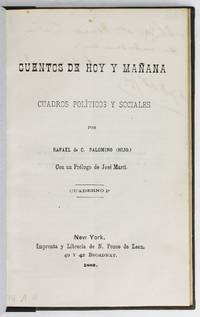
18834665New York: Imprenta y Libreria de N. Ponce de Leon 1883. Very good. vii53pp. Modern quarter calf and marbled boards spine gilt. Inscribed by the author on verso of title page. Manuscript pencil numbering to top corner of each page. Minor foxing. One of the most important and intriguing 19th century Cuban-American imprints featuring two Socialist 'morality tales' that while lauding the quest for social and economic equally also decry the risks posed by human nature and totalitarianism upon the practical application of Marxism. It was written by the prominent Cuban émigré Rafael de Castro Palomino and features a famous prologue by his close friend and colleague José Martí. From the 1870s to 1890s New York City was the heart of the Cuban community in exile. During the Ten Years' War 1868-1878 a wave of Cuban dissidents many being highly educated and with financial resources arrived in New York forming a vibrant and politically active community. There they had almost unfettered freedom to publish raise money and buy arms to support the struggle in the homeland especially at the U.S. Government hoped to exploit instability in Cuba for its own imperialistic advantage. From 1881 until 1895 José Martí 1853-1895 the brilliant author philosopher poet and journalist who was the 'Apostle of Cuban Independence' often made New York his home.<br /> <br /> Upon Martí's arrival in New York in 1881 he was greatly assisted by Rafael de Castro Palomino a long-established Cuban resident of the city. Palomino was a prominent Socialist writer and journalist being the author of numerous articles and short books. Even though his name comes up frequently much of Palomino's biography remains hazy. We do know that he was considerably older than Martí hailed form an affluent Havana family and had been educated in France. Like Martí he was deeply concerned about the potential excesses and pitfalls of Marxism as applied on the real world. Notably Martí and Palomino were close friends of Néstor Ponce de León y de la Guardia 1837-1899. An exiled Cuban lawyer and bibliophile he founded the Imprenta y Librería de N. Ponce de León in the early 1870s a Spanish-language printing house and bookstore that became the intellectual center of the New York Cuban émigré community. As an interesting side note he possessed the largest Spanish language private library in New York featuring more than 1700 titles which he made openly available to his colleagues such as Martí and Palomino. The work is relatively rare and particularly so in commerce. We locate four copies in OCLC at the University of Florida's Cuban collection Harvard Yale and the University of Chicago. An important work from the Cuban exile community. Imprenta y Libreria de N. Ponce de Leon unknown
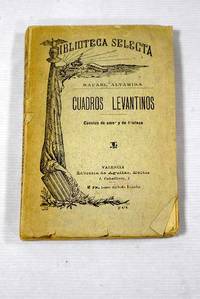
18973392939Valencia.: Pascual Aguilar. 1897. Paperback. Cubierta deslucida. Good. 15 cm. VII 217 p. Encuadernación en tapa blanda de editorial ilustrada. Colección 'Biblioteca selecta' numero coleccion92. Altamira Rafael 1866-1951 . Cubierta deslucida. Pascual Aguilar. paperback
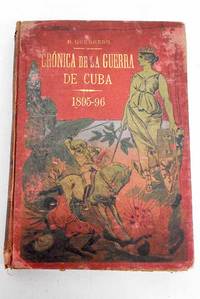
18971193491Barcelona.: Librería Editorial de M. Maucci. 1897. Hardcover. Good. 25 cm. . Encuadernación en tapa dura artesanal lomo en piel con dorados. Guerrero Rafael . Historia de la Edad Media y Moderna. Filipinas. Años 1896 a 98 94599"1896/98" 94 null [Librería Editorial de M. Maucci]. hardcover
18961193492Barcelona.: Librería Editorial de M. Maucci. 1896. Hardcover. Good. 25 cm. . Encuadernación en tapa dura artesanal lomo en piel con dorados. Guerrero Rafael . Historia de la Edad Media y Moderna. Filipinas. Años 1896 a 98 94599"1896/98" 94 null [Librería Editorial de M. Maucci]. hardcover
18963389285Barcelona.: M. Maucci. 1896. Hardcover. Cubierta deslucida. Good. 25 cm. 623 p. Encuadernación en tapa dura de editorial ilustrada. Cubierta deslucida. Literatura.82 82 M. Maucci. hardcover
1875129Cronica medico quirurgica de la habana revista mensual de medicina cirugia y ciencias auxiliares dirigida por los doctores jose r argumosa y j santos fernandez habana cuba 1875.encuadernacion en media piel.11 numeros encuadernados en un volumen comienza con el numero 1 mayo de 1875 y termina con el numero 11 noviembre de 1876.revista muy rara ilustradacon trabjos de grandes medicos cubanos de la epoca.conto con la colaboracion de.joaquin lebredocalixto oxamendifelipe rodriguezmanuel bangoserafin gallardoluis montanerafael cwleyjose argumosaantonio mestrejose r a montalvojose pulidoantonio reyneztomas plasenciagabriel garciajose francisco arangovicente de la guardiasiendo su redactor administrador don eduardo f pla la propaganda literaria hardcover
186435208Paris: E. Dentu Libraire-Editeur 1864. Troisieme Edition. Hardcover. Good. 12mo. 4 471 pages. Frontispiece illustration of the Alabama and Sumter. Marbled paper covered boards. Leather tips on the boards. Brown leather spine with 4 gilt lined bands and title. Marbled end papers. Leather joints are rubbed. Bookseller ticket - "Herman Janssen Encuadernador Y Cartonero Lima" located in the upper left corner of the front paste down. Number '202' small label on the front paste down. Some light bug damage to the text edges. Interior text is very clean. Text all in French. E. Dentu, Libraire-Editeur hardcover
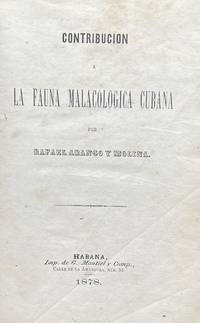
18782328Habana: Imp. de G. Montiel y Comp. Calle de la Amargura num. 36. 1878. In contemporary half leather. Bookseller’s/bookbinder’s vignette on inner front panel: Miguel Alorda / Libreria la Enciclopedia Encuadernaciones Habana. Later presentation inscription on front fly leaf. Binding worn rubbed. Inside firm sporadic foxing otherwise in very good condition. In contemporary half leather. 280 35 1 p. <p><p><br /> First edition of the first catalog of Cuban mollusks.<br /> Contribucion a la Fauna Malacologica Cubana was written by the most notable Cuban malacologist of all time Rafael Arango y Molina 1836–1893. Espinosa 2013 Contribucion Arango’s most important work is an extensive catalog of autochthonous mollusks that collects the classification of this group of families genera and species with their scientific names and also the synonymy the habitat and region of the country where they are located.<br /> <p><br /> During the 17th–18th centuries only a few Cuban species of the mollusk fauna were discovered and all of them were erroneously attributed to Italy and China. It was the 19th-century when more than a hundred new Cuban mollusks were discovered and described also in the present work which is the first catalog of Cuban mollusks. Maceira et al. 2011<br /> <p><p><br /> Literature: Espinosa J.: Las polimitas. Guatemala; La Habana: Ediciones Polymita; Ediciones Boloña. 2013.; Maceira D. et al. 2011. Historia de la malacologia terrestre cubana 1839–2010. Gaia Biodiversidad medioambiente y sociedad 12: pp. 1–48. Imp. de G. Montiel y Comp., Calle de la Amargura, num. 36. unknown
1878131Contribucion a la fauna malacologica cubana obra escrita por Rafael arango y molina e impreso en la habana cuba 1878.<b>Rafael Arango y Molina.habana 1837-1893 </b> Ilustre malacólogo cubano del Siglo XIX.Aunque aficionado a las ciencias naturales en general su formación autodidacta le inclinó hacia la Zoología y especialmente hacia el grupo de los moluscos de la que llegó a tener vasto conocimiento.Sus colaboraciones y descripciones figuran en importantes publicaciones como el Journal de Conchyologie de París y los Anales de la Academia de Ciencias de Filadelfia así como en las obras de Felipe Poey Luis Pfeiffer Alcides D'Orbigny y otros naturalistas.<p>El objetivo perseguido por Arango era que sus colecciones no salieran de Cuba y sirvieran para que la juventud estudiosa pudiera utilizarlas.De 1878 al 1880 publica su obra más importante: la <i>Contribución a la fauna malacológica cubana</i> un extenso catálogo de los moluscos autóctonos que recoge la clasificación de este grupo de familias géneros y especies con sus nombres científicos y además la sinonimia el hábitat y región del país donde se localizan.</p> Imprenta de g montiel y comp hardcover
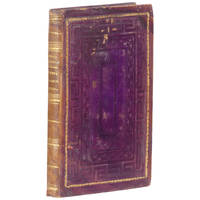
1871361923Mexico: Tipografia de J. Rivera Hijo y Compañía 1871. First Edition. Very good. A Spanish translation of Great European Conflict. Franco-Prussian War: Chassepot - Rifle vs. Zundnadelgewehr or the Needle Gun: Real Cause of the Struggle by a Mexican army general. <br /> <br /> 208 pages plus four inserted lithographic portraits of the leaders of the conflict including Napoleon III and Otto von Bismarck with a folding bird's-eye view of the defenses around Paris and a folding map of the theater of war. First edition of this translation. Bound in full Mexican purple leather stamped with geometric designs. Spine faded to brown. Tipografia de J. Rivera, Hijo y Compañía unknown
187371567Naples 1873. 305x240mm. cloth binding. Half back of volume 4 torned. Caps and spines of all volumes are used. 3250 hardcover
186862927Naples 1868. First edition. old full vellum. Old bookplate on each pastedown; some scattered light foxing. Folio. Illustrated throughout from engravings. hardcover