Alfons MUCHABiblio.com
36 résultats
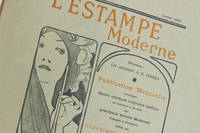
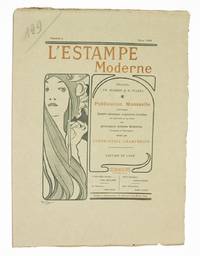
189874362Paris: Imprimerie Champenoispour CH. MassonH. Piazza 1898. Fine. Imprimerie Champenois pour CH. Masson H. Piazza Paris Mars 1898 41 x 56 cm une feuille Original black and white print with full margins serving as cover for the famous monthly publication L'Estampe Moderne. Entirely printed in black our print is the cover of the rare deluxe volume compilation with full margins of the first year of publication. Artist's signature in the plate and luxury edition number added in pencil. Magnificent French monthly publication issued between May 1897 and April 1899 L'Estampe moderne consists of unpublished chromolithographs which unlike other journals such as Les Maîtres de l'Affiche and as stipulated on the tissue guards were created specifically by each artist for the journal. Thus 100 prints appeared in total covering the major artistic movements of the late 19th century: Symbolism Art Nouveau Pre-Raphaelites Orientalists and Belle Epoque. Each issue of four prints was printed in 2000 copies sold for 3.50F and 100 on Japan paper offered at 10F. Henri Piazza also planned a confidential deluxe printing: 50 copies on Japan paper with full margins and 50 in black on China paper at the considerable price of 30F. French collectors' interest in artistic posters intensified in the early 1890s. Octave Uzanne to describe this fever invented the term ""affichomanie."" The poster originally popular and pasted in the streets of the capital then became an art object and its ephemeral medium became precious and destined for preservation. Piazza decided to remove the poster from its advertising purpose and elevate it to the rank of a complete work of art on the same level as the deluxe illustrated book. He thus composed a prestigious collection of entirely original works by the most prominent European artists of the moment: Georges de Feure Eugène Grasset Henri Detouche Emile Berchmans Louis Rhead Gaston de Latenay Lucien Lévy-Dhurmer Gustave-Max Stevens Charles Doudelet Hans Christiansen Henri Fantin-Latour Steinlen Ibels Engels Willette Henri Meunier Evenepoël Bellery-Desfontaines Charles Léandre etc. The publisher also integrated into his project a Czech artist freshly arrived in Paris Alfons Mucha ""qui s'est révélé depuis peu en France et qui a conquis d'emblée une si grande place dans la faveur du public. Comme dans ses affiches que tout le monde connaît et recherche il nous montre ici les ressources variées de son talent multiple et sûr de dessinateur de décorateur et de coloriste."" ""who has recently emerged in France and who has immediately conquered such a great place in public favor. As in his posters which everyone knows and seeks he shows us here the varied resources of his multiple and sure talent as draftsman decorator and colorist."" caption printed on the tissue guard of Salomé. It was moreover to him that the first premium of the journal was entrusted offered ""à tous les souscripteurs des douze livraisons annuelles de L'Estampe moderne"" ""to all subscribers of the twelve annual issues of L'Estampe moderne"" as well as the famous illustration of the covers. Very handsome copy. Imprimerie Champenoispour CH. MassonH. Piazza unknown
189974618Paris: Imprimerie Champenoispour CH. MassonH. Piazza 1899. Fine. Imprimerie Champenois pour CH. Masson H. Piazza Paris Janvier 1899 41 x 56 cm une feuille Cover of L'Estampe Moderne n°21 January 1899 L'Estampe Moderne Imprimerie Champenois pour CH. Masson & H.Piazza Paris January 1899 41 x 56 cm one leaf Original large margin print in black and white serving as the cover of the famous monthly publication Estampe Moderne. Entirely printed in black and white our print is the cover of the rare collection in a large-margin luxury print of the first year of publication. Artist's signature on the board and number of the luxury print added in pencil. A magnificent monthly French publication published between May 1897 and April 1899 L'Estampe moderne comprised unpublished chromolithographs which unlike other magazines such as Les Maîtres de l'Affiche and as is stipulated on the protective tissue were specially made for the magazine by each artist. There are thus 100 prints that appeared in total covering the major artistic movements of the late 19th century: Symbolism Art Nouveau the Pre-Raphaelites Orientalism and the Belle Epoque. Each delivery of four prints was printed with 2000 copies and sold for 3.50F with 100 on Japan offered for 10F. Henri Piazza also planned a high-luxury confidential print: 50 copies with wide margins on Japan and 50 in black and white at the considerable price of 30F. French collector's interest in artistic posters grew from the beginning of the 1890s. Octave Uzanne invented the term affichomanie poster-mania for this growing interest. The poster originally common-place and plastered across the streets of the capital then became an object of art and its ephemeral medium precious and dedicated to conservation. Piazza decided to remove the poster from its advertising role and elevate it to the rank of a work of art in its own right in the same way as the luxury illustrated book. Thus he composed a prestigious collection of entirely original works by the most well-known European artists of the time: Georges de Feure Eugène Grasset Henri Detouche Emile Berchmans Louis Rhead Gaston de Latenay Lucien Lévy-Dhurmer Gustave-Max Stevens Charles Doudelet Hans Christiansen Henri Fantin-Latour Steinlen Ibels Engels Willette Henri Meunier Evenepoël Bellery-Desfontaines Charles Léandre etc. The publisher also included in his project a Czech artist newly arrived in Paris Alfons Mucha qui s'est révélé depuis peu en France et qui a conquis d'emblée une si grande place dans la faveur du public. Comme dans ses affiches que tout le monde connaît et recherche il nous montre ici les ressources variées de son talent multiple et sûr de dessinateur de décorateur et de coloriste. who has recently emerged in France and who has straightaway conquered a significant place in the public's favour. As in his posters that everyone knows and desires he shows us here the varied resources of his multiple and sure talent as an artist decorator and colourist. caption printed on the Salomé protective tissue. Incidentally it is also to him that the first premium of the magazine will be entrusted offered à tous les souscripteurs des douze livraisons annuelles de L'Estampe moderne to all the subscriber of the twelve annual deliveries of L'Estampe moderne as well as the famous illustration of the covers. A very beautiful copy. Imprimerie Champenoispour CH. MassonH. Piazza unknown
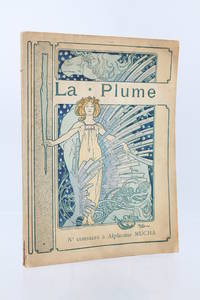
189785616Paris: La Plume 1897. Fine. La Plume Paris 1897 17.50 x 24 cm broché First edition of this issue entirely devoted to Alfons Mucha. Two tears and a lack to spine a light dampstain at head of first cover small stains at head of second. Numerous literary contributions including those by Léon Deschamps Frantz Jourdain Sarah Bernhardt Paul Redonnel Yvanoé Rambosson Charles Chincholle. Issue decorated with 127 illustrations by Alfons Mucha including the cover and a portrait of the latter by David Ossipovitch Whidhopff. La Plume unknown
1900MUCHAALP002009Printed by F. Champedois Paris. c 1900. Four colour and gilt lithographs each depicting along the left-hand edge a different full-length female figure holding a champagne glass. According to the Victoria and Albert Museum this is a complete set. The spaces for the menu listing are blank. It should be pointed out that these are the originals measuring 22 x 15 cm and not the smaller postcard-sized versions.Faint darkening to two of the cards. Bottom left corners creased at the very tips. Fine. Printed by F. Champedois, Paris. unknown
189824116Paris: La Plume 1898. Fine. La Plume Paris 1er janvier au 15 décembre 1898 19 x 25 cm relié First edition of the final year edited by Léon Deschamps founder of this magazine which gave a predominant place to the visual arts. 24 issues gathered here including the exceptional number devoted to Alexandre Falguière. Publisher's binding in full fir green cloth smooth spine red shagreen title label gilt floral motif blind fillets on boards. The cover of the first issue illustrated by Mucha is bound at the head of the volume. Contributions by Théophile Gautier Jules Barbey d'Aurevilly Karl Boès Adolphe Retté Francis Jammes Victor Margueritte Ernest Raynaud Stuart Merrill etc. Numerous illustrations including a watercolored frontispiece by Eugène Grasset and drawings by Henri de Toulouse-Lautrec Alfons Mucha Alexandre Falguière Vivant-Denon Willette Jossot André des Gachons Ferdinand Cazals Henri Detouche James Ensor. The frontispiece by Emile Berchmans announced on the title page is not present in our copy. Table and index at end of volume. Manuscript dedication by a former owner on the endpaper. Tiny tear on the front board otherwise a rare and handsome copy. La Plume hardcover
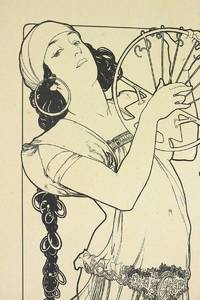
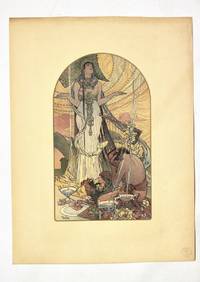
189773919Paris: Imprimerie Champenoispour CH. MassonH. Piazza 1897. Fine. Imprimerie Champenois pour CH. Masson H. Piazza Paris Juin 1897 23.50 x 33 cm une feuille ""Salomé"" - Original lithograph on China paper - L'Estampe Moderne L'Estampe Moderne Imprimerie Champenois for C H Masson & H Piazza Paris june 1897 subject: 23.5 x 33 cm plate: 40.8 x 55 cm one leaf and one guard Rare original black and white lithograph by Alphonse Mucha for L'Estampe Moderne series number 2 published in June 1897. One of the 50 grand luxe proofs printed on China paper with wide margins signed and dated by the artist in the plate. Embossed stamp of the publisher showing a child in profile to lower margin laid down on a leaf of vélin paper with the numbered stamp of the tirage de luxe to verso occasional spotting to margins not touching image blank guard. A magnificent monthly French publication that appeared between May 1897 and April 1899 L'Estampe moderne comprised unpublished chromolithographs that unlike those in other magazines like Les Maîtres de l'Affiche and as is stipulated on the guard sheets were specially made by each artist for the magazine. There are thus 100 prints that appeared in total covering the major artistic currents of the late 19th Century: Symbolism Art Nouveau the Pre-Raphaelites Orientalists and the Belle époque. Each fascicule of four prints was printed in 2000 copies and sold for 3.50F with 100 on Japan paper sold at 10F. Henri Piazza also planned a very luxurious secret printing of 50 copies on Japan paper with wide margins and 50 in black and white on China paper at the considerable price of 30F. This well-sized print is superbly printed in colors on the most prestigious of papers: Japan. Thick creamy satin and with a nice sheen it contributes to making each page a work of art in itself. Its absorptive qualities for ink and its affinity for colors make it the ideal support for these lovely lithographs. The interest of French collectors for artistic posters grew from the beginning of the 1890s. Octave Uzanne invented a term for this growing interest: affichomanie or poster mania. The poster originally not rare and posted up in the streets of the capital thus became a work of art and its ephemeral background became precious and essential for conservation. Piazza decided to extract the poster from its advertising role and to elevate it to a form of art similarly to luxury illustrated artists' books. He thus put together a prestigious collection of entirely original works by the most fashionable European artists of the age: Georges de Feure Eugène Grasset Henri Detouche Emile Berchmans Louis Rhead Gaston de Latenay Lucien Lévy-Dhurmer Gustave-Max Stevens Charles Doudelet Hans Christiansen Henri Fantin-Latour Steinlen Ibels Engels Willette Henri Meunier Evenepoël Bellery-Desfontaines Charles Léandre etc. He also included in this project a Czech artist freshly arrived in Paris Alfonse Mucha who has only recently become active in France but who has immediately carved out for himself the affection of the public. Like in his posters which everyone knows and covets he shows us here the varied resources of his multifaceted talents as accomplished draughstman decorator and colorist from the notes printed on the guard for Salomé. The two first special numbers of the review were in fact dedicated to him and were given to all the subscribers for all twelve annual numbers of L'Estampe moderne as well as the famous illustration of the covers. A fine signed plate by the master of Art nouveau. Imprimerie Champenoispour CH. MassonH. Piazza unknown
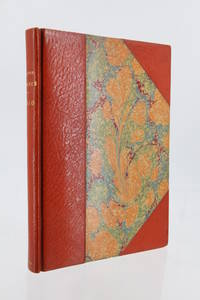
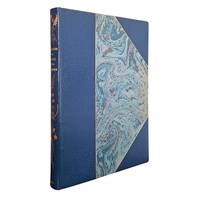
190081385Paris: Calmann Lévy 1900. Fine. Calmann Lévy Paris 1900 14.50 x 21 cm relié Calmann Lévy Paris 1900 145 x 21 cm half morocco First edition with 13 original illustrations by Alfons Mucha the cover 7 hors-text and 5 banners one of 50 numbered copies on China paper the tirage de tête deluxe copies. Binding in half orange morocco gilt date at the foot of the spine frame of black fillets on the marbled paper boards endpapers in the same marbled paper illustrated covers and spine preserved contemporary binding signed Champs-Stroobants. Pleasant attractively set copy including as stipulated in the print justification its double series of engravings: in colour and line drawings. Calmann Lévy hardcover
189773887Paris: Imprimerie Champenoispour CH. MassonH. Piazza 1897. Fine. Imprimerie Champenois pour CH. Masson H. Piazza Paris s. d. Mai 1897 22 x 38 cm une feuille et une serpente ""L'incantation"" Salammbô Original lithograph on papier japon L'Estampe Moderne L'Estampe Moderne Imprimerie Champenois for C H Masson & H Piazza Paris june 1897 subject: 23.5 x 33 cm plate: 40.8 x 55 cm one leaf and one captioned silk tissue Rare Alphonse Mucha color lithograph heightened with gold for L'Estampe Moderne 'The free first prize reserved to subscribers to a whole annual run of L'Estampe Moderne'. One of 50 'grand luxe' prints with wide margins signed by the artist in the plate publisher's stamp to lower margin de luxe printing numbered stamp to verso upper margin slightly sunned; the plate itself preceded by a silk tissue with the name of the artist title a poem and a caption - a tear to the tissue not affecting the text. A lithograph inspired by Gustave Flaubert's Salammbô with a excerpt from the novel printed on the silk protective paper: And Salammbô went out onto the balcony of her palace. L'Estampe moderne was a magnificent monthly French publication published between May 1897 and April 1899. It included unpublished chromolithographs specially made by each artist for the magazine as mentioned on the protective silk tissue over each plate unlike other publications such as Les Maîtres de l'Affiche. 100 prints were published in total covering major artistic movements of the late 19th-century: Symbolism Art Nouveau Pre-Raphaelites Orientalists and Belle époque'. 2000 copies were printed of each fascicule containing four prints and sold for 3.50F. 100 copies were printed on papier japon for 10F. Henri Piazza also planned a very luxurious secret print of 50 copies on papier japon with wide margins and 50 in black and white on papier chine at the considerable price of 30F. This well-sized print is superbly printed in colors on the most prestigious of papers: japon. Thick creamy satin and with a nice sheen it contributes to making each page a work of art in itself. Its qualities of absorption and its affinity for colors make it the ideal support for these lovely lithographs. The interest of French collectors for artistic posters grew from the beginning of the 1890s. Octave Uzanne invented a term for this new form of collection: affichomanie' or poster mania. The initially common poster displayed in the streets of Paris became a work of art and its ephemeral material became precious and made to last. Piazza decided to separate the poster from its advertising role and to elevate it to a form of art similarly to luxury illustrated artists' books. He put together a prestigious collection of entirely original artworks by the most fashionable European artists: Georges de Feure Eugène Grasset Henri Detouche Emile Berchmans Louis Rhead Gaston de Latenay Lucien Lévy-Dhurmer Gustave-Max Stevens Charles Doudelet Hans Christiansen Henri Fantin-Latour Steinlen Ibels Engels Willette Henri Meunier Evenepoël Bellery-Desfontaines Charles Léandre etc. He also included in this project a Czech artist freshly arrived in Paris Alfonse Mucha who has only recently become active in France but immediately carved out for himself the affection of the public. Like his posters which everyone knows and covets he shows us here the varied resources of his multifaceted talents as accomplished draughstman decorator and colorist from the notes printed on the silk protective paper of Salomé. The two first special numbers of the journal were in fact dedicated to him and were given to all the subscribers for all twelve annual numbers of L'Estampe moderne as well as the famous illustration of the covers. A fine signed plate by the master of Art nouveau. Imprimerie Champenoispour CH. MassonH. Piazza unknown
189773918Paris: Imprimerie Champenoispour CH. MassonH. Piazza 1897. Fine. Imprimerie Champenois pour CH. Masson H. Piazza Paris s. d. Juin 1897 23.50 x 33 cm une feuille et une serpente Salomé Original lithograph on papier japon L'Estampe ModerneL'Estampe Moderne Imprimerie Champenois for C. H. Masson & H. Piazza Paris June 1897 subject: 23.5 x 33 cm plate: 40.8 x 55 cm one leaf and one captioned silk tissue Rare Alphonse Mucha color lithograph heightened with gold for L'Estampe Moderne series number 2 published in June 1897. One of 50 grand luxe proofs printed on papier japon with wide margins signed by the artist in the plate publisher's stamp to lower margin de luxe printing numbered stamp to verso upper margin slightly sunned; the plate itself preceded by a silk tissue with the name of the artist title a poem and a caption. L'Estampe moderne was a magnificent monthly French publication published between May 1897 and April 1899. It included unpublished chromolithographs specially made by each artist for the magazine as mentioned on the protective silk tissue over each plate unlike other publications such as Les Maîtres de l'Affiche. 100 prints were published in total covering major artistic movements of the late 19th-century: Symbolism Art Nouveau Pre-Raphaelites Orientalists and Belle époque'. 2000 copies were printed of each fascicule containing four prints and sold for 3.50F. 100 copies were printed on papier japon for 10F. Henri Piazza also planned a very luxurious secret printing of 50 copies on papier japon with wide margins and 50 in black and white on papier chine at the considerable price of 30F. This well-sized print is superbly printed in colors on the most prestigious of papers: japon. Thick creamy satin and with a nice sheen it contributes to making each page a work of art in itself. Its qualities of absorption and its affinity for colors make it the ideal support for these lovely lithographs. The interest of French collectors for artistic posters grew from the beginning of the 1890s. Octave Uzanne invented a term for this new form of collection: affichomanie' or poster mania. The initially common poster displayed in the streets of Paris became a work of art and its ephemeral material became precious and made to last. Piazza decided to separate the poster from its advertising role and to elevate it to a form of art similarly to luxury illustrated artists' books. He put together a prestigious collection of entirely original artworks by the most fashionable European artists: Georges de Feure Eugène Grasset Henri Detouche Emile Berchmans Louis Rhead Gaston de Latenay Lucien Lévy-Dhurmer Gustave-Max Stevens Charles Doudelet Hans Christiansen Henri Fantin-Latour Steinlen Ibels Engels Willette Henri Meunier Evenepoël Bellery-Desfontaines Charles Léandre etc. He also included in this project a Czech artist freshly arrived in Paris Alfonse Mucha who has only recently become active in France but immediately carved out for himself the affection of the public. Like his posters which everyone knows and covets he shows us here the varied resources of his multifaceted talents as accomplished draughstman decorator and colorist from the notes printed on the silk protective paper of Salomé. The two first special numbers of the journal were in fact dedicated to him and were given to all the subscribers for all twelve annual numbers of L'Estampe moderne as well as the famous illustration of the covers. A fine signed plate by the master of Art nouveau. Imprimerie Champenoispour CH. MassonH. Piazza unknown
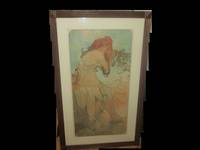
189615844AB1896. Paris F.Champenois 1896. 1003 : 505 cm image Lithograph in colours by Alphonse Mucha. Framed in contemporary wooden frame. Alphonse Mucha's poster "Été" "Summer" is part of his series titled The Seasons created in 1896. This poster captures the essence of summer with its warm golden hues and lush flowing forms. Mucha depicts a young woman draped in a light flowing garment that accentuates the curves of her body embodying the sensuality and warmth of the season. She is surrounded by an abundance of flowers and foliage symbolizing the fullness and fertility of summer. Her hair long and wavy cascades down her back adding to the natural unrestrained feel of the image. Mucha's characteristic use of intricate lines and decorative patterns is evident in the detailed borders and the swirling motifs that frame the central figure. The poster exudes a sense of harmony and beauty typical of Mucha's Art Nouveau style where nature femininity and elegance are central themes. The soft color palette dominated by shades of gold green and soft pastels further enhances the idyllic dream-like quality of the work making "Été" a quintessential representation of summer's warmth and beauty. Alphonse Mucha was known for his distinctive Art Nouveau style characterized by its use of natural forms flowing lines and elaborate decoration. His techniques combined both traditional and innovative approaches contributing to his iconic aesthetic. Here are some of the key techniques and elements in Mucha's work: Line Work: Mucha's use of lines is one of the most defining aspects of his style. He employed fine flowing outlines to create graceful organic shapes that mimic the curves found in nature. His lines were often decorative and stylized contributing to the overall harmony and unity of the composition. Color Palette: Mucha favored a soft pastel color palette often using muted tones of gold green pink and blue. These colors were carefully chosen to create a sense of harmony and to evoke specific moods often reflecting the seasons or the subject matter of the piece. Ornamentation and Patterns: Mucha's works are rich in decorative elements and intricate patterns. He incorporated floral motifs arabesques and geometric designs into his compositions often framing the central figure with these ornate details. This ornamentation was not merely decorative but also served to enhance the thematic elements of the piece. Use of Light and Shadow: Although Mucha's work is more stylized than realistic he employed light and shadow to add depth and dimension to his figures. His approach to light was subtle often using gentle shading rather than harsh contrasts which contributed to the soft ethereal quality of his work. Symbolism: Mucha frequently used symbolic elements in his paintings and posters. For example flowers seasons and zodiac signs often carried deeper meanings related to themes of nature femininity and the passage of time. These symbols were seamlessly integrated into the decorative elements of his work. Composition: Mucha's compositions were carefully balanced often centered around a single idealized figure. He employed symmetry and repetition to create a sense of order and harmony with the figure often surrounded by elaborate circular frames or halos that draw the viewer's eye. Media and Techniques: While Mucha is best known for his posters and prints which were typically lithographs he also worked in a variety of media including painting drawing and jewelry design. His lithographic technique involved multiple layers of color carefully aligned to create richly textured and vibrant images. In his paintings he used traditional techniques such as oil on canvas but applied them with the same decorative and stylized approach as in his graphic works. Mucha's techniques were instrumental in defining the Art Nouveau movement blending fine art with applied arts and his work remains a cornerstone of this decorative style. Alphonse Mucha holds a significant place in the history of art particularly as a leading figure of the Art Nouveau movement. His influence extends beyond his immediate contributions to the art world affecting design advertising and popular culture. Here are some key reasons why Mucha is important in the history of art: 1. Pioneer of Art Nouveau: Mucha is often credited with shaping and popularizing the Art Nouveau style which emerged in the late 19th century. This movement was characterized by its use of organic forms flowing lines and intricate decorative patterns all of which are hallmarks of Mucha's work. His designs especially his posters became synonymous with the Art Nouveau movement defining its aesthetic and helping it gain widespread recognition. 2. Innovative Use of Graphic Design: Mucha was a pioneer in using graphic design as a fine art form. His work in advertising and posters elevated these mediums to a new level blending commercial appeal with artistic integrity. His posters for Sarah Bernhardt the famous actress are particularly notable. They not only promoted her plays but also became collectible works of art in their own right. 3. Influence on Decorative Arts: Mucha's influence extended beyond painting and posters to various decorative arts including jewelry furniture and interior design. His aesthetic principles were applied to everyday objects making art more accessible to the public. This blending of fine art with applied arts helped bridge the gap between high art and popular culture a concept that has continued to evolve in modern design. 4. Impact on Visual Culture: Mucha's style has had a lasting impact on visual culture influencing everything from early 20th-century design to contemporary art and popular media. His work has inspired countless artists and designers in the realms of illustration fashion and graphic design. The Art Nouveau style as epitomized by Mucha has seen periodic revivals and continues to be referenced in various cultural contexts demonstrating its enduring appeal. 5. Symbolism and National Identity: Beyond his contributions to Art Nouveau Mucha was also deeply involved in the promotion of Czech national identity. His later works particularly the Slav Epic reflect his interest in Slavic history and mythology aiming to create a visual narrative that celebrated his cultural heritage. This aspect of his work underscores the role of art in expressing and shaping national and cultural identity adding another layer to his importance as an artist. 6. Legacy in Fine Arts: Mucha's ability to blend aesthetics with practical applications laid the groundwork for future movements in art and design particularly in how art could be integrated into everyday life. His legacy is evident in the continued appreciation and study of his work which remains a significant part of museum collections and exhibitions worldwide. Alphonse Mucha's contributions to the art world go beyond his beautiful and iconic images; he played a crucial role in defining an era shaping modern design and influencing the intersection of art culture and commerce. His work continues to inspire and resonate across disciplines making him a central figure in the history of modern art. The panel 'Ètè' Summer out of the series 'Four Seasons'. Mucha made a panel for each of the four seasons. He represents each season with characteristic flair here the sultry Summer. Four Seasons was Mucha's first series of decorative panels and one of his most popular ones. An classic Art Nouveau piece. A highlight in each Mucha collection. - Here contemporary framed therefore in very good condition. unknown
19000037327Paris: F. Champenois & H. Piazza et Cie 1900. First Edition. Hardcover Hardcover. Near Fine Condition. 31cm x 22cm. vi 80 2 pages 1 original pencil and watercolour drawing and 86 leaves being a double suite of the plates most printed on both sides. Signed Vermorel half blue leather inlay design of bells and roses to spine marbled papered boards top edge gilt marbled endpapers. Text is in French. Copy No. 1 of 10 on Japon containing an original Mucha drawing. Emile Gebhart's three medieval tales: Les trois rois La derniere nuit de Judas and Alleluia! presented in one of the great illustrated books of the Art Nouveau period. Alphonse Mucha provided the complete decorative programme: cover design title-page decoration limitation page colophon and 78 individual headpiece compositions with elaborate floral borders enclosing the text each hand-coloured by au pochoir. This copy No. 1 contains an original full-page mixed-media drawing in pencil and watercolour on Japon signed 'Mucha' at lower right depicting a young woman in flowing drapery and broad knotted sash her hair loose to her waist beneath a patterned headband in profile with her hands raised to her collarbone a detailed study for the main figure featured in the vignette on page 69. Also bound in are a complete suite in colour on Japon of the 78 borders and vignettes and the three designs for the title limitation and colophon together with a second state in black on China paper. The original wrappers and prospectus are retained. The prospectus established a hierarchy of 252 copies in five categories of which the ten copies on Japon with original watercolours priced at 550 francs each ranked only below the unique parchment and satin copies priced at 1000 and 800 francs both entirely reworked by the artist and above 25 further copies on Japon without watercolour and 215 copies on velin de Rives. The prospectus also noted explicitly that trade discount on the watercolour copies excluded "the cost of the watercolour executed by the artist" formally distinguishing the value of the Mucha original from that of the book at the point of publication. Provenance: Acquired in 1947 by Albert Quesnot 1882-1954 first violinist with the Paris Opera thence by descent retained in the family home until 2026 when acquired at auction in Paris. Fresh to the market after nearly eighty years of unbroken family ownership. Text is in French. Minor tanning to fore-edge of marbled papered boards. Very minor rubbing to fore-edge of upper board near crown corner. Offsetting to flyleaf facing original upper wrapper. Upper wrapper fore-edge very slightly cropped . Category: Art & Design; Foreign Language::French; French Language; Fine Bindings. Inventory No: 0037327. BZDB407 Art & Design; Foreign Language::French; French Language; Fine Bindings. Unbranded Emile Gebhart; Alphonse Mucha Cloches de Noel et de Paques F. Champenois & H. Piazza et Cie hardcover