Bartlett JosephABAA

106 résultats
18210046721821. Hardcover. Leather spine. Good. A manuscript notebook with lovely original folk art oil paintings on both boards and two watercolors within! 4to. 30.5 by 19.5 cm. Unpaginated 18 leaves of wove paper with content followed by a few blanks. Watercolored title page with American eagle atop an orb and pedestal and a beautiful painting of ships bearing the American flag near a lighthouse perched on a rocky spit and a cape house beyond. The paintings on the boards are what strike us as the most unusual though especially because the medium is oils. One is of a windmill and a pastoral setting the other a cow drinking at a pond. Also a faint pencil sketch on the final leaf possibly a draft of one of the two cover paintings and elsewhere a tail vignette of a tombstone. The verse is not credited. The longest selection is "An abbreviation of the Shipwreck" which is in fact an abridged version of Falconer's narrative poem. Another "Epitaph on a Blacksmith" was written by Alexander Pennecuik. A poem entitled "Water" was penned by an Ann Taylor. We thus assume based on the title that most of the poetry was transcribed. The sea is the most common subject but by no means the exclusive one. The alum-tawed leather of the spine is heavily soiled. Repair of the sewing which binds the text block. Rubbing and minor loss on the cover panels. Darkening of the cover paintings. <br /><br /> hardcover books
1840238057London: George Virtue 1840. First edition state A of volume II with Contents list numbered. With 120 steel engraved plates by William H. Bartlett including a full-page map of the Northeastern United States portrait and two engraved title pages tissue guards. 2 vols. 4to. In HARPER'S binding of half purple-morocco gilt spine a.e.g. Harper was likely the American distributor; extremities slightly rubbed vol. II covers soiled plates with scattered light foxing mostly marginal overall a very attractive copy. First edition state A of volume II with Contents list numbered. With 120 steel engraved plates by William H. Bartlett including a full-page map of the Northeastern United States portrait and two engraved title pages tissue guards. 2 vols. 4to. Originally published in 30 parts without text and appearing here for the first time in expanded book form this is a beautiful series of views showing principal cities and scenic views engraved from drawings Bartlett made during a visit to America and Canada 1837-1838. He stayed with his collaborator the poet N.P. Willis and accompanied him on a trip West. A handsome survey of the New World. Sabin 3784; Howes B209; BAL 22755; Abbey Travel 651 George Virtue unknown books
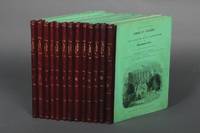
1840025470London: Virtue 1840. Quarto. Volume I: Portrait frontispiece hand-colored vignette title page and regular title page ix 140 pages 66 leaves of plates one map. Volume II: hand-colored vignette title page and regular title page iv. 106 pages 52 leaves of plates. The map plate in volume I was done by W. Hughes. All 119 plates are present. In 1836 William Henry Bartlett was sent to America to begin making engravings of the major sites in the United States. Virtue had also commissioned Nathaniel Willis to make letterpress descriptions of each image. Thomas Dougherty drew two of the originals while the rest were done with remarkable precision by Bartlett. While Willis is first on the title page it is Bartlett's fine work that has made this the finest 19th century work on America from the artists' perspective. the plates view the Eastern U.S. before the full force of the Industrial Revolution changed the face of the eastern landscape forever. Bound in a very fine rich red 3/4 red morocco spines with bands and decorative panels with a matching slipcase. Abbey Travel in aquatint and lithography 651; Blanck BAL 22755; Sabin 3784. Virtue unknown books
184022476London: George Virtue 1840. First edition. Hardcover. Orig. dark salmon cloth decorated in blind and gilt front and back covers with gilt arabesques and lettering at spine. Aeg. Very good. Bartlett William H. 48 106 96 140 4 52 28 x 22 cm. 117 steel engrave plates with tissue guards. Originally published in Thirty parts at one shilling or in Divisions 6s. 6d. cloth gilt. Drawings by William Henry Bartlett one of the most prolific of illustrators for topographical works. "It is almost certain that there are more steel engravings after Bartlett than after any other painter of views" -- see RUSSELLp.196. Bartlett made four voyages to America between the years 1836 and 1852. HOWES B209. From the publisher's original announcement: "Like Columbus at first we only dream of America. It is yet both a new and an unknown world to us in regard to its scenes of natural beauty and sublimity. The Proprietors.have sought to produce a series of Select Views which will form a characteristic Panorama of the Western World; especially in its Lake and River Scenery which has no parallel in Europe perhaps not on earth." Four pages of adverts Vol. 1 Vol. III booklabel rear pastedown of publisher rare first issue in five volumes. Slight rubbing to backstrip extremities and a few corners cover gilt illustrations very bright and fresh. George Virtue hardcover books
184252681London: published for the proprietors by George Virtue 1842. 4to 4 volumes in 13; 2 maps and over 200 fine steel engravings list of subscribers and advertisement leaves with the author's notice in the final volume. Bound with: Canadian Scenery Illustrated. Original quarter roan gilt-lettered in decorated publisher's boards; occassional spotting to edges of plates. A rare set of the two works issued together and assembled from the original parts. A most appealing set of an illustrated classic here in extended form with both the separate American and Canadian publications issued in this form as one continuous work numbered as a coherent series on the bindings. The series in this form includes over 200 steel-engraved images. The publisher's charming binding is in particularly good condition. "The New World of Columbus.its sudden rise to independence wealth and power" Author's preface is captured in this Victorian publication on the United States and "British America" Canada with fine engravings after the noted British landscape painter William Henry Bartlett. This is a wonderful illustrated romp published at a time to illustrate the last days of relative freedom of the North American native peoples Willis cites Blumenbach in analysing the "real character of the aboriginal inhabitant" and the development of the cities on the West coast of America and unusually Lower Canada. William Bartlett "made four voyages to the United States and Canada.the fruits of which appeared in American Scenery and Canadian Scenery" DNB. The famous plates depict North American cities New York Philadelphia Boston Washington; important buildings such as the U.S. Bank the Capitol and Yale College; bridges parks falls ferries rivers; as well as fine views of Canada through Quebec Montreal Toronto and including Niagara Falls and Thousand Isles. Also included is an engraved portrait of Bartlett a map of the north-eastern United States and Lower Canada. Sabin calls Canadian Scenery "the finest of Mr. Bartlett's works." Willis's "The Literary Department" accompanying letterpress lyrically opines on the picturesque quoting Byron's Childe Harold on sighting Niagara Falls and noting that in America the traveller may imagine "an Eden newly-sprung from the ocean". Abbey 651 American Scenery; Sabin 3784 3786. <br/><br/> published for the proprietors by George Virtue hardcover books
1887574231887. 4to 353 pages of entries in a legible hand approx. 65000 words plus an additional 80 pages of notes lists of officers and ships and tables of ships coordinates. Contemporary half sheep over cloth chipping and wear to spine and edges all page edges marbled. Bartlett's ink name and other notes on spine. Laid in are three silver albumen prints depicting Bartlett at various points in his career a letter from the Secretary of the State in Schuylkill Rodman Wister as well as handwritten copies of correspondence between Willard Bartlett and W.C. Whitney and three small broadsides of General Orders likely printed aboard ship. A small oval photo of the U.S.S. Sacramento in March 1867 is laid down on the ms. title page. Three small hand-colored illustrations of natives from sketches by M. Hypolite Silvaf are laid in or laid down in the text. Henry Bartlett was born in Rhode Island son of John Russell Bartlett an ethnologist and well known author of The Dictionary of Americanisms published in 1848 who also served for many years as Rhode Island's Secretary of State. He was also the state's first bibliographer having compiled A Bibliography of Rhode Island Providence 1864. Henry Bartlett saw service in the Civil War commissioned a second lieutenant in the Marine Corps in 1861. He was put in command of the Marine Guard aboard the iron-clad "New Ironsides" involved in actions in Charleston Harbor and later was part of the expedition to capture St. Augustine. Bartlett used this journal over the course of two decades during tours of duty as a U.S. Marine aboard the USS Sacramento from Cape Town to Ceylon Pondicherry Madras etc. in 1867; aboard the US Flag Ship Contoocook bound for Havana from 1868-69; on the US Flag Ship Hartford on the Asiatic Station in China and Japan from 1872-75; and on the USS Trenton in China Japan and Korea 1883-86. He records in some detail life aboard ship and at the various ports he visited. During his time on the Asiatic Station he also acted as a Judge Advocate at on board court martials. Following the Civil War the U.S. Navy along with the Marine Corps was expanding its influence and its reach around the globe. Of particular note is Bartlett's tour with the USS Trenton just as the first US diplomats were making inroads in Korea. By 1867 when this journal commences he was aboard the USS Sacramento bound for India. In short near daily entries later less frequent Bartlett records the weather; ports visited interactions with other international ships in the harbors etc. He mentions encountering a French Corvette bound for New Caledonia with 200 convicts aboard including twelve women. He notes the presence of two American whalers and an outbreak of yellow fever at Mauritius. In Ceylon he mentions meeting the American Consul going hunting and sightseeing and dining well on several kinds of curry. The account ends somewhat abruptly when the ship runs aground. Apparently while sailing en route from Madras to Calcutta the Sacramento was stranded on an uncharted shoal. Makeshift rafts were constructed and Bartlett boarded the last of these to leave the ship. Bartlett's raft suffered the misfortune of drifting miles away from the wreck and for two days the small craft with its 29 passengers was hopelessly lost at sea until rescued by the steamer Madras. Bartlett resumes his record in September 1868 with his new post aboard the US Flag Ship Contoocook bound for Havana. Anchored in the harbor there by mid-November Bartlett observes: "Havana is a strange looking place a great number of old tumble down forts at the entrance to the harbor mounting any number of guns. We found two large Spanish vessels in port & one English Man-of-War the "Jason." The Governor General Lersundi still holds out for the Queen. He had sixteen thousands troops in the city of Havana for which reason this place is very quiet - the island is much excited. We hear of fighting near us." In January he mentions that Captain General Dulce has little or no control over the Volunteers. "The force of Marines from the vessels lying here went on shore during the afternoon to try and keep quiet in the City. Cohner an American citizen was shot Sunday night while walking near his house." By June 1869 the Captain General Dulce had been driven from office and the city was under the control of an armed mob. Yellow fever and cholera were also constant threats to the health of locals and sailors. Despite the turmoil Bartlett managed to see a bull fight buy cigars and tour the sugar estate of the Arriettas known as "Flor de Cuba." The journal recommences in September 1872 with Bartlett's next post aboard the US Flag Ship Hartford bound for Hong Kong China and Japan. By spring they were moving from port to port in the Far East Singapore Hong Kong Shanghai Chin Kiang and Canton the Temple of Longevity Flowery Pagoda the Temple of the Sleeping Buddha etc. and dining on Birds Nest Soup shark fins and seaweed stew. He also mentions that a great crowd of American missionaries came on board to visit the ship while it was in port in Canton. In early 1874 the Hartford was in Yokohama. He and some of his shipmates toured Osaka and Nagasaki. In August he records what he was told was the most severe typhoon ever to hit Nagasaki with nearly every building in the city suffering some damage. In early 1875 he visited the Chinese Arsenal in Canton where he watched them making Remington and Spencer rifles "on a mammoth scale" 8-foot rifles requiring three men to fire them plus the manufacture of gatling guns and torpedos. While aboard the Hartford Bartlett received an appointment as a Judge Advocate and was often called upon to be one of the judges for the General Courts Martial which took place on board. The Hartford was ordered home in mid-1875. The ship stopped at Tripoli in August on its return trip and the Consul came on board complaining of his ill treatment by a group of Egyptian sailors and demanding help. Bartlett says: "I think the whole matter will be quietly settled in a few days. Our Consul is a Frenchman from New Orleans a quick fiery fellow and no doubt much to blame for the course he has pursued. He got himself in trouble only a year ago and stands in a very bad order with the Egyptian Government." Bartlett returned to the United States married in November 1875 and took a stateside post in Washington DC for a time. His wife Edith died in June 1877. By 1883 he takes up his journal again to record a final overseas posting this time aboard the USS Trenton. Bartlett records the ship's itinerary from Naples to Rome through the Suez Canal and on to Bombay Formosa and Nagasaki. In June 1884 the USS Trenton is in port in Seoul Korea. The ship provided an escort for the US minister General Foote to visit Seoul at the invitation of the King of Korea. Although Bartlett was not a member of the escort detail he did do some sightseeing around the city. He toured the grounds of the New Palace which had been partially destroyed by fire several years before and where the local population felt superstitious about living. Bartlett also continued his service as a Judge Advocate though in at least one case he was asked by a sailor to defend him in front of the courts martial Laid in is the small broadside printing of the General Court-Martial Order No. 11 dated Yokohama Japan July 29 1884 convincing Passed Asst. Paymaster James A. Ring of drunkenness. The sentence of the court found Ring suspended from rank and duty for two years but allowed to retain his present number on the list of Passed Assistant Paymasters during that time. Evidently Bartlett did a good job defending Ring. The printed broadside notes "the sentence is deemed by the Revising Authority as altogether inadequate to the offence but is approved in order that the offender may not entirely escape punishment." Bartlett records in his private journal that Ring was very grateful to him and presented him with a "very handsome present" as payment a Heizen Teapot cup and saucer. The USS Trenton was again called back to Seoul in December 1884. Both the Chinese and the Japanese were contending for influence in Korea. Early in December word had arrived of an insurrection in Seoul with a number of the Japanese-backed Korean Cabinet killed by anti-government Chinese troops. The US minister General Lucius Foote sent word that he needed protection and assistance and the USS Trenton was dispatched to his aid. Arriving in Chemul'po on Dec. 18 two officers and a detachment of ten men left the ship armed with 2000 rounds of cartridges and six days of rations to act as a guard for the US Consulate and escort Gen. and Mrs. Foote to safety. Rumors about the fate of some of the Korean government officials were abundant - Min Yong Ik was brutally attacked and there appeared to have been a slaughter of all Japanese found in the city. U.S. Naval Attache George Faulk was away in Fusan but the sailors successfully got the General and his wife aboard ship. Tensions in the region continued for most of the rest of the USS Trenton's time on the Asia Station. The ship sailed for home in June 1886 arriving back in the United States in September. Bartlett continued to serve in the Marine Corps taking a post at the Naval Academy in Annapolis Maryland in April 1887 in command of the Marine Corps Barracks there. He retired in 1898. He is buried at Arlington National Cemetery. Bartlett also compiled some 80pp. of notes and lists at the back of the journal including names of Americans he knew or met in Shanghai China Japan and Hong Kong lists of the "open ports" of Japan and China lists of officers aboard the Hartford the Contoocook the Sacramento plus the occasional recipe for curry or milk punch. <br/><br/> hardcover books