65 résultats
1778W132Dublin: John Exshaw Dame Street 1778. paper wrappers. Fine. 8vo. 593-648pp. Frontis. folding engraving 'A PERSPECTIVE VIEW OF COXHEATH CAMP Representing a Grand Review of the Army'.20x38 cms O'Neil/ W. Esdal. Reverse engraved for the Dublin issue of the Gentleman's Magazine in fine condition. Also a folding plate 'Dispositions of the Army Encamped on Coxheath with a treatise to the reverse by Lewis Lochee'. Also folding printed manuscript plate of 'A Song on Coxheath and A favourite Duet to the reverse'; Articles include Humours of a camp from an officer at Coxheath; Progress of English Commerce in Bengal; History of Europe; etc etc; List of births deaths bankrupts promotions and marriages in Ireland. NB This not the Gentleman's Magazine from London but the much rarer Dublin magazine pub. by John Exshaw. <br/> <br/> John Exshaw, Dame Street unknown
1758T371Dublin: John Exshaw Dame Street 1758. 1st Edition . No Binding. Fine. 8vo. 481-536pp. A disbound copy of the Dublin version of the Gentleman's Magazine for the month of Sept 1758. Fine fresh paper with no foxing wear or marks. The title-page lists 25 articles on the title-page and includes a fine copy of the rare 'Plan of the Country from the LANDING PLACE with the Encampments and Marches of the Troops under Major General ABERCROMBIE to the Attack of TICONDEROGA . 19 x11 cms. Together with an account from the action. Also a fine plan of St Malo with map of part of French Coast inset 19 x 11cms together with an account of shipping lost in recent action. Also a PLAN of Cherburg with Channel map inset 19 x 11cms with an account. All 3 plans engraved by Ridge. Please email for photos. <br/> <br/> John Exshaw, Dame Street unknown
1778W106Dublin: John Exshaw Dame Street 1778. paper wrappers. Fine. 8vo. 129-184pp. Frontis. engraved plate 'A Picturesque View of the State of the Nation'. A reverse etching engraved for the Dublin issue of the Gentleman's Magazine in fine condition. With an explanation of the plates. Also bound in a folding plate of a song printed in manuscript on 2 sides entitled 'A Favourite Song in the Merchant of Venice' Sung by Mr Du Bellamy in the character of Lorezo. Articles include British Theatre; 'History of Europe; AN ADDRESS TO THE INHABITANTS OF PENNSYLVANIA; Also a COMMAND FROM CONGRESS TO ARREST PERSONS LISTED; Irish Parliamentary Intelligence; Notes extracted from Congress relating to the American War 169-174pp; Poetry; Irish Intelligence; List of births death and marriages in Ireland. PLEASE EMAIL FOR PHOTOS. NB This not the Gentleman's Magazine from London but the much rarer Dublin magazine pub. by John Exshaw. LACKS MAP OF 'PART OF PENNSYLVANIA' p152 <br/> <br/> John Exshaw, Dame Street unknown
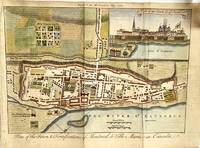
1760M11318London: London Magazine 1760. Very Good. Notes: With an inset: View of the Town & c.of Montreal.<br>An early and important street map of Montreal.<br><br> Size : 186x258 mm 7.32x10.16 Inches Coloring: Hand Colored Reference: Jolly Lond-192<br><br> Category: Maps Canada East Quebec Montreal; London Magazine unknown
1774179641774. The London Magazine December 1774 records British reporting on the developing conflict between Great Britain and the American colonies in the months after the Intolerable Acts and the First Continental Congress. The issue captures the political language of grievance liberty parliamentary authority colonial coordination and imperial anxiety before the outbreak of war. Its contents support research into Revolutionary-era public opinion transatlantic news circulation colonial resistance and British interpretations of American political organization.<br /> <br /> The London Magazine: Or Gentleman's Monthly Intelligencer. London: Printed for R. Baldwin December 1774. Octavo. Pages 567-616. 5.25 x 8.25 inches. Contents include "Plan of A Union Between Great Britain and the Colonies" "The King's Speech to the New Parliament" "Protest against the Lord's Address" "Letters From the Massachusetts Assembly to Lord Dartmouth" "Proceedings in the Province of Pennsylvania relative to the General Congress" "Instructions to the Pennsylvania Deputies" "American Affairs" and reporting on the Six Nations. One letter states that "the interesting controversy between administration and America daily grows more and more serious" and argues that a people whose property is controlled "by another people at an immense distance" cannot believe themselves free.<br /> <br /> The issue gives contemporary printed evidence of how London readers encountered colonial resistance as it moved from local protest toward intercolonial congress and coordinated political action. Its reporting on Pennsylvania proceedings Massachusetts correspondence the King's speech and Indigenous diplomacy places the imperial crisis within a wider Atlantic and frontier context rather than a single Boston-centered narrative. Disbound toned and bumped at outer top corner; good. A substantive Revolutionary-era magazine issue preserving British coverage of American resistance immediately before armed conflict. unknown
1778W105Dublin: John Exshaw Dame Street 1778. paper wrappers. Fine. 8vo. 65-128pp. Frontis. engraved plate 'An Arch Prelate in Boots or The Church Militant'. Engraved for the Dublin issue of the Gentleman's Magazine in fine condition. Also bound in 'The Last Drop' a folding satirical print also a folding plate of a song printed in manuscript on 2 sides entitled 'Damon and Clora' A duett. Articles include 'Letter from George Washington to his Wife'; Account of the memorable Battle of Paltowa; British Theatre; LETTER FROM THE AMERICAN PLENIPOTENTIARIES TO LORD NORTH by Benj. Franklin Silas Deane Arthur Lee; 'History of Europe; A list of recent Lottery prizes; A Tour through France; Irish Parliamentary Intelligence; History of British Parliament; Poetry; Irish Intelligence; List of births death and marriages in Ireland. PLEASE EMAIL FOR PHOTOS NB This not the Gentleman's Magazine from London but the much rarer Dublin magazine pub. by John Exshaw. <br/> <br/> John Exshaw, Dame Street unknown
175535632London: Scots Magazine 1755. First Edition. Leather bound. Defective. Octavo. 12 monthly issues bound in one volume. 648 pages 16 pages partial index. No illustrations in this volume. Brown calf leather binding with red leather title labels on the spine. Defective. Missing all the preliminary pages. Missing index pages and rear end papers after the name "Stuart". Leather covers are rubbed and edge worn. Outer joints and inner hinges are cracked. Covers are loose but attached. Title page has light damp stains and a small scuff. Pages 159 160 have an edge tear resulting in minor loss of print. The first page is present in the January issue. Defective.<br /> <br /> A sampling of subjects covered in this volume include East India Company Mutiny Bill; Sir Isaac Newton on the ancient year; Affairs in Spain Barbary and France; An Account of Mr. Johnson's English Dictionary; Improvements of the musket and of church-music; 'Pensylvania' German Protestants; Importance of British Plantations; Gov. Dinwiddies Speech to the assembly of Virginia; Gov. Dobb's message to the assembly of N. Carolina; Affairs in the United Provinces and the Plantations; General Braddock's defeat with the lists; Further accounts of the fatal action in America; Affairs in France and the Plantations; Different accounts of General Braddock's defeat; An Examination of the Edinburgh Review; A New History of 'Pensylvania'; Of the French 'incroachments' in America; Gov. Glen's interview with the Cherokee Indians; Speeches of Indian Chiefs and several more articles. Contents also include European history public affairs parliament acts births deaths marriages poetry book reviews and more. Interior contents are mostly in good condition. Volume published during the French Indian War era in America. Scots Magazine unknown
17883752This engraving of the lighthouse at Cape Henlopen is the first image of a lighthouse to appear in an American magazine. Indeed we believe this is one of the earliest American images of a lighthouse one can hope to obtain. The Cape Henlopen light was completed in 1767 and first lit in 1769. This view according to the caption was drawn in 1780. It was published in the February 1788 issue of <i>The Columbian Magazine</i>. Although the engraving plate is not signed the engraver was likely James Trenchard one of the proprietors of the <i>Magazine</i>. <br /><br />This wonderful early American image has survived longer than its subject -- the lighthouse depicted collapsed in 1926 due to erosion. <br /><b>References:</b> Lewis: <i>A Guide to Engravings in American Magazines 1741-1810</i>: p. 4. Stauffer <i>American Engravers Upon Copper and Steel</i>: 3293. <br /><br /><br /><b>Condition</b><b>:</b> Occasional mostly very light foxing and a small stain at lower left in the margin; otherwise very good. From the February, 1788 issue of The Columbian Magazine.
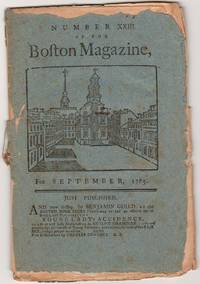
17853784<b><i>Founding of Harvard Medical School</i></b><br /><br /><i>The Boston Magazine</i> was published from October 1783 to December 1786 and was the first magazine to be published in Boston in the aftermath of the American Revolution. A major attraction of this issue is the presence of the front and rear printed wrappers although they are frayed and detached. The front wrapper features a large woodcut of the State House and surrounding buildings in Boston.The first 3 1/2 pages of the<i> Magazine</i> are Harvard's announcement from September 1783 of the creation of "the Medical Institution" now known as Harvard Medical School. This is followed by about two pages of an address "to the students in physic" i.e. the medical students reflecting upon the first two years of the medical school and outlining the requirements for a medical degree. About two pages are devoted to the sailing directions into and out of Plymouth Harbour. A brief news item in the "Monthly Chronology" reports a meeting to be held in October in Falmouth in the District of Maine on creating a "separate government" for the eastern counties -- a very early report on a separation that would not happen for another 35 years. Issues of <i>The Boston Magazine</i> in the original wrappers are extremely uncommon.<b>References</b>: Mott<i> A History of American Magazines 1741-1850</i>: Vol. I p. 28. Richardson <i>A History of Early American Magazines 1741-1789</i>: pp. 212-227. Lomazow <i>American Periodicals</i>: 15. <br /><br /><br /><b>Condition:</b> Signatures loose. Front and back wrappers present but frayed and detached; top 1/2" or so of front wrapper lacking. Occasional spotting. Interior pages very good. ICN 2933. Printed and published by Edmund Freeman
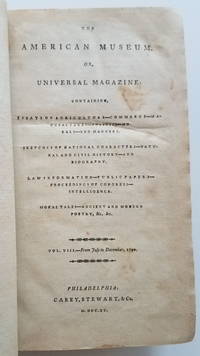
17903753<b>Washington's First State of the Union Address & Jefferson's Report on Currency Weights and Measures</b><p>Mathew Carey's <i>American Museum</i> was published from January 1787 to December 1792. According to Mott it shared with <i>The</i><i>Columbian Magazine</i> the honor of being America's first successful magazine. This is volume eight of twelve volumes with six issues each with the issues from July through December 1790. <br /></p><p>The volume contains two signature pieces from the early Federal period -- Washington's first State of the Union address Appendix II pp. 47-48 and Jefferson's report on currency weights and measures Appendix II pp. 35-46. Among the other noteworthy content is Ferdinando Fairfax's "Plan for liberating the negroes within the United States" essentially a gradual voluntary government-assisted emancipation with relocation of the freed slaves to a new colony in Africa.<br /></p><p><b>Reference:</b> Mott <i>A History of American Magazines 1741-1850</i>: pp. 100-103.</p><b>Condition:</b> Original calf binding with red title label and embossed volume number "8". Ex-library with ornate early "Erasmus Hall Library" bookplate inside front board. Lacking ffep. Head and tail of spine eroded. Front board rejointed; rear hinge cracked. Contents age-toned with scattered light foxing and spotting with very infrequent heavier foxing. <br /><br />ICN 2387. Carey, Stewart, & Co. hardcover
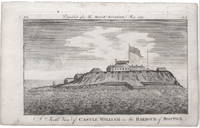
17893563Castle William's heritage as a military installation dates to 1634 when cannons first were deployed in an earthen fort to defend Boston Harbor. British officials used the fort as a refuge in the tumultuous times leading up to the American Revolution; on their way out of Boston in March 1776 the British destroyed the Fort. It was quickly rebuilt by Bostonians. <br /><br />The present view shows the rebuilt Fort with an oversized American flag waving above. The Fort served as an active military installation during the American Revolution the War of 1812 the Spanish-American War and World Wars I and II. Known as Fort Independence since 1797 the Fort today is a state park. <br /><br />Stauffer attributes the engraving to Samuel Hill who did many of the plates for the <i>Massachusetts Magazine</i>. Uncommon. <br /><br />References: Lewis: <i>A Guide to Engravings in American Magazines 1741-1810</i>: p. 10. Stauffer <i>American Engravers Upon Copper and Steel</i>: 1397. <i>John Carter Brown Archive of Early American Images</i>: Record no.5437-4. Cresswell T<i>he American Revolution in Drawings and Prints</i>: 491. From the May, 1789 issue of The Massachusetts Magazine.
17883741<p><strong>Harvard College -- "the earliest engraving of the College</strong><strong> which one may reasonably hope to obtain"</strong></p><p>This engraving entitled "View of the ancient Buildings belonging to Harvard College Cambridge New-England" appeared in the December 1788 issue of <em>The Columbian Magazine.</em> Bail notes that the view is based on the Burgis-Price print of 1743 which in turn was a slight modification of the Burgis view of 1726. The view taken from a point in front of the present Johnston Gate shows three College buildings in 1726 from left to right: the second Harvard College the first Stoughton Hall and the still-standing Massachusetts Hall. Although unsigned the engraving is undoubtedly the work of James Trenchard a co-owner of <em>The Columbian</em> <em>Magazine </em>and the engraver of nearly all the plates which appeared in it. <br /><br />Of the<em> Columbian</em> <em>Magazine</em> view Bail states: "In spite of the fact that the print is solely an adaptation it is important because of its early appearance and relative scarcity. This is the earliest engraving of the College which one may reasonably hope to obtain."</p><p>The engraving is accompanied by a disbound example of the December 1788 <em>Columbian Magazine</em> in which it appeared. It includes a 5-page "An Account of the ancient Colleges of Cambridge in New-England." Most of this is a republication of material from "a very scarce and valuable pamphlet" printed in London in 1642. In addition to a description of the College "The edifice is very fair and comely within and without." the rules and curriculum of the College are provided.</p><p>A very desirable engraving of Harvard with an example of the magazine in which it originally appeared.</p><p><strong>References:</strong> For the engraving: Bail <em>Views of Harvard</em>: 13; Plate XVII illustrated. Fielding <em>American Engravers upon Copper and Steel</em>: 1819. <br /><br /><strong>Condition: </strong>Image is age-toned with some generally light foxing. Darkening to margins outside of platemark where previously matted; remnant of strip of masking tape at upper margin on verso. The <em>Magazine</em> is complete and quite bright and clean although several pages are detached from the balance of the text.<br /><br />ICN 3431. <br /><br /><br /><br /></p> Printed for the Proprietors by W. Spotswood.
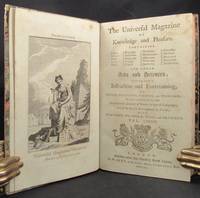
179031351London: W. Bent 1790. First Edition of the volume for January through June of 1790 including the supplements. Containing the stated FIRST PRINTING of the Addresses of the Mayor of Alexandria VA. to George Washington on his leaving his home in Mount Vernon to become President of the United States and of Washington's address to the people in reply. Most probably the first printing in book form of either of the addresses. No earlier printings in book form seem to exist and the Library of Congress shows only the manuscript copy in their holdings. Also containing one of the earliest reports of the mutiny onboard the H.M.S. 'Bounty' and an extensive essay on William Harvey as well as an essay by Mrs. Piozzi on the present King of Naples. Illustrated throughout. 8vo contemporary tan calf over marbled paper covered boards the spine with raised bands and a single red morocco label gilt tooled and lettered. 379 5 index pp. A very fresh and well preserved copy the text still quite clean and crisp only a hint of occasional spotting a few old marks by an early reader including the marking of one small section as "Not Fact". The binding has some rubbing at the tips and edges two joints starting but still a firm and solid binding in original state with no evidence of repair or restoration. THE UNIVERSAL MAGAZINE FOR THE FIRST HALF OF 1790; which with the stated first printing of the address to George Washington and his address to the Citizens of Alexandria also contains "Letters Debates Essays Tales Poetry History Biography Antiquities Voyages Travels Astronomy Geography Mathematics Mechanics Architecture Philosophy Medicine Chemistry Husbandry Gardening and other Arts and Sciences."<br> At 10:00am on the morning of April 16 1789 General George Washington left Mount Vernon for the journey north to New York where he would be inaugurated as the first President of the new United States. His first stop was in Alexandria with his former aide-de-camp Col. David Humphries and the Secretary of Congress Charles Thomson. At noon he arrived in Alexandria where he took an early dinner at Wise's Tavern with citizens of the town. The address by the Mayor celebrating Washington's service to and love of country was followed by Washington's own address concerning his considerations for his having accepted the honour to be bestowed upon him in New York. Washington had wanted to retire from public life but agreed to continue to serve the new nation upon the call of its citizenry.<br> Both addresses are moving tributes one to the man one to the new nation and its people. Humble in origin brilliant in effect they are. In the later afternoon hours General Washington was escorted by admirers up the Potomac to Georgetown where he was greeted by a large contingent of the citizenry of that town who escorted him up the Post Road towards Baltimore where he spent the night at Spurrier's Tavern. <br><br>George Washington's Address:<br> <br>To THE MAYOR CORPORATION AND CITIZENS OF ALEXANDRIA<br><br>Alexandria April 16 1789.<br><br>"Gentlemen: Although I ought not to conceal yet I cannot describe the painful emotions which I felt in being called upon to determine whether I would accept or refuse the Presidency of the United States.<br><br>The unanimity of the choice the opinion of my friends communicated from different parts of Europe as well as of America the apparent wish of those who were not altogether satisfied with the Constitution in its present form and an ardent desire on my own part to be instrumental in conciliating the good will of my countrymen towards each other have induced an acceptance.<br><br>Those who have known me best and you my fellow citizens are from your situation in that number know better than any others that my love of retirement is so great that no earthly consideration short of a conviction of duty could have prevailed upon me to depart from my resolution “ never more to take any share in transactions of a public nature .†For at my age and in my circumstances what possible advantages could I propose to myself from embarking again on the tempestuous and uncertain ocean of public-life<br><br>I do not feel myself under the necessity of making public declarations in order to convince you Gentlemen of my attachment to yourselves and regard for your interests. The whole tenor of my life has been open to your inspection; and my past actions rather than my present declarations must be the pledge of my future conduct.<br><br>In the mean time I thank you most sincerely for the expressions of kindness contained in your valedictory address. It is true just after having bade adieu to my domestic connexions this tender proof of your friendship is but too well calculated still farther to awaken my sensibility and encrease my regret at parting from the enjoyments of private life.<br><br>All that now remains for me is to commit myself and you to the protection of that beneficent Being who on a former occasion has happly brought us together after a long and distressing separation. Perhaps the same gracious Providence will again indulge us with the same heartfelt felicity. But words my fellow-citizens fail me: Unutterable sensations must then be left to more expressive silence: while from an aching heart I bid you all my affectionate friends and kind neighbours farewell! "<br><br> This volume also contains a series of Picturesque Scenes from Homer's Iliad with handsome engravings; Memoirs of the life and writings of the celebrated physician Dr. William Harvey; and a virtually countless array of stories and reports of "all things instructive and entertaining." W. Bent hardcover
179863098London Scatcherd & Whitaker; Parsons; Cawthorn 1793 - 1798. 8vo. Bound in 11 volumes. Volume 2 - 11 uniformly bound in contemporary half calfs. Volume 1 in half calf with later marbled paper covered boards. Bindings with wear and stains. Leather on spines cracked. Volume 1 with reinforced hinges a dampstain to first leaves. A few volumes with dampstain to first leaves but internally generally a nice and clean set. 616 4 pp. 2 frontispiece and 7 engraved plates; 4 480 pp. 7 plates Wolstieg only calling for 5; 4 450 4 pp. 7 engraved plates; 4 426 6 8 pp. 7 engraved plates Wolstieg only calling for 3; 2 436 pp. 6 engraved plates Wolstieg only calling for 2; 2 452 4 pp. 6 engraved plates Wolstieg only calling for 4; 6 438 4 pp. 8 engraved plates Wolstieg only calling for 6; 4 464 4 pp. 8 engraved plates Wolstieg only calling for 4; 6 506 pp. 9 engraved plates Wolstieg only calling for 4; 2 430 pp. 6 engraved plates Wolstieg only calling for 1; 2 IV 338 8 pp. 9 engraved plates Wolstieg only calling for 2. This set has a total of 79 engraved plates Wolfstieg only calls for 47 plates. <br/><br/><em>Rare complete run of the first English periodical dedicated to freemasonry “the archetype of later Masonic periodicals†Önnerfors The Freemasons’ Magazine 1793–1798 published at a crucial time in the history of European Freemasonry in the immediate aftermath of the French Revolution. It represents one of the first efforts by the fraternity to define consolidate and disseminate its intellectual and moral identity in public. Its contents - lodge proceedings philosophical essays antiquarian inquiries biographical notices poetry and finely executed symbolic engravings - reflect the full breadth of late Enlightenment Masonry. The importance of the work lies in its function as a precursor since it anticipates the Masonic journals in the 19th century and marks the transition of Freemasonry into a self-conscious print-based intellectual culture. â€The Freemasons’ Magazine represent a forceful statement of British Freemasonry concerning its vigour loyalty and societal engagement. During 1794 the journal for the first time served as a platform to refute anti-Masonic writings that circulated in the public. Important apologies such as Defence of masonry 1730 or Cousto’s spiced account of his treatment by the Portuguese inquisition were republished. Parts of Ramsay’s ‘Oration’ were republished not just once but twice. We can also witness how the Knights Templar called the ‘sublime degree of masonry’ entered the world of British Masonic imagination long after the continental development. Nevertheless at the very same time Freemasonry in Britain was also celebrating technological progress in industry agriculture and science which makes its relationship to modernity complex. The Freemasons’ Magazine managed to attract correspondents in different parts of the empire and even the USA. A particularly strong link throughout the first seven volumes was Edinburgh. In the last four volumes we find more material inserted from Ireland at exactly the time when political tensions there erupted into a full-scale rebellion. The political tense years of 1797 and 1798 offer an intriguing insight into the British psyche at the time. Under constant real and imagined threat of French invasion internally shaken by the Irish rebellion uprisings and repeated mutinies public opinion was fuelled with anti-Masonic ideas not at least by Robison’s book Proofs of a conspiracy. The Freemasons’ Magazine unfortunately did not survive 1798. Most importantly perhaps it can be regarded as the archetype of later Masonic periodicals developing into a archtype Masonic press by the middle of the nineteenth century with titles such as he Freemasons’ Quarterly Magazine and Review 1834–53 The Masonic observer 1856–9 he Freemason’s Magazine and Masonic mirror 1856–71 the Freemason 1869–1951 some of them surviving well into the twentieth century. Whereas Masonic periodicals during the first century of their existence tied into the ongoing debates and controversies surrounding Freemasonry in culture and society they developed more and more into purely internal membership magazines with little connection to the outside world.†Önnerfors The Freemasons’ Magazine 1793–1798. Wolfsteig 516 </em> hardcover
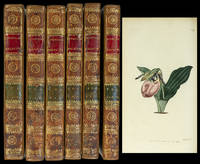
17934973DB1793. Vols. I to XII in six volumes. London W. Curtis 1793-1798. 8°. 1- 432 S. 12 title pages 2 pages of Index. With 432 coloured plates. Gilt contemporary calf with red spine labels. Nissen 227 2350. Pritzel 74 2007. Blunt 183 I. First edition. Vols. I and XII of the first series conducted by William Curtis. "It has suggested but without any positive evidence that some of the earliest drawings in the Botanical Magazine were made by Curtis himself; but William Kilburn and James Sowerby joined the following year by Sydenham Edwards were responsible for almost the whole work of the first twenty-eight years - most of it being by Edwards with Sansom as engraver" Blunt. - With 6 mounted ex libris labels library of Mary Ferguson on the backside of the front covers. - Backs professionally restored. Flying leafs are slightly foxed. Otherwise a clean copy in very good condition. unknown