6 résultats
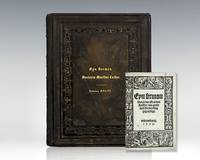
152379343Wittenberg: Jobst Gutknecht 1523. First edition of Dr. Martin Luther's Maundy Thursday Sermon with explicit instruction on the correct preparation for receiving the holy sacraments. Quarto 24 leaves of German text disbound from the original Gutknecht edition and tipped in to accompany a rare 16-page handwritten manuscript containing a literal translation in English from 1864. Bound in full brown morocco elaborate tooling to the front and rear panels tooling to the spine yellow silk endpapers gilt turn-ins inner dentelles all edges gilt. Best known for initiating the Protestant Reformation in 16th century Europe German theologist Dr. Martin Luther's writings represented one-fifth of all materials printed in Germany between 1500 and 1530. His translation of the Bible from Latin into German and use of Gutenberg's printing press had an enormous impact both the accessibility of the Biblical teachings and on the German language itself. Jobst Gutknecht unknown books
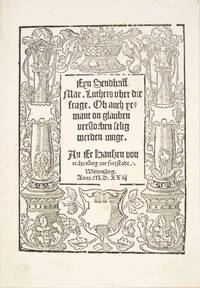
15233175Erfurt:: Stürmer 1523. FOURTH PRINTING. Quarto:. 20 x 14.5 cm. 8 pp. A4 Modern boards with a stamped Luther rose. With a narrow woodcut title border. A very fresh clean copy with an intricate title page border. All printings are rare. Luther wrote this letter in August 1522 to Hans von Rechenberg a strong supporter of the Reformation and a man who distinguished himself in battle against the Turks. There is no evidence that Luther knew von Rechenberg personally but the question that Luther addresses in the letter whether a person who dies without faith may be saved seems to have been one of personal concern to the addressee. Luther’s reply is quite direct and to the point: whether men like it or not Luther says God saves no one without faith for to do so would be contrary to his word. Furthermore faith does not seek to penetrate why God does not save without faith. Luther cites four passages of scripture: Mark 16:16 where Jesus says “Whoever does not believe will be condemnedâ€; Hebrews 11:6 which says “Without faith it is impossible to please Godâ€; John 3:6 “Whoever is not born anew of the Spirit and water cannot see the kingdom of Godâ€; and John 5:18 “Whoever does not believe is already judged.†Luther writes: “Now if God were to save someone without faith he would be acting contrary to his own words and make himself out to be a liar. Yes he would be denying himself and that is impossible. For St. Paul says in 2 Timothy 2:13 “God cannot deny himself.†As impossible as it is for divine truth to lie it is just as impossible for him to save someone without faith.†He continues: “It would be a completely different question to ask whether God could grant faith to a few at the moment of their death or after death and thereby save them through faith. Who would doubt that he could do this But no one can prove that he does do this. For we only read that he has already raised the dead and given them faith. No matter what he does whether he grants faith or not it is impossible for anyone to be saved without faith. Otherwise all preaching and the Gospel and faith itself would be futile false and deceptive since the entire Gospel makes faith necessary.†Benzing 1270 Stürmer], unknown books
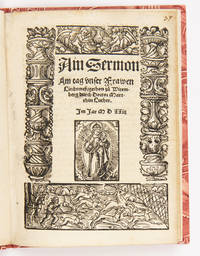
15233029<p>Augsburg: Melchior Ramminger 1523. </p><p>Price: $5500.00 </p><p>Quarto: 20 x 15 cm. 8 pp. Collation A4</p><p>One of five editions all printed in 1523.</p><p>Modern boards. A fine copy with a beautiful four-part title page border the lower register of which shows a stag hunt. There is also a small woodcut of the Virgin balancing on the crescent moon and holding the infant Christ.</p><p>A sermon for Lichtmeß Candlemas the feast of the presentation of the infant Jesus in the temple and the purification of Mary February 2. Jesus takes as his text Luke 2:22-39.<br /><br />For the complexities of Luther's evolving Mariology see Thomas O'Meara Mary in Protestant and Catholic Theology 1966. "Luther's attitude toward the theology of Mary and toward the devotion which a Christian should have to the Mother of God is a small-scale representation of his entire religious accomplishment. During any discussion of Luther and the Blessed Virgin we must keep uppermost in our minds that there was a development in his ideas a change more or less drastic in each aspect of Marian theology. This development has its beginning in Catholicism; it passes through contradictions struggles and uncertainties and terminates in a new Marian viewpoint one which Luther decided was Christocentric biblical unexaggerated and edifying."p. 123.</p><p>Benzing 1746; VD16 L-6084</p> Melchior Ramminger, books
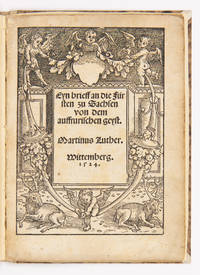
15243177Wittenberg:: Cranach and Döring 1524. FIRST EDITION. Quarto:. 21 x 15 cm. . 20 pp. A4 B2 C4 Bound in marbled boards. With an excellent woodcut title page by Lucas Cranach Luther 43c cut from a single block with putti cornucopiae architectural motifs and stags. A good copy light soiling a few stains. First edition of Luther’s response to the growing danger posed by the radical preacher Thomas Münzer who was ultimately executed the following year for leading the violent open revolt that came to be known as the Peasants’ War. In 1523 Thomas Münzer formerly the leader of the radical “Zwickau Prophets†began to radicalize the area of Allstedt where he was then pastor preaching that the ungodly were to be eliminated and the elect would establish a kingdom of Christ on earth and threatening the political rulers of the area with rebellion. In early 1524 as Münzer “grew bolder in his denunciation of the authorities and called for an elimination of the enemies of God†he divided the citizenry into military units in order to resist any outside interference in his activities. Münzer openly challenged and attacked Luther who was openly opposed to Münzer’ ministry of the elect as one of “our mad debauching pigs which are horrified by the windstorm the raging billows and by all the waters of wisdom.†In his “Letter to the Princes of Saxony Concerning the Rebellious Spirit†written in July 1524 in response to the recent violence and Münzer’s mystical theology Luther “appealed to the rulers to act before the incendiary suggestions of Münzer led to civil rebellion and open revoltâ€. Luther “distinguished two sides of Münzer’s behavior that of violence and that of precept. Only the subject of violence concerns the princes and to this subject he devotes almost his entire letter. Satan can here be seen at work in a new way and has shown us his hoofprint all too plainly –meaning Münzer says that one is not to leave it up to the Word but that it is time to resist the authorities with fists with the sacking of cloisters with the destruction of images. Luther demanded that the princes respond preventively by rigorous prohibitions. If the Allstedters wished to defend themselves and show their true colors let them do so in a public trial before whomever they choose. “Luther’s book is noteworthy not because he admonished them to suppress violence but much more because he drew boundaries for them to observe. They do not have to defend themselves against Münzer’s teaching: ‘Let them preach as confidently and as boldly as they are able and against whomever they wish…There must be sects and the Word of God must be under arms and fight…Let the spirits collide and fight it out. If meanwhile some are led astray let it be; such is war. Where there is battle and bloodshed some must fall and some are wounded. Whoever fights honorably will be crowned.’… “The princes became convinced that the disturbances might lead to rebellion and they summoned the leaders before them. The Allstedt council and Münzer were examined in Weimar at the beginning of August. To escape the impending verdict Münzer fled to Mühlhausen where later in the year he gained leadership over the city. He became a central figure in the Peasants’ Revolt and suffered death in May 1525 when the revolt was crushed.â€Bornkamm Luther in Mid-Career p. 152 ff. Benzing 1927; Kessler 553; Title border: Luther “Titeleinfassungen der Reformationszeit†43c Cranach and Döring, unknown books
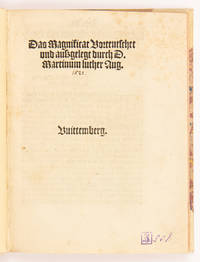
15213036<p>Wittenberg: Melchior Lotter 1521. </p><p>Price: $5600.00 </p><p>Quarto: 19 x 13 cm. 88 pp. a-l4</p><p>FIRST EDITION.</p><p>Modern marbled boards vellum spine and corners. A fine copy with contemporary marginalia in red and black. Provenance: Alain Moirandat Switzerland.</p><p>Luther wrote his "The Magnificat Translated into German and Explained" in two parts the first composed before his appearance at the Diet of Worms and the second part while he was in hiding in the Wartburg in May and June 1521. Given that Luther's vision of the church and of Mary's nature and place within Christianity were evolving and were to evolve much further over time and the fact that Luther left the Diet a changed man living in changed circumstances it is no wonder that Luther's exposition of the Magnificat has been the subject of numerous conflicting interpretations.<br /><br />In Albert Steinhaeuser's view the work "is a classical discussion of the place that the Virgin Mary occupies in the Protestant system. Although Luther regards her in one place as sinless and invokes her aid and intercession at the beginning and close of his work these are isolated instances; the whole tenor of the exposition is evangelical and as far removed from the Mariolatry of Rome as from an ultra-protestant depreciation of the Mother of our Lord. 'She does not want you to come to her but through her to God.' There is something very human and altogether unlike the radiant Queen of Heaven in the Mary who 'goes about her household tasks milking the cows cooking the meals washing pots and kettles sweeping out the rooms.' It is Luther's contribution to the German Madonna and the Weimar editors well compare this and similar passages of the Magnificat with Albrecht Durer's Marienleben a series of quaint woodcuts portraying the life of the Virgin 1503-10."<br /><br />But Hartmann Grisar one of the leading Catholic writers on Luther writes "Luther's 'Exposition of the Magnificat' has frequently been taken as a proof of Luther's great piety. It indeed contains many good thoughts even apart from those relating to Mary but in numerous passages the author uses his pen for a highly prejudiced vindication of his new teachings on the state of grace. It should also be borne in mind that the printers started on the book just before the Diet of Worms and that it was intended to attract and secure the support of the future rulers of the Saxon Electorate. Luther was also engaged at that time on his exceedingly violent screed against Catharinus in which he attempts to reveal the Pope in his true character as Antichrist. When after the Diet of Worms he continued his work on the Magnificat he was certainly in no mood to compose a book of piety on Mary. The result was that the book became to all intents and purposes a controversial tract which cannot be quoted as a proof of his piety or serenity of mind during those struggles. Luther's Magnificat is as little a serious work of edification and piety as his exposition of certain of the Psalms which appeared almost simultaneously and was also directed " against the Pope and the doctrine of men.".</p><p>VD16 L-5453; Benzing Luther 855; Kuczynski 1431</p> Melchior Lotter, books
15564183Wittenberg:: Georg Rhau 1542 1556. Octavo:. 15 x 10 cm. I. a-h8; A-Z8 Aa4 lacking blank Aa4. II. A-L8 with blank L8 Bound in contemporary alum-tawed pigskin over wooden boards one clasp defective binding soiled and mildly worn and with small defects. The boards are ruled and tooled in blind signed and dated “IPN 1556â€. The contents are in excellent crisp condition one leaf working loose marginal tear in margin of leaf E5 no loss. With a historiated woodcut title border to the “Apologiaâ€. Woodcut coat-of-arms to verso of final leaf of the “Confessio†and fine woodcut initials in the Saxon Confession. Text of second work in Latin and German. With 16th c. notes on the f.f.e.p. This is the authorized text of the Augsburg Confession 1st ed. 1531 approved by Luther edited by and with the "Apologia" of Philip Melanchthon. It was printed by Georg Rhau who also printed the first editions both in Latin and German of the “Confessio†and “Apologiaâ€. The “Apologia†of this 1556 edition is dated 1542 see VD 16 ZV 31340. This edition was printed in the wake of the agreement reached in 1555 between the Lutheran princes and Charles V known as the Peace of Augsburg which granted Lutheranism legal status within the Holy Roman Empire. Bound into this copy is the 1553 Leipzig edition of the Saxon Confession which was drawn up by Melanchthon and intended for presentation at the Council of Trent; it presented the doctrinal status of the Lutheran Church of Germany as of 1552 and was the basis for the signing of the Peace of Augsburg. The Augsburg Confession: "On January 21 1530 the Emperor Charles V issued letters from Bologna inviting the German diet to meet in Augsburg on April 8 for the purpose of discussing and deciding various important questions. The far-seeing Landgrave of Hesse hesitated to attend the diet but the Elector John of Saxony who received the writ March 11 directed Luther Jonas Bugenhagen and Melanchthon to meet in Torgau and present a summary of the Protestant faith to be laid before the Emperor at the diet. This summary has received the name of the "Torgau articles". On April 3 the Elector and the reformers started from Torgau and reached Coburg on April 23. There Luther was left behind. The rest reached Augsburg May 2. On the journey Melanchthon worked on an "Apology" using the Torgau articles and sent his draft to Luther at Coburg who approved it. "The Emperor had ordered the confession to be presented to him on June 24. The evangelical princes however declared that they would not part with the confession until its reading should be allowed. The 25th was then fixed for the day of its presentation. In order to exclude the people the little chapel of the Episcopal palace was appointed in place of the spacious city hall. The two Saxon chancellors Bruck and Beyer the one with the Latin copy the other with the German stepped into the middle of the assembly and against the wish of the Emperor the German text was read. "Although the emperor prohibited the printing of the evangelical confession without his special permission during the diet six German editions and one in Latin were published. Their inaccuracy and incorrectness induced Melanchthon to prepare an edition to which he added the Apology. Thus originated the so-called 'editio princeps' of the Augustana and the Apology which was published in the spring of 1531." Schaff-Herzog "Melanchthon drafted the ‘Confession’ in both German and Latin using the Torgau Schwabach and Marburg Articles. The intention of the German Protestants was to present a single creed. Since they could not all agree on one several versions were presented to the Diet meeting at Augsburg. Of these it is the ‘Augsburg Confession’ that is remembered today; the others have long been forgotten. The presentation of the ‘Augsburg Confession’ was probably Melanchthon’s finest hour as a theologian. He had written a theological document that presented a reasonable compromise in the ongoing religious disputes in Germany. Luther himself said that he could never have ‘trod so lightly’ in treating such matters. The ‘Confession’ has come to be the standard Lutheran statement of faith and was included in the ‘Book of Concord’ of 1580."Kessler I. VD 16 ZV 31340; II. VD 16 C 4807 Georg Rhau, 1542, unknown books